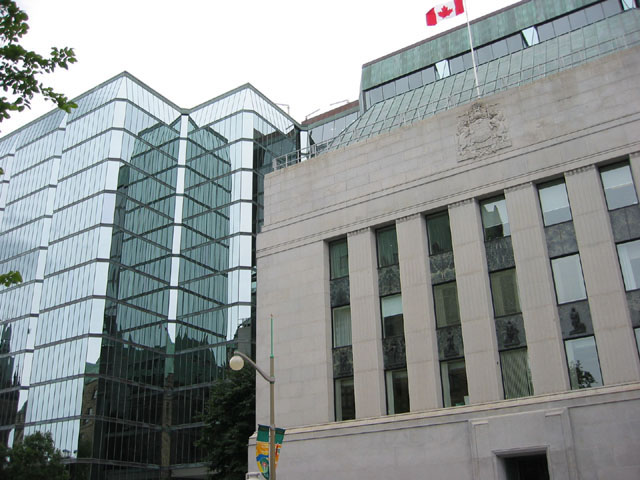
Bank of Canada building
Canada’s central bank turns 75 today. There have been a number of stories about the anniversary in the media. See here, here, and here.
Governor Mark Carney’s speech on the anniversary says little about the actual history of the institution. The historical parts of his speech focused mainly on the decision of Bank to allow the value of the Canadian dollar to float in 1950. He said:
“In 1950, Canada faced adjustment problems of its own, and the Bank, as a learning institution responded. Large capital inflows threatened to drive up inflation in Canada in the context of our then-fixed exchange rate. In an effort to maintain price stability, the decision, unpopular internationally, was taken to float the Canadian dollar, which duly appreciated. While this was inconsistent with the rules of Bretton Woods, it was consistent with their spirit, as a floating dollar allowed both for domestic stability and for the market to determine the rate, rather than being set by government for national advantage. Canada’s move to a flexible exchange rate was a precursor to the breakdown of the Bretton Woods system 20 years later.”
I think that Mr Carney’s decision to focus on this episode is curious. Today, free-floating exchange rates are uncontroversial. Is it really necessary to defend this decision taken by the Bank in 1950? Aren’t there more controversial actions in the Bank’s history that he might wish to address? The really interesting thing about Mr Carney’s speech are the major omissions.
First, while Mr Carney spoke about the creation of the Bank in 1935, he did not mention that it was nationalized by the government three years later. Wouldn’t it be interesting to know why it was nationalized? Wouldn’t it be possible to draw some useful lessons from this episode?!?!?
Second, Mr Carney ducked the issue of whether the central bank should be independent of elected politicians. Arguments both in favour and against central bank independence can be made. Perhaps the most exciting event in the history of the Bank of Canada was the 1961 fight between Governor James Coyne and the government of John Diefenbaker. It is unfortunate that Mr Carney did not offer some thoughts on this issue. Perhaps Mr Carney wanted to avoid mentioning this episode because it made Canada look like a Mickey-Mouse country.
I looked at the materials on the BofC’s website related to the 75th anniversary. The PDF file “Canada’s Economy since the Founding of the Bank of Canada” set off my BS detector. It included a chart showing that “Real gross domestic product per person has grown almost sixfold over the past 75 years—an indication of improved economic well-being.” There is also chart showing that more Canadians own cars today than they did before the advent of central banking. The document says: “When the Bank of Canada was founded in 1935, the country was still widely regarded as a nation of “hewers of wood and drawers of water.” Back then, there were far more jobs in agriculture than in manufacturing. Today, four out of five jobs are in the services sector.”
Yeah, all of that is true, but it doesn’t necessarily prove that the Bank of Canada was a good economic manager. A somewhat more convincing stat would be to compare the rate of growth in the 75 years before 1935 and the 75 years since. Even then, it would be risky to draw any conclusions from the numbers, since so many other things were going on in the economy. Christ, even my undergraduate students should be able to see through that one.
The National Post published amusingly nutty perspective on the bank’s history from Martin Masse, a former advisor to erstwhile Foreign Affairs Minister Maxime Bernier. See here. Mr Masse thinks that it was a mistake for Canada to leave the gold standard.
If Andrew Coyne says anything interesting about the anniversary on his blog, I shall let my readers know.


 The Past Speaks
Leave a comment