I have finished reading Michel Ducharme’s new book Le concept de liberté au Canada à l’époque des Révolutions atlantiques (1776-1838). It is an important and valuable contribution to our understanding of Canadian history in this epoch.

This book is useful on several levels. First, it provides a pretty good narrative history of Upper and Lower Canada from the 1770s, when the American Revolutionaries invaded Canada and attempted to persuade its people to side with their cause, and the anti-British Rebellions of 1837-8. Ducharme’s narrative is based on recent scholarship and it effectively supersedes the older narrative histories, such as Gerald M. Craig’s 1963 history of Upper Canadian politics or the research that Fernand Ouellet did the 1970s.
Another advantage of this book is that Ducharme examines both English-speaking Upper Canada and predominantly Francophone Lower Canada in the same volume rather than treating the developments in the two provinces in isolation from each other. Another advantage of this book is that it situates Canadian developments in a trans-national Atlantic World context. This certainly makes sense, as one can’t understand Canadian politics without knowing what is going in France, Britain, and the United States in the same period. After all, ideas circulated around the North Atlantic world.
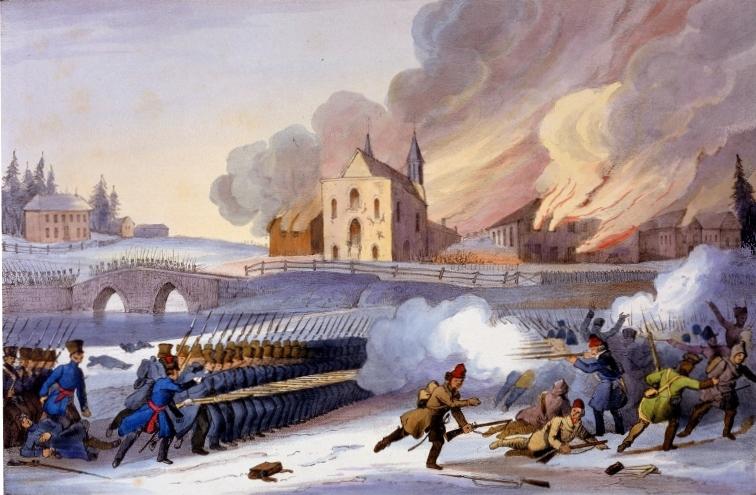
Battle of St-Eustache, 1837 Rebellion
Political conflict often involves competing definitions of the same word (e.g., “equality” or “democracy”). Ducharme is interested in an important question: how did different definitions of “liberty” influence politics in Canada in this period. For centuries, there has been a consensus in Western culture that “liberty” is a good thing. The consensus breaks down, however, when people start to define what exactly they mean by liberty.
In 1816, the French classical liberal Benjamin Constant contrasted the liberty of the ancients with that of the modern world. Constant stated that people in classical antiquity defined liberty in terms of the collective freedom of a polity (e.g., the freedom of Sparta from Persian rule). Constant said that in modern times a new definition of liberty focused on the rights of the individual had emerged. Confusion arises when people used the same words for two radically different things.
In his 1958 “Two Concepts of Liberty”, Professor Isaiah Berlin demonstrated that there were at least two major schools of though when it came to defining “liberty”.

Berlin
Ducharme argues that political conflict in Upper and Lower revolved around competing definitions of liberty. On the one hand, there were those who used what he calls modern liberty. On the other were those who used an older definition of liberty developed by republicans. He argues that radicals such as William Lyon Mackenzie and Louis-Joseph Papineau, moderate reformers such as William Baldwin, and establishment Tories such as John Strachan all believed in “liberty”. However, the last two groups subscribed to the modern definition of (individual) liberty, while the radicals, who ultimately rebelled against British rule in 1837, believed in an older definition of liberty that can be traced back to the ancient world.

William Lyon Mackenzie
Ducharme’s analysis is sophisticated because he shows that the competing definitions of liberty did not align perfectly with partisan groupings—some of the reformers in Upper Canada believed in modern liberty, the more reformers did not. Ducharme associates the competing definitions of liberty with the ongoing debate over commercialism: was the development of a commercial capitalist society desirable?
Moderate reformers and the Family Compact Tories certainly welcome the growth of commerce, the intensification of the division of labour, the emergence of modern capitalist society. Ducharme suggetes that those who subscribed to the ancient definition of liberty, however, were proponents of pre-commercial and largely agrarian society. According to Ducharme, William Lyon Mackenzie denounced the growth of cities, business, and luxury goods, which were destroy virtue and leading to the corruption. Ducharme provides some quotations from the corpus of Mackenzie’s writings to support this interpretation.
If Ducharme is right that Mackenzie was indeed anti-commercial and a proponent of “ancient liberty” as opposed to “modern liberty”, then it makes sense to regard the 1837 rebellion in Upper Canada as an example of an agrarian uprising against the rise of commercial capitalism. However, I am not entirely convinced by Ducharme’s analysis. It seems to me that the ideas of William Lyon Mackenzie cannot be understood without referring to the policies of President Andrew Jackson. There is a great deal of evidence to suggest that William Lyon Mackenzie’s economic and political ideas, particularly his opposition to the monopolistic Bank of Upper Canada, were influenced by Jacksonian Democracy. Andrew Jackson was, famously, opposed to the existence of a central bank in the United States: his veto of rechartering of the Second Bank of the United States in 1832 ignited a political firestorm. Andrew Jackson opposed the Bank’s charter not because he was opposed to the growth of a modern commercial economy or even the existence of bank. Rather, Jackson was against the existence of government-granted monopolies and other examples of what he regarded as undue state interference in the economy. At one time, it was common for historians to regard Jacksonian Democracy as an expression of anti-commercial, anti-business, agrarian ideology.

Andrew Jackson
This was, of course, the viewpoint of historian Arthur Meier Schlesinger, who died in 1965. Thanks to more recent historical research, we know now that Jackson and his followers were just an enthusiastic about capitalist development as their political opponents. In fact, Jackson embraced policies of economic laissez-faire precisely because he though that de-regulating the economy would unshackle businessmen and spur economic growth. It is no more accurate to say that Jackson was anti-capitalist than to suggest the Tea Party people in today’s United States are against business and commercial society because they opposed the Wall Street Bailouts. The Tea Party is supported by many small businessmen who are hard core supporters of economic laissez-faire. I would suggest that the supporters of Jackson and William Lyon Mackenzie in the 1830s were similar in terms of their ideology and class backgrounds.
I think that Ducharme’s book would have been stronger had he integrated a more extended discussion of Jacksonian Democracy into his analysis. After all, Jacksonian ideas influenced people in the two Canadas. Moreover, Jacksonian Democrats in New York State and Vermont provided crucial military assistance to the rebels of 1837-8. Among the Americans who participated in cross-border raids designed to assist the rebels were a significant number of members of the Locofoco Party, a branch of the Jacksonian Democrats who were staunch advocates of economic laissez-faire. Somewhat curiously, I could not find the name Andrew Jackson in the index of this otherwise excellent book.
Notwithstanding this quibble, I would like to compliment Ducharme for having produced such an important book on Canadian history.


 The Past Speaks
I’m curious whether Ducharme cited David Hackett
Fischer’s Liberty and Freedom, which explored similar distinctions
between definitions of “liberty” through US history.
I don’t recall seeing it in the index…
That’s a real pity, I think. The books might complement each other quite well, nevertheless.