Last week, I drove from Toronto to Sudbury. My journey, which was about 400km long, took me through the urban sprawl of Toronto, then into the Ontario countryside with its neat farms, and finally into the sparsely populated Canadian shield. For the final 200km of the trip, we passed through an area with a very low population density. The highway passed several First Nations communities as well as some predominantly white settlements. I noticed that while there were a fair number of stores and gas stations along the highway, few of them were located in the First Nations communities. This pattern will be familiar to most Canadians who have ventured out of the big cities in which most of them actually live. It got me thinking about ways the First Nations could develop their economies a bit more.
A while back, the National Post has been running a series of stories on the underground tobacco economy in Canada’s First Nations communities. Some First Nations communities have been using their ambiguous constitutional status under Canadian law to build up a thriving trade in the contraband cigarettes and other tobacco products. Some, but not all, First Nations communities in Canada claim to be sovereign states and exempt from all Canadians laws and taxes. (It should be pointed out that there are Native people who are proud citizens of Canada: the former Premier of Nunavut eschews the term “First Nations” and instead uses the slogan “First Canadians and Canadians First”).
Anyway, because of the unwillingness to the federal government to impose tobacco taxes and otherwise enforce Canadian laws in First Nations communities, many non-Native Canadians now purchase their cigarettes in stores on reserves. Needless to say, this contraband trade has implications for public health policy. In the interests of avoiding another bloody confrontation with First Nations groups, the federal government has turned a blind eye to it.
As the National Post points out, some First Nations communities have found that exploiting this loophole in Canadian law is quite lucrative. A few First Nations individuals have become millionaires. However, the contraband trade is unlikely to benefit the most deprived First Nations, who tend to be really remote communities accessible only by air. The contraband trade is mainly centred on reserves that are on the outskirts of urban Canada. These are communities are comparatively well off, since they live close to employment and can buy groceries in supermarkets.
Moreover, one wonders whether it is wise for First Nations people to invest so much this branch of commerce. After all, the long-term trend in the percentage of smokers in the general population points down, so the Natives may be entering into a disappearing industry. Natives have invested a fair bit of capital in warehouses, cigarette factories, and stores. If the number of smokers to continues to fall or if a government ever decides to crack down on this trade, this investment in fixed assets will have been lost. I would be interested to know where the money for the warehouses, cigarette rolling machines, etc., came from and how much the Natives are paying in interest. I bet the interest rate is quite high because of the uncertainty involved. I can’t imagine a conservative bank manager putting money into this sort of semi-criminal venture.
The NP story got me thinking about another way in which FN people might develop their economies: the sale of residency permits and band membership to people from overseas. Through its immigrant investor program, Canada essentially sells Canadian citizenship. If you have roughly a million dollars to invest in Canada, you can gain permanent residency and become a citizen in a few years. See here. Many people in Hong Kong have taken advantage of this program because they want an insurance policy in case China does something nasty to its SAR. The Province of Quebec, which has its own immigration program, sets it own criteria for immigrant investors that are a bit lower than that the federal government applies to people who want to settle in Toronto or Vancouver.
It has occurred to me that a First Nations band might sell band membership to immigrants in China or elsewhere who want to live in Canada. If the band were worried about an influx of immigrants diluting the voting power of the Natives living on reserves, they could create a class of non-voting members. These band members could live on the reserve but wouldn’t cast ballots in elections. If the reserve at the same time put in place the sort of policies needed to become a financial centre, it might experience explosive growth. The policies required would involve the right sort of financial laws, tax policies, and allowing international developers to build large housing complexes in which the immigrants would feel at home.
Dubai, which was formerly a desert, has experienced mushroom growth in the last two decades in part because its ruler adopted policies designed to lure foreign workers, tourists, shoppers, and capital. Key to the success of Dubai has been the creation of gated communities in which Western and East Asian professionals feel like they are living at home. Each of these communities is targeted at a given nationality.

Expats can shop in supermarkets stocked with international products, including alcohol. The indigenous Arab population of Dubai is now a tiny minority in its own country, but it has gone along with this breakneck development because they share in the proceeds: many do not work and subsist of welfare payments that allow them to have very living standards. Eventually they might have enough money to build an international airport, which would make them more independent of the Canadian government.
A Native community in Canada might be able to replicate this sort of policy, provided it was located close to the Interstate highway system and the federal government allowed the would-be immigrants to travel freely from their port of entry into Canada to the reserve.
Band membership is sort of a grey area. Since the middle of the nineteenth century, the Canadian government has claimed the right to determine who is a Status Indian and who is a member of a band. Until the 1850s, First Nations in Canada were allowed to define their own membership and in some cases they were able to attract “immigrants” from the white community. Many First Nations resent Ottawa’s attempts to define their membership and claim that as sovereign nations, they have the right to determine membership, just as Canada has a right to select its citizens. Perhaps the strongest advocates of this position are the Iroquois. The Iroquois, who live in communities on either side of the Canada-US border even issue their own passports, which they have used, on occasion, to travel on long-haul airline flights.
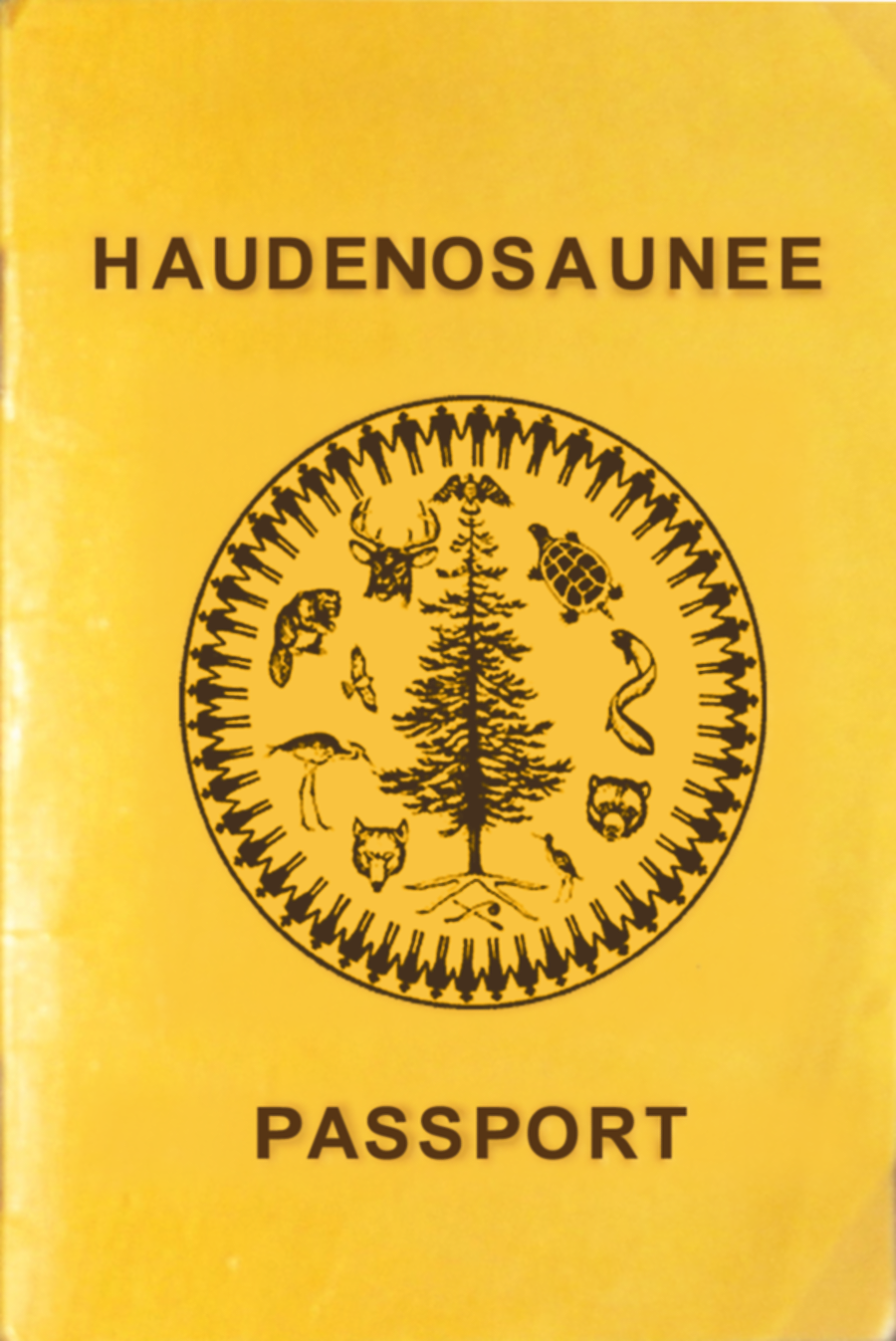
Iroquois Passport
Recently there was a controversy about whether these passports would be recognized by the UK Border Service at Heathrow: a group of Iroquois athletes were denied entry to the UK because their passports were not issued by a recognized nation-state. It seems to me that if the Iroquois could succeed in getting their passports recognized by other countries, they could undertake the sort of project I am proposing. Some countries, especially Germany, are very sympathetic to Canadian First Nations, so the Iroquois might have an ally in this department. Many Iroquois settlements are near urban centres, major highways, and the United States and are thus perfect candidates for Dubai-style re-development.
Another thing that occurs to me is this: why hasn’t one or more of Canada’s First Nations communities attempted to set itself up as a tax haven along the lines of the Cayman Islands or the Isle of Man. Many of the world’s “Offshore Financial Centres” are semi-sovereign entities attached to larger nation states (e.g., British Crown Dependencies), which is pretty much what Canada’s First Nations are. If the legal doctrine of Native self-government can be interpreted to mean that First Nations are entitled to sell cigarettes for half the regular price, why can’t this argument be extrapolated to off-shore banking. Why fiddle around with the piddling business of cigarette smuggling when you could be making real money as a tax haven/financial service centre. I’m mystified by the failure of Canada’s First Nations to establish themselves as OFCs. It may be that they are afraid of pushing the concept of aboriginal sovereignty too far and thus provoking a crack-down by the Canadian government.
Please note that I am not saying that any First Nation should or should not do any of these things. I’m just saying it would interesting to watch them try to maximize the economic benefits of their distinct constitutional status by becoming tax havens.


 The Past Speaks
In terms of using their ambiguous legal status to avoid regulation for financial transactions, there may be more going on in Reserves than most educated Canadians think of. The large British bookmakers all like to run websites in areas of little regulation to allow for offshore gambling, especially from countries that would otherwise prohibit it. I know one of them sets up those computers in Tel Aviv, the Cayman Islands and one of the Mohawk Reservations near Montreal. There are probably other instances of reserves acting like tax havens as well but on these scales do not bring large benefits to local communities.