
The Ontario town of Thamesville is planning a big memorial for Tecumseh, the First Nations leader who fell in the War of 1812. More details are available here.
The Ontario town of Thamesville is planning a big memorial for Tecumseh, the First Nations leader who fell in the War of 1812. More details are available here.
Canadian business historian Joe Martin will appear on TVOntario’s Agenda program at 8pm on Friday. He will speak about his new history of Canadian business. The title of his book is Relentless Change.

Relentless Change
Martin will be interviewed by host Steve Paikin (below). A link to the podcast of the interview will be posted here on Saturday.

Steve Paikin
The Agenda‘s program tonight is about the Ontario city of Sudbury.

Sudbury at Night
The first segment of the show is about pollution in Sudbury. The President of Laurentian University, Dominic Giroux, will be interviewed in the second half of the program. Laurentian is located in Sudbury. It’s where I teach.

Laurentian President Surveying Campus With Students
The Canadian newspapers have published the results of a poll that has tried to gauge the average Canadians’ level of knowledge of the War of 1812. The pollsters asked Canadians: ”
Who won the War of 1812? Canada or the United States?”
The fact many Canadians were unable to give an answer has been the occasion of some debate and angst.
This is one of the most ridiculous polls I have every heard. I’m disturbed that so many people thought that “Canada” won the war. It is anachronistic to speak of “Canada” as being a combatant in this war. One might as well speak of the Roman conquest of the “United Kingdom”. The war was fought in a variety of places, including what is now “Canada”, between British and American forces, not to mention a variety of First Nations. War was declared by the United States on Britain and was ended with an inconclusive peace treaty between those two Powers. Most of the English-speaking colonists in Upper Canada were bystanders in this conflict between two empires. The Dominion of Canada was formed in 1867 and only gradually acquired a diplomatic personality. In suggesting that “Canada” was a combatant in this war, the creators of this poll are suggesting a gross ignorance of history.
One might say that this was the war that both sides won, but that would involve restricting our focus to just Britain and the United States. Britain’s Native allies lost this war, big time.
The War of 1812 has become something of a touchstone for left-wing anti-Americans in Canada. Part of the folklore of this war is that Canada’s army burnt down the White House. Have a look at the video for this song by the Arrogant Worms, a Canadian group. The video shows George Bush Junior being chased out of the White House by Canadian troops in 1812.
For Canadians to celebrate the alleged British victory over the US in the War of 1812 is to miss the point. Canadians should instead be asking why Britain and the United States have remained at peace since 1815. The two countries drew close to war at various points in the nineteenth century, but their diplomats were always able to work out a solution. Someone should explain the democratic peace theory to the public.
Laurentian University history professor Mark Kuhlberg has recently published One Hundred Rings and Counting: Forestry Education and Forestry in Toronto and Canada, 1907-2007 (University of Toronto Press).
Commissioned by the University of Toronto’s Faculty of Forestry, the book examines the history of the Faculty, which was the first in Canada and one of the country’s most influential institutions, from its founding in 1907 to its 100th year anniversary in 2007.
While the Faculty of Forestry’s beginning was marked by opposition from both the university’s uncertainty of the field’s importance and the provincial government’s concern about how such an institution would affect control over forests, the faculty has produced a disproportionate number of leaders in the world of forestry and beyond.
Demonstrating the Faculty of Forestry’s longstanding commitment to conservation and environmental stewardship, Kuhlberg depicts its struggles with governments and the public to implement sustainable natural resource practices. Using unexamined archival materials, while contextualising the Faculty within the major educational, social, and political changes of the last hundred years, One Hundred Rings and Counting is a solid institutional history that also traces the development of conservationism in Canada.
Born and raised in Toronto, Kuhlberg earned his undergraduate history degree from UofT and Master’s and PhD (both history) from York University. His doctoral dissertation analyzed the Ontario government’s approach to the province’s pulp and paper industry between 1894 and 1932; he is currently revising it for publication with UofT Press.
Kuhlberg’s field of expertise is forest history. He has published numerous articles that address topics ranging from industry’s forestry initiatives during the 1920s to the mismanagement of First Nations timber in the first half of the twentieth century. Over the last decade he has been retained by several First Nations to substantiate their timber and flooding claims. Kuhlberg is also a board member of the Forest History Society, based at Duke University in North Carolina, and is a founding member of the Forest History Society of Ontario.
He now serves as a volunteer member of Sudbury’s Re-greening Committee (VETAC) and the Local Citizens’ Committee for the Sudbury Forest.
Although he beams when he speaks of the 20 seasons he spent working in the treeplanting industry in northern Ontario and Alberta (1984-2003), his proudest achievement is his family. It is composed of wife Cindy, two “energetic” kids, Nolan (3) and Carling (5), and their wonderdog, Fernie.
 In 2008, I had the opportunity to hear historian T. J. Stiles speak at the Business History Conference in
Sacramento. Stiles is a historian who decided to become a popular writer rather than try for a post in a university. He has had a very successful career researching and writing books that combine scholarly rigour with popular appeal.
Stiles has won the 2009 National Book Award for non-fiction for his exhaustively researched biography, The First Tycoon: The Epic Life of Cornelius Vanderbilt (Alfred A. Knopf). I recently read and enjoyed this book. In fact, I am planning to assign it to my students when I teach a course on North American business history.
Hear Stiles speak about his biography of Vanderbilt here:
You can see Stiles talking about his earlier biography of Jesse James.

Thank goodness for European overseas imperialism!
Don’t get me wrong. I’m not trying to get minimize the impact of European colonization on indigenous peoples on other continents. However, the age of European overseas expansion did leave us some fantastic archival sources useful to climate history. I’m speaking about the weather records created by ship captains in the Royal Navy and other European navies.
The Climatological Database for the World’s Oceans is an online database of weather data for the world’s oceans between 1750 and 1850. The database was created by several European Universities and was funded by the European Union between 2001 and 2003. You can download the database free of charge.
The Network In Canadian History and Environment describes the database as follows: “The database includes information from ship logs on British, Dutch, French and Spanish vessels. These logs almost invariably show daily records of weather conditions at noon local time each day. Thousands of log books were examined and uploaded to the database, which includes 280 280 individual entries. Most of the points appear in the North Atlantic Ocean, but extensive data for the southern tip of Africa and the Indian Ocean are also available. The most prominent period for data is 1778-1780, with relatively little data between 1808 and 1835. All of the original log books are housed in European archives.”

Ship's Log
“Each entry may include climatological information such as date, longitude and latitude, wind speed, wind direction, precipitation, temperature, air pressure and humidity – though the completeness of records varies widely. Because the instruments used by the sailors often pointed to the magnetic north rather than true north, the precise location of the record is difficult to discern. CLIWOC has provided a formula to correct for this but this is a complicated correction that casual users are unlikely to make.”
More information on the use of archival records in reconstructing climate history is available here.
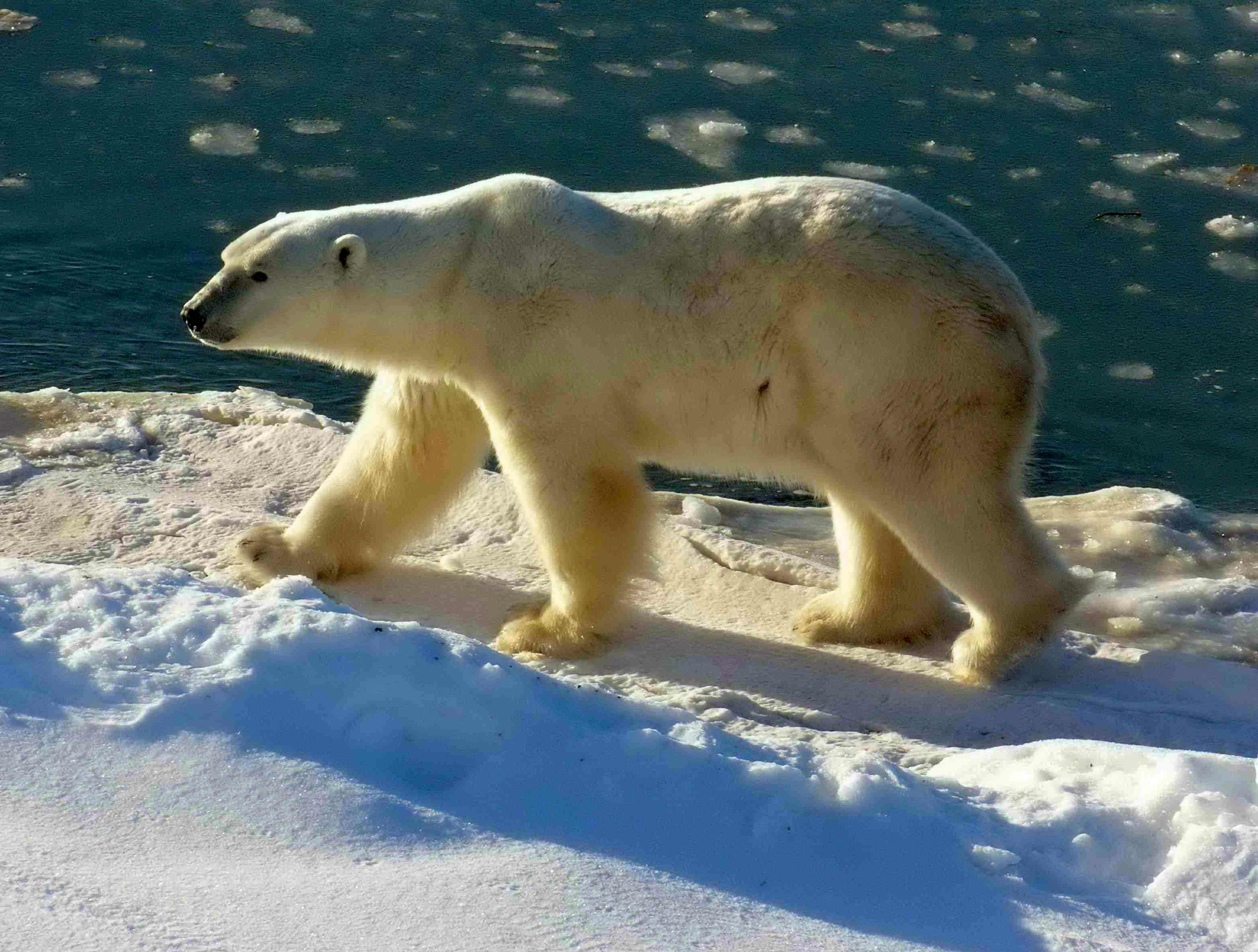
Polar Bear at Cape Churchill (Wapusk National Park, Manitoba, Canada). Photo by Ansgar Walk
The great climate change conference has opened in Copenhagen. Some are branding this gathering as the most important international meeting since the Congress of Vienna. It remains to be seen what future historians have to say about it. Most historians hesitate to predict the future or how our descendants will view present-day events. In any event, historians have already said a great deal about past climate changes. You might think that climate change is a purely scientific topic about which historians would have relatively little to contribute. The reality is that historians’ work has been important in advancing the scientific community’s understanding of past climate changes and their impact on societies. Moreover, many of the existing climate models depend on data that historians have carefully gathered from archives all over the planet.
Patrick D. Nunn , Climate, environment and society in the Pacific during the last millennium; Brian Fagan; The Little Ice Age : how climate made history 1300-1850 ; The way the wind blows : climate, history, and human action edited by Roderick J. McIntosh, Joseph A. Tainter, Susan Keech McIntosh; Richard H. Grove, Ecology, climate and empire : colonialism and global environmental history, 1400-1940.
 Canadian historians have researched a variety of topics related to climate change. The Hudson’s Bay Company archive is a particularly useful resource for climate-change historians because the clerks at HBC posts were required to record the daily temperature. The post records provide information about climatic conditions in the days before national weather services began collecting records. A list of other records related to the climate history of Canada is available here.
Last year, an academic conference on Canadian history and climate change was held at the University of Western Ontario. The presentations were recorded and are available online here. More information about the Early Canadian Environmental Data project is available here.
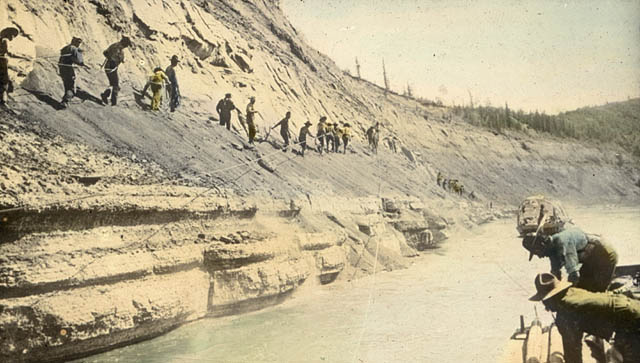
Athabasca Tar Sands, Early Twentieth Century. Image Source: Library and Archives Canada
Also, check out: Paul Chastko’s history of the Alberta tar sands, Developing Alberta’s Oil Sands : from Karl Clark to Kyoto.
Update: the blog at Activehistory.ca has some more information on historians and climate research.
Check out this excellent animated overview of the history of climate change.
George Monbiot of the Guardian has published an article attacking Canada’s track-record on the issue of climate change.
Monbiot is quite right to attack Canada’s foot-dragging on the issue of climate change. His criticisms of the party currently in power in Ottawa are also justified, although it must be said that the old government’s _revealed preferences_ were basically the same. I find, however, that Monbiot’s article lacks historical context. I don’t know if Canada’s record on the environment is significantly better or worse than that of the other settler countries, such as the USA or Australia. These are all societies based on consuming vast quantities of natural resources. That’s how they’ve been doing things for the past couple of centuries. The people in these countries are basically the same: big farms, big houses, big cars, and, quite literally, big people. Given the attitudes to the environment that people in settler countries have inherited from their land-raping grandparents from the period in which their societies grew mainly through extensive economic growth, there is a limit as to how much even a centre-left government can do. After all, the government needs to get re-elected and people in new world societies are far less willing to make sacrifices for the environment than their European cousins. It’s clear to anyone who walks into a British supermarket that British consumers are more interested in helping the environment than Canadian ones. These preferences need to be taken into account in designing a climate change strategy. I admire the committment to the environment of the former leader of the Liberal Party, but I must say that running a campaign promising a carbon tax was a foolish political tactic. Sometimes I think that Mr Dion forgot that he was now back in Canada, not in Paris.
I admit that Canada’s stand on CO2 has become a little bit worse under Harper than it was under the Liberals. But the Liberals did little on the CO2 file aside from pay lip service to the issue. The Liberals of the Jean Chrétien era were astute to enough to realize they needed the votes of minivan driving couch potatoes. But it is a bit unfair to compare white Canadians’ level of concern for the environment to that of people in a densely settled countries where most of the population is descended from people who have lived in the same region for millenia and have a deep attachment to the soil. In general, New World folk are footloose people with less attachment to particular biomes. Canadians are less interested in solving the CO2 problem and that attitude is a product of our history. It would be foolish to predict that North Americans would behave like Europeans when it comes to political and consumer choices about the environment.
It may be that North Americans will have to be coerced into making the right choice.

In 1880, a group of Inuit were transported to Germany to be exhibited in a zoo alongside wild animals. One of the Inuit, Abraham Ulrikab (c. 1845-1881) kept a diary during his captivity in trip to Europe. This diary was recently translated into English and published by the University of Ottawa Press. Ideas, CBC’s Radio 1’s flagship documentary program, is currently broadcasting a two-part documentary based on the diary. You can download the podcasts and check out images here. It is worth checking out.
 Kudos to Ideas director Paul Kennedy for his stewardship of this program. Ideas has been broadcasting some very good documentaries of late.
 The Past Speaks