That is the title of a provocative article in GlobeCampus.
Why Professors Don’t Teach
26 09 2009Comments : Leave a Comment »
Tags: GlobeCampus, publish or perish, university teaching
Categories : In The News, Teaching
Campus Life
25 09 2009The BBC has a story on the controversy surrounding Terence Kealey, a professor at the University of Buckingham. (See here). For Canadian coverage of this controversy, see the Montreal Gazette. Kealey has published a defence of his earlier comments in London’s Daily Torygraph newspaper.
Comments : Leave a Comment »
Tags: Terence Kealey, University of Buckingham
Categories : In The News
Campus Life
24 09 2009
Rowing Blade in Queen's Tricolour
Queen’s University has cancelled this year’s homecoming party for fears that it will lead to a repeat of last year’s rioting. The Globe story on the cancellation features a detailed map of the area around the university, pointing out known hotspots for trouble. I think that providing this map on the internet is a really bad idea, since it gives trouble-makers from out of a town a better idea of where to go to get into mischief. Was it really necessary to point out the area where bar fights occur most frequently? Did Canada’s national newspaper really need to tell people where on Aberdeen Street the drunken riots are most likely to take place? This is throwing fuel on the fire and telling people it’s water.
As this video suggests, many of the trouble-makers at previous homecomings were outsiders not from Queen’s.
Comments : Leave a Comment »
Tags: future leaders of Canada, Queen, Queen's homecoming, Queen's University, riots by spoilt upper-middle class children, so-called elite institutions of higher education
Categories : In The News
Wolfe, Montcalm, and Remembrance Day 2009
19 09 2009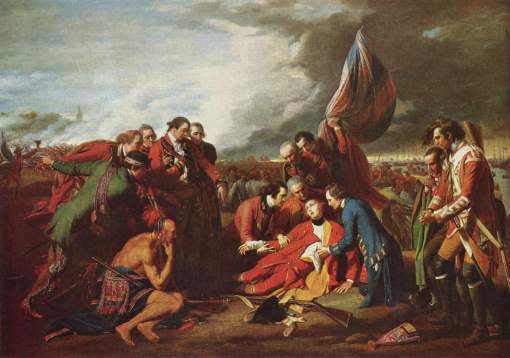
Benjamin West, The Death of General Wolfe, 1771
2009 marks the 250th anniversary of the Battle of the Plains of Abraham, an event that is still remembered by many Canadians. I believe that we should include a prominent reference to this battle in the Remembrance Day ceremonies held this year at the National War Memorial in Ottawa.
The National War Memorial, originally built to honour the memory of those who died in the First World War, has now come to represent the losses suffered in all of Canada’s wars both here in North America and overseas. Increasingly, the space around the memorial has been used to commemorate those who died in pre-Confederation conflicts rather than only those who fell in the better-known wars of the twentieth century.

War Memorial in Ottawa
In 2006, statues and busts of important figures from Canada’s pre-Confederation military history were installed around the National War Memorial. The individuals represented by these statues include: Louis de Buade, Comte de Frontenac; Mohawk chief Joseph Brant; Laura Secord; and Sir Isaac Brock.

Statue of Joseph Brant, National War Memorial in Ottawa
Although these statues, known collectively as the Valiants Memorial/ Monument aux Valeureux, are fine works of art, the decision to omit any representation of the British and French commanders at the Plains of Abraham, Generals Wolfe and Montcalm, was highly unfortunate. (It would be interesting to speculate on why statues of Wolfe and Montcalm were not included. My guess is the National Capital Commission‘s fear of touching a potentially explosive political issue outweighed its interest in promoting an awareness of Canadian history).

Poppy
Although it is, of course, too late to include a permanent symbolic tribute to Wolfe and Montcalm in the National War Memorial in time for this year’s Remembrance Day, there is another way we can commemorate the memories of Wolfe, Montcalm, and all those who died on the Plains of Abraham. I believe that the descendants of Generals Wolfe and de Montcalm should be invited to Ottawa to participate in this year’s ceremony as the honoured guests of the Government of Canada. Representatives of the First Nations present at the battle should also be invited to take a prominent place in this year’s ceremonies.
Andrew Wolfe Burroughs, a descendant of General Wolfe and Georges Savarin de Marestan, a descendant of General Montcalm, have participated in events related to the memory of their illustrious ancestors on numerous occasions. As a result of working together on heritage projects, Burroughs and de Marestan are now good friends. Their ability to put aside past hatreds is inspiring to all those who hope for a more peaceful world. It is fitting to highlight the Battle of the Plains of Abraham by inviting Burroughs and de Marestan to this year’s Remembrance Day ceremonies. The friendship of these two men is, in some ways, representative of the friendship that English- and French-speaking Canadians, the descendants of the two armies of 1759, now feel for each other. For 250 years, English- and French-speakers have lived together in Canada with a minimal amount of violence. In a world rent frequent by ethnic violence and civil war, the history of the relationship between Canada’s two largest linguistic groups can act as a beacon of hope in the world. The beginning of this historical relationship deserves to be commemorated on 11 November 2009.
The Government of Canada should invite Andrew Wolfe Burroughs and Georges Savarin de Marestan to participate in the 2009 Remembrance Day ceremonies.
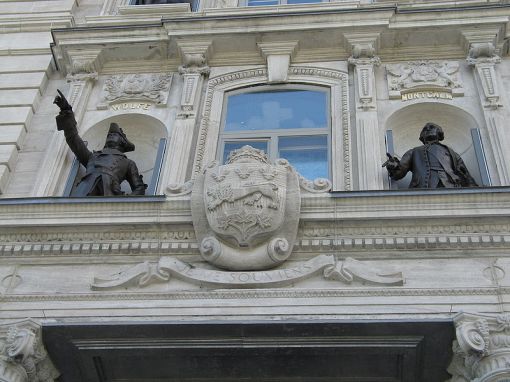
Statues Honouring Both Wolfe and Montcalm, National Assembly Building, Quebec City
All images in this post are from the Wikimedia Commons and are used under a Creative Commons Licence.
Comments : 2 Comments »
Tags: Battle of the Plains of Abraham, James Wolfe, Marquis de Montcalm, National Capital Commission, National War Memorial, remembering war in Canada, Remembrance Day, Valiants Memorial
Categories : In The News
Historian Gerhard Ens in the News
13 09 2009Fort Whoop-Up is notorious in the history of western Canada because American whiskey traders sold poisonous liquor to First Nations there. Canadian historians have traditionally regarded the presence of American whiskey traders in the Canadian west as an essentially negative force. University of Alberta historian Gerhard Ens, however, is now challenging the conventional wisdom. He shared his research with the public at a recent conference at Fort Whoop-Up, which is now a historic site. See this item from the Lethbridge Herald.
Comments : Leave a Comment »
Tags: Canadian History, Canadian-American Relations, Fort Whoop-Up, Gerhard Ens, western Canadian history
Categories : In The News
Teaching After Midnight
11 09 2009Should universities offer classes in the middle of the night? Bunker Hill Community College in Boston appears to think so. Last night they offered their first night-time class: it started at 23:45 and ended at 02:45. The instructor blogged about it here. Midnight classes were introduced as a way of dealing with a shortage of classroom space caused by a sudden surge in the student population. Some students prefer the late night classes because they are in shift work.
For press commentary, see here, here, and here. To listen to an interview with the profs involved, click here.
Comments : Leave a Comment »
Tags: Bunker Hill Community College, higher education, teaching after midnight
Categories : In The News
The University Dropout Rate
10 09 2009Yesterday’s New York Times carried a story about dropout rates at U.S. universities. David Leonhardt provides some interesting statistics regarding the proportion of students admitted to university who actually graduate. At elite universities, the vast majority of students admitted will graduate with a degree within six years. However, at universities where the admission standards are lower, the dropout rate is far higher. Leonhardt writes that while the U.S. “does a good job enrolling teenagers in college, but only half of students who enrol end up with a bachelor’s degree. Among rich countries, only Italy is worse”. He argues that the college dropout rate is a major reason why measurably inequality in the United States has soared in the last few decades and economic growth has slowed.
This article has generated a great deal of online debate, (also see here and here and here) with some people questioning Leonhardt’s rather bold assertions that the high college dropout rate is a _major_ cause of rising inequality and slowing growth. Clearly, a high dropout rate isn’t a good thing, but is it really what’s driving these broad economic trends? I’m inclined to be a bit sceptical of this part of his argument. Leonhardt appears to be using a bit of hyperbole in the interests of bringing our attention to what is an important issue.
As a professor at a Canadian university, this article raises several questions. (I was struck by the paucity of cross-national comparison data in this article, aside from the token reference to Italy at the start. I must say that this article displays the typical United States parochialism). Anyway, I’m left wondering whether there is similar data for Canada that would allow us to estimate the dropout rate at Canadian institutions of higher education? (There is a definitional issue here, of course, since college has a different meaning in Canada). Which Canadian universities and provinces have the highest dropout rates?
The sources cited in this article include: Failure Factories, from the right-leaning American Enterprise Institute, and Crossing the Finish Line, a new book from Princeton University Press. You can watch an interview of the lead author of Crossing the Finish Line, William G. Bowen, by clicking here.
Update:
I’ve discovered some sources re the dropout rate in Canadian universities. The Maclean’s survey of Canadian universites contains data on retention rates. The Ontario Council of Universities provides information on both retention and graduation rates. In February 2008, the Ottawa Citizen carried a story about “first-year flameouts” and what universities are attempting to remedy the problem of low retention rates.
Comments : 6 Comments »
Tags: Crossing the Finishing Line, David Leonhardt, Dropout Rate at Universities, New York Times, William G. Bowen
Categories : In The News
Seventieth Anniversary of Canada’s Declaration of War on Nazi Germany
10 09 2009Several Canadian newspapers have covered this anniversary. See here, here, and here. Perhaps the best anniversary-related item to appear in the press today was J.L. Granatstein’s piece in the Globe and Mail.
Comments : Leave a Comment »
Tags: J.L. Granatstein, Second World War, Seventieth Anniversary of Canada’s Declaration of War on Nazi Germany
Categories : In The News
 The Past Speaks
