Comeau Case Decision

16 04 2018

On 19 April, the Supreme Court of Canada will announce its decision in the constitutional case of the Queen v. Comeau, which deals with the legitimacy of interprovincial trade barriers in Canada. As long time readers of this blog will know, I was the expert witness who testified at the 2015 lower court case that was the basis of the appeal now being considered by the Supreme Court.

Here is a backgrounder for people outside of Canada.

Canada’s subnational governments, the provinces, impose many restrictions on interprovincial trade that are protectionist in intent and effect. (Canada isn’t the only country to have such internal trade barrier—see here for a gateway into the academic literature on this subject).  Canada’s internal trade barriers appear to conflict with section 121 of the 1867 Canadian constitution, which explicitly provides for free trade between Canadian provinces. This constitution is the British North America Act, 1867 (UK), which was retroactively renamed the Constitution Act, 1867 by the Constitution Act, 1982 . [Most academic historians continue to refer to the text by its historical name]. Since I wrote a PhD thesis and book on the political economy of the 1867 constitution, I am considered to be well qualified to speak about the motivations of the creators of section 121. You can read the expert witness report I wrote for the Comeau case here.

I believe that section 121 was included in the Canadian constitution because the framers of this document wanted the new Dominion of Canada to be a single market without fetters on interprovincial trade. These framers included the Fathers of Confederation- a group of British North American politicians- as well some senior British politicians (especially the Earl of Carnarvon but also Adderley, Watkin, and others), and a handful of very accomplished civil servants and lawyers in London.

150 years later, trade barriers are still in place. For those who don’t wish to read my entire expert witness report, this 2015 CBC article gives a summary of the views I presented in “The Historical Origins of Section 121 of the British North America Act: a Study of Confederation’s Political, Social, and Economic Context


Moving Towards Open Data in Business History

13 04 2018

I have long been an advocate of Open Data and of the adoption of an Open Data norm in the field of business history. I recently published a paper in the journal Business History that outlines why our field needs to adopt Open Data and a system called Active Citation. What Open Data would mean in practice is that whenever a business historian cites a primary source (e.g., a letter in an archive or an article in a historic newspaper), the footnote must include a hyperlink to a scanned image of the document. This system would have a number of advantages. First, it would accelerate the digitization of primary sources and once a primary source has been put online for one purpose, it can be re-used by another researcher. Moreover, the creation of an Open Data rule in business history would be yet another victory for the research transparency movement. In the last half decade, a variety of academic disciplines have embraced research transparency and Open Data is a big part of the research transparency movement.  The requirement that raw data be published alongside the article based on that data is designed to counteract the impression that researchers sometimes use data selectively or in an otherwise unprincipled way.


Although the impetus for research transparency and Open Data has come largely from academics concerned about data mis-representation, the movement has been able to make so much progress in recent years because it has had a backer with deep pockets, the philanthropist John Arnold. Arnold was recently profiled in Wired magazine. I would encourage anyone interested in Open Data and Research Transparency to check out this article.

In view of the importance of Open Data to the future of the field of business history, it is exciting to see that an increasing number of business-historical data sources are being made freely available online.

I see from The Exchange, the blog of the Business History Conference, that The Newberry Library in Chicago has announced a major revision to its policy regarding the re-use of collection images: “images derived from collection items are now available to anyone for any lawful purpose, whether commercial or non-commercial, without licensing or permission fees to the library.”

This reform to the Newberry Library’s rule would certainly help to make it easier for researchers who based papers on materials in their collection to use Open Data in their papers. I would like to congratulate the Newberry Library on their wise decision and would like to encourage other repositories of business historical materials to follow this example whenever they are legally allowed to do so.


Stanford Applied History Conference

31 03 2018


The academic internet was recently ablaze with controversy about a conference on “Applied History” that took place at Stanford (see here, here, and here). The point of this conference was to showcase historical research that can inform policymaking, particularly the making of (US) geo-political strategy.

The conference organizers were criticized for a list of speakers that was almost exclusively male and exclusively white. Journalists at the New York Times picked up on the story and asked the main organizer, Niall Ferguson, about the lack of racial and gender diversity at the conference.

The concerns about the lack of gender and racial diversity are important and suggest that there is a need to encourage more female grad students to do historical research in areas that are relevant to the making of grand strategy. The fact that the academics at the conference are overwhelmingly based at US universities, which is even more problematic than the lack of gender and racial diversity, went un-discussed by the US academics and journalists who covered the story. However, my main problem with the Applied History is that all but one of the sessions was prescriptive and involved academics dispensing advice to policymakers rather than discussing how policymakers use history. I see from the programme that there was a lunch-time discussion with Philip Zelikow and Robert Zoellick on the subject of “Applied History in Washington since c. 2000”. Now that session would be really interesting to me, because it would involve people who are embedded within the Beltway sharing their observations about how history is being used and perhaps misused by policymakers.


So much important research has been done on how policymakers use (and misuse) historical analogy and historical knowledge. I’m thinking of the work of Khong, Jervis, and many other political scientists. There is also the historian Alix Green in this country, who has studied how historical knowledge is used in Whitehall. It is such a shame that none of these researchers were at the conference.

I am sharing the conference programme below

Day One—Friday, March 2, 2018


Breakfast and registration
Welcome and opening remarks
Niall Ferguson
Session 1: Undead Rome: the Decline, Fall and Afterlives of the Roman Empire?

Presenter: Tom Holland
Commentator: Peter Frankopan
Chair: Niall Ferguson
Session 2:Is Trumpism Merely Populism revisited?

Presenter: Eric Rauchway
Commentator: Daniel Sargent
Chair: Niall Ferguson
Break
Session 3: The China Story

Presenter: Frank Dikötter
Commentator: Arne Westad
Chair: Robert Zoellick
Lunch
Discussion with Aaron O’Connell and Fredrik Logevall: Déjà Vu All Over Again? Vietnam, Afghanistan and the Search for Lessons in History

Chair: Graham Allison
Session 4: The Ecological Origins of Economic and Political Systems

Presenter: Stephen Haber
Commentator: Ian Morris
Chair: Peter Frankopan
Session 5: Kicking Away the Ladder? Cryptocurrencies in Historical Perspective

Presenter: Tyler Goodspeed
Commentator: Barry Eichengreen
Chair: Michael Bordo
Adjourn
Tour of Hoover Archives
Eric Wakin
Session 6: Is Putin’s Russia a Potemkin Power? Leadership, Succession and Russian Foreign Policy

Presenter: Christopher Miller
Commentator: Stephen Kotkin
Chair: Amir Weiner
Reception
Dinner


Day Two—Saturday, March 3, 2018


Breakfast
Session 7: The History of the Future

Presenter: Matthew Connelly
Commentator: Christopher Clark
Chair: Mary Sarotte
Session 8: Thinking Historically: A Cold War Historian’s Reflection on Policy

Presenter: Francis Gavin
Commentator: Marc Trachtenberg
Chair: Arne Westad
Break
Session 9: How Might 21st-Century Deglobalization Unfold?

Presenter: Stefan Link
Commentator: Norman Naimark
Chair: Marc Trachtenberg
Session 10: Same As It Ever Was: The History of Inequality and Mobility

Presenter: Gregory Clark
Commentator: Glen O’Hara
Chair: Harold James
Lunch
Discussion with Philip Zelikow and Robert Zoellick: Applied History in Washington since c. 2000
Session 11: Wine and Winning: From Muhammad to the Islamic State, a Tangled Relationship

Presenter: David Cook
Commentator: Emile Simpson
Chair: Sean McMeekin
Session 12: Defeating an Idea: What the Cold War Can Teach Us About How States Fight Ideologies

Presenter: Jeremy Friedman
Commentator: John Bew
Chair: Philip Zelikow
Adjourn


Countering Political Risk in Colonial India: German Multinationals and the Challenge of Internment (1914-1947)

27 03 2018

I’m sharing the details of a new HBS working paper that draws on business history to understand the perennial issue of the management of political risk by multinational firms.


Abstract:

Internment in so-called “enemy countries” was a frequent occurrence in the twentieth century and created significant obstacles for multinational enterprises (MNEs). This article focuses on German MNEs in India and shows how they addressed the formidable challenge of the internment of their employees in British camps during both WWI and WWII. We find that internment impacted business relationships in India well beyond its endpoint and that the WWI internment shaped the subsequent perception of and strategic response to the WWII experience. We show that internment aggravated existing staffing challenges, impacted the perception of racial lines of distinctions and re-casted the category “European business.” While internment was perceived and managed as a political risk, the case also shows that it created unexpected networking opportunities, generating a tight community of German businesspeople in India.


The authors are: Christina Lubinski, Valeria Giacomin, and Klara Schnitzer

The


Prospects for a transparency revolution in the field of business history

27 02 2018

Abstract

The last five years have seen is an increasing emphasis on research transparency in many disciplines. Unfortunately, the field of business history is being bypassed by the movement for the creation of research transparency institutions. The article begins by showing why it is important for the business history community to engage with the research transparency movement by embracing the principle of Open Data. The article then argues that Active Citation is the right variant of Open Data for the business–history community and that the widespread adoption of Active Citation in the field of business history would be promoted by the creation of a specialised repository for business–historical research data. The challenges involved in establishing such a repository are discussed. The article concludes by arguing that business historical journals and monograph publishers should not require authors to use Active Citation; rather, contributors should merely be required to state whether they have made the data underlying their article available online.


The full paper is available here, in open access.


The Black Swan Strike

23 02 2018

81iebqqqwtl

That’s what I am now calling the current industrial dispute that has paralysed Britain’s research intensive universities. Readers here in the UK will be aware that academics at the country’s leading universities (Oxford, Cambridge, Manchester, etc. including my own employers, University of Liverpool) have been on strike since yesterday in a dispute over our pensions. The issue is this: the bargaining agent that represents our employers, an organization called Universities UK, claims that the pension fund has a massive deficit that needs to be addressed by some mixture of higher contributions and lower benefits for future retirees. Our union, the UCU, disagrees with this claim and thus opposes the proposed cuts in the pensions.

The employers’ belief that the pension fund has a large deficit is, in large part, a function of the curious, indeed rather extreme, methodology they have used to forecast future revenues and liabilities. The approach they have taken is designed to ensure that the pension fund could remain solvent in the event of a worse-case scenario which involves the closure of all of the UK’s universities. This radically pessimistic approach is justified on the grounds that some industries with occupational pensions have, within living memory, been disrupted out of existence. There are, after all, lots of retired coalminers and steelworkers who still collect pensions by virtue of their having worked in industries that have essentially ceased to exist in the UK. The union argues that in adopting this worse-case scenario approach, the employers’ federation is being recklessly prudent.

I’ve long been fascinated by how ideas that emerge from the ivory tower and which are disseminated in highbrow books filter down to decision-makers and then result in concrete changes in how people behave in the real world. That’s why one of the books I was most interested in as a second-year undergraduate was called The Ideological Origins of the American Revolution—the book argued that a series of influential books published in England ultimately led to tea being poured into Boston harbour, British troops firing on minutemen, etc.


Of course, any good historian will eschew monocausal explanations and will recognize that a host of other, non-ideological variables explain why revolution and other phenomena occur. There are variety of reasons that the academics’ union and the employer are now at an impasse. These include the effects of Quantitative Easing on bond yields, Brexit, and, of course, the medical technologies that are extending the lives of retired lecturers and other upper-middle class people.


For the time being, however, let’s focus on the ideological variables, the ideas that have brought us to where we are today, with an employer that wishes to use a recklessly prudent methodology. If I have to identify a single author who has helped to produce the intellectual climate that resulted in the employers’ bargaining agent adopting and then sticking to its very pessimistic, belt-and-braces, approach, I would say that it is Nassim Nicholas Taleb, who, in the wake of the 2008 financial crisis, promoted fairly radical ideas about the need to create “anti-fragile” systems capable of withstanding Black Swan events, such as the Once-in-a-Century storms that occasioned sweep over financial markets. He popularized this idea to the management of risk in his bestselling book, The Black Swan and I would bet good money that the well-intentioned individuals who are behind the pessimistic methodology have read, and have been influenced by this book. That’s why I call this the Black Swan Strike.

Whilst I certainly agree with prudence in the management of pension funds, I would call on all concerned to reflect on whether we really need to design a pension fund that is capable of surviving the effective end of universities as we know it in the UK.  After all, the some of the universities that support the pension scheme have been around since the Middle Ages. Universities serve many functions, so even if MOOCs (remember them) disrupted away their teaching income, they would still likely survive. (Disruption by MOOC is most unlikely, as universities serve an important signalling function to employers). I would therefore suggest that the recklessly prudent approach that has been adopted is totally unnecessary.


P.S. I am sharing a screenshot of an excellent Tweet about the strike that will be enjoyed by anyone who has read George Lakoff on framing.

lakoff


CFP: Varieties of Capitalism and Business History

15 02 2018

AS: I’m sharing the CFP for a special issue of the journal Business History on Varieties of Capitalism (VoC). The editors of the SI will be running a PDW at Stirling Management School in Scotland in early June.  My sense is that this special issue will complement and update the SI on VoC that appeared in the Business History Review back in 2010. As someone who helps to teach a course on comparative capitalism, this CFP is quite interesting to me.
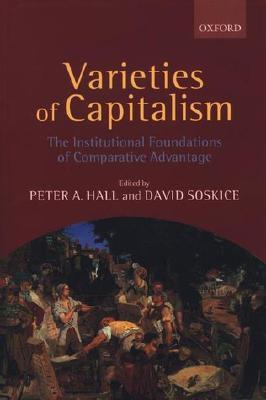
 

745751

Business-Government relations and national economic models: how do varieties of capitalism emerge and develop over time?

Special Issue Editorial Team

Niall G MacKenzie, University of Strathclyde (niall.mackenzie@strath.ac.uk)
Andrew Perchard, University of Stirling (a.c.perhard@stir.ac.uk)
Neil Forbes, Coventry University (lsx143@coventry.ac.uk)
Christopher W Miller, University of Glasgow (christopher.miller@glasgow.ac.uk)

The varieties of capitalism concept and literature has been dominated by conceptual
institutional modelling (Hall and Soskice, 2001; Hancké et al, 2007; Whittington and
Mayer, 2002; Whitley, 1999). Business and economic historians have undertaken a
number of significant works on varieties of capitalism in the form of empirical
transnational firm and sectoral case studies (Chandler 1990; McCraw, 1997;
Musacchio and Lazzarini, 2015; Cassis, 2002; Fellman et al, 2008; Sluyterman,
2014). A special issue in Business History Review in 2010 sought to bring a number
of prominent business historians together to offer their thoughts on how business
history can contribute to the varieties of capitalism literature which has been
described as “ahistorical, at least in its original formulation” (Friedman and Jones,
2010). This call for papers seeks to extend and complement the work produced in
that issue to consider how varieties of capitalism evolve in relation to governmentbusiness relations, building on and extending recent work by Thomas and
Westerhuis on networks of firm governance and national economic models (2014),
by elucidating how business-government relations affect the development and
promulgation of different types of varieties of capitalism.


The focus of much of the existing canon on varieties of capitalism is centred on aggregated models of institutional environments, and less on the critical interactions between principal actors within the economy, of which both businesses and governments are key.
Indeed, recent work has been critical of the relatively static conceptualization and
narrowness of the varieties of capitalism idea (Baccaro and Pontusson, 2016). To
this end, business historians are uniquely placed to comment on the specifics and
wider relevance of the role of both businesses and governments, the character of
their interactions, and motivations, in the formation and development of varieties of
capitalism.
In the political science field, the conceptual institutional modelling of varieties of
capitalism has been exemplified by the work of eminent political economists Hall and
Soskice (2001) who have advanced what they term as the five spheres in which
firms must develop relationships to resolve co-ordination problems in their core
competencies: industrial relations; training and education; corporate governance;
inter-firm relations; and employee relations.


We are seeking to understand the dynamics of such engagements beyond simple
firm-level competence and into the nature, structure, flows and intensity of
interactions between firms and governments across different contexts and time as a
way of explaining the development of different forms of capitalism. To this end, both
descriptive and analytical analyses are welcome in submissions.
We posit that varieties of capitalism (VoC) develop in different ways, partly as a
result of the complex interactions between government and business over time and
in different contexts.


An example of the demonstrable opportunities, and the current
gap, are to be found in the lack of engagement between international political
economy discourses on development (for e.g. Acemoglu and Robinson, 2013), and
detailed historical studies of business in the decolonizing world (e.g. White;
Stockwell; Butler, 2008; Decker, 2005). Similarly, detailed business historical studies
of elites and networks within specific commodity markets offer to provide valuable
insights to models of VoC (e.g. Ingulstad et al, 2014) and how they emerge, are
impacted by, and impact on business-government relations. A further illustration of
this can be found in the emergence of a particular form of capitalism in post-Soviet
Russia where well-documented business-government interactions created a number
of super-wealthy oligarchs against a backdrop of economic change and upheaval. To
this end, we propose that VoC act as a framework for analysis of such relations in
submitted papers, both focusing on individual countries, and companies operating
across countries where appropriate.

We encourage new historically informed reflections on national
economic models and institutional environments, especially from under-represented
territories (for example, South Asia, Eastern Europe, Africa and Latin America), or
during scenarios such as war, disasters, or other exogenous crises, or on the role of
family wealth in developing forms of capitalism (for example the influence of the
Wallenberg family in Sweden, or the Rothschilds’ financial influence). The proposed
special issue will raise the profile and awareness of the potential contribution of
business history to wider debates on capitalist systems of economic organization by
utilising the unique insights gleaned from historical enquiry into the actions and
motivations of business and government actors to interrogate the efficacy of the
varieties of capitalism concept. In turn, this will have wider value beyond business
history and offer a demonstrable contribution to a range of other disciplinary studies.
We welcome innovative submissions that combine empirical studies with conceptual
literature both on business-government relations and national economic models
(including different conceptualisations of national and regional economies).
Submissions may adopt a local, regional, and/or national, foci. Whilst we welcome
submissions focusing on any country, we particularly encourage those covering
relatively under-researched regional models of capitalism (such as Eastern
European, African and Latin American areas). All manuscripts will be expected to
demonstrate an active engagement with historical approaches and methods,
conceptual models, and be based on substantive use of historical sources (public
and private archives, oral history and other personal narratives). Articles that engage
with both the political science and business history fields are particularly welcome.
Amongst the topics and themes suggested are:

 The development of varieties of capitalism and national economic
models;
 Governments as business actors in terms of rule setting and
participation in business activities;
 How and why firms engage with government within different national
and transnational contexts;
 The different experiences of businesses and sectors of industry under
national governments during wars and major conflicts and the resultant
impact on national economic systems;
 Theorising on national economic modelling and institutional
environments from historical perspective; and
 Different forms of capitalism and regulation.
The above is by no means an exhaustive list, but rather an indicator of the types of
work the editors are provisionally interested in seeing.

Submission instructions:
Articles should be based on original research and should not be under consideration
by another journal. Abstracts of articles of up to 1,000 words should be submitted by
30 April 2018 via ScholarOne, using the drop down to select submission to the
Special Issue on Business-government relations and national economic models:
How do varieties of capitalism emerge and develop over time?

The abstracts initially selected for the Special Issue will be presented as full papers
in a workshop that will take place at the Stirling Management School, University of
Stirling, Scotland, in early June 2018, sponsored by the Stirling Management School
and the Business History Editors’ Fund. The final version of the papers, to be
submitted via ScholarOne by 15 August 2018, should be the result of this workshop.

All abstracts and articles will be peer reviewed and, therefore, some may be
rejected. Authors should ensure that their manuscripts comply with the Business
History formatting standards. Authors who are not English native speakers are
responsible for having a native English-speaking copyeditor check and correct their
texts before final acceptance.


Research Transparency Valentines Twitter Feed

14 02 2018

Academics who support the open data/research transparency movements have been having fun on Twitter this Valentine’s Day by composing #opensciencevalentines.

I’m sharing three of my favourites:

Sanjay Srivastava aka @hardsci:  Roses are read Violets are blue Show me your data And I’ll show you mine too.

Jim @n_equals_42 Will you be my PLOS One? #opensciencevalentines

Cassie Brandes @cmbrandes: Control group is red, Experimental, blue, The authors posted their data, I recommend this for review!


Why Libertarians Like Historical Research That Shows That What You Know About Tulipmania is Wrong

12 02 2018

Tulipmania didn’t exist, at least not in the fashion you think it does.

That’s the argument of Anne Goldgar, Professor of Early Modern History at King’s College London. Back in 2008, Professor Goldgar  published a study that debunks many elements of the pop-history account of Tulipmania that many observers applying in discussing financial bubbles in the present.

The conventional view is that Tulipmania was the first of the many episodes in financial history in which irrational exuberance on the part of investors resulted in a bubble. Tulipmania is often referenced by those of us who question the Efficient Market Hypothesis (EMH) and the belief that financial markets always set prices correctly. Whenever people see bubbles, references to Tulipmania are sure to follow. Although I can’t find the reference right now, I believe that Warren Buffett has used the historical example of Tulipmania when speaking to investors at his annual Berkshire Hathaway conference.


The recent BitCoin bubble has, of course, see frequent invocations of Tulipmania.  As Prof. Goldgar writes:

Right now, it’s Bitcoin. But in the past we’ve had dotcom stocks, the 1929 crash, 19th-century railways and the South Sea Bubble of 1720. All these were compared by contemporaries to “tulip mania”, the Dutch financial craze for tulip bulbs in the 1630s. Bitcoin, according some sceptics, is “tulip mania 2.0”.

Prof. Goldgar argues that contrary to the convention wisdom, Tulipmania in the Netherlands did not result in a frenzy of speculation that involved large numbers of people and which inflicted long-term damage on the Dutch economy. She shows that relatively few people were involved, the inflation of asset prices was modest, and that the bursting of the bubble resulted in neither a widespread recession in the Netherlands nor a wave of suicides.


I’m not disputing the accuracy of Prof. Goldgar’s historical research, which received fairly positive reviews by other scholarly experts on the 17th century Netherlands (see here). However, I’ve noticed that her research has being press-ganged into service by hardcore libertarians, a group that includes many people who subscribe to a very hard version of the EMH and who tend to regard the market as infallible, and therefore not requiring regulation by the state. When Goldgar’s book appeared in 2008, it received a highly favourable, indeed enthusiastic review from the libertarian economist Deirdre McCloskey, who praised the book for demolishing a historical narrative used by so-called “anti-capitalist” writers. Today, the libertarian website CapX has published an article that showcases her research.

I’m left wondering why libertarians appear to be so interested in Prof. Goldgar’s research. What rhetorical purpose does citing her research actually serve? I suspect that libertarian like her research because it shows that one of the many data points used to prove the existence, and harmful social consequences, of financial bubbles didn’t really exist.


“So you’re saying … we should live like lobsters?” or: Why does politics make us stupid?

9 02 2018

That’s the title of a very important and interesting blog post by Pascal Boyer, a French anthropologist and evolutionary psychologist who was discussing a now infamous interview of an academic by a UK journalist. I would encourage anyone whose job involves reasoning and persuasion to read the post.

Boyer discusses the damage that “politics inflicts on people’s intellects. Living among academics, it is of course always a wonder to witness how people who display great sophistication in understanding multiple intertwined factors, or the way some variable modulate the interaction between tow other factors, etc., suddenly turn into four-year olds when they talk about politics. It is a wonder that the same people, who are so careful with the logic of arguments, suddenly get into a passionate refutation that b could possibly imply a, when all you suggested to them was that perhaps a implies b.”

I’ve long noticed the same phenomenon: otherwise smart people suddenly become stupid and ignorant when talking about politics. If you talk to someone about their parenting strategy, or the relative merits of two different cars, or their investments, they will be calm, judicious, and will tend to base their statements on evidence. The moment the conversation turns to politics, the IQ of everyone in the room drops.

Boyer advances one explanation for why smart people say really stupid things when the subject is political, namely, that people are engaged in furious signalling of affiliation when they are in the political sphere.

I tend to support a somewhat different explanation for why politics makes people stupid that relates to the sheer size of most of the political units that are controlled by our collective decision-making processes. (I’m thinking especially of nations, not municipal politics here). When we make decisions individually, or in very small groups, we often suffer the consequences of our negative consequences of poor decision-making. For instance, if I indulge my emotions and whims too much when making consumer decisions, I will soon run out of money. If I convince myself that eating lots of sugar will make me thin, I will get fat. I am, therefore, held accoutable for my decisions. But when I am asked to participate in an election or some other decision-making process involving millions of other people, I can free ride on the intelligence of others. If I fail to vote or make voting decisions based on stupid considerations, I am most unlikely to face any consequences, given that the chances of my casting the decisive ballot in a national election are slim indeed.

Bryan Caplan develops this idea in his book The Myth of the Rational Voter.