Returning to growth in the UK: Policy lessons from history

25 10 2012


That’s the title of a recent lecture and now blog post by Nick Crafts, an economic historian at the University of Warwick. There’s loads of good stuff about macroeconomic policy here, but I think his most important point relates to housing. The UK escaped from the Great Depression of the early 1930s by building massive numbers of houses. Maybe it can replicate this feat by scrapping some of the existing planning rules.
Abstract: A return to growth is urgently needed in the UK. Recovery from severe recessions was achieved in the 1930s and the 1980s in the presence of fiscal consolidation. This column examines the lessons from those experiences for today’s policymakers.
Bottom Line: If there is one area that could deliver short-term stimulus and long-term efficiency gains, as in the 1930s, it is surely private house building. The evidence suggests that draconian planning restrictions mean that the stock of houses is three million below and real prices are 35% above the long-run free market equilibrium (Hilber and Vermeulen 2012). The welfare gains from some relaxation of these planning rules are huge and the employment implications of steadily addressing the housing shortfall could be considerable – building 200,000 extra houses per year might employ 800,000. This would require addressing issues of housing finance and incentivising local communities to want development because they can benefit from it and builders to believe that delaying construction would not be profitable (Besley and Leunig 2012).


A Response to Randall Morck, or, Why We Can’t Blame Pierre Trudeau for the Decline of the Widely Held Firm in Canada

25 10 2012

I’m writing this post in response to a chapter about the history of Canadian corporate governance and Canadian politics that appeared in Randall Morck, ed, A History of Corporate Governance Around the World: Family Business Groups to Professional Managers (Chicago: University of Chicago Press, 2005). You can read the chapter, “The Rise and Fall of the Widely Held Firm: A History of Corporate Ownership in Canada”  by Randall Morck, Michael Percy, Gloria Tian, Bernard Yeung,  here.

It may seem strange that I would write a lengthy blog post in response to something that was published more than half a decade ago. The authors of this piece are prolific scholars and have published many other things since then. This post may also strike some as presumptuous. Randall Morck, the lead author, is a very distinguished scholar. He is the Stephen A. Jarislowsky Distinguished Chair in Finance and University Professor at the University of Alberta. I hesitate to publish anything critical of such an illustrious academic. However, the chapter written by Morck et al. contains some very problematic ideas about  important subjects, so I think that I must say something about it here. I believe that what I say in this post will be of interest to many people both in Canada and other countries, as the topic has big implications for how we think about the political economy of corporate governance.

Morck et al., argue that in the early 20th century, large pyramidal corporate groups controlled by just a handful of wealthy families or individuals dominated Canada’s non-bank corporate sector. By the 1960s, he says, most of the large companies in Canada were widely held.  Ownership of Big Business became democratized—instead of a few magnates holding huge chunks of companies, there were vast numbers of small investors each owning a few shares in enterprises like Bell Canada.

Then, starting in the 1970s, the pyramidal corporate group controlled by families came back in a major way. Whereas the trend in the decades leading up to the 1970s was towards the wider dispersion of corporate equities, the data presented by Morck et al., show that the opposite trend has been at work in the last few decades. The authors suggest that the Canadian economy is now dominated by a few family groups. In this sense, it is much more like a continental European country or even a Latin American oligarchy than Britain or the United States, where the widely-held corporation is relatively common.  Like most other Anglo-American academics, Morck regards the widely held corporation as the socially optimal arrangement.  I will note here that not all scholars agree with this idea, although I won’t go off on a tangent about the literature about the merits of the family firm.

I don’t have any qualms with the raw data presented by the authors of this paper. I suspect that the trend evident in their data does correspond to the reality. I do, however, find their explanation for this trend to be very problematic. I particularly object to the political part of the explanation they offer.

It seems to me that the authors have overlooked the most obvious explanation for why the trend reversed itself in the 1970s: the period since the 1970s has been one of neo-liberalism in Canada and most other Western countries. In the 1970s, the post-war Keynesian consensus frayed, the role of the State in actual production has been dramatically curtailed, the welfare state came under attack, taxes became less progressive, unions became weaker. In contrast, the trend in Canada (and most other Western countries) from the 1930s to the 1970s was for a steady increase in the role of the state and more egalitarian distribution of income and wealth.

I will not dwell on the factual errors that appear here and there in this piece.  “The new Tory prime minister, John Diefenbaker, an upstart lawyer born in a shack in rural Saskatchewan, had little use for great nation-building schemes or business lobbyists. The decade and a half following the war was probably the apogee of free market philosophy in Canada.”

Really? Diefenbaker sought to divert Canada’s foreign trade away from the United States. He also planned massive nation-building infrastructure projects in the far north. He expanded the government’s role in the redistribution of wealth. He did end the state’s monopoly over television broadcasting by permitting the creation of a commercial TV network, but I would hardly call Diefenbaker an apostle of the free-market economic philosophy we now associate with Ronald Reagan and Margaret Thatcher.

Morck et al., blame Trudeau for the decline of the widely held firm and the re-emergence of the family held pyramids. People on the left might argue that the simplest explanation for their re-emergence is Trudeau’s elimination of succession duties in 1972. For more about the end of the inheritance tax see here

This seems like a pretty plausible explanation to me.  After all the imposition of the inheritance taxes by Canadian governments early in the twentieth century were followed by the trend towards widely-held ownership that Morck et al. document so well. The decision of the allegedly left-wing government of Pierre Trudeau to eliminate the inheritance taxes was followed by the reversal of the trend towards the widely-held firm. Of course, the fact that B followed A does not prove that A caused B. Post hoc ergo propter hoc is a common logical fallacy. However, the timing would appear to provide us with a working hypothesis that we could then test. I’m a big fan of Occam’s Razor, so maybe I have a personal bias here.

Pierre Trudeau

Instead of investigating the actual impact of the repeal of the inheritance taxes, Morck et al. construct a complex theory that rests on the unproven assumption that family firms will be more proficient at rent-seeking than widely-held corporations. They argue that in the 1970s Canada shifted from being a largely free-market liberal democracy to a social democracy with a Byzantine array of neo-mercantilist regulations. In such a social democracy, the business that are best at manipulating politicians are the ones that succeed. According to the authors, such a political regime favours family-controlled groups over widely-held corporations because the former have more political clout and are therefore better at rent-seeking. (They don’t cite any actual evidence from Canada or any other country to support this assertion, upon which their entire intellectual edifice rests).  According to Morck et al., social democracy rather than the elimination of the succession duties, was the real reason for the re-emergence of the pyramidal groups.

“Now, suddenly, the Trudeau government’s hand was visible everywhere, and there was no longer a single point of contact for business. Numerous agencies, offices, and authorities now took part in regulating the economy. The Trudeau-era federal government was large and complicated, with interconnected lines of control that did justice to the most complicated corporate pyramids. Increasingly estranged from this new public sector, business leaders were repeatedly hit with regulations, laws, and decisions that seemed to come from out of the blue…”

“Other widely held firms joined other great pyramidal groups during the Trudeau years.”

“The Trudeau Liberals sought a just society and distrusted markets. An alphabet soup of federal agencies began micromanaging “strategic industries,” like energy and the media. Complicated systems of taxes and subsidies redistributed income across corporations and regions.”

“The Trudeau Liberals probably lessened competition in the 1970s and early 1980s through an extensive program of nationalization, aimed at restructuring the economy to limit foreign control and execute industrial policies of various sorts. The most invasive, and economically disastrous, of these was the National Economic Policy… ordinary rules of competition clearly ceased for the duration of the program…”

I see several big problems with this explanation.

First, it isn’t proved that there was less rent-seeking in Canada in the earlier periods of Canadian history than in the Trudeau era. In fact, I think we could find some plausible data to argue that the opposite was true. Manipulating the tariff is a classic case of rent-seeking. Canada developed highly protectionist tariffs after 1879 via a process that would today be regarded as legalized bribery. Railway charters were also granted through a corrupt process.  In the post-1945 period, as Canada became steadily more social-democratic (i.e., adopting socialized medicine) and it also moved in the direction of free trade, largely due to the various rounds of tariff reduction under the GATT and then the WTO. In effect, these trade agreements tied the hands of policymakers and made tariff-based rent-seeking more difficult.

Second, every Western country because increasingly regulated in the 1970s. This was the apogee of the interventionist state in the post-war Western world—the closest the Western democracies approached to a command economy since the Second World War. The trend towards government intervention in the economy, which was seen in Trudeau’s Canada, was visible in other countries as well.  President Nixon set up the EPA and imposed wage and price controls. There was even gasoline rationing in the United States. Carter imposed new controls, although by the end of his presidency the US had adopted some neo-liberal policies, such as deregulating the airlines. The UK had all sorts of exchange controls and nationalized some of the car companies in the 1970s. Australia lurched to the left under a Labor government. The nominally centre-right government of Robert Muldoon in New Zealand had an extremely interventionist economic policy between 1975 and 1984.  How is it, then, that these economies didn’t experience the same trend away from widely-held firms that Trudeau’s mercantilism allegedly caused in Canada?

Third, judging from Figure 1.5 on page 99, Morck et al. don’t distinguish between companies in different sectors. They do exclude financial companies from their analysis but they fail to break the data down into manufacturing companies, mining companies, media companies, etc. That’s a problem, since it keeps us from isolating trends in the ownership patterns of federally-regulated firms from companies that are mainly regulated by the provincial governments. It also prevents us from isolating the types of firm that were most subject to new federal regulations of the 1970s (e.g., radio stations, which now had to play a certain amount of Canadian music) from ones that weren’t really impacted much by Trudeau’s policies (e.g., retail).

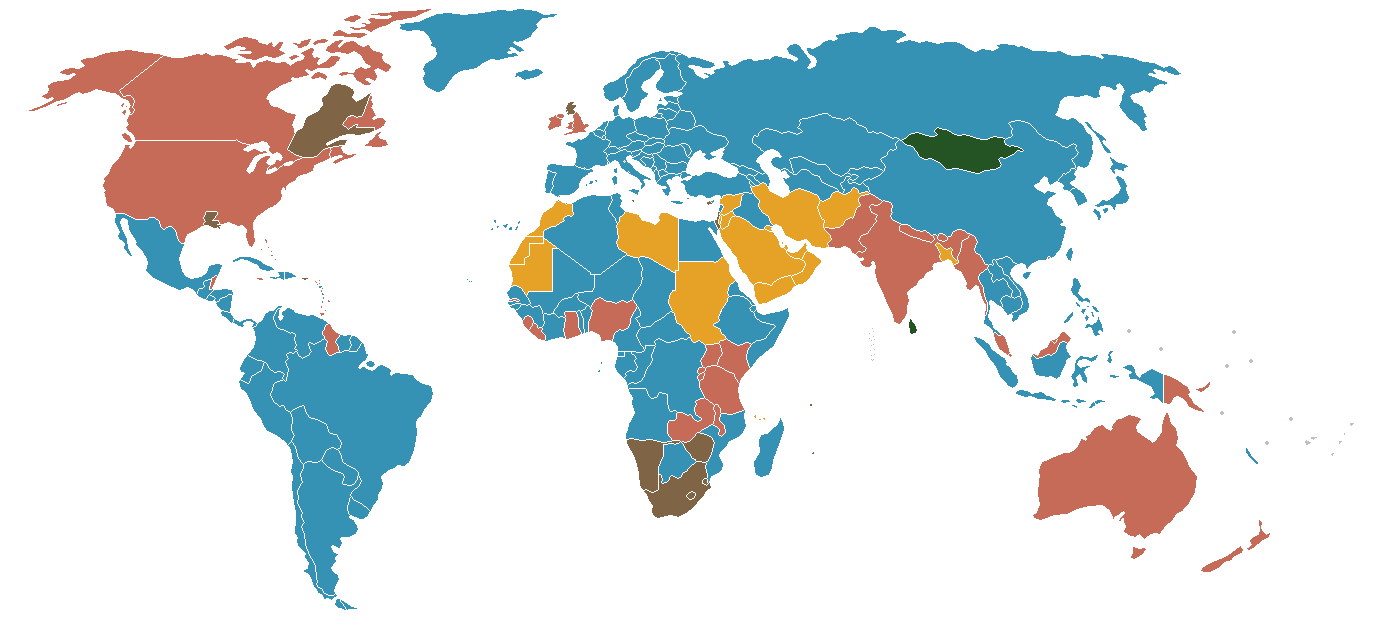
Legal Systems of the World (Common Law Jurisdictions Shown in Pink)

Fourth, the authors’ analysis doesn’t pay any attention to the province of incorporation or the nitty-gritty details of corporate law in each province. The authors say nothing about the evolution of shareholders rights in Canada outside of the Province of Ontario. Each province in Canada has its own securities regulator. In Canada, a company may be incorporated under either federal or provincial legislation.  I’ve  recently been reading extensively about the importance of the fine-grain details of company law in corporate governance.  The law and economics literature (La Porta et al.) strongly argues that strong shareholders rights help to promote the widely-held firm.  It also suggests that shareholder rights are strongest in jurisdictions where the legal system is derived from that of England rather than the legal traditions of continental Europe.[1] Weak shareholders rights (e.g., no right to call an emergency AGM and no right to fire the CEO) help to produce the family-controlled pyramidal firms so common in many civil law jurisdictions. Morck et al. say that this explanation doesn’t hold any water. They say: “If widely held firms become more viable when shareholder rights are stronger, they should have been rare until circa 1960 and then more common. But Canadian shareholder rights were consistently weak up to the 1960s, while diffuse ownership inexorably expanded. Then, in the 1960s, shareholder rights were abruptly strengthened, and widely held firms began to fade away. Changing shareholder rights seem a poor candidate to explain the rise and fall of the widely held firm.” [Italics added by me].

They authors aren’t really talking about Canadian shareholder rights. They are really talking about rights in companies regulated by the Ontario government. Their statements about shareholder rights are based on two secondary sources, both by historian Christopher Armstrong, whose focus was on Ontario. Morck et al. say nothing about how shareholder rights evolved in the civil-law jurisdiction of Quebec or any of the other Canadian provinces in this period. In this section of their chapter, the author appear to forget that Canada is a bijural and bilingual country.

Fifth, the authors say nothing about widening inequalities of income or wealth. I suppose this is understandable, given than they wrote this paper in 2005, before the Occupy Movement had raised the issue of inequality. Today, everyone is talking about inequality. Last week, the cover story in The Economist, a neo-liberal publication was about inequality. Nowadays we are all thinking about the impact of rising inequality. So we need to take trends in inequality into account in thinking about the data presented by Morck et al.

There is certainty data showing that income inequality in Canada has increased since about 1980, although not as dramatically as in the United States or the United Kingdom. Perhaps this provides the best explanation for the trend in share ownership documented by Morck et al.

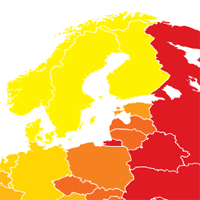
Sixth, neo-mercantilism and social democracy are not synonymous. Some of the least protectionist and least mercantilist societies on the planet are also the most social democratic. The Scandinavian countries also have famously high levels of transparency and very low levels of corruption.

This map is from Transparency International’s 2011 Corruption Perceptions Index. As you can see, the Scandinavian countries are shaded lightly to indicate they are among the least corrupt in the world.


[1] Rafael La Porta & Florencio Lopez-de-Silanes & Andrei Shleifer & Robert W. Vishny, “Law and Finance,” Journal of Political Economy 1998; Thorsten Beck, Aslı Demirgüç-Kunt, and Ross Levine, Law and Finance: Why Does Legal Origin Matter? (Cambridge, Mass: National Bureau of Economic Research, 2002).


Tony Slaven Doctoral Workshop in Business History

23 10 2012

Association of Business Historians

The ABH is holding its second Tony Slaven doctoral training workshop on 27th and 28th June
2013. This is immediately preceding the 2013 ABH Annual Conference at the University of
Central Lancashire and participants will also be welcome to attend the Annual Conference.
This is an excellent opportunity for doctoral students to discuss their work with other research
students in business history-related disciplines in an informal and supportive environment.
Students at any stage of their doctoral career, whether first year or near submitting are
encouraged to attend. In addition to providing new researchers with an opportunity to discuss
their work with other research students in a related discipline, the workshop will also include
a session related to career development.

Business history doctoral work is spread over a large number of departments and institutions
and by bringing students from throughout the UK together for an annual workshop, we hope
to strengthen links between students working on business history and related topics. For the
purposes of the workshop `business history’ is therefore interpreted broadly, and it is
intended that students in areas such as (but not confined to) the history of international trade,
investment, financial history, agricultural history, not for profit organisations, governmentindustry
relations, government policy towards trade and industry, accounting history, social
studies of technology, and labour history will find it of interest. Students undertaking topics
with a significant business history related element but in disciplines other than economic and
business history are therefore also welcome. We would welcome papers from students
researching any era whether, modern, early modern or medieval.

A limited number of Tony Slaven scholarships are available, to contribute towards the travel,
accommodation and registration costs of attending the doctoral workshop and ABH
conference. These will be awarded competitively prior to the workshop.

Students will present for around 20-30 minutes, with roughly the same time for discussion.
Participants would also be expected to act as discussant for one of the other papers being
presented. First year students might with to present an overview of their project, including
research questions and methodology. Those at a more advanced stage of their thesis might
wish to present a draft chapter, or focus on one particular section or aspect of their thesis.

Students interested in attending the workshop should send their application to Dr Sheryllynne
Haggerty, Department of History, School of Humanities, University of Nottingham,
University Park, Nottingham, NG7 2RD. Email sheryllynne.haggerty@nottingham.ac.uk.
The application should be no more than 4 pages: a one-page CV; one page stating names of
the student’s supervisors, the title of their thesis, the university and department where they
are registered, the date of commencement of their thesis registration*; a two page abstract of
their paper.

For full consideration, applications should be submitted prior to 12th April 2013.
*Students should clearly state if they wish to be considered for the Tony Slaven scholarships.
For further information, please contact Sheryllynne Haggerty at the above e-mail address.


French Canada and the American Civil War

19 10 2012

24 October 2012

British Library, London

This lecture by Damien-Claude Bélanger, an author and Assistant Professor of Canadian History at the University of Ottawa, will focus on the effects of the American Civil War on French Canada, how it led to Confederation and why thousands of French Canadians served in the Union forces.  Hosted by the Quebec Government Office in collaboration with the British Library Eccles Centre.
6:30pm to 9pm. Tickets must be booked in advance.


US Election Roundtable at Coventry University

19 10 2012
Open to the Public. No Admission Charge

On Tuesday, 6 November 2012, American voters will make a decision that has momentous implications for the world. On the evening of Monday, 5 November, Coventry University will host a forum at which academic experts on the United States will discuss the recent election campaign and what is at stake for Americans—and the world as whole. We invite you to join us.


This event will start at 7.30pm and shall conclude at 9.00pm. Doors open at 7.00pm. It is taking place in the Alan Berry Building at Coventry University, which is directly opposite the Cathedral.  Members of the audience will have the opportunity to ask questions.


Our three expert speakers are:


Steve Hewitt, Senior Lecturer in American and Canadian Studies, University of Birmingham. Dr Hewitt is an expert on espionage and the War on Terror. His most recent books are: Snitch!: A History of the Modern Intelligence Informer (New York and London: Continuum, 2010) and The British War on Terror: Terrorism and Counterterrorism on the Home Front since 9/11   (New York and London: Continuum, 2008).


Derek William Vallès, PhD candidate in Government, London School of Economics. Derek’s research interests are healthcare, financial reform, social security and taxation. His PhD thesis is on the Patient Protection and Affordable Care Act of 2010, President Obama’s signature piece of healthcare legislation. He previously held fellowships at the American Institute for Economic Research and the People for the American Way Foundation. His website is: http://www.derekvalles.com/


Caroline Page, Senior Lecturer in International Relations, Coventry University. She teaches modules on international relations and US foreign policy. Her publications include: Propaganda and Foreign Policy in the Twentieth Century (London: RoutledgeCurzon, 2005) and US Propaganda During the Vietnam War, 1965-73: Limits of Persuasion (Leicester University Press, 1995).


If you have any questions about this event, please direct them to Dr Andrew Smith, ab0352@coventry.ac.uk


EU Wins Nobel Peace Prize

12 10 2012

The European Union has won the Nobel Peace prize. This was a great decision.

The EU has transformed most of Europe “from a continent of wars to a continent of peace,” Nobel Committee Chairman Thorbjoern Jagland said in announcing the award in Oslo.

The EU has done some amazing things, such as making a Franco-German war unthinkable and facilitating free mobility.

Some people have criticized this decision on the grounds that the EEC failed to prevent the civil wars in the former Yugoslavia in the early 1990s. The criteria for the Peace Prize don’t include perfection, just movement towards world peace. Carter got the prize even though the Camp David accord only covered Israel and Egypt, not the Middle East as a whole. Theodore Roosevelt got the prize for brokering an end to the Russo-Japanese War, even though China was a party to this agreement. So the Yugoslavia criticism doesn’t hold water, especially since Bosnia isn’t part of the EU. It’s pretty clear that EU institutions have advanced 2 of 3 the criteria specified in Nobel’s will: it has promoted “fraternity between nations” (think Erasmus students or the vast number of trucks from all over the EU you see on British roads). It has also caused a reduction in the size of many “standing armies” another goal that Nobel mentioned. There is no doubt that the EU mobility rights have contributed to the end of conscription in France and many other EU countries. Compared to the UN or Mercosur or Nafta.

The only thing that comes close to the EU’s record in promoting peace is the US constitution, which has a reasonably good (but imperfect) record in promoting peace among its constituent member units (which include the 50 states as well as the domestic dependent nations). A comparison of European history since 1957 with the state of Europe in Alfred Nobel’s lifetime indicates why the EU is a very good thing. The EU imposes some annoying rules on member countries, such as the ban on imperial units, but it is a tremendous net benefit both in economic and security terms.


The Eurosceptic newspapers in this country sometimes overlook this.


P.S. It’s ironic, however, that this prize was awarded by a committee in a European country that isn’t part of the EU.


The ROI on Higher Education in Different Countries

11 10 2012

“Students pay much more for a college education in the U.S. than they do in most other countries. But they also get a bigger return on their investment.” That’s the claim of a recent OECD study.

A quick thought about this data: the major costs associated with higher education provision relate to labour. These are bound to be higher in a country where wages and salaries are relatively high. So of course, higher education is going to be more expensive in a rich country than a poor one.


Similarly, the extra income students gain from education is also going to be greater in a country where the baseline of wages for unskilled workers is already pretty high. A more useful metric would be to compare the ratio of university graduate incomes and high school graduate incomes in different countries.

Read more here.


Canadian Business History Workshop

8 10 2012
Invitation for the first Canadian Business History Workshop
 
Dear All,
 
We are pleased to invite you to the first Canadian Business History Workshops, which will feature presentation and discussion of two draft papers (circulated in advance). We hope that these will become regular meetings as part of an attempt to build a closer network among business historians in Canada.
 
The inaugural workshop will be held at the Brantford Campus of Wilfrid Laurier University, 73 George Street, Brantford, Ontario N3T 2Y3 on Friday, 16 November 2012. (For a map, please see: http://tinyurl.com/8kmgjtj).
 
We will start from noon onwards with lunch, which is kindly offered by the Dean’s office. Please make your way to the Carnegie Building, Lower Level, Room 100 for both lunch and sessions.
The schedule is:
 
12:00-1:30 pm            LUNCH
 
1.30-2.30 pm              J. Andrew Ross (University of Guelph), “A Gigantic Hockey Slave Farm”: The Business of Professional Hockey Player Recruitment, 1930-1967
 
2.30-3.00 pm              Coffee break
 
3.00-4.00 pm              Todd Stubbs and Reg Horne (Lakehead University, Orillia Campus), Early Canadian Auto Entrepreneurs and the Failure of the ‘All-Canadian’ Car Revisited
 
To facilitate planning please confirm attendance by sending an email to Rob Kristofferson (rkristofferson@wlu.ca). Even if you cannot attend, but are interested in future events and news about Canadian business history, please join the Canadian Business History Group / Groupe d’historiens des affaires canadiens, accessible at https://groups.google.com/d/forum/cbh-hac


Trends in Higher Education in the UK and the US

4 10 2012

A good friend of mine from the United States, observing the British higher-education scene, noted that, whereas the United States had taken 30 years to make its system more market-oriented, it was taking England only two.

That’s from a piece in The Chronicle of Higher Education about the recent movement in the direction of a more market-oriented higher education system in the United Kingdom. It’s fascinating reading. Check it out here.


A Few Quick Thoughts About the Presidential Debate

4 10 2012

I don’t normally comment on electoral politics, since it isn’t my main area of expertise. However, I just want to put Obama’s performance in last night’s debate into some historical context. The general consensus is that his debating skills have deteriorated since 2008. There is, however, a fairly large body of historical research to show that presidential debates simply don’t have much on an impact on voter intentions.  Consider the data in this chart, which was recently posted on the excellent MonkeyCage political science blog.

U.S. presidential debates rarely change a candidate’s polling figures by more than the margin of error. With the possible exception of 2000, no debate since 1988 has had more than a trivial impact on voting intentions. (Support for Gore fell during the debate period in 2000, but there were other things going on in the campaign and the economy that may explain it_.

The only presidential debates that have really mattered were 1960, when the election was a very close and Kennedy’s superior performance helped to swing many female voters, and 1976, when Gerald Ford discredited himself by stating that the Soviet Union did not dominate the countries of Eastern Europe, a misstatement that made him seem ill-informed about foreign affairs.

The debates have produced a few memorable moments. Many readers will remember the 1988 debate when Michael Dukakis was flustered by a (really stupid) question by CNN anchorman Bernard Shaw.  Shaw asked Dukakis, who opposed capital punishment, whether he would continue to be against it if his own wife was raped and murdered. Dukakis, who obviously hadn’t prepared for this question, gave a poor response.

However, the  whole incident had little impact on how folks actually voted. The vice-presidential debates, which have been even more entertaining, have had an even smaller impact on voting intentions.