Cinzia Lorandini
The Financing of SMEs and the Role of Knowledge: Some Evidence from Trentino-South Tyrol, 1950s-1990s
Rachel Maines
Engineering Standards as Collaborative Projects: Asbestos in the Table of Clearances
Shigehiro Nishimura
International Patent Control and Transfer of Knowledge: The United States and Japan before World War II
Laura D. Phillips
The Economics and Ideology of American Fair Trade: Louis Brandeis and Open Price Associations, 1911-1919
Lydia Redman
Knowledge Is Power? Victorian and Edwardian Employers and the Rhetoric of Expertise
Daniel L. Rust
Lambert-St. Louis International Airport’s Alternative W-lW: A Case Study
Minoru Shimamoto
R&D Strategy and Knowledge Creation in Japanese Chemical Firms, 1980-2010
Hiroshi Shimizu and Satoshi Kudo
How Well Does Knowledge Travel? The Transition from Energy to Commercial Application of Laser Diode Fabrication Technology
Marc Stern
Real or Rogue Charity? Private Health Clubs vs. the YMCA, 1970-2010
Jeffrey L. Sturchio and Louis Galambos
The German Connection: Merck and the Flow of Knowledge from Germany to the United States, 1880-1930
Ross Thomson
Did the Telegraph Lead Electrification? Industry and Science in American Innovation
Robert E. Wright
Governance and the Success of U.S. Community Banks, 1790-2010: Mutual Savings Banks, Local Commercial Banks, and the Merchants (National) Bank of New Bedford, Massachusetts
Alexia Yates
Developing Knowledge, the Knowledge of Development: Real Estate Speculators and Brokers in Late Nineteenth-Century Paris
BEH On-Line is the successor publication of the BHC’s Business and Economic History, print collections of papers from the annual meetings. The complete run of Business and Economic History, 1962-1999, can be accessed from the BHC website, and includes a cumulative index as well. See http://www.thebhc.org/publications/BEHprint/aboutbeh.html
An increasing number of academic lectures are now available online through iTunes University. I’ve sampled more than a few of them and find that listening to the lectures of others gives me ideas about how to increase the effectiveness of my own communication with students.
Downloadable lectures have been around for a few years now, so we now have charts similar to those used to record music sales. Some fascinating patterns have appeared. According to the BBC, the lectures of the Open University, which was designed to extend access to higher education for non-traditional students, are more popular than those of prestige institutions such as Oxford, Cambridge, and Harvard.
There is no official league table of university download totals, but Apple says that other highly popular providers are Oxford, Yale, Massachusetts Institute of Technology, University of California Berkeley and South Florida.
Neither the Open University nor the University of South Florida are terribly famous, yet their podcasts are roughly as popular as those of famous universities.
The conclusion I would draw from this is that while technology will doubtless cause a major shake up in the higher education sector in the coming years, it is too easy to predict which universities will be the beneficiaries of this. Old and prestigious universities such as Oxford and Harvard clearly have an advantage in the downloadable lecture market, but it is possible for a relative obscure university to develop a worldwide reputation for high quality lectures.
About a month ago, economics blogger Matt Yglesias speculated that technology might destroy the traditional university. His reasoning is this: if everyone can listen to academic superstars lecture online, why bother listen to an average academic at your local average university? As he put it, universities might be the new newspapers. He was referring to the financial problems faced by many newspapers in medium-sized cities in the United States, which have lost readers to the New York Times etc and to bloggers such as himself thanks to the advent of the internet. Twenty years ago, you were pretty much forced to read the Boise newspaper if you lived in Idaho. Today you can read the best newspapers in the world thanks to the internet. Read more here.
I’m not entirely convinced by Yglesias’s argument. Watching a lecture online just isn’t the same as being in a lecture theatre where you can put your hand up and ask a question. I know that some academics are worried about technological unemployment (i.e., that the podcasting of lectures might put most of us out of our jobs). Those of us who have studied economic history know all about the weavers who once made a good income working on hand looms, before industrialization.
Perhaps the solution here is to shift from emphasizing lecturing to focusing on the sorts of activities where you absolutely need someone in the flesh and blood (e.g., leading seminar discussions, one-on-one meetings with students in offices, and, of course, actual academic research). These are things that can’t ever be outsourced to a superstar lecturer on YouTube.
Journal of Historical Research in Marketing has published a special theme issue on the history of marketing in Canada. Here are the abstracts of the articles. The bibliography will be very useful to scholars, I bet.
Monday, August 08, 2011, 5:00:00 PM | Barry E.C. Boothman
Abstract
Purpose – The purpose of this paper is to appraise the spread of supermarkets in Canada during the mid-twentieth century. It examines how corporate chains altered the organization of distribution, reconfigured shopping experiences, and promised gains realized through greater business volume. Design/methodology/approach – The paper utilizes a mix of primary and secondary sources to compare how companies responded to opportunities for mass marketing that emerged in the post-war era. The perspective is grounded in the theory of managerial capitalism, which was originally elaborated by Alfred D. Chandler. Findings – The paper highlights how mass food retailing in Canada shared some attributes normally associated with the rise of managerial capitalism, but it also reviews the variations and highlights the difficulties faced by firms despite their jump to giant size. In particular, it stresses how the leading companies did not build secure positions. Research limitations/implications – Corporate archives in Canadian retailing either did not survive or remain inaccessible. The essay therefore draws upon a mix of sources including company publications and government investigations. The paper highlights the inability of companies to realize permanent gains commonly associated with large firm size or mass retailing. It stresses that there was no one “model” of corporate development. Originality/value – This paper illustrates the complexities associated with developing strategic leadership in retailing and therefore should be valuable to educators and practitioners.
Monday, August 08, 2011, 5:00:00 PM | Dale Miller
Abstract
Purpose – The purpose of this paper is to examine how one Canadian retailer developed customer confidence in the interwar years when the automobile was in its infancy. The emphasis is on products and product information in the mail-order catalogue. Design/methodology/approach – The research design strategy draws on a longitudinal case study research using primary archival data collection and analysis. Findings – In the 1930s, the firm used multiple approaches to respond to opportunities and challenges and to reassure customers through product assortment, guarantees, branding, quality assurance and support services. Generating an extensive mail-order business occurred in tandem with the opening of stores, and together these approaches created rapid growth. In the early years, the emphasis was on maintenance, repairs and some augmentation through accessories. From the mid-to late 1930s, with easing economic conditions, the focus shifts from automobile functionality to include roles for leisure and sport products, and the injunction to engage with the Canadian countryside. Originality/value – The paper uses original historical research to contribute a new way of understanding how retailers developed customer confidence. The study contributes to knowledge about Canadian retailing in the interwar years, and the means for building customer confidence using a range of marketing techniques. For researchers, the study demonstrates a further example of the efficacy of using archival materials to explore marketing questions.
Monday, August 08, 2011, 5:00:00 PM | Paul D. Earl
Abstract
Purpose – The purpose of this paper is to examine the meaning and content of the term “orderly marketing” as it was adopted by Western Canadian farm leaders in the 1920s, and to determine whether the expected results of “orderly marketing”, as they were enunciated by farm leaders, were met. Design/methodology/approach – The paper examines the critique that farm leaders and Wheat Pool officials levelled against the open market, and the way they posited “orderly marketing” as a solution to their perceived problems. Using contemporary data on wheat prices and movements, it analyzes the content of orderly marketing, and the results of its implementation by the Pools. Findings – The paper finds that “orderly marketing” was primarily a campaign slogan, that the problems it was alleged to address did not exist, and that its implementation by the Wheat Pools did not yield the results that the farm leaders had promised. The paper acknowledges however, the significant accomplishments of these organizations, and postulates that the concept of orderly marketing resonates with aspects of Canadian culture and helps to explain why grain marketing in the USA and Canada evolved so differently. Originality/value – The agricultural cooperative movement in Western Canada has been the subject of a great deal of historical research, most of it positive. However, there are no recently published qualitative studies of the history of the term, nor in-depth quantitative analyses of the economic results achieved by the Wheat Pools during the 1920s that compare with the contents of this paper.
Purpose – The purpose of this paper is to assess, by providing a case study of flagship brand, Rothmans, why Rothmans, Benson & Hedges Inc. (RBH), Canada’s second largest tobacco firm, has historically lost ground to industry leader, Imperial Tobacco Canada Limited (ITL). Design/methodology/approach – The paper utilizes data from internal corporate documents, made public from litigation, as well as trade press and promotional materials accessed from advertising archives. More specifically, the tobacco industry documents reviewed were made public from two Canadian trials: the 1989 Canadian trial to decide the constitutionality of the Tobacco Products Control Act; and the 2002 Quebec Superior Court trial in which Canada’s three major tobacco firms challenged the constitutionality of the Tobacco Act. Findings – The declining market share of Rothmans is largely explained by the brand’s inability to appeal to the highly valued youth or “health concerned” segments. RBH failed to link the cigarette brand consistently with segment-appropriate imagery during a time when legislation prompted a shift in promotional spending by the Canadian tobacco industry towards sponsorship communications. Unlike ITL, RBH failed to capitalize on the potential of sponsorship to contemporize the Rothmans brand and make it relevant to younger smokers. Moreover, RBH was slow to introduce a so-called “light” line extension, which would appeal to existing smokers with health concerns. Originality/value – This study should particularly interest researchers and practitioners interested in marketing and public policy, in which insight is provided about unique challenges to marketing in Canada on the basis of government regulation.
Monday, August 08, 2011, 5:00:00 PM | Robert Mittelman, Leighann C. Neilson
Abstract
Purpose – Child sponsorship programs have been accused of representing children in the developing world in a manner described as “development porn”. The purpose of this paper is to take an historical approach to investigating the use of advertising techniques by Plan Canada, a subsidiary of one of the oldest and largest child sponsorship-based non-governmental development agencies, Plan International, during the 1970s. This time period represents an important era in international development and a time of significant change in the charitable giving and advertising industries in Canada. Design/methodology/approach – The authors conduct a content analysis on an archival collection of 468 print advertisements from the 1970s. Findings – A description of the “typical” Plan Canada fund-raising ad is presented and shown to be different, in several aspects, from other advertisements of the time period. It was determined that Plan Canada’s advertisement did not cross the delicate line between showing the hardship and realities of life in the developing world for these children and what became known as “development porn”. Originality/value – There has been little previous research which focuses specifically on the design of charity advertisements. This paper presents a historically contextualized description of such ads, providing a baseline for further research. It also raises important questions regarding the portrayal of the “other” in marketing communications and the extent to which aid agencies must go to attract the attention of potential donors.
Monday, August 08, 2011, 5:00:00 PM | Stanley J. Shapiro, Robert D. Tamilia
Abstract
Purpose – The purpose of this paper is to provide a briefly annotated bibliography of some 200 items that together constitute a “select list” of the available academic literature on the history of Canadian marketing from the seventeenth century to the beginning of Second World War. Design/methodology/approach – After all the available academic literature on Canadian marketing the authors could uncover was examined, the most relevant, interesting, and accessible material was identified and annotated. In addition, all of the literature considered in any way pertinent was added to a more complete bibliography available on the CHARM web site. Findings – Though existing Canadian business and economic history texts and courses tend to pay far more attention to other topics, there is a rich and varied literature on the history of Canadian marketing. Research limitations/implications – No selections are included from either archival sources or the popular press nor are unpublished theses or dissertations cited. Originality/value – This appears to be the first annotated bibliography on the history of Canadian marketing ever to have been compiled and published.
Kwasi Kwarteng (born 1975) is a historian and British Conservative MP. His career includes work as a financial analyst for a hedge fund, getting a PhD in history, and standing as a parliamentary candidate. Very impressive. You can read Linda Colley’s review of his most recent book, Ghosts of Empire: Britain’s Legacies in the Modern World , here. You can watch Kwarteng talk about his book below.
In Ghosts of Empire, Kwarteng challenges the neo-conservative view that the British Empire. Historian Niall Ferguson rose to prominence in the noughties by making a robust defence of British and American imperialism. Indeed, he called on the United States to behave even more like the old British Empire and occupy Iraq on a permanent basis. According to Ferguson, the British Empire helped to spread capitalism and liberal values throughout the whole world and was, therefore, a Very Good Thing. More than any other single individual Ferguson has contributed to the rehabilitation of the British Empire’s reputation in recent years, an intellectual project that helped to legitimate present-day Anglo-American imperialism.
In sharp contrast, Kwarteng’s interpretation of the imperial past is far more nuanced and much more negative: he shows that the British left many toxic legacies in different corners of the world. Although less stridently anti-imperial than some of the books published by historians on the left of the political spectrum, it is utterly different from Ferguson’s neo-conservative view.
Here is the really interesting thing. Kwarteng’s political sympathies are very much with the free-market right of the British Conservative Party. Among other things, he has advocated putting tolls on every road in the UK on the grounds that free roads are the “last vestige of socialism.” He appears to share much of Ferguson’s free-market philosophy. Yet his attitude to Empire is radically different.
We are witnessing the start of an interesting debate within the political right on the lessons to be derived from the history of imperialism.
I suspect that most academic historians will be more sympathetic to Kwarteng’s interpretation that than of Ferguson, since it is more nuanced, more grounded in the primary sources, and more consistent with the historiographic mainstream. One wonders whether his ideas will be as influential with the general public as those of Ferguson.
Kevin Tennent, a lecturer at the York School of Management, has posted something on his blog that got me thinking about the recent turn towards historical analysis by people in business and management schools.
Scholars in business schools draw on a wide variety of disciplines and paradigms in understanding how firms operate in the real world. This eclecticism is, of course, a good thing, since no single discipline can provide all the answers. However, I think that it is safe to say that until recently, business history occupied a much smaller place in the toolkit of business scholars than economics.
There has, recently, been a shift away from the largely deductive approach of the economists towards the inductive approach favoured by historians. Indeed, narrative approaches to studying organisations have been adopted by scholars in business schools. (See here).
Dr Tennent has given us an update on the business history papers presented at the recent British Academy of Management conference. Tennent and John Wilson, Professor of Strategy at the University of Liverpool Management School, have been able to revive the Business and Management History track within the BAM Conference at Aston Business School. Dr Tennent informs us that there will be a sessions devoted to business history at the next BAM Conference, which will be held in Cardiff in 2012.
The BAM conference just concluded featured a session on international retail history, organised by Professor Andrew Godley from Henley Business School at Reading. Nicholas Alexander of Lancaster University Management School made an enjoyable contribution contrasting ‘globalisation era 1’ (i.e. 1870-1929) international retailers to ‘globalisation era 2’ (1970-present) retailers. There was also a workshop on the use of archives by management scholars. This session was introduced by Dr Terry Gourvish in his guise as Chairman of the Business Archives Council, who introduced the concept of archival research and some of its advantages first.
It’s nice to see that management scholars, at least those in Britain, are turning to historical analysis. Aside from the hard work by Tennent and John Wilson in organizing these sessions, one can attribute the growing interest in business schools in the discipline with the increasingly evident problems in the discipline of economics. The serious limitations of neoclassical economics have been highlighted by the 2008 crisis.
As Roger Backhouse showed in his recent book The Puzzle of Modern Economics: Science or Ideology? the financial crisis has caused many academics to question the descriptive and predictive value of economics and the assumptions (e.g., the rational actor theory) under which mainstream economists operate.
There is a widespread feeling that the science of economics has lost its way. Its current orthodoxy is a belated child of nineteenth century Utilitarianism. It is trapped in a narrow and misleading view of human nature which regards human beings as individuals motivated by material self-interest and making rational choices with a wide range of good information normally available to them. Most economists seem to believe the aim of economic policy should be to promote growth through the medium of markets – which by nature are self-correcting, tend towards equilibrium, assess risk better than any government agency, and ensure the most efficient allocation of resources.
The current economic crisis has cast fundamental doubt on all of this. It has shown that markets do not assess risk well, do not allocate resources efficiently and, when unrestrained, tend towards the unstable disequilibrium of boom and bust. But where are we to look for more reliable guidelines? George Akerlof and Robert Shiller have accused economists of ignoring the vital input of ‘animal spirits’, a term they borrow from John Maynard Keynes. Similarly, according to the Financial Times, at a recent gathering of leading economists in Cambridge to discuss the failures of economics, ‘One of the central conclusions was that economists and market traders alike need to devote far more time to human psychology, rather than just the raw economic numbers beloved of many policy wonks.’
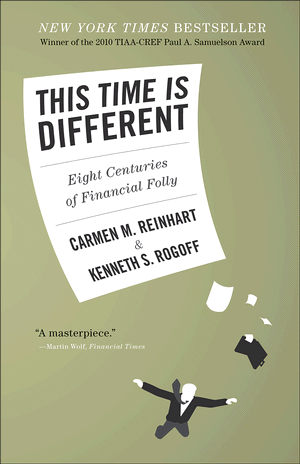
It should be noted that books on business-historical topics, such as The Match King: Ivar Kreuger and the Financial Scandal of the Century: Ivan Kreuger and the Financial Scandal of the Century and This Time It’s Different have also sold well in the aftermath of the GFC. There is a real appetite for historical analysis out there.
Disciplines such as history and psychology may be able to fill the vacuums in both academic and popular discourse that economics has vacated. It remains to be seen, however, whether this trend continues.
On Monday, 19 September CBC-TV will be broadcasting a docudrama about Confederation. I’m really sorry that I won’t be able to see the broadcast, but I’m looking forward to seeing it on DVD at Christmas time, when I shall be near a Region 1 DVD player. In 2009, I answered some historical questions for the producers, some of which related to the scene in the trailer (below).
Here is the press release for the TV show.
John A: Birth of a Country is all about the passionate struggle between Macdonald, leader of the Conservative Party, and the fiercely determined Brown, leader of the opposition, which would become the Liberal Party. Both of the men spurred on by hugely different visions for the fututre of Canada… and a deep hatred for each other. Set in the mid 1800s – ’56-’64 to be precise – the English of Upper Canada (now Ontario) and the French of Lower Canada (now Quebec) battle it out to see who will change the shape of Canada’s future, with the United States keeping a close eye on the situation, ready to pounce. The fascinating struggle between these two centres on many of the key questions that still asked in Canada today: What does the military mean to us? How do we define sovereignty? What responsibility do we have to each other? “I like the fact that Canada is an independent nation,” said producer and six time Gemini winner Bernie Zukerman, “and it gives me great pleasure to tell the stories of Canada and celebrate the remarkable men who made this country possible.”
Personally, I think that it is wonderful that a documentary about Confederation is being broadcast. This is a wonderful opportunity to educate the Canadian public about the origins of their system of government! I would imagine it would encourage people to read the second volume of Richard Gwyn’s new biography of Macdonald.
P.S. The producers have posted a behind-the-scenes video diary about the actual production on YouTube. Here are the clips.
To mark Constitution Day, Time published an article by Richard Stengel on the cult of the constitution (i.e., the tendency of Americans to ask what the drafters of the 1787 constitution would think of particular modern issues).
In the United States, it has long been customary for politicians and constitutional lawyers to appeal to the “original intent” of the “Founding Fathers”. This mode of argument overlooks the enormous technological, economic, and above all ethical gulf separating the eighteenth-century slave-owners who wrote the American constitution from twenty-first century Americans. Moreover, it rests on the dubious notion that people ought to be restricted by agreements made by the dead, a theory that was demolished quite effectively by Thomas Paine, the pamphleteer whose writings helped to inspire the American Revolution in the first place. In 1792, Paine wrote:
It requires but a very small glance of thought to perceive that although laws made in one generation often continue in force through succeeding generations, yet they continue to derive their force from the consent of the living. A law not repealed continues in force, not because it cannot be repealed, but because it is not repealed; and the non-repealing passes for consent.
But Mr. Burke’s clauses have not even this qualification in their favour. They become null, by attempting to become immortal. The nature of them precludes consent. They destroy the right which they might have, by grounding it on a right which they cannot have. Immortal power is not a human right, and therefore cannot be a right of Parliament. The Parliament of 1688 might as well have passed an act to have authorised themselves to live for ever, as to make their authority live for ever. All, therefore, that can be said of those clauses is that they are a formality of words, of as much import as if those who used them had addressed a congratulation to themselves, and in the oriental style of antiquity had said: O Parliament, live for ever!
The circumstances of the world are continually changing, and the opinions of men change also; and as government is for the living, and not for the dead, it is the living only that has any right in it. That which may be thought right and found convenient in one age may be thought wrong and found inconvenient in another. In such cases, who is to decide, the living or the dead?
As someone who grew up under Canada’s monarchical regime, I’ve always been somewhat amused by the argument that present-day Americans are morally obliged to defer to the values embodied in an 18th century constitutional document. After all, the American Revolutionaries saw fit to overthrow the 17th century system of government they had inherited. Anyway, it is nice to see that the spirit of Thomas Paine lives on in the United States. Stengel mercilessly and correctly skewers the contemporary American cult of the constitution in a piece that begins as follows:
Here are a few things the framers did not know about: World War II. DNA. Sexting. Airplanes. The atom. Television. Medicare. Collateralized debt obligations. The germ theory of disease. Miniskirts. The internal combustion engine. Computers. Antibiotics. Lady Gaga.
People on the right and left constantly ask what the framers would say about some event that is happening today. What would the framers say about whether the drones over Libya constitute a violation of Article I, Section 8, which gives Congress the power to declare war? Well, since George Washington didn’t even dream that man could fly, much less use a global-positioning satellite to aim a missile, it’s hard to say what he would think…
You can read more of this article here.
[1] Jack N. Rakove. Original Meanings: Politics and Ideas in the Making of the Constitution (New York : Alfred A. Knopf, 1996), 3-23.
The bicentennial of the War of 1812 is rapidly approaching. I’m moderately interested in social memory (i.e., how people who aren’t trained historians think about historical events and how the memory of events are manipulated for present-day political purposes), so I’m going to make some predictions about how the anniversary of the war will be exploited by political commentators and governments in Britain, the United States, English-speaking Canada, and Quebec. Historians should rarely make predictions, but in this case I think that I can prognosticate with a reasonable degree of confidence.
Americans like to believe that their country won a clear victory in the War of 1812. In reality, the terms of the peace were ambiguous enough to allow both sides to claim victory. I suspect that much of the American media coverage of the War and its various anniversaries over the next four years will emphasize that the United States was the clear victor.
In Britain, the War of 1812 is rarely discussed, in part because it is overshadowed by the Napoleonic Wars, and because paying attention to this particular conflict would be inconsistent with the idea of the “special relationship”, the powerful myth that Britain and the United States ought to be close and permanent allies. (Note that I am using the word myth in its original, non-pejorative sense). Of course, not all British people buy into this myth, as was illustrated most vividly during the Iraq War, when Tony Blair was routinely denounced as George Bush’s poodle.
Some British people view the special relationship in terms of a strictly bilateral relationship between the UK and the US, which leaves the smaller English-speaking countries out of the analysis. In other cases, the idea of the Anglo-American special relationship is wrapped up in a modernized version of the pan-Anglo-Saxon “race patriotism” once articulated by Andrew Carnegie and Winston Churchill. Carnegie, it will be remembered, was an enthusiastic supporter of the idea of an Anglo-Saxon union embracing the United States and the British Empire. Churchill played with similar themes of Anglo-Saxon unity and superiority in his writings on the history of the English-speaking peoples. Since 2000, the idea of Anglo-Saxon unity has been revived by such authors as Niall Ferguson, Andrew Roberts and Walter Russell Mead. Mead, who is one of the most influential foreign policy intellectuals in the United States, makes just one brief reference to the War of 1812 is his massive tome God and Gold: Britain, America, and the Making of the Modern World. Mead’s narative emphasizes cooperation between the two Anglo-Saxon powers. Similarly, Roberts downplays the disagreements within the Anglo-Saxon family of nations in his recent and quasi-Churchillian history of the English-speaking peoples.
In any event, I suspect that most coverage of the War of 1812’s anniversary in the British press will emphasize that the War of 1812 took place in a very distant time and that today Britain and America are best friends. The stress will be placed on the special relationship and two centuries of Anglo-American friendship.
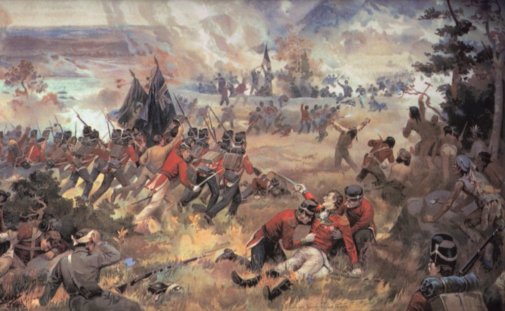
I suspect that the French language media in Canada will pay little attention to the war’s anniversary. The Rebellions of 1837-8 against British rule loom larger in the collective memory of French Canadians than the War of 1812, which saw French- and English-speakers unite in resisting the American invaders, as was seen at the Battle of Châteauguay River.
Let me turn now to English-speaking Canada. The War of 1812 has a very important place in the social memory of [English] Canadian nationalists because it saw the invasion of what is now Canada by the United States. In the popular Canadian narrative, the invading Americans had their asses kicked by the brave Canadian citizen-soldiers, who then went on to burn the White House. When I taught at a Canadian university I was told repeatedly by students that Canadian troops from Toronto had destroyed the White House. At times when anti-Americanism has flared up in Canada (e.g., during the Vietnam and Iraq Wars), the memory of the War of 1812 has been invoked by nationalists in [English-speaking] Canada. Although academic historians do not subscribe to this view, it has considerable purchase with the general population. The late Pierre Berton’s works on the War of 1812 continue to sell well in Canada, seven years after the death of their author.
For history professors, teaching about the War of 1812 involves a certain amount of re-education. Typically, it requires pointing out the many anachronistic concepts have crept into the popular discourse surrounding this war. For instance, I always began my lecture on the War of 1812 by quoting media reactions to a recent survey that showed that many Canadians did not know that “Canada defeated the United States in the War of 1812”. Typically, media pundits deplored this evidence of Canadians` ignorance about their own past. I then asked my students to explain what was wrong with this survey. Usually a bright student pointed out that Canada did not exist as a nation state at the time in question: territories that later became part of Canada were among the battlegrounds on which British and American forces fought. It is therefore a mistake to speak of a Canadian victory in this war. I then want on to explain that most farmers and other people living in Upper Canada and other borderland regions were emphatically neutral during this conflict between London and Washington. I also pointed out that many of them were New Englanders who had moved to Upper Canada in search of land and really didn’t care one way or the other about which flag they lived under. I suggested in lecture that the Upper Canadians’ laregly indifferent attitude to the outcome of the war is consistent with the behaviour of peasants people in conflict zones around the world today: most peasants in Kashmir don”t really care whether they live under the flag of India or Pakistan.
A recent article in the Globe and Mail spoke about the planning for the bicentennial events. Historian Jack Granatstein was quoted— he is very concerned that the commemoration might degenerate into anti-Americanism. This is a legitimate concern, but I also expect that the social memory of this War will be twisted or spun a variety of directions.
I predict that spin placed on the War of 1812 by the Canadian media will follow a limited number of tropes or narratives, or which anti-Americanism is but one. I have listed these tropes below in ascending order of intellectual respectability.
1) a) Crude Anti-Americanism. This trope goes as follows: Canadians in 1812 united to fight the evil American invaders. Canadians in 1812 were anti-American, ergo, present-day Canadians should also be hostile to the United States, American mass culture, etc.
b) The memory of the War of 1812 will also be used to try to justify the mindlessly pro-American attitude typical of much of the political right in present-day Canada. We will hear it said that the War of 1812 shows that Canada and the United States have always been and always should be allies. In other words, present-day Canada should therefore support American wars in Iraq, Afghanistan, or wherever the next country might be. This somewhat absurd historical argument in favour of a pro-American position has been articulated in the past.
For instance, in the second week of April 2003, a group called “Canadians for Bush” organized a rally at Queenston, the site of a famous War of 1812 battle where an American invasion force was defeated. The battlefield is now marked by a monument to Sir Isaac Brock, who died there. The people at this rally celebrated the fact that Americans、Britons, and Canadians had fought alongside each other in the War of 1812 and about that it was unfortunate that Canada did not participate in the Anglo-American invasion of Iraq.
Brock Monument
It appears that the organizers of this rally were operating on the assumption that the American, Canadian, and British troops at Queenston had been fighting against some common enemy, perhaps the Germans or someone like that. I thought that this rally especially curious, as there are blue plaques at the site clearly explaining that the British regulars and colonial militiamen were fighting the forces of the United States. This rally was organized by an American-educated pastor who had previously been a candidate for the Christian Heritage Party and who had once protested against the dinosaur skeletons in the Royal Ontario Museum. The really interesting thing about this rally was that it was attended by Tim Hudak, now the PC leader in Ontario, and Jim Flaherty, who is now Canada’s Minister of Finance, which shows that the idea of Anglo-Saxon race patriotism has infected relatively mainstream politicians as well.
2) We can also expect to hear something about North American/Western moral superiority and two centuries of peace. Some commentators will use the anniversary of the war to point out that there hasn’t been a major war along the Canadian-American border since 1815. In the 1920s and 1930s, it was common for commentators in North American to contrast the rationality and peacefulness of the North Americans with the warlike disposition of the Europeans, who were constantly slaughtering each other over Alsace-Lorraine and other territories. Of course, the proponents of this self-congratulatory view were overlooking all sorts of evidence of the warlike propensities of North Americans, such as the Civil War in the United States, the massacres of Native Americans, or the now notorious plans by Canadian army officers to invade the United States. Nevertheless, some good scholarly research on why Canada and the United States had refrained from fighting each other for so long was produced in the 1920s and 1930s, much of it sponsored by the Carnegie Endowment for International Peace. Anyway, we can expect to see this sort of rhetoric revived as 1812 approaches, although I suspect that North America will no longer be contrasted with Europe. After all, the French and the Germans now share a currency and have turned their swords into ploughshares. I suspect that the pacific North Americans of the last two centuries will be contrasted by commentators with the inherently violent and warlike races of the Middle East.
3) The role of the First Nations in the conflict will also be highlighted, quite legitimately. We will also hear it said that without the support of First Nations warriors, Canada would have been conquered by the United States. Of course, we won’t hear much about the subsequent transformation of the First Nations from warriors to wards of the state, nor will the public hear about how the Canadian and American governments subsequently cooperated in assaulting the sovereignty of native peoples. I predict that the following Heritage Minute video will be broadcast ad naseum in the next few years.
4) a) The proponents of the theory of the democratic peace will also use the War of 1812 bicentennial as a vehicle for disseminating their pet theory. They will be able to do so since the long period of peace between the United States and the British Empire that followed the end of this conflict is an important data point that supports this theory of international relations. Democratic peace theory holds that democracies never go to war with each other and that as nations move from non-democratic regimes (e.g., monarchy or dictatorship or rule by tiny elites) to universal suffrage, the chances of wars breaking out will decrease. Establishing when exactly Britain and the United States became truly democratic countries is tricky, especially since a large proportion of US households (i.e., Blacks) were massively underrepresented in legislatures until the 1960s, but it is clear that both countries experienced democratization in the decades after 1815. Subsequently, there were diplomatic incidents in which Britian and the United States pulled back from the brink of war. There are serious limits to the explanatory power of democratic peace theory, but it is a theory that deserves to be exposed to the wider public. One hopes that the references to “two centuries of peace” one will hear in the media in the next few years will be coupled with some attempt to provide an explanation for why there has been peace between the United States and the British Empire. There will probably be references in the press to a book called The North American Democratic Peace: Absence of War and Security Institutions Building in Canadians-U.S. Relations (1867-1958) by Stéphane Roussel.
b) The theory of the commercial peace is one of the major rivals of the theory of the democratic peace. Basically, it holds that the way to prevent countries from going to war with their neighbours is to promote economic integration. In other words, cross-border trade promotes peace. The history of Canada-US relations would appear to support this idea. The merits of the theory of the commercial peace were debated a few months ago in the Cato Unbound forum devoted to explain why today’s world is relatively peaceful. There are, of course, problems with the theory of the commercial peace. After all, Germany and Britain went to war in 1914 despite being each other’s best customers. Nevertheless, it is a theory that is worth being aired in newspapers. One expects that Erik Garztze and the other proponents of commercial peace theory will use the 1812 bicentennial as a teachable moment for communicating their ideas to the general public. The journalist Tom Friedman has tried to popularize this theory with his famous quip that no two countries with McDonald’s restaurants have ever gone to war with each other. This statement was true until 2008, when Russia and Georgia fought a very brief war.
In a recent post on the Marginal Revolution blog, economist Tyler Cowen made an interesting historical parallel comparing anti-tax sentiment in the present-day United States with that in the Qing, the last of China’s dynasties. The Qing dynasty lasted from 1844 until 1911. The Tea Party in the United States thinks that it would be unacceptable to raise any taxes on anyone at any point in the future and that dealing with the deficit must be met 100% by spending cuts, regardless of their impact on the social programmes, military capability, or infrastructure of the United States.
Tea Party Rally
In 1712, the Kangxi Emperor permanently froze the land tax, the major source of the state’s revenue. This decree bound his descendants to keep this tax low. According to historian William T. Rowe, this decision had the long-term effect of weakening the Chinese state. Future emperors had less money to spend on maintaining infrastructure (e.g., canals), paying civil servants, or fighting off foreigners (e.g., British merchants selling opium).
Cowen’s post was inspired by something he read in Strange Parallels: Volume 2, Mainland Mirrors: Europe, Japan, China, South Asia, and the Islands: Southeast Asia in Global Context, c.800-1830 (Studies in Comparative World History) (9780521530361):
I’m going to reproduce Cowen’s post below in italics, putting Cowen’s original quote from Lieberman in red font. Then I’ll discuss it.
…best estimates are that during the second half of the 18th century imperial taxes captured only 5 percent of the gross national product in China, compared to 12-15 percent in Russia, 9-13 percent of national commodity production in France, and 16-24 percent of national commodity production in Britain. During the 18th century in Russia, moreover, corvees and military service were far more onerous than in China, where most labor services had been commuted. If we consider that under the Northern Song in 1080, imperial revenue averaged about 13 percent of national income, and under the Ming in 1550 6-8 percent, we find some support for Skinner’s thesis that percentage of the surplus captured in imperial taxes shrank steadily relative to the share retained by local systems.
Victor Lieberman presents “philosophical commitment to low taxes” as a major reason for this pattern. Further explanations are a lack of foreign threats and that the Chinese state did not always have the capacity to collect much more.
I was intrigued by Cowen`s post for several reasons.
First, I teach a lecture class on global history and one of our central themes is the role of institutions in the Great Divergence. The Great Divergence is one of the central research questions in global history and the debate about it boils down to this: 500 years ago, Western civilization was at roughly the same economic and technological level as the other great civilizations of Eurasia. In fact, there is evidence that Chinese civilization was somewhat more advanced that that of Europe in terms of technology and economic development. So why did the Industrial Revolution take place in Western Europe and not some other part of the world, such as China? Why did Western Europeans and their descendants dominate the world in the 19th and 20th centuries? Why did they have the advanced technology? Why were the British able to set up a colony in Hong Kong? Why wasn’t it the other way around? Why didn’t the Chinese set up a colony on, say, the Isle of Wight? Taxes may be a big part of the explanation. We’ve long known that the greater willingness of upper-class Britons to pay taxes was one of reasons why Britain was able to defeat France is the great conflicts of the 18th and early 19th centuries. It appears that this pattern was replicated on a somewhat grander, civilizational level.
Second, there is some literature on the history of laissez-faire ideology in China. The present-day libertarian mantra that small government is good and taxes are bad has parallels in ancient Chinese economic thought. Moreover, as Christian Gerlach of LSE has argued, the Chinese doctrine of laissez-faire was imported by European philosophers in the 17th and 18th centuries when all things Chinese were fashionable in Europe.
The paper “discusses the impact and context of the most cited articles in two premier journals in the field of business history in the 1990s (Business History Review, BHR (USA) and Business History, BH (UK). Why do scholars refer to these articles? The obvious and most simple answer is that the most cited articles are interesting. But what makes a business history article an interesting one? Is it the topic of the paper, the findings, the method applied, the theoretical framework, the scholar him/herself and his or her reputation, the high quality of the article in general, or perhaps the controversial nature of the subject or the argumentative style the scholar has decided to use?
In earlier research we found that the use of even simple quantitative tools increased the citation counts in BHR, with the more quantitatively sophisticated articles receiving more citations, but not in BH. There were certain differences in the subject matter between the two journals that might be linked to the divergence of European and American academic discourses. Overall, the interdisciplinary appeal of articles that used quantitative methods, when used in conjunction with theory, was higher.
The basic lesson to be taken from this paper is that if a business historian wants his or her research to be read and cited by many people, a business historian needs to engage with theory and use plenty of quantitative data. It matters much less which country or time period you are studying. To my mind, however, the really interesting thing is the difference between American and European academic culture identified by the authors.
One further thought– why wasn’t Enterprise and Society, the business history journal published by Oxford Journals, included in this analysis? In 2010, the impact factor of the Business History Review (founded in 1926) was 0.648. The impact factor for Business History (founded 1958) was 0.427. Enterprise and Society‘s impact factor in 2010 was somewhat lower, at 0.306, but this journal is much younger, having been founded in 2000. Perhaps EandS should be included in future versions of this paper.
The authors are: Heli Valtonen, University of Jyväskylä; Academy of Finland, Finland ; Jari Ojala, University of Jyväskylä, Finland; Jari Eloranta Appalachian State University, USA.






 The Past Speaks