Ta-Nehisi Coates: The Civil War Was Not a Tragedy

2 05 2011

Battle of Antietam, 1862; Confederate dead

Ta-Nehisi Coates, an African-American columnist at the Atlantic, dislikes it when people say that the American Civil War was a “tragedy”. Coates was writing in response to a recent podcast about the Civil War from the “Backstory” American history website.

Coates writes:

The conceded common ground was the following–The Civil War was a tragedy. I think that ground is generally accepted by almost everyone, and for good reasons. Six hundred thousand people died in the Civil War, a shocking figure which doesn’t really capture the toll that this sort of violence took on the country at large. And yet when I think about the Civil War I don’t feel sad at all. To be honest, I feel positively fucking giddy.

His blog post gets us thinking about qualifies as a historical tragedy. Some might dismiss this as a purely semantic issue, but I think there is actually a pretty fundamental question that needs to be asked.


Canadian Elections, 1891 and 1911

2 05 2011

There is an election in Canada today, so I thought I would post some items related to historical Canadian elections.

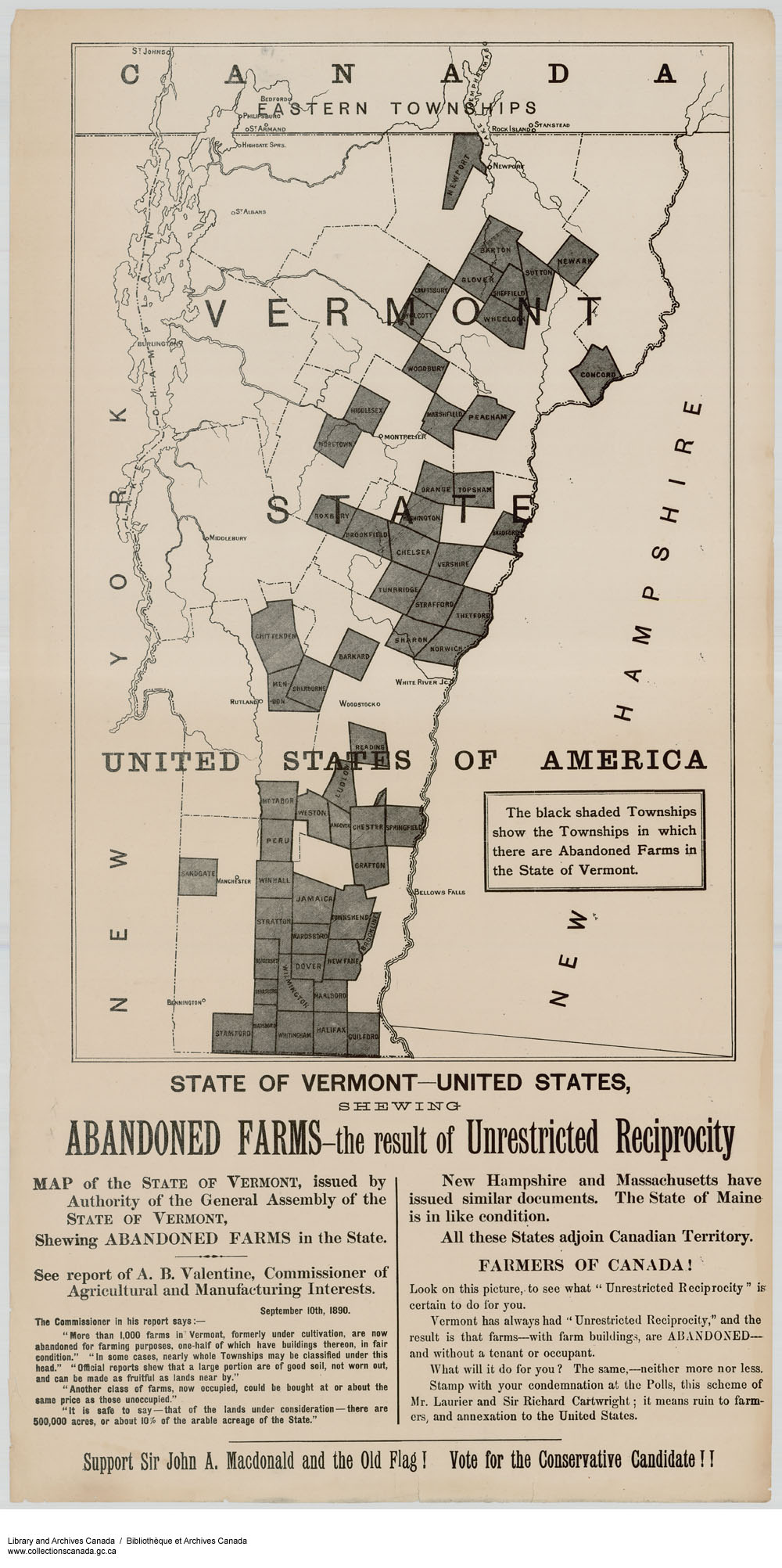
This poster was issued by the Conservatives in 1891 to warn people of the dangers of voting in favour of Laurier and Unrestricted Reciprocity (i.e., free trade) with the United States.

https://i0.wp.com/data2.archives.ca/e/e431/e010756969-v8.jpg

The poster below dates from 1911, when the main issue in the election was Reciprocity with the United States. Taft was the US President at the time.

His Master's Voice


Happy May Day

1 05 2011

There is a good summary of the history of May Day here and here.


Survey – What are the Benefits of a PhD in History?

28 04 2011

In December 2010 the Institute of Historical Research conducted an online survey asking the simple question ‘What are the benefits of a PhD in History?’

Here are the results.


Alexander J. Field on the 1930s

27 04 2011

Alexander J. Field, an economist at Santa Clara University, is the author of “A Great Leap Forward”. This book argues that the terrible years of the Great Depression actually set the stage for the post-World War II boom. Field was recently interviewed for Economix blog at the NYT.

Field states that:
In 1941, the U.S. economy produced almost 40 percent more output than it had in 1929, with virtually no increase in labor hours or private-sector capital input. Almost all of the increase in output per hour is attributable to technological and organizational advance. As I said in the title of my 2003 American Economic Review article, the 1930s were indeed the most technologically progressive decade of the century.

DC-3


Field basically argues that a number of technological innovations emerged in the 1930s that paved the way for the tremendous prosperity of the post-war period. He writes that notable new products included the DC-3, a plane introduced in 1936 that revolutionized commercial aviation; television, developed with venture capital funding during the 1930s and rolled out at the 1939-40 World’s Fair; and nylon stockings, introduced in May 1940, with 63 million pair sold the first year.

Aviation and television were, of course, industries that employed vast numbers of people during the post-war boom. The US Route system of paved two-line highways, which was built mostly in the 1930s, also contributed to post-war prosperity, although it was eventually replaced by the Interstate Highway System, which had an even more revolutionary economic impact.

Route 66

Field does not deny that there was tremendous misery in the 1930s or that unemployment was sky-high. Rather, he argues that the foundations for post-war prosperity were laid during this period of terrible suffering.

Field’s book shows why we should feel some gratitude to the folks who lived through the Depression. Of course, many of us already felt gratitude to that generation, since that age cohort also fought the Second World War on our behalf.


Beaverbrook’s House Sold to Investors

27 04 2011

Home of Legendary Canadian Financier Lord Beaverbrook

Cherkley Court, the country home of the Lord Beaverbook, has been sold to investors. See here.  To see the property’s location on Google Maps, click here.

Max Aitken, 1st Baron Beaverbrook, (1879-1964) was an Anglo-Canadian business tycoon, newspaper publisher, and politician. He bought the house in 1910.


Scary Sentences About Higher Education

27 04 2011

“If current trends continue, the Department of Education estimates that by 2014 there will be more administrators than instructors at American four-year nonprofit colleges.”

“Since 1978, the price of tuition at US colleges has increased over 900 percent, 650 points above inflation.”

“If you’re enrolled in four college classes right now, you have a pretty good chance that one of the four will be taught by someone who has earned a doctorate and whose teaching, scholarship, and service to the profession has undergone the intensive peer scrutiny associated with the tenure system. In your other three classes, however, you are likely to be taught by someone who has started a degree but not finished it… This is not an improvement; fewer than forty years ago, when the explosive growth in tuition began, these proportions were reversed.”
“In addition to the billions colleges have spent on advertising, sports programs, campus aesthetics, and marketable luxuries, they’ve benefited from a public discourse that depicts higher education as an unmitigated social good.”

Read more here.


The Changing Justification for Tax Cuts: From Efficiency to Fairness

24 04 2011

The Changing Justification for Tax Cuts: From Efficiency to Fairness

Matt Yglesias has posted something interesting about the ongoing debate in the US about tax cuts for the wealthy. He notes that people on the right of the political spectrum traditionally defended tax cuts for the wealthy on the grounds that they would spur economic growth. In effect, they were asking voters to trade the principle of economic equality away for higher economic growth. The famous trickle-down metaphor said that the best way to help the poor was to invigorate the economy with a bit more inequality.

There is more and more empirical evidence that the Reaganite formula for economic growth (cut taxes and regulation) doesn’t actually work. Much of this evidence, I am proud to say, has come from the discipline of economic history. There is a great deal of evidence of the suggest that there isn’t necessarily at trade-off between growth and equity. For most of human history, massive inequality was a fact of life: there was a huge gap between the peasants and the wealthy in Elizabethan England, but this sure didn’t produce modern economic growth. Even during the British Industrial Revolution, the rate of economic growth in Britian was pretty slow by today’s standard, less than 1% per year. Really rapid economic growth only became common in the Western world at roughly the time these countries were starting to create welfare states. In the 30 years after 1945, when there was consensus in favour of fairly generous welfare states in the United States and other Western countries, economic growth was rapid. Income tax rates for the wealthy were sky high in 1950s America, but this didn’t keep the US from enjoying tremendous prosperity. Presumably there was enough inequality in Eisenhower’s America to encourage the Don Drapers of the world to work hard.  The period since the late 1970s, which saw the erosion of the redistributive state in most Western countries (as represented by Reaganite tax cuts, Thatcher, Prop 13, etc.), also saw a slow-down in economic growth and technological progress.

So now that the economic argument in favour of cutting taxes for the rich has been shot to hell, the right’s justification for tax cuts has shifted from economic efficiency to equity: the right is now arguing in favour of tax cuts for the wealthy on the grounds of fairness.

Yglesias summarizing the new argument coming from right-wing figures such as Arthur Brooks, Yglesias writes:

It’s not that higher taxes on our Galtian Overlords would backfire and make us worse off. It’s just that it would be immoral of us to ask them to pay more taxes even if doing so would, in fact, improve overall human welfare.

Two days ago, the Center for American Progress in DC in hosted a public forum with leading economists and policy experts to discuss the proposition that a focus on equity and economic inclusion is necessary to grow the U.S. economy. In the companion framing paper titled “Is Equity the Superior Growth Model?” authors Sarah Treuhaft from PolicyLink and David Madland from American Progress discuss how economic growth has been slower and less broadly shared over the past several decades, leaving more and more families, even entire communities, behind with diminishing prospects for catching up. Let me quote from their excellent paper at length:

Economists have long considered the relationship between equity and economic growth. Early economic thinking was heavily shaped by Simon Kuznets, a Nobel Prizewinning economist, who argued that economic inequality increases while a country is developing, and then after a certain average income is attained, inequality begins to decrease. His explanation for this pattern was that shifting from agriculture to industry caused inequality to rise but further growth led to increased economic opportunities as well as equalizing government policies.

Kuznets Curve

Kuznets Curve


This argument and its graphical representation—the inverted U-shaped Kuznets curve—suggested that inequity was good for economic growth, at least at the early stages of development. Alas, overwhelming evidence has accumulated that development does not quite work like Kuznets predicted.

Many countries have not become first less and then more equal as they develop. Instead, there have been a wide variety of development patterns, with some countries growing relatively equally at all points in their development and others growing unequally at all points in their development, and still others vacillating between relatively equal and unequal. South Korea, for example, has seen relatively equitable economic growth throughout the past 60 years as it developed from a relatively poor country to a middle-upper-income country. Brazil, historically one of the most inequitable countries, has in very recent years begun to grow more equally. And in the United States, from the 1940s to the 1970s, economic growth went with increased equality, but since the 1970s, additional growth has reduced equity.

The real world has not conformed to the Kuznets curve. Still, the idea that there is a tradeoff between growth and equity did not just go away. Instead, it remained influential, even for advanced countries, though the hypothesis was largely untested.

Read more here.

Update: Krugman has commented on Yglesias’s post. See here also.


What is an entrepreneur?

23 04 2011

This is a question I’ve been thinking about recently, as I’m working on the intro to an edited collection on historical Canadian entrepreneurs. It is, therefore, with some interest that I saw that the blog Organizations and Markets had a recent post about competing definitions of “entrepreneurship”. See here.

So what exactly is an entrepreneur? That question has been debated extensively by generations of academics. It has been raised again by the essays in The Invention of Enterprise: Entrepreneurship from Ancient Mesopotamia to Modern Times (ed. David S. Landes, Joel Mokyr, and William J. Baumol, Princeton, 2010). Reviewers of this collection of essays have noted that the contributing authors could not agree on a common working definition of “entrepreneur”, which means that their edited collection lacks coherence.

Mansel Blackford of Ohio State University had this to say of the book:

Moreover, the authors of the essays follow no commonly agreed-upon definition of entrepreneurship, making cross-national comparisons difficult.  Most of the authors bow in the direction of Joseph Schumpeter, but essentially fail to adopt a common approach.  I was disappointed that little effort was expended by the editors or authors to reach comparisons across boundaries of time or space.  For the most part, this study consists of fairly traditional national studies.  Ironically for a book about innovation, this volume contains little in the way of conceptual breakthroughs.  The authors might well have explored more fully innovative business networks and industrial districts that often spread across national lines, especially in modern times.

I suppose that it would be difficult to come up with a common definition, given the diverse disciplinary backgrounds of the scholars who contributed to this book.

Here is the Table of Contents of the Invention of Enterprise book:

Foreword by Carl J. Schramm vii Preface: The Entrepreneur in History by William J. Baumol ix
Acknowledgments by William J. Baumol and Robert J. Strom xv

Introduction: Global Enterprise and Industrial Performance: An Overview by David S. Landes 1
Chapter 1: Entrepreneurs: From the Near Eastern Takeoff to the Roman Collapse by Michael Hudson 8
Chapter 2: Neo-Babylonian Entrepreneurs Cornelia Wunsch 40
Chapter 3: The Scale of Entrepreneurship in Middle Eastern History: Inhibitive Roles of Islamic Institutions by Timur Kuran 62
Chapter 4: Entrepreneurs and Entrepreneurship in Medieval Europe by James M. Murray 88
Chapter 5: Tawney’s Century, 1540-1640: The Roots of Modern Capitalist Entrepreneurship by John Munro 107
Chapter 6: The Golden Age of the Dutch Republic Oscar Gelderblom 156

Chapter 7: Entrepreneurship and the Industrial Revolution in Britain by Joel Mokyr 183
Chapter 8: Entrepreneurship in Britain, 1830-1900 by Mark Casson and Andrew Godley 211
Chapter 9: History of Entrepreneurship: Britain, 1900-2000 by Andrew Godley and Mark Casson 243
Chapter 10: History of Entrepreneurship: Germany after 1815 by Ulrich Wengenroth 273
Chapter 11: Entrepreneurship in France by Michel Hau 305

Chapter 12: Entrepreneurship in the Antebellum United States by Louis P. Cain 331
Chapter 13: Entrepreneurship in the United States, 1865-1920 by Naomi R. Lamoreaux 367
Chapter 14: Entrepreneurship in the United States, 1920-2000 by Margaret B. W. Graham 401
Chapter 15: An Examination of the Supply of Financial Credit to Entrepreneurs in Colonial India by Susan Wolcott 443
Chapter 16: Chinese Entrepreneurship since Its Late Imperial Period by Wellington K. K. Chan 469
Chapter 17: Entrepreneurship in Pre-World War II Japan: The Role and Logic of the Zaibatsu by Seiichiro Yonekura and Hiroshi Shimizu 501
Chapter 18: “Useful Knowledge” of Entrepreneurship: Some Implications of the History by William J. Baumol and Robert J. Strom 527

I will say, parenthetically, that one of the most astonishing things about the Invention of Enterprise volume is, in my view, the absence of an essay of female entrepreneurship. One might get the impression from the ToC that half the human race did not exist. The decision not to include a chapter on cultural and legal barriers to female entrepreneurship is shocking, given that we know that the failure to exploit the full potential of the female half of the population is one of the things that can keep a country poor. Women, including those who are given micro-credit loans, are the key to economic development.


Canadian Economic History 1500-1929, Image Bleg

22 04 2011

This blog post is a bleg. “To bleg” is to write a blog entry for the sole purpose of asking for something, usually information.

I am currently co-editing a collection on entrepreneurship in Canada from 1500 to 1929. (More details of this book will appear here later, so watch this space). Anyway, it is now time for us to select images that speak to the major themes of the book. Our book aims to capture the historical experience of Canadian entrepreneurship in all of its diversity and considers French-speaking entrepreneurs, women entrepreneurs, Aboriginal business, and commerce in all regions of what is now Canada.

The overarching theme of the book is the challenge of doing business in an ethnically, linguistically, and geographically diverse country. There is general agreement that economic actors have a preference for doing business with members of their own cultural group. Economic historians have documented a widespread tendency to buy from members of one’s own imagined community rather than from individuals who are part of an imagined “Other”.  Doing business in a homogenous society (e.g., present-day Japan or Sweden a few decades ago) is relatively easy because homogeneity tends to promote trust.  (Perkins, 1999; Evans et. al., 2011; Akerlof and Kranton , 2010; Magee and Thompson, 2010). Canada is one of the world’s most diverse countries and diversity has been a fact of life in Canadian business for centuries. Despite the challenges  of tremendous cultural, ethnic, and racial diversity, Canada has developed a prosperous economy. So how were they able to overcome cr0ss-cultural barriers? Or, more to the point, were they able to overcome cultural barriers? Did clannishness impede economic exchange between different groups? These are the sorts of issues the book will, hopefully, raise in the minds of readers.

In any event, we need high-quality images that speak to these themes. A picture can be worth a thousand words. The pictures can be colour paintings or high resolution black-and-white photographs.

The challenge for us is that there are so many digitized images available. To do a thorough search of the National Archives, the  McCord Museum, the BC Archives, Glenbow, the City of Toronto archives, plus hundreds of smaller archives, would take a long time.  We wouldn`t want to miss a really superb picture that had been digitized by one of the more minor archives. That’s why we are asking for your help!

We’ve identified a number of images (see below), but there might be more suitable images out there. If you know of any such pictures, please let us know in the comments section of this blog post. I will post any images you suggest to us, along with your name, below. If we use your suggestion in the book, you will be acknowledged there.

Anyway, here are the images we have already. They are arranged in rough chronological order, i.e., the order they will appear in the book.

So far, we have a shortage of images showing Aboriginals and women engaged in commerce. There are also precious few images of commerce in New France: the surviving paintings and drawings from New France are biased towards military subjects (e.g., sketches of fortresses or portraits of army officers). We also need more images from west of the Lakehead.

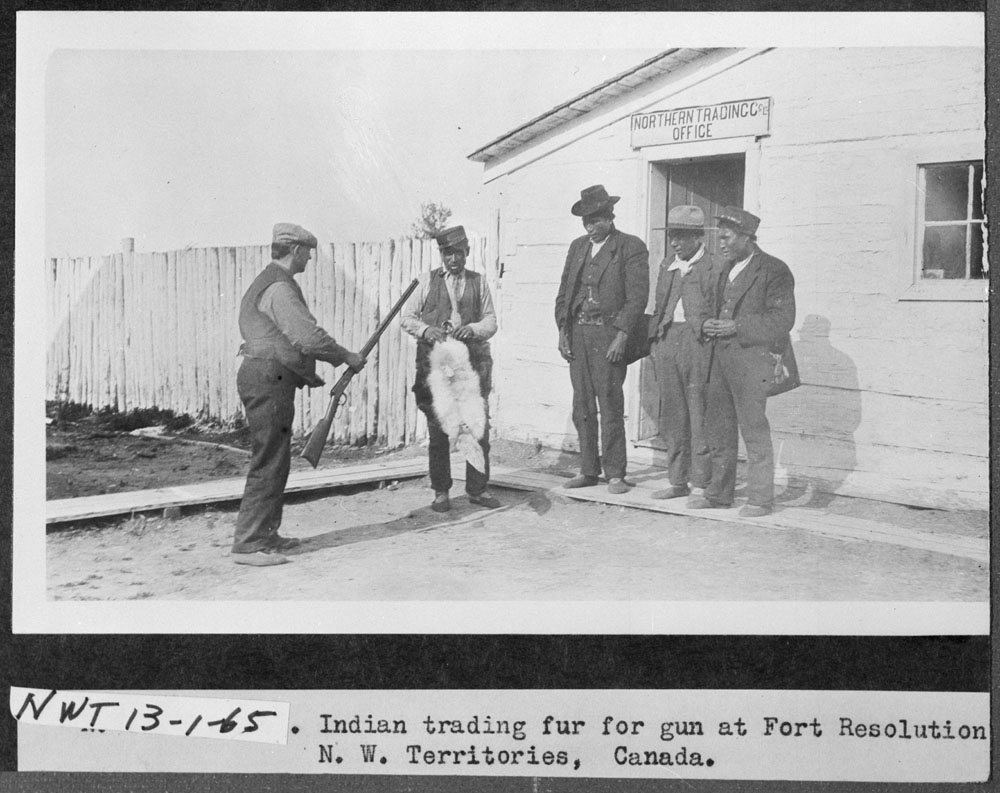
``Indian trading fur for a gun.`` An obviously staged photo from the 1920s. We need a better image of First Nations people engaged in the fur trade.

Scene showing a large Hudson's Bay Company freight canoe passing a waterfall, presumably on the French River. The passengers in the canoe may be the artist and her husband, Edward Hopkins, secretary to the Governor of the Hudson's Bay Company.

Gaspé, Québec

Painting shows both sailing ships and a steamship in the harbour of Gaspé, Québec, with the buildings of the Robin and Le Boutilier trading companies in the background. Painting dates from 1871.Painting shows both sailing ships and a steamship in the harbour of Gaspé, Québec, with the buildings of the Robin and Le Boutilier trading companies in the background: ‘A typical Robin establishment would have consisted of a general store, a house where the manager lived, a warehouse for dry fish, and a stage (or landing platform) where the fish were brought ashore. There would also have been a large area on or near the beach where flakes for drying the fish had been erected. These were waist-high frames on which the split cod would be spread out to dry. Paspébiac was the headquarters. The Robin and Le Boutillier installations on the barachois resembled a small town. Each company had a warehouse four or five storeys high, a general store, a wharf, a carpenter shop, a sail loft, a blacksmith shop and forge, a cooper shop for making barrels, offices, a cook-house, a boarding house for the apprentices, and numerous other buildings besides the large area given over to the flakes and the drying fish.

Port of Halifax, 1830s, Unknown Artist. Note the mixture of RN and commercial ships in the picture.

Toronto Rolling Mills, 1864

Toronto Rolling Mills, 1864

A great painting of Canada`s Industrial Revolution. Painting of the Toronto Rolling Mills, an iron rails factory founded in 1857 by a group of businessmen led by railway magnate Sir Casimir Gzowski. At that time, it was the largest iron mill in Canada and the largest manufacturer in Toronto. The introduction of steel rails led to its closure in 1873.

This image is available from the Toronto Public Library under reference identifier JRR 1059

Great Western Railway Station, Toronto 1867

Great Western Railway Station, Toronto 1867

This image is available from the Archives of Ontario under the item reference codeF 4436-0-0-0-19

Montreal Harbour, 1872

This image is available from the McCord Museum under the access number MP-0000.1452.53

British Columbia “toothpicks“, Montreal, QC, 1892

Eaton's Dinner, 1919

Complimentary dinner tendered by Sir John Eaton, King Edward Hotel. (Related to the golden jubilee of the Eaton’s department store chain?) John Craig Eaton is seated at the table to the left, closest to the photographer.1919

Source: City of Toronto Archive

Board at the Toronto Stock Exchange, February 1910.

Board at the Toronto Stock Exchange, 1910

This image is available from the City of Toronto Archives, listed under the archival citation Fonds 1244, Item 144.

Jewish Butchery

A butcher shop sign in "the Ward", the original centre of Toronto's Jewish community. The sign, in Yiddish, identifies the butcher as a "Shechat", or ritual slaughterer. The sign also indicates that the Shechat is a Russian Jew.

A butcher shop sign in “the Ward”, the original centre of Toronto’s Jewish community. The sign, in Yiddish, identifies the butcher as a “Shechat”, or ritual slaughterer. The sign also indicates that the Shechat is a Russian Jew.

Toronto's Financial District, 1930

Toronto's Financial District, 1930

Source: City of Toronto Archive

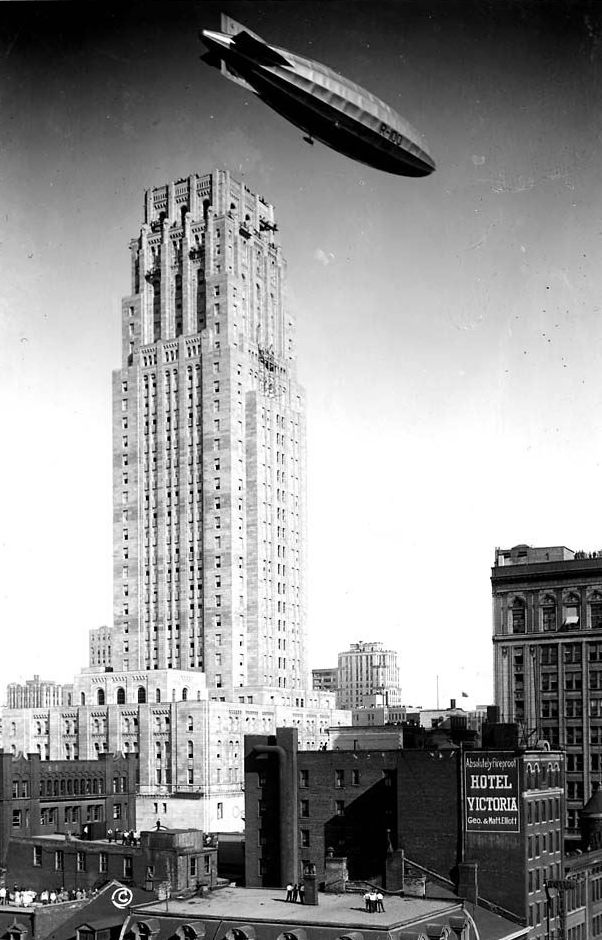
Picture description: His Majesty’s Airship R-100, over the Canadian Bank of Commerce, the tallest building in the British Empire (Toronto, Canada), 11 August 1930

Our caption: This photo shows Toronto’s financial district at the start of the Great Depression. The large building underneath the airship is the Canadian Bank of Commerce, then the tallest building in the British Empire The 1929 Stock Market Crash marked the beginning of a new era in Canadian capitalism, one characterized by much more state intervention in the economy. It also saw Toronto eclipse Montreal as Canada’s undisputed financial capital.

This superb photo will be the final image of the book.