The New York Times reports that we can expect to see a slew of new movies about Abraham Lincoln this year, which is the 150th anniversary of the start of the Civil War.
The first of the films to be released, The Conspirator, will appear in April.
The New York Times reports that we can expect to see a slew of new movies about Abraham Lincoln this year, which is the 150th anniversary of the start of the Civil War.
The first of the films to be released, The Conspirator, will appear in April.
2010 was the year that collaborative manuscript transcription finally caught on, according to a recent blog post by Ken Brumfield.
Brumfield states that:
Probably the biggest news this year was TranscribeBentham, a project at University College London to crowdsource the transcription of Jeremy Bentham’s papers. This involved the development of Transcription Desk, a MediaWiki-based tool which is slated to be released under an open-source license. The team of volunteers had transcribed 737 pages of very difficult handwriting when I last consulted the Benthamometer. The Bentham team has done more than any other transcription tool to publicize the field — explaining their work on their blog, reaching out through the media (including articles in the Chronicle of Higher Education and the New York Times), and even highlighting other transcription projects on Melissa Terras’s blog.
I agree that Transcribe Bentham was the big digital humanities news story of 2010.
The Lynton R. Wilson Institute for Canadian History at McMaster University in conjunction with the Department of History and Faculty of Humanities is pleased to announce two L. R. Wilson postdoctoral fellowships in Canadian history.
The fellowships will be awarded to candidates able to contribute to the mission of the Wilson Institute. The Institute has as its mission the rethinking of Canadian History within a globalization framework. This perspective involves studying the ways in which Canadians have contributed to and been influenced by transnational or supranational phenomena such as international migration, Diaspora politics, religious movements, changing conceptions of human rights, gender and civil society, popular culture, epidemics, wars, and global finance and trade, to take just a few examples.
Scholars interested in engaging with the mandate of the Institute are invited to apply. The fellowship is open to junior scholars who have received their PhD no earlier than 1 January 2009 or who are scheduled to receive their PhD by 1 June 2011. The two-year appointment to the Institute for Canadian History begins on 1 July 2011 and carries a stipend of $45,500 plus benefits. The fellow will receive $5,000 for research or publication expenses and be eligible to apply for additional travel, research or publication funds from the Wilson Institute.
Each fellow will pursue her/his own research and publishing agenda, teach one one-term course, and contribute to the research and outreach activities of the Institute.
Completed applications must include a cover letter, CV, a sample of scholarly writing, and two (2) letters of reference, including one from the dissertation advisor. In the covering letter, which should not exceed 1500 words, all applicants must discuss the ways in which they will engage the research mission of the institute, as well as their research and publishing plans while holding the fellowship. Those plans can include preparing the dissertation for publication.
Electronic applications and letters of reference will be accepted. An applicant for any of the advertised positions at the Wilson Institute will be considered for all positions for which she or he is eligible. Only one complete application to the Wilson Institute is necessary. All complete applications received before 18 March 2011 will be assured of consideration. Send to Debbie Lobban, Administrative Assistant, Wilson Institute for Canadian History, Chester New Hall 619, McMaster University, 1280 Main Street West, Hamilton, Ontario, Canada L8S 4L9. wilsonch@mcmaster.ca .
McMaster University is strongly committed to employment equity within its community, and to recruiting a diverse faculty and staff. The University encourages applications from all qualified candidates including women, members of visible minorities, Aboriginal persons, members of sexual minorities and persons with disabilities
This is from a piece that was sent to me today. It is most outrageous paragraph I have read in a long time:
The system of journal editing now existing in our field virtually forces academics to become prostitutes: they sell themselves for money (and a good living). Unlike prostitutes who sell their bodies for money (Edlund and
Korn 2002), academics sell their soul to conform to the will of others, the referees and editors, in order to get one advantage, namely publication. Most persons refusing to prostitute themselves and to follow the demands of the system are not academics: They cannot enter, or have to leave, academia because they fail to publish. Their integrity survives, but the persons disappear as academics. This paper discusses the process forcing persons wanting to pursue a university career to act as intellectual prostitutes (Section II). Intellectual or academic prostitution is defined here as acting against one’s convictions in order to get a reward.
Read more here. The author is Bruno S. Frey, a Swiss economist.
Description: The Education, Audiovisual and Culture Executive Agency invites applications for transatlantic exchange partnerships under its EU-Canada programme for cooperation in higher education, training and youth. Funding supports joint study or training programmes allowing transatlantic exchanges between European and Canadian education institutions, and the development and implementation of dual or joint degree programmes. Higher education institutions and vocational education and training institutions established in one of the EU member states may apply. Each project must have one lead institution in the EU and one lead institution in Canada. The consortium must be comprised of at least four institutions in total – two from the EU and two from Canada. There is also a requirement that the institutions have to be from two different EU member states and two different Canadian provinces/territories.
The budget for this call is 1.546 million euros and each project may request up to 428,000 euros over four years. OJ 2010/C 323/08. EACEA/37/10.
Closing date: 31 Mar 11
Deadline information: This call is repeated once a year.
Award type: Institutional development, Travel for research purposes, Directed grants to institutions, research groups etc, Networking/collaboration
Award amount max: €428,000
Award budget total: €1,546,000
Website: http://eacea.ec.europa.eu/extcoop/canada/2010/index_en.htm
Application form:
Contact
———————————————-
EACEA, EU-Canada call 2011, Avenue du Bourget 1, BOUR 02/17, 1140 Brussels
Disciplines
———————————————-
Training & Development, Higher Education, Educational Planning & Policy, International Planning & Policy, International Cultural Exchange, Politics and International Studies (RAE Unit 39), Social Policy and Administration (RAE Unit 40), Social Work (RAE Unit 41), Sociology (RAE Unit 42)
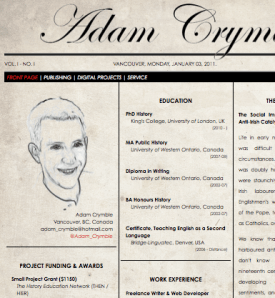
That is the boast that Adam Crymble makes on his digital public history. His claim is not that the actual achievements recorded in his CV are better than those of other people, but rather that his actual CV is of a more attractive design. In effect, he is arguing that job applicants use Photoshop and other editing software to produce better-looking, visual attractive CVs rather that will stand out in a pile. The average CV in 2011 looks pretty much like typewriter age CV.
Over at the Business History blog, management expert Dr Kevin Tennent has posted some thoughts on the demise of EMI. Tennent, who teaches strategy at the business school of the Open University, brings his insights as a business historian into play in his analysis of the problems of EMI. His post contextualizes the current situation of the company in its overall history.
EMI’s long-term decline was typical of the protracted death of many British companies, and came about as a consequence of mismanagement. EMI, which stands for Electric and Musical Industries, was founded in 1931 as the result of a merger between the Columbia and Gramophone companies, following a collapse in the gramophone market during the great depression. The company started to move into growth industries in this period, such as radio and TV manufacture as well as transmission equipment, indeed effectively inventing the 425 line television system originally adopted by the BBC. EMI also diversified into radar and defence electronics during the WW2.
For more, see here.
The M6 Business History workshop is designed to allow business historians living near(ish) the M6 motorway to meet and exchange ideas. I thought I would bring your attention to their forthcoming workshop on “Historical Approaches to Organisational and Institutional Change”. It will be held at Aston University in Birmingham.
Thursday 16 February 2011
Main Building Room G8 (East wing)
Programme
12.45 -1.00pm Registration (Main Building, Lower Foyer near reception )
1-2pm Sandwich lunch
2-2.45pm Simon Mollan (Durham) – “South Africa versus the United Kingdom: double taxation, organizational change and the Union Corporation in the 1950s and 1960s”
2.45-3.30pm Koji Yamamoto (St. Andrews) – “Distrust, Innovation, and Public Service: ‘Projecting’ in Seventeenth- and Early Eighteenth-Century England”
3.30-4pm Coffee break
4-4.45pm Andrew Popp (Liverpool) – “History’s Wild Play: G.L.S. Shackle, Decision and Business History”
4.45-5pm Final comments & end of workshop
Business historians deal with cases of growth and decline of individual firms, industries, countries or regions, as well as its causes and consequences. This workshop will offer a forum for scholars who are interested in the process of transition and adaptation that takes place in organisations and their institutional environments. These themes underpin a variety of historical investigations of enterprises and economies, and are equally relevant to business and management studies. Papers are welcome on any time period, area or context, both from established scholars and (post-) doctoral researchers.
The M6 Business History Workshop is run by Dr Stephanie Decker (s.decker@aston.ac.uk).
Adam Crymble has posted a very thoughtful piece about indexing and the extent to which historians can determine whether contemporaries were interested in a particular issue. This is a question of major important for digital humanities scholars interested in quantitative discourse analysis.
His post begins as follows:
Today, gauging the general pulse of what people are saying or talking about or reading is fairly easy. Twitter’s “Trending Topics” are one of many methods for seeing what people are interested in right now. Others include a scan of the top stories in today’s newspapers, or a comparison of today’s blog posts by keyword.
In the post, Crymble talks about the Gentleman’s Magazine, an 18th century London publication. Using the index to the magazine, he did a work frequency count to see what sorts of subjects it covered. (see image below)

John Bull's Mind
He concludes:
By applying my historical knowledge of Britain during this era, my distant reading of the Gentleman’s Magazine suggests to me the following conclusions:
Wealthy Englishmen in the late eighteenth, early nineteenth century were interested in whichever country was currently causing the most trouble. They wanted to be kept informed of things that could kill them, or things that could disrupt their trade. They were interested in discussing the structure of the Anglican church, but less interested in discussing other religions, or directly engaging with the Bible. And finally, London was more important than America.
CALL FOR PAPERS
“Transformation: State, Nation, and Citizenship in a New Environment”
A conference sponsored by the Avie Bennett Historica Chair in Canadian
History, Department of History, Faculty of Liberal Arts and Professional
Studies, will be held from October 13-15, 2011 at York University in
Toronto.
DESCRIPTION
Canadian Political History has changed over the last fifteen years. With a
growing research interest in social history and for those who came to be
categorized as “ordinary” people, some have lamented that the study of
“great men” seems to have ended and, as a result, that political history had
disappeared as a field of research. Although these concerns have received
much attention, especially outside of academia, new venues were being
investigated by scholars preoccupied with the study of the state, the
development and implementation of public policies, strategies used by state
components to foster a sense of belonging less centered around ethnicity and
more around civic values, and strategies used by large segments of societal
groups in order to shape policies and state symbols in a way that they would
permit them identify themselves with these new symbols. Concluding that
political history has disappeared is quite premature.
This conference entitled “Transformation: State, Nation, and Citizenship in
a New Environment” will give researchers an opportunity to reveal the
breadth and the level of sophistication that has developed within political
history over the last decade. At the same time, it will reveal the
discipline’s transformation.
The state has been fundamentally transformed and shaped by Keynesianism,
then neoliberalism and now neo-Keynesianism. These transformations also
reflect the fact that the state – a sovereign entity that controls a
well-defined territory recognized by the international community- has seen
its actions, powers and abilities circumscribed by supranational entities,
and regional, continental, and international treaties.
Individuals should submit a title, a 300-word abstract plus a brief
biography or one-page c.v./resume before March 1, 2011.
Please send your proposal to hist2011@yorku.ca
Applicants will be notified of the acceptance of their proposal in April
2011.
Papers accepted for this conference may be requested for subsequent
publication.
CONFERENCE ORGANIZERS
Dimitry Anastakis, Department of History, Trent University
Matthew Hayday, Department of History, University of Guelph
Marcel Martel, Department of History, York University
Jennifer Stephen, Department of History, York University
Will Stos, Department of History, York University
 The Past Speaks