James Belich, Replenishing the Earth

25 06 2010

I recently got into a discussion over email about James Belich`s recent book Replenishing the Earth, which is a good book that everyone should read.

Here is a description of the book from the Oxford University Press website.

“Why are we speaking English? Replenishing the Earth gives a new answer to that question, uncovering a “settler revolution” that took place from the early nineteenth century that led to the explosive settlement of the American West and its forgotten twin, the British West, comprising the settler dominions of Canada, Australia, New Zealand, and South Africa.

Between 1780 and 1930 the number of English-speakers rocketed from 12 million in 1780 to 200 million, and their wealth and power grew to match. Their secret was not racial, or cultural, or institutional superiority but a resonant intersection of historical changes, including the sudden rise of mass transfer across oceans and mountains, a revolutionary upward shift in attitudes to emigration, the emergence of a settler “boom mentality,” and a late flowering of non-industrial technologies–wind, water, wood, and work animals–especially on settler frontiers. This revolution combined with the Industrial Revolution to transform settlement into something explosive–capable of creating great cities like Chicago and Melbourne and large socio-economies in a single generation.

When the great settler booms busted, as they always did, a second pattern set in. Links between the Anglo-wests and their metropolises, London and New York, actually tightened as rising tides of staple products flowed one way and ideas the other. This “re-colonization” re-integrated Greater America and Greater Britain, bulking them out to become the superpowers of their day. The “Settler Revolution” was not exclusive to the Anglophone countries–Argentina, Siberia, and Manchuria also experienced it. But it was the Anglophone settlers who managed to integrate frontier and metropolis most successfully, and it was this that gave them the impetus and the material power to provide the world’s leading super-powers for the last 200 years.

This book will reshape understandings of American, British, and British dominion histories in the long 19th century. It is a story that has such crucial implications for the histories of settler societies, the homelands that spawned them, and the indigenous peoples who resisted them, that their full histories cannot be written without it.”

My view is that this book is an impressive piece of research. Belich had to do a massive amount of reading on many countries. It is a powerful reminder of the problems with parochial “national” histories, so I wish more people would read it. That being said, I don’t think his explanation for the emergence of the Angloworld is that convincing. He states at the start of the book that he wants to explain why it was English-speakers rather than Spanish-speakers or someone else who colonized North America and Australasia. This is a very good research question. In 1750, Spanish-America was a giant and Anglo-America was a pygmy. A few generations later, the English-speakers were no longer upstarts. Why the Anglosphere was able to overtake the Hispano-sphere is a big question that deserves an answer. Unfortunately, explanation Belich presents in Replenishing the Earth isn’t terribly convincing. What made the English more successful imperialists in the period after 1750 than any other group? Belich doesn`t really say, except for talking about export-oriented natural resource based economies.

This explanation doesn`t really hold water, because the Spanish, the French, the Portuguese all had similar commodity-type economies. Was it Protestantism that made the English better imperialists than the post-1750 Spaniards? I doubt it, but a religious explanation would be less implausible than the one Belich has offered. Belich is skeptical of Douglass North`s institutional explanation for the relative rise of Britain and its offshoots. He is right to be skeptical of this and any other theory, but I think that he is too dismissive of it. I also think that Belich`s book would have been stronger had he incorporated more about technology and the origins of the knowledge-based economy in 18th century Britain into his book. I think that the rise of the “Enlightenment Economy”in the 18th century provides the best, single-factor explanation for the rise of the Angloworld. I`m not saying that we should embrace any single-factor explanation, but if we had to select one factor, I would have to say it would involve the phenomena discussed in Joel Mokyr`s new book The Enlightened Economy.  So there are some big problems with Belich`s book, however, he has started a potentially very interesting debate. It`s particularly interesting to me now that I`m getting into comparative history, comparing Latin America with Canada (and Anglo-America).

To sum up my views– read Belich`s book, but read it along with the new work by Mokyr.

Anyway, I should get back to work writing a lecture on the history of irrigation in western North America.



Bonne Fête Nationale du Québec

24 06 2010

Bonne Fête Nationale du Québec!

LA GRANDE FETE NATIONALE DES 24-25 JUIN 1874, A MONTREAL. LA PROCESSION PASSANT DANS LA RUE ST. JACQUES.

24 juin 2006


New Canadian History Blog

24 06 2010

I would like to draw your attention to Acanademics: An untenured look at Canadian History, Politics, and Academics. It`s a new blog by an anonymous young Canadian historian.


Father Edgar Thivierge Chair in Business History

23 06 2010

University of Ottawa

The University of Ottawa has received $3.5 million from an undisclosed donor who has specified the money be used to create the Father Edgar Thivierge Chair in Business History.

The first holder of the Chair will be appointed in the upcoming months and will tap into his or her expertise and interests in business history to help design and deliver a new curriculum through which students can add a historical context to their exploration of business and, in the process, better understand the world they will face as business leaders.

“The Chair will also develop a research program in Canadian business history as it applies to management in the private, public and non-profit sectors, thus contributing to the progress of management expertise and leadership in Canada. Using a collaborative approach with other teachers, thinkers and researchers, the Chair aims to broaden the body of knowledge in management science by shedding light on the many facets of business history, including insights into family businesses, models of governance, financial systems, corporate structures, and the social, political and economic factors that shape our country.”

Read more.

It will be interesting to see what the job ad says about the specifics of the job. It’s pretty clear that U of Ottawa wants someone pretty senior, but aside from that it isn’t clear what sort of person they are looking for.


The Gladstone Box, Japanese Highways, and the Yankee Tea Parties

23 06 2010

Yesterday, George Osborne, Britain’s Chancellor of the Exchequer (in Canadian parlance, finance minister), presented his budget. The media have, quite rightly, focused on the substance of this budget, which involves spending cuts and tax increases to deal with the deficit.  However, they have also mentioned some of the rituals surrounding the presentation of the budget to parliament. See here.

George Osborne With Budget in Box

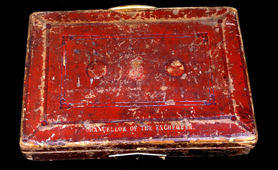
British Chancellors have traditionally brought a copy of the budget to parliament in an iconic red budget box, first used by William Gladstone in the early 1860s. This box, which is supervised by the British National Archives in Kew, will be officially retired after this week’s budget because it is in a state of disrepair. Made for William Gladstone around 1860, it has been used by every chancellor since, with the exception of James Callaghan and Gordon Brown. The box will now be kept on display at the Cabinet War Rooms in Whitehall, which you can visit.

The retirement of this box is a good time to think about financial history and differences in national political culture.

For more about the Gladstone box, see here. You can also see a cool video on the history of British public finance here.  I’ve included a video about the history of the box.

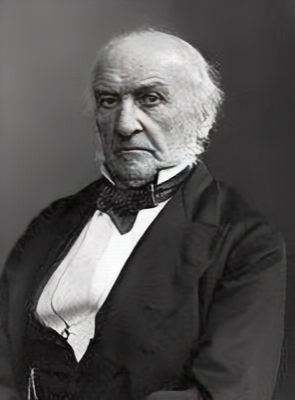
The story of the box is interesting to me because of what it represents. First, in the course of researching my PhD thesis, which dealt with an attempt by Canadian politicians to get money out of the British government in the 1860s, I had to do a fair bit of reading on Gladstone and his financial policies. There is a sizeable literature on Gladstonian finance and the reforms he implemented as Chancellor in the 1860s and later as Prime Minister. These reforms included placing all government funds in a single consolidated fund, which was a step towards transparency. Previously, the British government’s annual expenditure had been divided among a vast array of special envelopes, with revenue from a particular source being hypothecated to a particular class of expenditure. This system was complex, made oversight more difficult, and resulted in “feast or famine” budgets in particular government departments.

Gladstone

After the achievement of Responsible Government, Canadians adopted the British practice of preparing the budget in secret and then announcing the entire budget in parliament. This practice was designed to cut down on last-minute lobbying by rent-seekers, which was once common in Westminster-style democracies and is still a prominent feature of the preparation of the budget in the U.S. Congress. In the U.S. Congress and in state legislatures, representatives will agree to vote for the budget in return for goodies for their home districts, the result being the misdirection of trillions of dollars into “bridges to nowhere”, obsolete military subsidies, and subsidies to farmers.

The existing literature shows that the British financial reforms of mid-19th century reduced the role of special-interest politics in the making of British government budgets and thus helped to increase the average taxpayers’ trust in the state. These reforms reduced anti-statist or anti-government sentiment in Britain, which had been rampant in the days of Old Corruption, and paved the way for the rise of the welfare state. If people in Britain, Canada, and other Commonwealth countries have  a more positive view of “Big Government” than their American cousions, it is likely a result of the reforms undertaken by Gladstone. Of course, this is highly ironic, since Gladstone was a small-government classical liberal. The US never enacted these reforms, which helps to explain why there is a deep suspicion of Big Government in that country, as is evident in the Tea Party movement.

I’m not saying I agree with the Tea Party movement. All of the energies the Americans are putting into the Tea Party movement should be devoted to Transparency International. However, I understand where they are coming from. If I had to live under corrupt U.S. politicians (let’s face it, pretty much every US President from Nixon on would be in jail in a Commonwealth country), I would probably want to reduce the amount of money at their disposal. After all, the US government budget seems to be chiefly devoted to obscene subsidies for farmers and paying for wars the US people don’t believe in rather than paying for service the public might actually value. In fact, if I were a pacifist living in the United States, I might even support the Tea Party movement, since that movement is probably the most effective means of bringing the US war machine to its knees.  Personally, I kinda hope that the Tea Party Revolt and the tax evasion it is encouraging forces the US to pull out of Afghanistan sooner than expected.

Tea Party in Philadelphia

Similarly, if I lived in Japan, I might also become an anti-tax crusader, since so much of that country’s budget is devoted to propping up the construction industry through useless infrastructure spending (e.g., multilane highways in remote parts of Japan). The corrupt gerontocracy that runs that country has spent billions on laughable infrastructure projects that aren’t needed when they should be putting money into encouraging Japanese women to have babies.  At the current rate, there will soon be more bullet trains than children in the land of the rising setting sun.

Half Completed Highway in Japan, Doubtless Built to Please Some Liberal Democrat Crony

Anyway, I digress. You can find an excellent survey of the scholarly debate on Gladstonian finance in historian Martin Daunton’s financial history of 19th century Britain, Trusting Leviathan. see excerpt here.

I’m particularly interested in the ways in which Canadian politicians in the 1860s and 1870s selectively copied some of the reforms that had been undertaken by Britain in the mid-19th century. Luther Holton, who has Canada’s Finance Minister in 1862-4, was an admirer of Gladstone, as were other Canadian politicians of the Liberal stamp.

Luther Holton, Canadian Classical Liberal

Canadians were rather selective in the ways they embrace Gladstonian finance. Like Britain, Canada decided to create a single consolidated fund and begin preparing budgets in secret. Canada also created the office of Auditor-General, to make sure that taxpayer funds were being spent wisely. However, Canada did not imitate Britain in the crucial matter of the tariffs. In the 1840s, the British government of Robert Peel shifted from indirect to direct taxes, cutting customs duties but making up for the shortfall by imposing an income tax on the top 2% of the population. This was a bold and selfless act on the part of the parliament that voted for this shift, since it was a parliament elected by the properties classes.  For better or worse, Canada did not follow suit until the 20th century, although some Canadian classical liberals proposed the introduction of income tax in 1860s. In fact, the failure of Canadian politicians to introduce income tax in the 1860s is one of the reasons I have so little respect for the Fathers of Confederation.  For decades after Confederation, Canada’s government got most of its revenue for the tariff, a rather regressive form of taxation. Needless to say, the tariff-protected industries that had grown up under this form of taxation were among the most vigorous opponents of the introduction of income tax into Canada. Canadians only began paying for income tax during the First World War.

You can read more about Luther Holton here.

There are some great images from recent Canadian budget history here.


Exhibition on the French activities of the Canadian Forestry Corps, 1916 to 1919

17 06 2010

Hâches de guerre – les bûcherons canadiens dans les forêts normandes de 1916 à 1919.


Archives départementales de l’Orne.

Exhibition on the French activities of the Canadian Forestry Corps, 1916 to 1919. Exhibition materials contributed, in part, by Library and Archives Canada, the Canadian War Museum and the National Film Board of Canada.

This exhibition will feature 3-D images, so it’s sort of Canadian history meets Avatar.

A l’heure de la première guerre mondiale, les besoins en bois pour les tranchées, les voies de chemins de fer, les baraquements sont considérables. Des troupes forestières canadiennes vont venir travailler dans les forêts ornaises pendant trois années. Un aspect peu connu de la Grande Guerre est révélé pour la première fois en France : la présence des troupes canadiennes non pas sur le front mais à l’arrière, dans les régions éloignées des combats.

Au travers d’une très belle collection privée de photographies, de films d’époque, de peintures et d’archives officielles, les Archives départementales de l’Orne proposent de découvrir la vie quotidienne du corps forestier canadien dans les forêts ornaises de 1916 à 1919. Le savoir-faire des bûcherons canadiens chargés de l’abattage, du débit et de l’expédition des coupes de bois ne lasse pas d’impressionner.

Grâce au traitement numérique effectué sur ces photos d’archives et une paire de lunette spéciale fournie à l’entrée, vous pourrez regarder ces images de la première guerre en 3D. Un événement à ne pas rater !

Jusqu’au 2 juillet 2010

Entrée libre – lunettes 3D prêtées

Du lundi au vendredi de 8h30 à 17h30 – Le dimanche de 14h à 18h

Archives départementales de l’Orne

6 avenue de Basingstoke

61 000 Alençon

Tél. : 02 33 81 23 00


Reading List on Upper Canada’s History

16 06 2010

I received the following message from an Australian historian:

“My research on Justice John Walpole Willis’ colonial career has focused so far on his time in Port Phillip (now Melbourne, Australia).  I am now moving onto the Canadian phase of my research.

I am particularly interested in Upper Canada in the late 1820s, and would appreciate your recommendations of scholarly texts that would give me an understanding of Upper Canada at that time.  My Port Phillip work
has taken a bottom-up approach, but of course as an Australian, I already have a broader contextual understanding of Australian colonial society at that time.  I find that I lack this completely for Upper Canada.

Would you be able to recommend works that would assist me?”

So, which books and articles would I recommend to a professional historian from the other side of the world who knows very little about Upper Canada but wants to find out more? I am taking the liberty of sharing this list here, in case it might be of interest to others. I’m not including any books on British Imperial history in this period or the function of the Colonial Office, since the Australian historian knows about these already.

Willis lived between 1793 and 1877. He trained as a lawyer and was appointed to the bench in Upper Canada in the 1820s. He quickly ran afoul of the Family Compact and was removed by the Lieutenant Governor. He was then appointed to a court in British Guiana. In 1837, he took up a judicial appointment in Australia. He returned to England in the 1840s.

To clarify, let me remind people that Upper Canada was the name given to what is now southern Ontario between 1791 and 1841. In 1841, the official name was changed to Canada West, but the term Upper Canada persisted in common discourse until 1867. Between 1791 and 1841, Upper Canada was a separate colony with its own legislature.

The obvious starting point for reading is Gerald M. Craig’s Upper Canada: the Formative Years, which was first published in 1963.  It is a good general narrative history and will give you the basic chronology of political events. Although this book is essential reading, it is now somewhat dated. It should be read alongside the following works.

The divided ground : Indians, settlers and the northern borderland of the American Revolution by Alan Taylor

It is impossible to understand politics in Upper Canada without knowing about what was happening in the United States in the same period. I recommend the two following books from the Oxford History of the United States. They are brilliant works of synthesis and include up-to-date bibliographies.

Empire of liberty : a history of the early Republic, 1789-1815 by Gordon S. Wood.


What hath God wrought : the transformation of America, 1815-1848 by Daniel Walker Howe.

Because the researcher is interested in legal and political history, I would recommend the following books on Upper Canadian legal culture.

Popular politics and political culture in Upper Canada, 1800-1850 by Carol Wilton.

Sir John Beverley Robinson : bone and sinew of the compact by Patrick Brode.

Jeffrey L.McNairn, The Capacity to Judge: Public Opinion and Deliberative Democracy in Upper Canada, 1791-1854.

Colonial justice : justice, morality, and crime in the Niagara District, 1791-1849 by David Murray

The Australian historian Greg Taylor has published a very interesting book called The law of the land : the advent of the Torrens system in Canada. This book shows how an Australian system of land tenure called the Torrens system spread first to British Columbia and then to other Canadian jurisdictions. It might be of interest.

All of these books are the catalogue of the national library of Australia and should be available through inter-library loan. In an ideal world, you would buy all of these books. However, since you have to prioritize, I would recommend buying the books by Craig and Brode. They will be the most helpful for your research, I would imagine.

Good luck with your fascinating project!

My research on Justice John
Walpole Willis’ colonial career has focused so far on his time in Port
Phillip (now Melbourne, Australia).  I am now moving onto the Canadian
phase of my research.I am particularly interested in Upper Canada in the late 1820s, and
would appreciate your recommendations of scholarly texts that would give
me an understanding of Upper Canada at that time.  My Port Phillip work
has taken a bottom-up approach, but of course as an Australian, I
already have a broader contextual understanding of Australian colonial
society at that time.  I find that I lack this completely for Upper
Canada.

Would you be able to recommend works that would assist me?


Historians and New Media

15 06 2010

“The use of new digital media in conjunction with conventional print publication is one of the many important contributions that Joy Parr’s recent Sensing Changes: Technologies, Environments, and the Everyday, 1953-2003 (2010, UBC Press) makes to our understanding of the past.”

That’s the opening sentence of Jay Young’s excellent new post on historians and new media. See here.

You should also check out the website Parr created to go along with the book.


Ranald C. Michie, _Guilty Money: The City of London in Victorian and Edwardian Culture, 1815-1914_

14 06 2010

I would like to draw your attention the following book review. The author of the book is Ranald Michie, a distinguished historian at the University of Durham who probably knows more about 19th century stock exchanges than anyone now living. The review is Leslie Hannah, an even more distinguished historian who now holds appointments at the University of Tokyo and the London School of Economics. The book under review is on an important topic, especially to those of who are interested in who attitudes to capitalism have evolved over time. The book deals with weighty themes such as imperialism and anti-Semitism.

———— EH.NET BOOK REVIEW ————–

Published by EH.NET (June 2010)

Ranald C. Michie, _Guilty Money: The City of London in Victorian and Edwardian Culture, 1815-1914_. London: Pickering & Chatto, 2009. x + 278 pp. $99 (hardcover), ISBN: 978-1-85196-892-3.

Reviewed by Leslie Hannah, Department of Economic History, London School of Economics.

Ranald Michie, Professor of History at the University of Durham, England, probably knows more about the history of stock exchanges than anyone. His 1987 study, _The London and New York Stock Exchanges, 1850-1914_, remains the classic source for those wishing to understand their different institutional characteristics. In this new book, however, he explores new and unfamiliar ground, admirably summarized in his preface: “Though its theme is the City of London as a financial and commercial centre, it is not a factual account. Though it relies heavily on novels it is not an exercise in literary criticism. Though it attempts to identify ideas and images it is not a cultural history. The fact that it does not fit into any obvious category may explain why referees for journals and publishers found it easy to be critical rather than to understand what I was trying to achieve. This book sets out to test one simple theory and that is whether it is possible to establish, with any degree of precision, the place occupied by a financial centre in the culture of a nation, and the degree to which that changed over time.”

We may already know that financiers played a large part in the nineteenth century novel from our reading of _Mansfield Park_, _Little Dorrit_ or _Howard’s End_ (or at least remember the television adaptations on the BBC or public television). We may even have encountered the playwright Israel Zangwill in melting pot contexts, if not through his less well known _Cheating the Gallows_, but Michie has intrepidly delved deeper into the century’s literary output to uncover novelists that few of us will have even heard of. He appears to have read every bad novel and mediocre play and viewed every painting that touches on the life of the City. Of course, many of these were more popular at the time than the surviving classics and arguably give us a clearer window on the everyday dialogues and immediate discontents of a lost world of contemporary public opinion.

Fear not, however: you are guided gently by the author though the relevant plots and dialogues, as he expertly and relentlessly assesses their significance, so you will not have to read them yourself. His thesis is that, in a period of rapid change for both the economy and cultural attitudes, we can chart their interactions with some chronological precision by using such sources. There is no hint here of the pervasive and unchanging simplicities of Martin Wiener’s British business culture, but rather an insistence that attitudes were contingent on events and their construction, with considerable leeway for prejudices and presentations to shift and evolve. For example, the negative view of finance and speculation in some early representations tended by 1895 to be reserved for some of the darker company promoters. City folk were then generally being portrayed as hard-working, effective and honorable contributors to Britain’s economic success. However, the two decades before 1914 saw a more negative portrayal again coming to the fore. Driven first by the “Kaffir circus” gold speculation of the late 1890s, there was an unpleasant emphasis on Jews and foreigners as a source not of the City’s international success but of dubious and underhanded practices. The rise of socialism also added a new element of negativity in the portrayal of the capitalist. Manufacturing was increasingly portrayed in positive terms while finance evoked deep-seated prejudices against money and speculation, as the unacceptable face of capitalism.

The book can be recommended to anyone seeking to understand shifts in popular attitudes toward finance and the strengths and limits of using literary evidence for this purpose. It makes no large claims to broader significance, for example, as an explanation of the financial repression which was such a marked feature of the post-1914 UK economy until the 1980s. The author can be pronounced successful in the unusual, challenging, and carefully limited, task that he set himself.

Leslie Hannah is Visiting Professor, Economic History Department, London School of Economics and is currently working on an international comparison of stock exchanges before 1914. lesliehannah@hotmail.com

An earlier review of the book is available here.


Huey Long

12 06 2010

The Kingfish

This link takes you to a very good report on the legacy of Huey Long, the famous Louisiana Governor. Long fought with the oil companies in the Gulf of Mexico, which perhaps explains why there is an interest in his legacy in these post-Deepwater Horizon days.