Some Thoughts On Trump and Annexationism

13 12 2024

In late 2024, President-elect Donald Trump reignited diplomatic tensions with Canada by making provocative remarks about the country’s sovereignty. Trump referred to Canadian Prime Minister Justin Trudeau as the “Governor of the State of Canada,” adding with a smirk that Canada might as well join the United States if it wished to avoid the heavy tariffs on its exports. Trump took to his preferred platform, Truth Social, to repeat these sentiments. Over the following days, Trump’s posts escalated in tone, suggesting that Canada’s economy relied heavily on U.S. trade and that tariffs were inevitable unless it reconsidered its status. By mid-December, Trump’s comments had sparked widespread media attention, with some analysts unsure whether his statements were intended as serious policy proposals or simply political theatre or were simply a joke.

Here is some media coverage from India of the issue.

My educated guess is that they may be serious. There are certainly people around Trump who are concerned about the “browning of America” and who have, in the past, mused that incorporating Canadian provinces as states of the union would raise the Caucasian share of the US population (sorry I can’t find the link but they did say that). The same people seem to be fiercely opposed to Puerto Rican statehood). I don’t think that Trump is a racist ideologue, but I do think that he is interested in building a legacy and there would be no greater legacy than permanently expanding the United States. Changing the map of your country is a way to get your face on Mount Rushmore. That’s even better than being happy about Trump Tower becoming the tallest building in New York.  When I first heard the slogan “Make America Great Again” I noted that it didn’t specify when exactly American greatness had peaked. Like many, I had assumed that the imagined Good Old Days in this slogan were either some nostalgic version of the 1950s or the 1980s, a period when Trump was in his prime. But it could be the vaguely defined period of greatness underpinning the slogan is the nineteenth century, the period of manifest destiny.

Perhaps I am personally biased in thinking that Trump is serious about offering statehood to some or part of Canada because my PhD thesis looked at the 1860s, a period when that option was very much on the table. Maybe my background is skewing my analysis of what is going on right now.

In any event, Canadian popular reaction to Trump’s remarks was swift and defiant. Prominent politicians across the Canadian political spectrum rejected any notion of annexation, although I did notice the Premier of Ontario took the precaution of placing a US flag next to a Canadian and provincial one during a press conference. Polling data showed that Canadians overwhelmingly opposed closer political integration with the United States, with support for national sovereignty apparently at record highs. Only 1 in 8 Canadians are open to the idea of Canada, or their Canadian province, joining the United States. Even in the more politically conservative Prairie provinces, that number isn’t much higher than 20%.

Trump’s 2024 comments about Canada echoed his earlier proposal in 2019 that the United States should acquire Greenland, then an autonomous territory of Denmark. In August 2019, news broke that Trump had floated the idea during meetings with aides, reportedly framing the acquisition as a strategic move to gain access to Greenland’s natural resources and enhance the U.S. military presence in the Arctic. Trump later confirmed the proposal on Twitter, which is now called X. The proposal drew immediate backlash from Denmark, with Prime Minister Mette Frederiksen describing it as “absurd” and anachronistic. Her view was that while Tsarist Russia might once have been able to sell Alaska to the US, this isn’t 1867 anymore and we don’t do things that way. Trump retaliated by cancelling a state visit to Denmark, claiming Frederiksen’s response was disrespectful.

The idea of the United States annexing Canada has deep roots. During the early 1800s, tensions between the United States and British North America culminated in the War of 1812, during which some American leaders saw the conflict as an opportunity to annex Canadian territories and to liberate their inhabitants, many of whom were Anglo-Saxons culturally indistinguishable from people in neighbouring states, from British misrule. While the war failed to achieve this goal, the idea persisted among American expansionists. The Annexation Movement gained momentum in the 1840s, spurred by Manifest Destiny and economic pressures. In 1849, a group of Montreal merchants published the “Annexation Manifesto,” calling for Canada to join the United States to escape economic stagnation and benefit from free trade.

William Henry Seward, U.S. Secretary of State during the 1860s, was a vocal proponent of territorial expansion and believed that Canada would eventually be absorbed by the United States. In the 1850s Seward, who was an ardent abolitionist from New York State, said it was more logical for Canada to be part of the United States than it was for the slave states.  Seward was confident that economic integration and demographic trends would lead to Canadian annexation without military force. However, these ambitions, along with garden variety interest group politics in the US congress, resulted in the cancellation of the Reciprocity Agreement in 1866, which had established free trade between the U.S. and British North America since 1854. This Free Trade agreement’s termination was partly driven by American resentment toward British support for the Confederacy during the Civil War, as well as lingering annexationist sentiment. The cancellation intensified Canadian fears of U.S. expansionism and reinforced support for Confederation as a means of unifying and protecting Canada against American ambitions.

A paper I wrote long ago, Confederation as a Hemispheric Anomaly: Why Canada Chose a Unique Model of Sovereignty in the 1860s,” sheds light on why Canada ultimately resisted annexationist pressures. I wrote this paper because in part because I was sympathetic to the 1860s Canadians who favoured Annexationism, some of whom had arguments that were based on economic logic. (Annexationism was very strong in communities in which the border was an annoyance that complicated everyday life.) Once the US passed a constitutional amendment ending slavery, many Canadians, particularly farmers in the area west of Toronto, concluded that they could now safely join the Union. The paper argues that, unlike the United States and many Latin American nations, Canada adopted a model of sovereignty that preserved close ties to the British Empire while granting autonomy through Confederation. I argued that Canadian Confederation as a deliberate rejection of U.S.-style republicanism, emphasizing the desire to strengthen ties with the British Empire. Another reason the Annexation movement of the 1860s failed was the fact that Anglo-Saxon Americans were aware that Canada was home to a very large number of non-Protestants). Whether those ties were ultimately good for subsequent Canadian living standards is something we can discuss—as I argued in the final chapter of book published in 2008, post-Confederation Canada’s economy really fell behind the US. I speculated that the Canadian constitution designed in London in 1866-1867, which provided for an excessively centralized and not very democratic political system, had something to do with it. In the generation after 1867, vast numbers of Canadians voted with their feet in favour of the US and moved there, settling in places such as Ontario California.

My own personal view is that while I don’t like Trump, I think there is a strong logic in favour of continent-sized economic units, particularly those that resist the tendency to become protectionist blocks. I was totally opposed to Brexit and think that Britain would have been better off had it remained in the EU. (I’m agnostic about whether the UK should have adopted the Euro as its currency, as was once proposed by Tony Blair). By the same token, I think that Canadians and Americans would be better off if they combined their two countries at least in the form of an EU-style customs union with a common currency. The devil is obviously in the details. However, I think that we need to be able to separate the issue of which constitutional arrangement is economically superior from the political personalities of the day. When Clinton and Obama were presidents, support for greater integration in Canada was higher than it currently is. Whenever some particularly objectionable Republican gets in the White House, be it Richard Nixon or the like, we tend to see a nationalist reaction in Canada.  I bet that if the annexation of Canada were proposed by the likes of a Clinton or an Obama, the Canadian reaction would be different. I also bet that if the prospect of Canada’s ten provinces getting votes in the electoral college became a realistic one, many Republicans would become strongly opposed to the concept because at least nine of those provinces would be staunchly blue states.

While Trump’s recent statements may have been made in jest, they reflect a pattern of American leaders revisiting old territorial dreams to achieve economic or political goals. Canada’s current response is consistent with a historical commitment to maintain sovereignty in the face of external pressures.


Thinking Historically About the South Korean Attempted Coup

4 12 2024

Yesterday, South Korean President Yoon Suk Yeol declared martial law, absurdly accusing the centre-left opposition parties of collaborating with North Korea to justify suspending constitutional protections, including the right of the National Assembly to meet and discuss. This move faced immediate backlash: opposition lawmakers defied military barricades to convene in the National Assembly, where they unanimously voted to overturn the decree. Facing mounting pressure, including dissent from his own centre-right political party, President Yoon rescinded the martial law order within hours.  Pro-democracy norms asserted themselves to ensure that there would be no backsliding into the authoritarianism South Korea suffered from pre-1987. The hapless president now faces calls for his impeachment and expulsion from his own political party. For me, the main takeaway from this episode is the resilience of South Korea’s democratic institutions. South Korea has Western-style political institutions that have been grafted onto its Confucian/East Asian culture in the last few decades. All of this makes me think that inherited culture is less important than social-scientific theories might lead one to suggest.  Social scientists, take note!  In fact, I think that maybe we should stop using the term “Western” as a short-hand for “liberal democratic countries.”

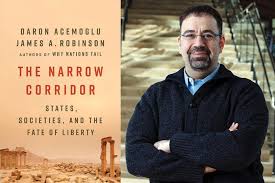
Here is another take away from the recent events in South Korea. Maybe cultural inheritance and long-term history going back centuries matter even less that Acemoglu and Robinson have suggested.  Daron Acemoglu and James A. Robinson, the authors of The Narrow Corridor, were big names even before their recent Nobel Prize. Acemoglu is an economics professor at MIT, known for his work on political economy and development economics. Robinson is a political scientist and economist at the University of Chicago, focusing on political and economic development in Latin America and sub-Saharan Africa. They’ve teamed up before on the bestseller Why Nations Fail, exploring why some countries prosper while others don’t. In The Narrow Corridor, they dive into the delicate balance between state power and societal influence that’s crucial for liberty to flourish. They focus a lot in this book on the Western cultural tradition and, in particular, the Anglo-American/Germanic cultural inheritance. The cover of one version of their book even has images of the ruins of the Parthenon, which communicates that idea that ancient Greeks in the family tree helps to explain why part of the world is democratic while other parts aren’t.

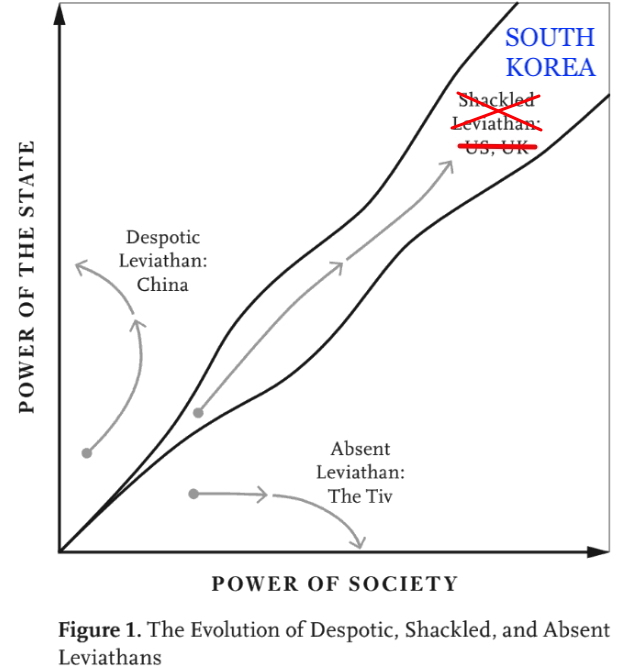
The Narrow Corridor argues that freedom and prosperity thrive when a delicate balance exists between the state and society—a “shackled leviathan.” In these countries (think the UK and the US), strong institutions ensure the state is powerful enough to govern effectively but also constrained by an engaged, organized society that can hold it accountable. In contrast, despotic leviathans have powerful states but weak societies (think China for most of the last thousand years), leading to oppression and authoritarian rule, while absent leviathans suffer from weak states and weak societies, leaving them mired in chaos and lawlessness (think Somalia or most tribal societies). The authors also emphasize that culture plays a huge role—societies don’t just randomly fall into one category or another. Historical events and cultural norms shape their trajectories, creating a kind of “path dependence” that makes it hard to break free from established patterns. That’s sort of true, but that theory makes it harder to explain what recently happened in South Korea. Having lots of Anglo-Saxon “cultural DNA” in a given country seems to matter less to its political institutions than the Narrow Corridor might lead you to believe.

I’m sharing an amusing/thought-provoking image that Pseudoerasmus shared on Twitter/X.  The image is a famous figure from the Narrow Corridor that someone hacked yesterday!


Brendan Greeley on AJR

23 10 2024

Brendan Greeley’s opinion piece in the Financial Times, “The Nobel for Econsplaining,” has sparked quite a bit of debate. Greeley’s writing is witty and engaging, and he clearly knows his stuff when it comes to econometric research methods, which makes his critique of economists’ work all the more credible.  Here is an example of his prose


Acemoglu and Robinson read a book called American Slavery, American Freedom, used the bits about American freedom and tossed the bits about American slavery. The new economic institutionalists treat work on institutions by a celebrated historian not as a coherent argument, but as a source of anecdotes. If they did this with data, you’d call it p-hacking.

However, I’m not totally convinced by his main argument. He suggests that understanding the history of slavery and race relations within the present-day United States and culturally proximate countries is key to seeing why Daron Acemoglu, Simon Johnson, and James Robinson (AJR) have produced an inaccurate theory about the relationship between political institutions and economic growth. The stakes in the debate about the accuracy of the AJR theory are high because it has massive normative implications: if their theory is true, then the case for Western countries promoting Western-style political style institutions around the world and for sending, say, more weapons to Ukraine, will be stronger than it would otherwise be.

Most of Greeley’s piece focuses on events in the British colonies in the New World and the historiographic debates around them. In trying to show what’s wrong with the AJR paradigm, he spends more time discussing a book by an American historian from 1975 than the incredible rise of the Chinese economy since 1978!!!  Greeley, being a US citizen who just happens to live in a region that once had African slavery (New Jersey), might be overestimating the importance of historical phenomena that are geographically close to him when evaluating AJR’s overall theory. I find that Greeley’s piece displays evidence of too many cognitive biases. In particular, the proximity bias is strong here. Maybe I’m guilty of recency bias in wanting us to focus our attention on China since 1978. I suppose we need to proper methodology to counteracting all of these biases so that we don’t end up cherry picking data.

Here is some background. As many readers of this blog will know, Daron Acemoglu, Simon Johnson, and James Robinson were awarded the 2024 Nobel Memorial Prize in Economic Sciences for their research on how political and economic institutions shape national prosperity. Their work, especially their theory of inclusive vs. extractive institutions, helps explain why some nations experience sustained economic growth while others remain poor. The award has been mostly well-received particularly by people in the centre of the Anglo-American political spectrum, highlighting the impact of their research on understanding global inequality, though some critics argue their theories overlook other factors like culture and geography. The critics come from various groups: academics in authoritarian yet economically successful regimes who don’t like the AJR insinuation that you need inclusive political institutions for prosperity, hard core left-wing critics who believe that it has already been proved that the West’s wealth is due to slavery and genocide, and then libertarians who think that AJR’s account is unduly celebratory of the mixed-economy arrangement that centrist academics tend to like.

AJR have faced heavy criticism from scholars who believe their work oversimplifies complex historical and economic processes, particularly in East Asia’s development and historical exploitation, such as slavery and colonialism. Austrian economists, people Pete Boettke and his colleagues at GMU, are also sceptical of their focus on state capacity, preferring more purely market-based explanations for economic development. The economists who were really vigorous critics of Covid lockdowns, US membership of NATO, and state intervention more generally tend to be the most sceptical of the AJR claim that England industrialized because it has the optimum blend of state and market. Seen from a sort of an-cap perspective, AJR sound like quasi-socialists.

In China, scholars have pointed out the tension between AJR’s emphasis on democratic governance and China’s authoritarian-led growth model. While their contributions are influential, the debate around their theories is shaped by ideological and geopolitical considerations.

AJR’s theory of inclusive political institutions, as detailed in works like Why Nations Fail (2012) and then their more recent book The Narrow Corridor argues that inclusive institutions—those allowing broad participation in political and economic processes—are key drivers of economic development. They contrast these with extractive institutions, where political power and economic benefits are concentrated in the hands of a few (think of Stalinism, feudalism, or the antebellum American South), which they argue stifle growth and innovation. They present historical evidence from various contexts to support this theory, emphasizing how colonial legacies, institutional arrangements, and power structures shaped different nations’ development trajectories.

Image from The Narrow Corridor

Critics argue that the rapid economic development of East Asian economies, such as South Korea, Taiwan, and above all mainland China, disproves AJR’s claim that you need inclusive institutions (basically democracy) for economic growth. These countries didn’t have fully inclusive political systems during their early development stages. Instead, they relied on strong, centralized, and often authoritarian governments to implement land reforms, industrial policies, and export-oriented strategies. In South Korea, this is more of an academic question, since the country transitioned to democracy around 1988 and has continued to develop since then. Everyone in South Korea now regards democracy there as normative.  In mainland China, however, the claim that you need inclusive political institutions for economic growth is provocative and highly threatening to the existing political system.  I find it strange that Greely says so little about China in his piece, as that’s the real Achilles heel of the AJR theory, not something that happened in Virginia in the 1600s.

Some scholars who fall into the camp of domestic British and American progressives argue that AJR downplay the role of slavery and other forms of coercive labour and land theft in the rise of Western economies. According to these people, we already know that the transatlantic slave trade, colonial resource exploitation, and forced labour were absolutely essential to Western Europe’s wealth accumulation, which fuelled industrialization. (Somehow these critics don’t explain why England and the Netherlands developed at a much faster rate that Portugal and Spain). Anyway, these critics suggest that economic growth can occur in contexts where extractive institutions play a significant role, contradicting the idea that inclusive institutions are always necessary for development.

The debate over AJR’s theory is deeply influenced by political ideology and geopolitics. I wish Brendan had said more about that factor and then about his own ideological commitments.

Here is Brendan’s brief biography:

Brendan comes to Princeton after 20 years as a journalist, covering economic and monetary policy. He was the US economics editor at the Financial Times, and continues to write a regular column there. Before that, he was a staff writer for Bloomberg Businessweek and The Economist, as well as an anchor and correspondent for Bloomberg TV. He has also written for the New York Times, the New York Times Magazine and the Wall Street Journal Europe, and received a New York Press Club Award for special event reporting in 2012. Brendan graduated from Tulane University with honors in German in 1997. 

I would note here that Tulane, where Brendan did his undergrad, is in a part of the US where the legacy of slavery is visible all around you. That fact and other autobiographical should perhaps have been disclosed here.

References

Acemoglu, D., Johnson, S., & Robinson, J. (2002). Reversal of Fortune: Geography and Institutions in the Making of the Modern World Income Distribution. The Quarterly Journal of Economics, 117(4), 1231-1294.

Acemoglu, D., & Robinson, J. A. (2012). Why Nations Fail: The Origins of Power, Prosperity, and Poverty. Crown Business.

Boettke, P. J., Coyne, C. J., & Leeson, P. T. (2008). Institutional Stickiness and the New Development Economics. The American Journal of Economics and Sociology, 67(2), 331-358.

Chang, H.-J. (2002). Kicking Away the Ladder: Development Strategy in Historical Perspective. Anthem Press.

 Inikori, J. E. (2002). Africans and the Industrial Revolution in England: A Study in International Trade and Economic Development. Cambridge University Press.

Wolfe, P. (2006). Settler Colonialism and the Elimination of the Native. Journal of Genocide Research, 8(4), 387-409.

Yao, Y. (2011). The End of the Beijing Consensus. Foreign Affairs, 90(6), 13-18.


Observations on the 2024 ABH Conference

2 07 2024

I recently got back from attending the 2024 Association of Business Historians (ABH) conference. I’m sharing my observations about this year’s ABH here.  Established in about 1991 or 1992, the ABH conference serves as a platform for business historians to present their work, share ideas, and discuss recent developments in the field. The conference covers a wide range of topics within business history, including corporate governance, entrepreneurship, international business, and the impact of historical events on business practices. In its early days, most of the attendees of the ABH worked in the Economic and Social History Departments. Today, most of the UK-based academics at the ABH are business historians who work within business school.  Each year, the conference attracts participants from around the world, fostering a global dialogue on business history. The ABH is closely associated with the journal Business History. I’ve been going to the ABH for a long time (I think 2008 in York was the first time I went) so I think I can speak with some authority about its evolution.

The ABH appears to be in very good health indeed. I was struck by how many academics from different disciplines and countries were there. The US was very strongly represented at the ABH this year, thanks to the partnership with the Economic and Business History Society, with whom the ABH jointly organized the conferences. In my books, a conference that can attract lots of people who are from far away both geographically and from different disciplines is a strong conference. You want to buy stock in that conference and the associated scholarly community.

The ABH-EBHS doctoral workshops that ran before the main conference attracted, I’m told, about 20 PhD students from various countries and disciplines. I was particularly impressed by the US sociology PhDs who were there. The workshop was funded by the Institute for New Economic Thinking (INET), which apparently sees lots of value in cultivating the next generation of business historians. Readers may recall that INET was founded in October 2009 in response to the global financial crisis of 2007-2012. Its funders, who included George Soros and James Balsillie were really dissatisfied with mainstream neoclassical accounts of how the economy operates and wanted to encourage new approaches, including historical ones.  The fact INET is funding this initiative is another indicator of the robust strength of business history.

I noticed a fair number of Canadians on the conference programme—many of them work at UQAM. At the conference, there was a very good discussion about why so few corporate archives in Canada are open to researchers. That discussion was sparked by a remark I happened to make in the session on corporate archives.

Congratulations to Dr Chris Corker on organizing this conference so well.


Using History to Think About Generative AI

23 01 2024

Niall G. MacKenzie, Stephanie Decker, Christina Lubinski, three business historians, have published a short but excelent piece in the British Journal of Management that puts Generative AI into some historical context “Contested Imaginaries Through Time: Putting Generative Artificial Intelligence in Context“. Their piece, which uses on the theory of the German sociologist Jens Beckert (see his book Imagined Futures: Fictional Expectations and Capitalist Dynamics) cites a number of historical studies, including works on the Industrial Revolution era by Joel Mokyr and Mary O’Sullivan.


I don’t disagree with anything MacKenzie et al. say in their paper. However, I have parallel set of observations that are about the use of historical analogy in the marketing of OpenAI’s flagship product, ChatGPT. (When I say marketing, I’m talking more about the attempts by the company to secure the support of investors and policymakers than the end consumers). The very term ChatGPT, is an allusion to a term that emerged from the field of economic history in, if memory serves me correctly, the early 1990s. At that time, Joel Mokyr, Nathan Rosenberg, and other who study industrial revolutions past and present, popularized the term General Purpose Technologies (GPTs) to describe any technology that have the potential to significantly impact multiple sectors of the economy, leading to widespread and transformative changes in various industries. [It may be that Robert Solow first introduced the term but in any event it was in common currency in econ history circles by the team I reached university in 1995]. Steam engines and electricity are cannonical examples of GPT. Since the 1990s, generations of students in intro economic history have been taught that the key characteristics of General Purpose Technologies are:

Breadth of Application: GPTs have the capacity to be applied across a wide range of industries and sectors.

Economic Impact: They have the potential to bring about substantial economic growth and TFP improvements. They allow lots of people to produce more GPT per hour worked.

GPTs tend to facilitate and support the development of complementary technologies, further amplifying their impact on the economy.

Long Gestation Periods. The development and diffusion of GPTs often take a considerable amount of time due to their complexity and the need for widespread adoption. It is took a long time for the steam engines invented down in Cornwall to really change the world, but once they did, the social returns on the initial investments on steam engines were just massive.


The long gestation period teaching from economic history stresses the need for patient capital. Telling your investors that your venture is working on a GPT is basically a way of explaining in advance why it is going to take a long time for venture to generate real profits for the investors or society as a whole. I would be fascinated to hear from readers what actual Venture Capitalists think when this historical analogy argument is used on them. (Information in the comments section welcome!).

Now since the 1990s, millions of people throughout the English-speaking world, and probably beyond. have probably been exposed to the concept of the GPT through introductory economic history class or maybe a geography class. (I first encountered the term in a geography course). For years, I delivered a few lectures each semester to business undergraduates that were designed to give them the overview of economic history they needed. So they got some Great Divergence, some new institutionalism, and, yes, some exposure to the concept of the GPT. So have millions of learners around the world– at least judging from the textbooks that are widely used. So by 2022, lots of people were vaguely familiar with the concept of the GPT. They were a small proportion of the human race, sure, but they were disproportionately in positions of power and authority. I bet everyone who did a PPE degree at Oxford or spent a couple of years at Stanford, which is what Sam Altman did, hear about General Purpose Technologies. That gives elites a common vocabulary for thinking about the world.

AI Enterpreneurs Meeting With a Key Stakeholder. Historical analogies can give people a common vocabularly for thinking about the world.

24/05/2023. London, United Kingdom. The Prime Minister Rishi Sunak meets with Demis Hassabis, CEO DeepMind, Dario Amodei, CEO Anthropic, and Sam Altman, CEO OpenAI, in 10 Downing Street. Picture by Simon Walker / No 10 Downing Street

What all of that means is that it was a brilliant use of rhetorical history by Sam Altman’s team at OpenAI to label their product ChatGPT. Rhetorical history is when a company, manager, or some other actor in the academy uses a historical argument or allusion to persuade others. As someone who studies how companies use historical ideas to appeal to consumers, investors, and other groups, I am impressed by what a clever move it was to dub OpenAI’s product ChatGPT. I say that as someone who is agnostic about whether generative AI, as opposed to say AGI, truly is a GPT. (The late Nick Crafts had some interesting observations about that).


University of Essex Webinar: “Slow Memory and Transformative Change: How to Confront the legacy of colonialism in business

18 10 2023

I would encourage anyone interested in the issue of colonialism’s long-term impact on business to attend this upcoming webinar.


Congratulations to Derek Lidow

28 09 2023

The Academy of Management Entrepreneurship Division and Yeshiva University have announced the winner of the Entrepreneurship Pedagogy Award for the year 2023. The winner is Derek Lidow of Princeton University’s Keller Center for their course entitled: The Histories of Entrepreneurship. Congratulation Derek! I’m happy that historical approaches are getting increased validation in both entrepreneurship teaching and research. Academic historians in business schools will be able to build on this momentum.

From the press release:

“The History of Entrepreneurship class developed at Princeton University over the past five years fills important gaps in entrepreneurship education (EE). The pedagogical framework of the class rests upon 70+ deeply researched historical examples of entrepreneurs and the impact of their behaviors on society and culture over the past nine-thousand years. The framework enables students to realize and simply understand the underlying reasons why and how entrepreneurs have such oversized impacts, which in turn contextualizes the importance of entrepreneurial ethics. Students love the class for being interesting, engaging, unexpected, accessible, and relevant. A detailed syllabus and abundant documentation make the class easily transferable and configurable for varied undergraduate and graduate school formats.

This class and its supporting materials and pedagogies were developed to deliver the following learning objectives:

Provide context for students to realize the magnitude of the impact of entrepreneurs on surrounding cultures and societies (i.e., its importance),
Understand the nature (i.e., the why and how) of those impacts,
Contemplate the ethical ramifications of entrepreneurial behaviors and the societal expectations they could or should engender.

The class enables students to realize and simply understand the underlying reasons why and how entrepreneurs have such oversized impacts, which in turn contextualizes the importance of entrepreneurial ethics.

The class is structured around more than 70 deeply researched historical examples of entrepreneurs and the impact of their behaviors on society and culture over the past nine-thousand years.” – Derek Lidow

To make The Histories of Entrepreneurship course easy for others to teach, there is an accompanying book, The Entrepreneurs, a detailed syllabus, and abundant documentation, including over 100 slides that are available to anyone interested in the class or subject matter.


Interesting New Paper: Historical Research and Nonmarket Strategy

27 09 2023

I’m sharing the details of an excellent new paper by Marcelo Bucheli and Thomas DeBerge,
Multinational enterprises’ nonmarket strategies: Insights from HistoryInternational Business Review,

Abstract

This paper aims to provide an historical perspective that offers insights from existing business historical research for the enrichment of current international business (IB) nonmarket strategy literature. Identifying seven questions that are of interest to IB nonmarket strategy scholars, we highlight exemplary historical studies to illuminate insights into each of these questions. We maintain that historians’ ability to provide such insights is rooted in their methodology consisting of archival research and an analysis of firms’ decisions within the context of long-term political and economic processes. The questions discussed in this paper cover various areas: the adoption of rhetoric that embraces host-country nationalism, the use of an MNE’s third-country status to gain advantages over other MNEs, the development of secret nonmarket strategies, the building of coalitions to obtain support from home-country stakeholders, the elements that turn the political ties between the MNE and the host-country elite from an advantage into a liability, the direct intervention of MNEs in international diplomacy, and the strategies developed by MNEs to confront global anti-corporate activism.

Keywords

Nonmarket Strategy

Multinational Corporations

Business History


Thoughts on the AoM 2023 Conference

14 08 2023

I recently returned from the Academy of Management conference in Boston. I left Boston in a really good mood—the conference went well for me (I got to meet co-authors, get feedback from journal editors, and hear really interesting research being presented. I also participated in a fantastic all-day PDW workshop that took place the day before the main conference started. So you can see why I left down in an upbeat mood. Another reason I was very encouraged by my experience at the AoM was that I witnessed some very position changes in the Management History division, which has expanded in terms of the number of participants and which has also experienced a qualitative change as well. This year, the MH division includes some panels that featured some top-notch presentations by great scholars. (My personal favourite was probably Lamar Pierce’s presentation of his research on the long-term effects on African countries of the slave trade).

The MH division sessions are also now attracting scholars who don’t primarily identify as historical researchers but who have concluded that it would be prudent to learn more about historical research methods and data since such approaches to theory development are increasingly regarded as legitimate by journal editors, reviewers, and hiring committees in North America. When I first started going to the AoM a decade ago, the MH division was tiny. It is now expanding and thriving. I was struck by the change from just 2019, the last time AoM was held in Boston. In that year, as in 2023, the MH sessions were mostly put in the Marriott Copley Place Hotel. In 2019, the division used the smallest meeting rooms, up on the fifth floor. This year, many of the meetings with in the more capacious ballrooms. That’s a small but telling indicator of a division on the move.


Academic Insights Into the Barbie Movie

27 07 2023

One of the two hit films of this summer is Barbie. The release of the film generated lots of discussion online, particularly after the conservative hivemind in the US decided, sight unseen and over a 48 hour period, that the film that the film was somehow leftist and therefore evil. A month ago, I would have predicted that the film would be attacked by the left in the US culture wars. Anyway, through sheer coincidence the journal Business History has published an excellent paper by Valeria Giacomin (Bocconi) and Christina Lubinski (Copenhagen Business School) on Ruth Handler the historical entrepreneur who was behind the Barbie phenomenon.  The main empirical basis of the paper was archival materials now stored at Harvard University.

Giacomin, V., & Lubinski, C. (2023). Entrepreneurship as emancipation: Ruth Handler and the entrepreneurial process ‘in time’and ‘over time’, 1930s–1980sBusiness History, 1-28.

Paper Abstract:

We take a historical approach to the concept of entrepreneurship as emancipation’ by exploring the entrepreneurial process of Ruth Handler, co-founder of the toy company Mattel and inventor of the iconic Barbie doll. Focussing on the link between Ruth Handler’s evolving self-narratives and her entrepreneurial process between the 1930s and the 1980s, we show how her entrepreneurial emancipatory agency was contextualised and socially embedded in time’ as well as an evolutionary and cumulative process over time.’ We explore how the entrepreneur engaged with the industry context of the toy industry, and how she linked her social identity to interpretations of past, present, and future. We base our analysis on autobiographical accounts from Handler’s personal archival collection at the Schlesinger Library and secondary sources.