More About Excelgate

23 04 2013

F.F. Wiley, the pseudonymous co-author of the Cyniconomics blog, has posted a very helpful overview of the Reinhart-Rogoff vs.  Herndon-Ash- Pollin controversy.

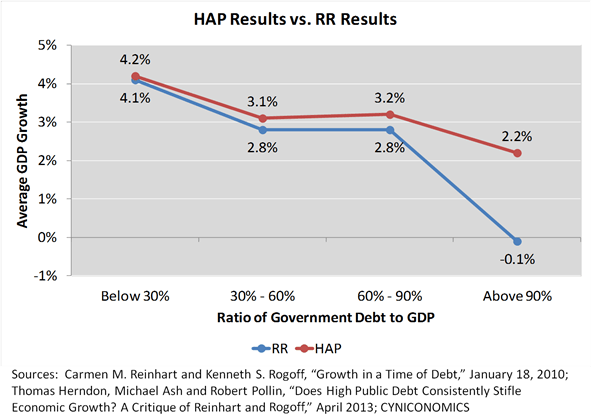
Wiley reminds us that while the sensationalist media have focused on the arithmetical error in  RR’s Excel file, the main reason for the discrepancy between RR and HAP is a function of their different ways of calculating averages.

Wiley also reminds us that  “Much of the reporting extended beyond the 2010 paper, leading readers to believe that HAP’s critique invalidates RR’s other work, including their 2009 bestseller, This Time is Different. An LA Times report, which was also picked up by RealClearPolitics, even claimed that RR “popularized” the 90% threshold in their book. In fact, the book did no such thing, nor did RR publish any similar results before 2010.”

Wiley also points out that the influence of RR over actual economic policy, while probably quite real, was also probably quite limited as well.  Austerity policies would probably have commanded majority support in national legislatures without the 2010 paper. At best, RR’s argument that a debt-to-GDP ratio of approximately 90% of GDP represented a sort of tipping point may have swung the vote of a few legislators. I made a similar point in an earlier blog post.

More fundamentally, HAP and RR agree that, in general, heavy public indebtedness is associated with reduced economic growth.  (See below).  They mainly disagree about whether debt’s impact on growth accelerates at around the 90% mark.  Neither side have really demonstrated causation or that high debt causes slow growth, or vice versa.


Video about Excelgate

22 04 2013

posted earlier about Excelgate, which is perhaps the most important controversy related to economic history research in recent years.

In this video, a left-wing US radio host named Mike Konczal discusses the controversy over the Carmen Reinhart – Kenneth Rogoff research.  This video certainly isn’t an academic podcast, but it may be useful in teaching as a way of kick-starting a classroom discussion.


Panel on British Business Overseas in the Mid-Twentieth Century

18 04 2013

AS: Our panel for the Association of Business History (ABH) Conference, 28 and 29 June 2013, has been accepted.

The paper titles are:

“The Transitory Period in British International Business, 1950-1980: Evidence from the British Overseas Mining Sector” Kevin Tennent; Simon Mollan; Philip Garnett.

“Delayering the Workforce: HSBC in the 1960s” Andrew Smith

“British Merchants on the West Coast of South America in the Inter-War Period: Growth, Survival and Failure” Rory Miller


The CEGBI/CSWL Summer Conference

18 04 2013

AS:The Centre for Evolution of Global Business and Institutions at the University of York (UK) studies the evolution of business and institutions around the world. It is an important centre of business-historical research. In partnership with York’s Centre for the Study of Working Lives (CSWL), they are holding a conference in June. 

Here is the draft programme: 

The CEGBI/CSWL Summer Conference

The York Management School

13-14 June, 9.00 am to 6.00 pm

Programme

Thursday 13 June 2013

9.00 – 9.10 am Welcome from Teresa da Silva Lopes and Stephen Linstead

9.10-10.40 am Session 1 – Entrepreneurship and Marketing

Chair:

‘Social Entreprise as hybrid organisational forms: A Review and Research Questions’Bob Doherty, University of York

‘Immigrant Entrepreneurs on World Successful Brands’ Nur Suhaili Ramli, University of York

‘How is marking implemented in social work social enterprises and with what effect does this impact upon their sustainability’ Madeline Osborne, University of York

‘The Impact of Strategic Airlines Alliances on Brand Management Practices’ Dana Kakeesh, University of York

10.40 – 11.00 am Coffee Break

11.00 – 12.30 pm Session 2 – Crisis and Inertia

Chair:

‘Evaluation Marketing Strategies’ Doaa Amin Shohaieb, University of York

‘Suez Crisis 1956-57’ Neveen Abdelrehim, University of York


‘Why GAP has decreased its brand values: from a brand management perspective’ Susumu Harada, University of Hyogo, Japan, and University of York

‘Risk Management Strategies in High Risk International Environments’ Teresa da Silva Lopes, University of York and Mark Casson, University of Reading

12.30 – 1.30 pm Lunch

1.30 – 3.00 pm Session 3 – Humour in Organization

Chair:

‘Visualising humour: Exploring jokes in virtual and material organisational space’ Carolyn Hunter, University of York

‘The Symbolic, the Imaginary and the Real – an Exploration of Zizek for Academia’ Lynne Baxter, University of York

‘Swarm Creativity and Relationship Marketing in Punk and Post-Punk: A Case Study of the Eruptörs’ Alex Gillett, University of York, and Gareth Dylan Smith, Institute of Contemporary Museum Performance

‘Laughter and Organization: An Initial Exploration’ Steve Linstead, University of York

3.00 – 3.30 pm Tea break

3.30 – 5.00 pm Session 4 – Management and Competitive Advantage

Chair:

‘The Blind Men and the Elephant – what did managers ever do for the railway?’ Nicola Forsdike, University of York

‘Managing Technological and Cultural Change at HSBC between 1945 and 1975’ Andrew Smith, Coventry University, and Bernardo Batiz-Lazo, Bangor University

‘Inter-firm networks as longitudinal determinants of corporate change: evidence from the British overseas mining industry’ Simon Mollan, University of Liverpool, Philip Garnett, Durham University

‘Management and Competitive advantage in the public transport industry – York Corporation Tramways c. 1909 – 1934’ Kevin Tennent, University of York

5.00 pm Drinks Reception

2

Friday 14 June 2013

9.00 – 10.30 am Session 5 – Social Roles and Identities

Chair:

‘Young men, family, and the breadwinner role: the place of work in the life course’ Sally Brown, University of Durham

‘It makes you make the time: An Ethnographic study of busy people on their allotments’ Abigail Schoneboom, University of York

‘Married women’s separate and joint savings bank accounts in the 19th century England’ Josephine Maltby, University of York

‘Women aiding the poor without almsgiving’ Josephine Maltby, University of York, Janette Rutterford, Open University

10.30 – 10.45 am Coffee Break

10.45 – 12.30 pm Session 6 – Capital Markets and Financial Services

Chair:

‘Day-of-the-Week Effect: Evidences from Dhaka Stock Exchange’ Moshfique Uddin, University of York

‘The analysis of social, political and economic influences on accounting changes to the Companies Act 1956 in India from 1947 to 1997’ Shraddha Verma, University of York

‘R&D Expenditure and Capital Market: Evidence from Bangladesh’ Ashraful Alam, University of York

‘Adaption of building societies in the United Kingdom to the introduction of competitveness in the financial services sector – the effect of securitasation and demutualisation on the composition of the board of directors’ Matthias Hambach, University of York

‘Hedge funds’ Dimitrios Stafylas, University of York

12.30 – 13.30 pm Lunch

3

1.30 – 3.00 pm Session 7 Political Economy and FDI

Chair:

‘The Evolution of an EU ‘institution’: Common Security and Defence Policy (CSDP)’ Simon Sweeney, University of York

‘Institutions and state building’

Seb Bytyci, University of York ‘The Role of Formal Institution and FDI in Innovation – Evidence from China’s Manufacturing Firms’

Yi Qu, University of York

‘The Role of Institutional Distances in Cross-border Mergers and Acquisitions – Evidence from Emerging Economies Firms’ Yaoan Wu, University of York

3.00 – 3.30 pm Tea Break

3.30 – 5.00 pm Session 8 – Employee

Chair:

‘Re-thinking Employee Recognition: Understanding Employee Experiences of Recognition’ Charlotte Smith, University of York

‘Sectors or Countries? Typologies and Levels of Analysis in Comparative Industrial Relations’ Barbara Bechter, Bernd Brandl, University of York

‘Employee suggestions schemes’ Qin Zhou, University of York

‘Professionalisation of Medical Physics Experts in Europe: The Need for A Consistent and Positively Recognised Brand’ Alex Gillett, University of York


Summer School: History of Business Systems and Entrepreneurship in Europe

17 04 2013

AS: I thought that this announcement might interest some of the grad student business historians who read this blog. 

Now open for enrolment

Date: August 5 – August 16 2013

Summer School 2013, Utrecht University, the Netherlands

This summer the Utrecht University Summer School will offer the course History of Business Systems and Entrepreneurship in Europe.

This two-week course will examine business systems and various forms of entrepreneurship in Europe from a historical perspective. Also the global market and the increasing influence of non-European businesses will be examined.

Students will participate in seminars and will get lectures from academic professionals and senior managers from Dutch corporations.

There will be two excursions during the course.

Given the intensity and academic level of the course a good understanding of the English language is mandatory.

For further information please see:


History of Business Systems and Entrepreneurship in Europe 


Utrecht Summer School:

http://www.utrechtsummerschool.nl/


Or contact Maurits Rost.


Of Excel and Nations

16 04 2013

In the General Theory, Keynes wrote: Practical men, who believe themselves to be quite exempt from any intellectual influences, are usually the slaves of some defunct economist.

Personally, I think that Keynes was exaggerating the impact of intellectuals on public policy here. However, he was right to suggest that ideas have consequences. Politicians certainly try to defend whatever policy they have already decided to implement by citing academic studies and cherry picking data points from the historical record. In some cases, they may actually be influenced by the teachings of academic economists and even economic historians.

For the last three years, austerity policies on both sides of the Atlantic have been justified by citing a 2010 economic history paper by Carmen Reinhart and Kenneth Rogoff that allegedly  demonstrated that debt loads over 90% of GDP were economically toxic. Now we find out the conclusions in the paper were due, in part, to an innocent but clumsy rounding error in Excel. See here.  Apparently, in doing their calculations, they made Excel cell L51 equal to AVERAGE(L30:L44) rather than AVERAGE(L30:L49), which accidentally meant that the strong post-1945 economic performance of such debt-laden countries as Canada, and Australia was not included in the average.

A new paper “Does High Public Debt Consistently Stifle Economic Growth? A Critique of Reinhart and Rogo ff” by Thomas Herndon, Michael Ash, and Robert Pollin has exposed some of the problems with the 2010 paper. See here.

Here is the abstract:

“Herndon, Ash and Pollin replicate Reinhart and Rogoff and find that coding errors, selective exclusion of available data, and unconventional weighting of summary statistics lead to serious errors that inaccurately represent the relationship between public debt and GDP growth among 20 advanced economies in the post-war period. They find that when properly calculated, the average real GDP growth rate for countries carrying a public-debt-to-GDP ratio of over 90 percent is actually 2.2 percent, not -0:1 percent as published in Reinhart and Rogo ff. That is, contrary to RR, average GDP growth at public debt/GDP ratios over 90 percent is not dramatically different than when debt/GDP ratios are lower. The authors also show how the relationship between public debt and GDP growth varies significantly by time period and country. Overall, the evidence we review contradicts Reinhart and Rogoff ’s claim to have identified an important stylized fact, that public debt loads greater than 90 percent of GDP consistently reduce GDP growth.”

It remains to be see whether any of the policymakers who cited the 2010 paper will acknowledge that they were citing flawed research.


History of Capitalism Summer Camp

16 04 2013
History of Capitalism Summer Camp
Cornell University
July 14 – 25, 2013
 
 
Want to write history using corporate archives?
Want to use numbers? 
Don’t know where to start?
 
Join 25 other historians and get the skills you need to understand economic theory, interpret quantitative sources, make sense of corporate archives, and write the new history of capitalism from the bottom all the way to the top
 
 
Topics Include:
 
Microeconomics
Macroeconomics
Data Analysis
GIS
Financial Statements
Corporate Finance
Business Strategy
Graphing/Data Representation
 
 
Session includes housing, breakfast, lunch, and all materials
Instruction will be by Cornell faculty and staff
Faculty: $1800                        Graduate Students: $600


Event Announcement: After Networks: New Approaches to British Imperial History, c.1750-1970

9 04 2013

Date and Location : 19-20 April, Humanity Manse and College Bounds, University of Aberdeen

In recent years, the study of the British empire has increasingly been driven by a focus on networks. Scholars have devoted considerable attention to reconstructing and conceptualising the various ‘imperial networks’, circuits, and circulations of people, ideas, and (to a lesser extent) resources that permeated the empire. The network turn has coincided with broader anti-structuralist trends and a resultant diffusion of network theory, transnational approaches, and attention to the study of globalisation across the humanities and social sciences. The turn has generated many fruits, highlighting the complex interconnections throughout the empire (and among colonies as well as between colony and metropole). Yet while the necessity of the network concept is well established, doubts are surfacing as to its sufficiency as a mode of analysis:

  • How and why do networks form and evolve?
  • Are some places more densely connected than others and if so why?
  • How do networks interact with institutions?
  • Should an attention to connectivity be tempered through a consideration of disconnection and dislocation?

The symposium aims to facilitate more nuanced and contextualised understandings of the value and limitations of networked approaches. It will do so by bringing togetherspeakers to offer papers (and ample time allocated for discussion) reflecting on networked approaches to the history of global empire, drawing perspectives from their own research.


Jatinder Mann on Integration Policy in Canada, 1950s-1960s

8 04 2013

Some readers may be interested in Dr Jatinder Mann’s forthcoming talk about the precursors of official multiculturalism in Canada:

Jatinder Mann, ‘“Retaining migrant cultures”: Integration policy in Canada, 1950s-1960s’, North American Studies Seminar Series, St. Anthony’s College, Oxford, UK, 5-6.30pm, Monday 29 April, 2013
Location: Fellows’ Dining Room, Hilda Besse Building, St Antony’s College, Oxford.


Is Business History Now Sexy?

7 04 2013

For the longest while, business history was deeply unfashionable in North American history departments. Indeed, many of the people doing research on business history migrated to other disciplines. That’s changing, as the New York Times reports on page A1 of today’s city edition. See here.

After decades of “history from below,” focusing on women, minorities and other marginalized people seizing their destiny, a new generation of scholars is increasingly turning to what, strangely, risked becoming the most marginalized group of all: the bosses, bankers and brokers who run the economy.

Even before 2008, classes dealing with the history of capitalism were starting to make their way back into the curriculum. The GFC accelerated this trend for a number of reasons, the most important of which, I think, the frequency with which journalists and policymakers compared the crisis to the 1929 stock market crash.

The article discusses the growing community of scholars who teach history majors about the history of business. Photographs of Julia Ott, Stephen Mihm, and Bethany Moreton are included.  These historians are members of the Business History Conference. Many scholars today identify with the label “history of capitalism” rather than “business history” and approach the study of the past with a set of assumptions very different from that of traditional  business history associated with Alfred Chandler. Fairly typical of the new type of business history is Bethany Moreton’s fascinating book To Serve God and Wal-Mart: The Making of Christian Free Enterprise (Harvard University Press, 2009).This book is a cultural history of Wal-Mart that shows how evangelical Protestantism was used to justify the free market and to attack the cultural and political foundations of the New Deal. It’s about an alliance of Deep South entrepreneurs, largely female evangelical employees, and free-market ideologues. Moreton’s research combines an interest in business history with the study of gender and religion. It is also decidedly non-celebratory, in sharp contrast to some earlier works in the field.  Indeed, the book’s page on the HUP website notes that “The author has assigned her royalties and subsidiary earnings to Interfaith Worker Justice and its local affiliate in Athens, GA, the Economic Justice Coalition.” 

Business history, which has the company as its basic unit of analysis, should not be confused with econometric history, which is both far more quantitative and interested in macro developments. (I’m currently at the Economic History Society Conference and have been listening to presentations by both econometric historians as well as narrative business historians. It is fascinating watching the two groups in dialogue). However, my impression is that economic history is increasingly important in economics departments.   Business history of a type is also being re-integrated into the curriculum of many management schools. The Rotman School of Business in Toronto has committed to nurturing Canadian business history.