That’s being debated by readers on the New York Times Economix blog right now. The blog post that started the conversation is a dialogue between David Leondhardt of the NYT and Professors Robert B. Archibald and David H. Feldman, two economists at the College of William & Mary. Archibald and Feldman are the authors of “Why Does College Cost So Much?”
This book seeks to explain why the total cost of delivering higher education (which is funded by a mixture of tuition fees, philanthropy, and taxpayers) has escalated much faster than the rate of inflation. The authors are not interested in the very important, but nevertheless separate question, of what the appropriate balance of these three main sources of funding would be. (This is a hot topic of political debate right now, especially here in the UK, where the burden is being shifted from the state to students). Instead, Archibald and Feldman are concerned with the more fundamental issue of the actual cost of educating a student rather than the issue of who picks up the bill.
One of the issues addressed in the dialogue is why technology has don’t more to drive down the cost of delivering university education. After all, there are lots of other products, services as well as goods, that are far cheaper than they were 30 years ago because of technology. Think of long distance phone calls. In terms of the number of hours the average person needs to work to buy it, a tonne of steel or a loaf of bread is far cheaper now than it was before the Industrial Revolution. The price of certain services has also fallen as well. So why have some services, such as higher education, stayed expensive?
When asked why technology hasn’t made higher education cheaper to deliver, Dr. Feldman had this to say:
Higher education certainly is affected by technological change, and this can indeed reduce cost. For instance, like most industries, we no longer use an army of typists to process paperwork. But the primary effect of technological change in higher education is not cost reduction. Instead, new technologies and techniques change what we do and how we do it. In many ways, colleges and universities are “first adopters” of new technologies because our faculty needs these tools to be productive scholars and teachers. Our students need these tools because they are used in the labor market they will be entering. In a sense, universities must meet an evolving standard of care in education that is set externally. The term “standard of care” is not an accident, since it reflects the way new techniques also affect the kindred service of medical provision.
The dialogue is pretty US-specific and is undermined by a near total lack of international comparative data, but there are some interesting ideas of more general applicability here. I would love to ask Archibald and Feldman “So if the cost of higher education is spiralling in the US far faster than inflation, which country has done the best job of controlling costs in higher education?”
In the US debate on healthcare reform, people make lots of international comparisons (e.g., “if we had single-payer like Canada, health care would consume a lower percentage of GDP” or “Singapore’s healtcare system is the most cost effective, so let’s copy that”). When it comes to the debate over the costs of higher education in the United States , few of international comparisons are made, which is odd because the higher education fields is actually highly internationalized in terms of the workforce, student body, etc.
For blogosphere reaction to the Archibald-Feldman book, see here, here, and here.
One of the more interesting reactions to the Archibald-Feldman book came from the blog Marginal Revolution, where Tyler Cowen alluded to the fact that it many fields there a big surplus of unemployed PhDs has persisted for many years without any impact on the price of higher education or average class sizes.
“There are plenty of wanna-bee professors discarded on the compost heap of academic history.” Yet the best discard should not be much worse, and may even be better, than the marginally accepted professor. Such a large pool of surplus labor would play a significant role in an economic analysis of virtually any other sector.
Cowen’s point has a certain logic to it– if there were a glut of crude oil due to over-production, we would expect the price of fuel to fall, with savings ultimately being passed on to the consumers. Motorists would respond to the new lower price for fuel by driving more or driving the same and spending the money elsewhere. Labour is the single biggest cost in higher education– so why isn’t the surplus of qualified instructors translating into either lower costs or smaller class sizes? This is an interesting question of economic analysis. I don’t pretend to have an answer to it, because I’m a historian rather than an economist.
My own theory about the escalating costs of US higher education is that landscaping is one area where economies should be made. Do universities really need elaborate gardens, fountains etc? Is it just to ask either students or taxpayers to pay for fancy buildings? Some of the universities in the US I have visited are far too nice.

Notre Dame Stadium

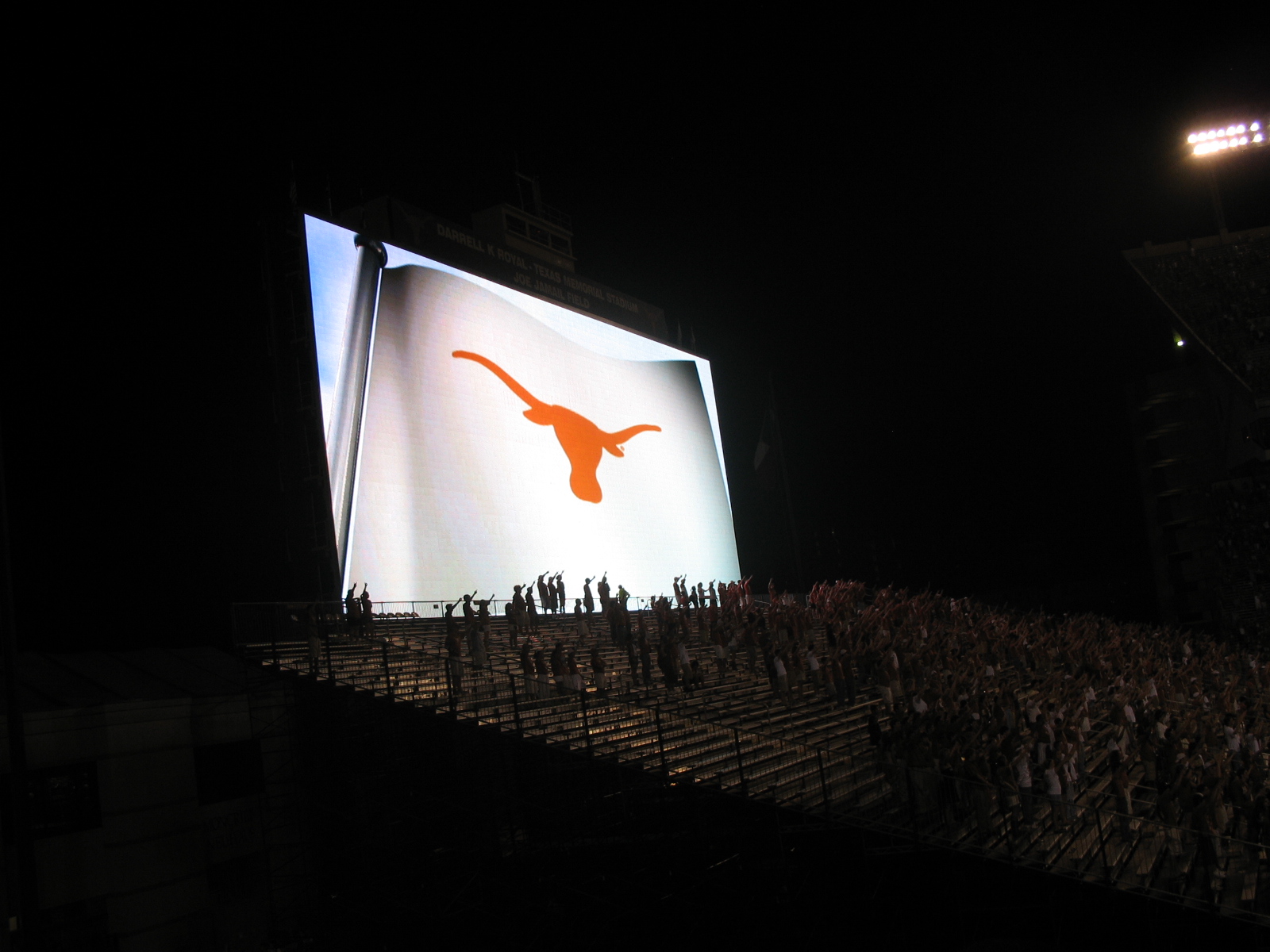
The Godzillatron Screen at Texas Tech Football Stadium Exists to Distract Students from their Studies
Facilities for spectator sports eat up a lot of money in the US higher education system as well. Some universities have huge stadia for football games. These are funds that could be going into scholarships for poor kids. If Obama wanted to be really bold, he could call for an end to inter-collegiate athletics as a temporary austerity measure. With luck, this temporary measure could become permanent.



 The Past Speaks