I am starting a new research project. Between Ethnocentrism and Commercial Cosmopolitanism: the Ethnic, Racial, and National Identities of Anglo-Celtic Businessmen in Asia, 1865-1914. This project, which is still in the research design/preliminary investigation stage, will be the major focus of my research time for the next five years. I’m planning to provide updates on the progress of this project on this blog.
Basically, I plan to research a book that will examines how white English-speaking businesspeople thought about and interacted with their East Asian peers from 1865 to 1914. (I have used the term Anglo-Celtic because it is a bit more accurate than the more familiar “Anglo-Saxon”. I’m also using the term “businessmen” rather than “businessperson” because commercial activity was highly gendered in this period and basically all of the individuals I will be examining were male).

Pedder Steet, Hong Kong, 1870s
This project is an outgrowth of my earlier research on the history of transnational business and globalization and my publications on race. The focus of this book will be on businessmen from Canada, the United States, and Britain, although I may find some information about Australasian businessmen as well.

Premises of Augustine Heard and Co., Hong Kong, 1860
The basic research question is to figure out the extent to which the racist ideas that were so common in this period actually influenced the day-to-day dealings between East Asian and Anglo-Celtic businessmen.
In the period under discussion, racism was rife in Western countries: the United States, Canada, and the Australasian colonies all introduced laws discriminating against East Asian immigrants. Influenced by social Darwinist ideas about race and Orientalist views of Asia, most Westerners regarded themselves as superior to “Orientals”. At the same time, the Anglo-Celtic countries traded extensively with China and Japan. Although some of this trade mediated by state, in most cases it was conducted by private firms. All of this commercial activity required Western merchants to interact with their East Asian peers. In some cases, their dealings were one-off transactions and cash deals.

Dai-ichi Mutual Life Insurance Company Building, Tokyo
In other cases, however, long-term contracts were signed and joint ventures were established. The Hongkong and Shanghai Banking Corporation, which had branches in many treaty ports in China, used compradores, who were typically already wealthy Chinese merchants, to deal with locals. In a few cases, corporations in which some of the managers were East Asian, others white, were formed. All of this raises the question of how attitudes towards race influenced business. One possibility is that Anglo-Celtic businesspeople in East Asia essentially ignored the racist messages they were getting from their home culture. Another possibility is that the ethnocentric ideas of the period had a measurable impact on their day-to-day business operations. I suspect that when I get into the archives, I am going to find that some businessmen in East Asia harboured quite racist attitudes and suffered commercial for it, while others had a more cosmopolitan attitude. I’m especially interested in the period around 1905-6, when there was a massive boycott of U.S. products in China to protest the immigration laws of that country.
In designing this research project, I read the works of historians such as Geoffrey Jones, Sherman Cochran, Mira Wilkins, and many others. However, the book that did the most to inspire this project was Kevin C. Murphy’s recent book on the American merchant experience in Japan between 1858 and 1899.
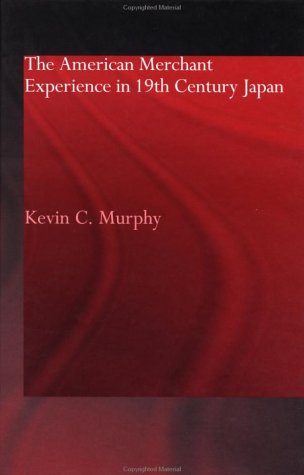
Murphy is a historian of the nineteenth-century United States whose research on American merchants in Japan was an outgrowth of his interest in race in the US. (His first book was on the Civil War and had nothing to do with Asia). Anyway, this book by Murphy covers the period of the “unequal treaties”, which gave Western merchants living in designated Japanese ports an exemption from Japanese laws. Only in the 1890s was Japan strong enough to demand the revision of these treaties. By 1858, when American merchants first entered Japan, a sophisticated market-based economy and large merchant class had already emerged in Japan. (In terms of its economy, Japan in 1860 was the Asian nation most like Western Europe). Murphylooks how race influenced how Americans interacted with this indigenous business class. He
contextualizes the attitudes of the American merchants by referring to the ongoing campaign against
Asian immigration in the United States. He argues that the Americans’ disdain for the Japanese caused
them to rely on middlemen called “boekisho” or ‘foreign goods merchants” to sell their wares to
Japanese consumers.
Murphy attributes the unwillingness of Americans to deal directly with consumers to the racist ideas then hegemonic in the United States. Murphy also documents the importance of “bantos” or “chief clerks”, the Japanese employees who were mainly responsible for negotiations with Japanese merchants. He shows that bantos employed by American firms were typically not classed as front-office employees, even though they were employed in clerical tasks that required literacy. He also shows that the typical American merchant in Japan was at the mercy of his banto because few of them bothered to learn any Japanese. The picture of the American merchant that emerges from Murphy’s
study is that of an arrogant and ethnocentric clique of expatriates who held aloof from the general
population, refused to learn more than a few words of Japanese, and suffered commercially as a result.
Murphy’s book is very interesting, but it suffers some limitations: a) his focus is just on Japan, whereas it would be helpful to look at the other East Asian treaty ports b) he looks only at US businessmen, when we know that by 1914 Englishmen outnumbered American merchants in Tokyo. It would be interesting to compare the attitudes to British and Americna businessmen in East Asia to see if the greater success of the British had cultural roots.
The companies I plan to examine include:
United States:
British American Tobacco
Singer Sewing Machine
Oriental and Occidental Steamship Co.
Standard Oil
British:
Alfred Holt and Co.
John Swire and Sons, Ltd.
Chinese Engineering & Mining Company Ltd.,
Lever Brothers.
Canada:
Canadian Pacific Steamships
Sun Life Insurance Company of Montreal, Ltd.

CPR's Empress of China, c. 1904, en route between Vancouver and Yokohama
The case studies relate to different industries (consumer goods, banking, shipping, insurance) for diversity/representativeness. Each case study will be based on archival materials and printed primary sources. The archives I plan to consult are manuscript collections in Britain and North America. My research should interest the following groups of scholars: social historians of Canada, the United States, and Britain; historians of globalization; historians of international political economy; historians of business. This project may also be of interest to historians of China and Japan, but I have conceived it as mainly as a contribution to the histories of North America and Britain.
If all goes as planned, in 2016 or so, I should publish a book on this topic. I hope that you buy it!
 The Past Speaks