Yesterday, South Korean President Yoon Suk Yeol declared martial law, absurdly accusing the centre-left opposition parties of collaborating with North Korea to justify suspending constitutional protections, including the right of the National Assembly to meet and discuss. This move faced immediate backlash: opposition lawmakers defied military barricades to convene in the National Assembly, where they unanimously voted to overturn the decree. Facing mounting pressure, including dissent from his own centre-right political party, President Yoon rescinded the martial law order within hours. Pro-democracy norms asserted themselves to ensure that there would be no backsliding into the authoritarianism South Korea suffered from pre-1987. The hapless president now faces calls for his impeachment and expulsion from his own political party. For me, the main takeaway from this episode is the resilience of South Korea’s democratic institutions. South Korea has Western-style political institutions that have been grafted onto its Confucian/East Asian culture in the last few decades. All of this makes me think that inherited culture is less important than social-scientific theories might lead one to suggest. Social scientists, take note! In fact, I think that maybe we should stop using the term “Western” as a short-hand for “liberal democratic countries.”
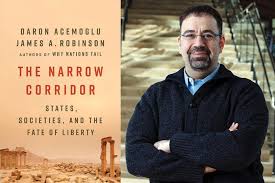
Here is another take away from the recent events in South Korea. Maybe cultural inheritance and long-term history going back centuries matter even less that Acemoglu and Robinson have suggested. Daron Acemoglu and James A. Robinson, the authors of The Narrow Corridor, were big names even before their recent Nobel Prize. Acemoglu is an economics professor at MIT, known for his work on political economy and development economics. Robinson is a political scientist and economist at the University of Chicago, focusing on political and economic development in Latin America and sub-Saharan Africa. They’ve teamed up before on the bestseller Why Nations Fail, exploring why some countries prosper while others don’t. In The Narrow Corridor, they dive into the delicate balance between state power and societal influence that’s crucial for liberty to flourish. They focus a lot in this book on the Western cultural tradition and, in particular, the Anglo-American/Germanic cultural inheritance. The cover of one version of their book even has images of the ruins of the Parthenon, which communicates that idea that ancient Greeks in the family tree helps to explain why part of the world is democratic while other parts aren’t.
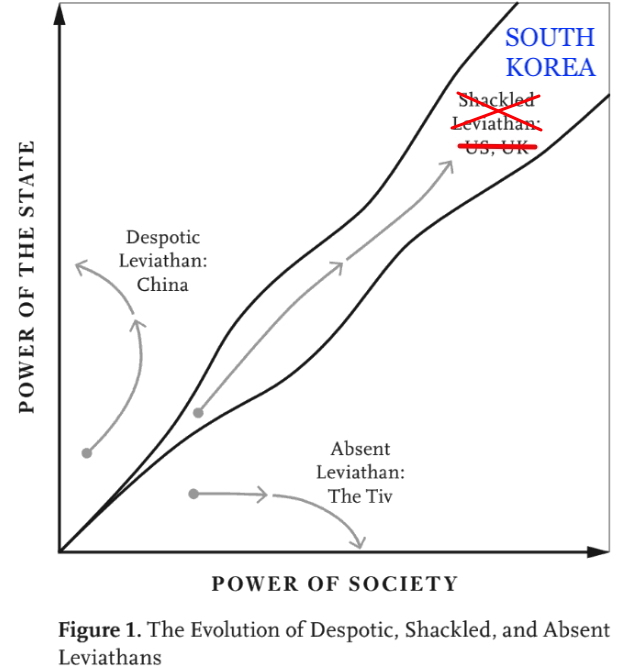
The Narrow Corridor argues that freedom and prosperity thrive when a delicate balance exists between the state and society—a “shackled leviathan.” In these countries (think the UK and the US), strong institutions ensure the state is powerful enough to govern effectively but also constrained by an engaged, organized society that can hold it accountable. In contrast, despotic leviathans have powerful states but weak societies (think China for most of the last thousand years), leading to oppression and authoritarian rule, while absent leviathans suffer from weak states and weak societies, leaving them mired in chaos and lawlessness (think Somalia or most tribal societies). The authors also emphasize that culture plays a huge role—societies don’t just randomly fall into one category or another. Historical events and cultural norms shape their trajectories, creating a kind of “path dependence” that makes it hard to break free from established patterns. That’s sort of true, but that theory makes it harder to explain what recently happened in South Korea. Having lots of Anglo-Saxon “cultural DNA” in a given country seems to matter less to its political institutions than the Narrow Corridor might lead you to believe.
I’m sharing an amusing/thought-provoking image that Pseudoerasmus shared on Twitter/X. The image is a famous figure from the Narrow Corridor that someone hacked yesterday!
Brendan Greeley’s opinion piece in the Financial Times, “The Nobel for Econsplaining,” has sparked quite a bit of debate. Greeley’s writing is witty and engaging, and he clearly knows his stuff when it comes to econometric research methods, which makes his critique of economists’ work all the more credible. Here is an example of his prose
Acemoglu and Robinson read a book called American Slavery, American Freedom, used the bits about American freedom and tossed the bits about American slavery. The new economic institutionalists treat work on institutions by a celebrated historian not as a coherent argument, but as a source of anecdotes. If they did this with data, you’d call it p-hacking.
However, I’m not totally convinced by his main argument. He suggests that understanding the history of slavery and race relations within the present-day United States and culturally proximate countries is key to seeing why Daron Acemoglu, Simon Johnson, and James Robinson (AJR) have produced an inaccurate theory about the relationship between political institutions and economic growth. The stakes in the debate about the accuracy of the AJR theory are high because it has massive normative implications: if their theory is true, then the case for Western countries promoting Western-style political style institutions around the world and for sending, say, more weapons to Ukraine, will be stronger than it would otherwise be.
Most of Greeley’s piece focuses on events in the British colonies in the New World and the historiographic debates around them. In trying to show what’s wrong with the AJR paradigm, he spends more time discussing a book by an American historian from 1975 than the incredible rise of the Chinese economy since 1978!!! Greeley, being a US citizen who just happens to live in a region that once had African slavery (New Jersey), might be overestimating the importance of historical phenomena that are geographically close to him when evaluating AJR’s overall theory. I find that Greeley’s piece displays evidence of too many cognitive biases. In particular, the proximity bias is strong here. Maybe I’m guilty of recency bias in wanting us to focus our attention on China since 1978. I suppose we need to proper methodology to counteracting all of these biases so that we don’t end up cherry picking data.
Here is some background. As many readers of this blog will know, Daron Acemoglu, Simon Johnson, and James Robinson were awarded the 2024 Nobel Memorial Prize in Economic Sciences for their research on how political and economic institutions shape national prosperity. Their work, especially their theory of inclusive vs. extractive institutions, helps explain why some nations experience sustained economic growth while others remain poor. The award has been mostly well-received particularly by people in the centre of the Anglo-American political spectrum, highlighting the impact of their research on understanding global inequality, though some critics argue their theories overlook other factors like culture and geography. The critics come from various groups: academics in authoritarian yet economically successful regimes who don’t like the AJR insinuation that you need inclusive political institutions for prosperity, hard core left-wing critics who believe that it has already been proved that the West’s wealth is due to slavery and genocide, and then libertarians who think that AJR’s account is unduly celebratory of the mixed-economy arrangement that centrist academics tend to like.
AJR have faced heavy criticism from scholars who believe their work oversimplifies complex historical and economic processes, particularly in East Asia’s development and historical exploitation, such as slavery and colonialism. Austrian economists, people Pete Boettke and his colleagues at GMU, are also sceptical of their focus on state capacity, preferring more purely market-based explanations for economic development. The economists who were really vigorous critics of Covid lockdowns, US membership of NATO, and state intervention more generally tend to be the most sceptical of the AJR claim that England industrialized because it has the optimum blend of state and market. Seen from a sort of an-cap perspective, AJR sound like quasi-socialists.
In China, scholars have pointed out the tension between AJR’s emphasis on democratic governance and China’s authoritarian-led growth model. While their contributions are influential, the debate around their theories is shaped by ideological and geopolitical considerations.
AJR’s theory of inclusive political institutions, as detailed in works like Why Nations Fail (2012) and then their more recent book The Narrow Corridor argues that inclusive institutions—those allowing broad participation in political and economic processes—are key drivers of economic development. They contrast these with extractive institutions, where political power and economic benefits are concentrated in the hands of a few (think of Stalinism, feudalism, or the antebellum American South), which they argue stifle growth and innovation. They present historical evidence from various contexts to support this theory, emphasizing how colonial legacies, institutional arrangements, and power structures shaped different nations’ development trajectories.
Image from The Narrow Corridor
Critics argue that the rapid economic development of East Asian economies, such as South Korea, Taiwan, and above all mainland China, disproves AJR’s claim that you need inclusive institutions (basically democracy) for economic growth. These countries didn’t have fully inclusive political systems during their early development stages. Instead, they relied on strong, centralized, and often authoritarian governments to implement land reforms, industrial policies, and export-oriented strategies. In South Korea, this is more of an academic question, since the country transitioned to democracy around 1988 and has continued to develop since then. Everyone in South Korea now regards democracy there as normative. In mainland China, however, the claim that you need inclusive political institutions for economic growth is provocative and highly threatening to the existing political system. I find it strange that Greely says so little about China in his piece, as that’s the real Achilles heel of the AJR theory, not something that happened in Virginia in the 1600s.
Some scholars who fall into the camp of domestic British and American progressives argue that AJR downplay the role of slavery and other forms of coercive labour and land theft in the rise of Western economies. According to these people, we already know that the transatlantic slave trade, colonial resource exploitation, and forced labour were absolutely essential to Western Europe’s wealth accumulation, which fuelled industrialization. (Somehow these critics don’t explain why England and the Netherlands developed at a much faster rate that Portugal and Spain). Anyway, these critics suggest that economic growth can occur in contexts where extractive institutions play a significant role, contradicting the idea that inclusive institutions are always necessary for development.
The debate over AJR’s theory is deeply influenced by political ideology and geopolitics. I wish Brendan had said more about that factor and then about his own ideological commitments.
Here is Brendan’s brief biography:
Brendan comes to Princeton after 20 years as a journalist, covering economic and monetary policy. He was the US economics editor at the Financial Times, and continues to write a regular column there. Before that, he was a staff writer for Bloomberg Businessweek and The Economist, as well as an anchor and correspondent for Bloomberg TV. He has also written for the New York Times, the New York Times Magazine and the Wall Street Journal Europe, and received a New York Press Club Award for special event reporting in 2012. Brendan graduated from Tulane University with honors in German in 1997.
I would note here that Tulane, where Brendan did his undergrad, is in a part of the US where the legacy of slavery is visible all around you. That fact and other autobiographical should perhaps have been disclosed here.
References
Acemoglu, D., Johnson, S., & Robinson, J. (2002). Reversal of Fortune: Geography and Institutions in the Making of the Modern World Income Distribution. The Quarterly Journal of Economics, 117(4), 1231-1294.
Acemoglu, D., & Robinson, J. A. (2012). Why Nations Fail: The Origins of Power, Prosperity, and Poverty. Crown Business.
Boettke, P. J., Coyne, C. J., & Leeson, P. T. (2008). Institutional Stickiness and the New Development Economics. The American Journal of Economics and Sociology, 67(2), 331-358.
Chang, H.-J. (2002). Kicking Away the Ladder: Development Strategy in Historical Perspective. Anthem Press.
Inikori, J. E. (2002). Africans and the Industrial Revolution in England: A Study in International Trade and Economic Development. Cambridge University Press.
Wolfe, P. (2006). Settler Colonialism and the Elimination of the Native. Journal of Genocide Research, 8(4), 387-409.
Yao, Y. (2011). The End of the Beijing Consensus. Foreign Affairs, 90(6), 13-18.
Nick Crafts (born 1948), who is a very senior and respected economic historian at the University of Warwick, has published a new paper on the postwar British productivity failure. It examines why productive grew at a slower rate in the UK than in similar Western European countries in the three decades after 1945, which were, of course, a period when the UK remained, for various reasons, outside of the EEC.
Abstract: British productivity growth disappointed during the early postwar period. This reflected inadequate investment in equipment and skills but also entailed inefficient use of inputs. Weak management, dysfunctional industrial relations, and badly-designed economic policy were all implicated. The policy framework was partly the result of seeking low unemployment through wage restraint by appeasement of organized labour. A key aspect was weak competition. This exacerbated corporategovernance and industrial-relations problems in the British ‘variety of capitalism’ which sustained low effort bargains and managerial incompetence. Other varieties of capitalism were better placed to achieve fast growth but were infeasible for Britain given its history.
Keywords: competition; productivity; relative economic decline; varieties of capitalism
In my view, the most interesting and policy-relevant part of this paper appears at the very end. Prof. Crafts has effectively “buried the lede” by tucking this information down near the end, where he writes that the main features of the postwar period of British economic history were
ineffective competition policy, nationalization, and protectionism including remaining outside the EEC. This exacerbated problems of corporate governance and industrial relations inherent in the British ‘variety of capitalism’ as the economic rents that were generated helped to sustain low effort bargains and managerial incompetence.
(Bolding added by AS)
This paper builds on Craft’s earlier estimate (2016) that joining the EEC raised the level of UK GDP by about 8 to 10 per cent through increasing the volume of trade and strengthening competition. You can also read his short piece on what history says about Brexit here.
That’s the title of a great blog post about Greece’s current finance minister.
By training, Varoufakis is not an economist, but a mathematical statistician. And similar to many academics who migrated from the ‘hard’ sciences to economics, Varoufakis has built a career on ridiculing economists’ inferior abilities in math and statistics. Also economists’ too simplistic belief in the miracles of the markets, their tendency only to see positive sides to technological progress, and the idea that to do economics is to build simple mathematical models, is derided by Varoufakis in witty and rhetorically gifted prose. At the same time, Varoufakis has been employed by economic faculties for some twenty-five years, in which he hence felt like an “atheist theologian ensconced in a Middle Ages monastery.”
The whole blog post is well worth reading, even if you are less fascinated by Yanis Varoufakis than I am.
Professor John Turner, who is a financial historian at Queen’s University Belfast, has posted some interesting thoughts about the post-2008 crisis in economics. The 2008 GFC hasn’t exactly discredited mainstream economics, but it has caused people to ask some tough questions about the limitations of this intellectual tradition.
Five years after the collapse of Lehman Brothers, economists are still picking over the corpse of the financial system in an attempt to understand why the financial crisis happened. Some simply blame capitalism. Such a view is naive at best. For others,and I include myself in this camp, there probably wasn’t enough capitalism. In this op-ed, Roman Frydman and Michael Goldberg, extremely insightful economists, point the finger of blame elsewhere – the discipline of economics. Economists had totally the wrong economic models in their toolkit – they had models which assumed that the economy works in a mechanistic way, much like a complex piece of machinery. This reduces economics to an engineering problem. But at its heart, economics is a social and political science. The real issue for me is not whether economists had the wrong models (they quite obviously did), but why did they have the wrong models.
The film Inside Job is about the complicity of the economics profession in the policies that led to the GFC. The film talks about possible conflicts of interest and advances a sort of theory of disciplinary capture which is analogous to the regulatory capture often associated with the financial sector. In regulatory capture, the industry being regulated exerts undue influence over the regulatory body, perhaps through revolving door recruitment. In disciplinary capture, key members of an academic discipline are persuaded to advance a set of arguments that is congruent with the industry’s PR and lobbying campaigns.
Personally, I don’t think that disciplinary capture explains the more fundamental problems in mainstream economics, which go well beyond the few economists with close ties to Wall Street. I think that the problems in the discipline of economics are much deeper and are rooted in the rational actor to which mainstream economists subscribe. As many people have shown, this model does a poor job of accounting for the behaviour of investors in particular historical contexts. Investors and other participants in capital markets are actually more altruistic than the rational actor model suggests. That was certainly the conclusion I reached in an article that was published earlier this year. That article examines the extent to which political views of turn of the last century British investors influenced the global allocation of British capital. Much of the existing literature on pre-1914 British investment overseas dismisses the possibility that the pattern in Britain’s capital exports was significantly affected by imperial patriotism. This article suggests that imperial sentiment did indeed influence the destination of British capital exports; at least some British investors were willing to accept a lower anticipated rate of return because they valued the psychological satisfaction of investing in territories that happened to be part of the British Empire.
The entrepreneur Luke Johnson has a column in the Financial Times. Yesterday’s column was particularly amusing, as he bashed pretty much the entire economics profession. The opening sentence was “I fail to see the point of professional economists”. It went downhill (or uphill, depending on your perspective) from there.
Here are some of his pearls of wisdom:
“And the most dangerous economist of modern times is surely Alan Greenspan, the former head of US Federal Reserve who cheered America over a cliff.”
“Give me the company of artisans who create tangible things, like the bakers and chefs with whom I work in my restaurant companies. They might lack some of the rhetorical finesse of the economics commentators we read or hear through the media – but their practical skills are of vastly greater value to society than the pseudo-science espoused by Krugman et al. ”
Johnson also wrote: “The fact that most economics textbooks barely mention entrepreneurs – and when they do they miss the point – shows that most “dismal scientists” are out of touch and unversed in the real workings of marketplaces.”
Actually, this last point is a good one indeed.
Although other academics certainly study entrepreneurship, most economists do not. Indeed, I wrote something about this a few months ago. The following is from a piece I wrote on the intellectual precursors of Joseph Schumpeter, who helped to pioneer the academic study of entrepreneurship in the 1940s.
Given that their teachings had massive implications for business, it is striking that early economists in the English-speaking world rarely spoke about businessmen as a class, let alone particular firms, when analysing the economy. Instead, they dealt with abstractions such as the laws of supply and demand, balance of payments, equilibrium, and comparative advantage. The apparent expectation was that market forces would “naturally” bring different factors of production together and then transport goods to where the price was highest. Nowhere in The Wealth of Nations is the function of the entrepreneur directly discussed, an omission that was repeated in the works of most English-speaking economists of the nineteenth century. [1]
Alas, market forces can only really operate with the aid of flesh and blood human beings. It appears that writers on economic topics in the French speaking world were much more aware of the importance of the individual entrepreneur. Jean-Baptiste Say (1767-1832), a French economist, discussed the role of the entrepreneur in creating value by shifting resources into faster-growing parts of the economy.[2] The word entrepreneur entered the English language very slowly: when the Say’s works were translated into English in 1836, the translator decided to render “entrepreneur” as “adventurer”, a term reminiscent of the investors who had “adventured” or lent money to the Hudson’s Bay Company.[3][4] John Stuart Mill (1806-1873), further refined the concept of the entrepreneur in his 1848 Principles of Political Economy. Mill provided a much clearer distinction than either Cantillon or Say between true entrepreneurs and those business owners (such as shareholders of a corporation) who assume financial risk without actively participating in the management of a company.[5] Despite its use by such an influential thinker as Mill, English-speaking economists did not really pay that much attention to the category of the entrepreneurs until the 1940s. According to the Oxford English Dictionary, the most common meaning for entrepreneur in the nineteenth century was “one who ‘gets up’ entertainments, esp. musical performances”.[6]
Mill, it should be noted, devoted just a few pages in his massive tome to the concept of the entrepreneur. At no point in this book did Mill mention the inventor James Watt (1723-1819) or any of the other entrepreneurs whose innovations were dramatically transforming the world around him.
An economics textbook published by Frank Fetter in New York City 1904 referred to “enterprisers”, but did not really explore entrepreneurship in great depth, confining its discussion to just a few pages out of six hundred.[7] Moreover, this book was unusual in that it spoke about “enterprisers” at all, which is one of the reasons why Fetter has been called “a forgotten giant.”[8] The economic profession’s collective sin of omission in this era is striking given that captains of industry such as Rockefeller had then made themselves into household words in the United States, which was by now the world’s most advanced economy. Despite the visibility of the surnames of particular entrepreneurs such as Ford, Heinz, or in Canada, Eaton in their own homes, early twentieth century economists were simply not that interested in entrepreneurs. Nor did they pay much attention to the reasons why the old-style market economy characterized by a large number of tiny family firms had been transformed by the rise of the Big Business, that is the emergence of vast impersonal corporations owned by absentee shareholders and managed by salaried executives. Totally committed to their aprioristic approach, English-speaking economists preferred to focus on thought experiments and deductive reasoning about how people would behave in a given circumstance.[9]
[1] Charles A. Tuttle, “The Entrepreneur Function in Economic Literature,” The Journal of Political Economy 35, no. 4 (1927): 504.
[2] Evelyn L Forget, The Social Economics of Jean-Baptiste Say: Markets and Virtue (London: Routledge, 1999).
[3] As the translator noted in a footnote, “the term entrepreneur is difficult to render in English ; the corresponding word, undertaker, being already appropriated to a limited sense. It signifies the master-manufacturer in manufacture, the farmer in agriculture, and the merchant in commerce ; and generally in all three branches, the person who takes upon himself the immediate responsibility, risk, and conduct of a concern of industry, whether upon his own or a borrowed capital. For want of a better word, it will be rendered into English by the term adventurer” .Jean Say, Traité d’économie politique. A treatise on political economy or The production, distribution, and consumption of wealth. By Jean-Baptiste Say. Translated from the fourth edition of the French, (Philadelphia, Grigg & Elliot., 1836), 78.
[4] N. S. B. Gras, “Capitalism-Concepts and History,” Bulletin of the Business Historical Society 16, no. 2 (April 1, 1942): 24.
[5] Bert Hoselitz, “The Early History of Entrepreneurship Theory, Explorations in Entrepreneurial History”, 3,no. 4 (April 15, 1951), pp 193-220
[6] Second edition, 1989; online version November 2010. <http://www.oed.com:80/Entry/62991>; accessed 17 February 2011. Earlier version first published in New English Dictionary, 1891.
[7] Frank Fetter, The principles of economics : with applications to practical problems (New York: Century, 1904), 265-272.


 The Past Speaks