Some Thoughts On Trump, Tariffs, and the Canadian Constitution

4 02 2025

I’m feeling a little bit guilty, albeit only a little bit. Canada is in a really difficult situation right now thanks to Trump’s plan to impose 25% tariffs on its exports to the US. I think that if I had been more proactive back in 2015-2017, Canada might be in slightly stronger bargaining position today. That sounds very arrogant and conceited but please hear me out.

Here’s the background as to why I feel a bit guilty. I’m a dual citizen of Canada and the UK and I feel a strong sense of loyalty to both countries. I feel a greater sense of debt to Canada because that’s where I grew up. My formative experiences there included a tremendous sense of material abundance that just wouldn’t be paralleled here in the UK. I doubt that I would have had the luxury of becoming an academic had I grown up in Britian. Canada invested in me (I’m thinking of various scholarships funded by private donors and taxpayers, research fellowships, nice juicy research contracts, etc) so I feel a sense that I should pay it back.

In 2015, I had the opportunity to do precisely that. I was the star expert witness in a Canadian constitutional court case that had the potential to reverse a historical miscarriage of justice in a way that would resulted in the dismantling of internal trade barriers and a boost to Canada’s economic output. Had my side in the court case prevailed, I think that Canada would today have interprovincial free trade, a higher standard of living, and greater bargaining power in the face of Donald Trump’s threats.  Many observers, including the OECD and the IMF have said that Canada’s internal trade barriers are dragging down productivity and living standards. Getting rid of them could boost GDP per capita by up to 4%.

Here is a summary of the court case and my role in it. R v Comeau was a fascinating case about beer, borders, and the Canadian Constitution. It started when when Gerard Comeau, a New Brunswick resident, was stopped by police immediately after crossing an interprovincial border. He was charged with buying cheap beer and liquor in Quebec and bringing it home, thus violating a New Brunswick statute that severely limits on how much alcohol residents can import from other Canadian provinces. Comeau’s lawyers, who were supported by a non-profit foundation, argued that this violated section 121 of the Constitution Act, 1867, which says that goods should be “admitted free” across provincial lines. I testified about the historical context and motivations for section 121 in the summer of 2015. (You can read my expert witness report here). The case was widely covered in the Canadian media and, because it coincided with a federal general election, was commented on by all but one of the party leaders. (see media coverage here, here, and here). In 2016, a trial judge delivered his verdict and agreed with our side, ruling that provincial trade barriers were unconstitutional. However, the Supreme Court of Canada overturned this decision in April 2018, ruling that provinces have the right to regulate goods crossing their borders, as long as the primary purpose isn’t to block trade.

At the heart of the case were competing views of section 121. Comeau’s legal team, and I, argued for a broad interpretation—that the section bans any provincial law that impedes free trade between provinces. That’s the interpretation of the section that is most consistent with the values of the free trading Victorian lawyers and politicians who created it. (See analysis of my arguments here, here, and here). On the other hand, the New Brunswick government and Canada’s top court leaned on a narrower reading, arguing that section 121 only prohibits outright tariffs on interprovincial trade, not non-tariff trade restrictions, such as sending the police out to arrest people who import beer from the next province.

You can read about my involvement in the case in this academic article and in a McGill-Queen’s University Press book that won a number of awards.

My involvement in the court case was primarily at the initial trial stage, when it was being litigated in New Brunswick. I flew to New Brunswick from Paris where I was then living with my family (LONG STORY), testified for several days, came back to Europe, and was then gratified to read the news that judge had found my interpretation of the Canadian constitution to be persuasive. Having discharged my contractual obligations, I then basically stopped doing any work related to the case, aside from penning a short opinion piece in the Globe and Mail newspaper. Perhaps I should have invested more time in the trying to create awareness in Canada in the constitutional issues at stake, for instance by writing more about it or speaking about in the Canadian media. However, I had other fish to fry. My employer, a UK university, wouldn’t have been that pleased had a spent a significant amount of time on doing media work that wasn’t connected to a REF Impact Case. (For various bureaucratic reasons, my expert witness work couldn’t be classified as Impact work for the purposes of the REF. The REF is the system by which research performance, including societal impact, is measured and incentivized in UK universities). So, I didn’t do much with respect to the Comeau case after the week I spend in New Brunswick. In invested my research time in other projects, including the production of articles to be published in journals in the famous FT50 journal list. Basically I did the rational thing and focused my research time on the activities that are rewarded the most in the UK academic labour market. I said above that I feel only a little bit guilty, not really guilty. That’s because it was necessary for me to focus on my own career. I’m now working on other REF Impact Case projects that are unrelated to Canada and which focus on disseminating knowledge to non-academic research stakeholders here in the UK.

I suspect that if I had done more to educate the Canadian public about the original intent for section 121 of the Canadian constitution, the Canadian Supreme Court might have ruled differently. Judges are socially situated and they can’t ignore the prevailing climate of thought in their society as they interpret the evidence presented in court. Its ruling, which was delivered unanimously and was apparently written by the Chief Justice, quoted extensively from my expert witness report but ultimately sided against my interpretation. Had the Supreme Court sided with me, the interprovincial trade barriers would have been declared unconstitutional—after further litigation and transition costs as inefficient producers went out of business, GDP in per capita would almost certainly have been higher. And Canada would have been in a stronger position to deal with Trump.

The US, Canada’s adversary in the current struggle over tariffs, does not hobble itself with internal trade barriers: over the last two centuries, state politicians have tried to create internally protectionist barriers (it’s a perennial temptation) but because their Supreme Court has consistently upheld the original intent behind the Commerce Clause, the unity of the American internal market has been largely maintained.  In the U.S., free trade between states is guaranteed by the Commerce Clause or Article I, Section 8 of the Constitution. It gives Congress the power “to regulate commerce… among the several States,” which has been interpreted to prevent individual states from restricting trade or discriminating against out-of-state goods and businesses. Over the years, the Supreme Court has reinforced this principle through the “Dormant Commerce Clause” doctrine, which basically means that even when Congress isn’t actively legislating on interstate trade, states still can’t pass laws that unfairly burden commerce between them. This clause has had a huge economic and social impact—it helped create a truly national market, allowing businesses to grow beyond state borders and preventing economic fragmentation like we see in Canada with cases like R v Comeau. So, while provinces in Canada still fight over interprovincial trade barriers, the U.S. system—thanks to the Commerce Clause—has largely prevented that kind of economic balkanization.

In recent weeks, the threat of US tariffs has caused Canadians to discuss the subject of internal free trade with renewed vigour. There has been a lot of talk about eliminating these trade barriers through the expansion of existing interprovincial compacts (see here, here, here, and here), such as the New West Partnership. In my view, these initiatives are nice but their potential benefits are small relative to those that would come from a clear reversal of the position the SCC adopted in interpreting s. 121 in the Gold Seal case.

Don’t get me wrong. There are many other things that Canada had done to put itself in a weak bargaining position. For instance, it failed to follow up the splendid Canada-EU trade agreement it negotiated by building the east-west infrastructure (what I called Laurentian infrastructure in a nod to the Laurentian thesis associated with the late Donald Creighton) that would have allowed it to really take advantage of this paper agreement. I’m thinking in particular of the unbuilt pipelines to bring natural gas to Canada’s Atlantic ports, where it could have been liquified and sent to Europe. However, failure to bring about internal free trade has made a bad situation worse.

Perhaps a future Canadian government will have a policy of only appointing Supreme Court justices who agree with the view that Section 121 should be interpreted broadly rather than narrowly.   



Thinking Historically About the South Korean Attempted Coup

4 12 2024

Yesterday, South Korean President Yoon Suk Yeol declared martial law, absurdly accusing the centre-left opposition parties of collaborating with North Korea to justify suspending constitutional protections, including the right of the National Assembly to meet and discuss. This move faced immediate backlash: opposition lawmakers defied military barricades to convene in the National Assembly, where they unanimously voted to overturn the decree. Facing mounting pressure, including dissent from his own centre-right political party, President Yoon rescinded the martial law order within hours.  Pro-democracy norms asserted themselves to ensure that there would be no backsliding into the authoritarianism South Korea suffered from pre-1987. The hapless president now faces calls for his impeachment and expulsion from his own political party. For me, the main takeaway from this episode is the resilience of South Korea’s democratic institutions. South Korea has Western-style political institutions that have been grafted onto its Confucian/East Asian culture in the last few decades. All of this makes me think that inherited culture is less important than social-scientific theories might lead one to suggest.  Social scientists, take note!  In fact, I think that maybe we should stop using the term “Western” as a short-hand for “liberal democratic countries.”

Here is another take away from the recent events in South Korea. Maybe cultural inheritance and long-term history going back centuries matter even less that Acemoglu and Robinson have suggested.  Daron Acemoglu and James A. Robinson, the authors of The Narrow Corridor, were big names even before their recent Nobel Prize. Acemoglu is an economics professor at MIT, known for his work on political economy and development economics. Robinson is a political scientist and economist at the University of Chicago, focusing on political and economic development in Latin America and sub-Saharan Africa. They’ve teamed up before on the bestseller Why Nations Fail, exploring why some countries prosper while others don’t. In The Narrow Corridor, they dive into the delicate balance between state power and societal influence that’s crucial for liberty to flourish. They focus a lot in this book on the Western cultural tradition and, in particular, the Anglo-American/Germanic cultural inheritance. The cover of one version of their book even has images of the ruins of the Parthenon, which communicates that idea that ancient Greeks in the family tree helps to explain why part of the world is democratic while other parts aren’t.

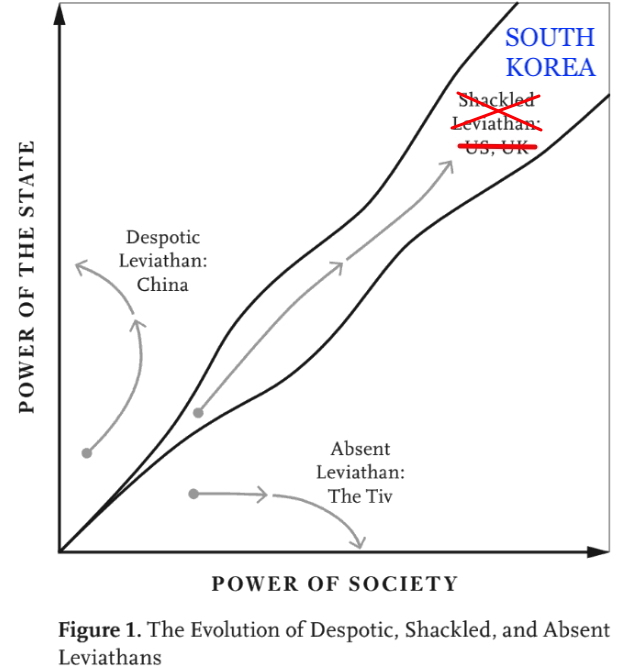
The Narrow Corridor argues that freedom and prosperity thrive when a delicate balance exists between the state and society—a “shackled leviathan.” In these countries (think the UK and the US), strong institutions ensure the state is powerful enough to govern effectively but also constrained by an engaged, organized society that can hold it accountable. In contrast, despotic leviathans have powerful states but weak societies (think China for most of the last thousand years), leading to oppression and authoritarian rule, while absent leviathans suffer from weak states and weak societies, leaving them mired in chaos and lawlessness (think Somalia or most tribal societies). The authors also emphasize that culture plays a huge role—societies don’t just randomly fall into one category or another. Historical events and cultural norms shape their trajectories, creating a kind of “path dependence” that makes it hard to break free from established patterns. That’s sort of true, but that theory makes it harder to explain what recently happened in South Korea. Having lots of Anglo-Saxon “cultural DNA” in a given country seems to matter less to its political institutions than the Narrow Corridor might lead you to believe.

I’m sharing an amusing/thought-provoking image that Pseudoerasmus shared on Twitter/X.  The image is a famous figure from the Narrow Corridor that someone hacked yesterday!


Brendan Greeley on AJR

23 10 2024

Brendan Greeley’s opinion piece in the Financial Times, “The Nobel for Econsplaining,” has sparked quite a bit of debate. Greeley’s writing is witty and engaging, and he clearly knows his stuff when it comes to econometric research methods, which makes his critique of economists’ work all the more credible.  Here is an example of his prose


Acemoglu and Robinson read a book called American Slavery, American Freedom, used the bits about American freedom and tossed the bits about American slavery. The new economic institutionalists treat work on institutions by a celebrated historian not as a coherent argument, but as a source of anecdotes. If they did this with data, you’d call it p-hacking.

However, I’m not totally convinced by his main argument. He suggests that understanding the history of slavery and race relations within the present-day United States and culturally proximate countries is key to seeing why Daron Acemoglu, Simon Johnson, and James Robinson (AJR) have produced an inaccurate theory about the relationship between political institutions and economic growth. The stakes in the debate about the accuracy of the AJR theory are high because it has massive normative implications: if their theory is true, then the case for Western countries promoting Western-style political style institutions around the world and for sending, say, more weapons to Ukraine, will be stronger than it would otherwise be.

Most of Greeley’s piece focuses on events in the British colonies in the New World and the historiographic debates around them. In trying to show what’s wrong with the AJR paradigm, he spends more time discussing a book by an American historian from 1975 than the incredible rise of the Chinese economy since 1978!!!  Greeley, being a US citizen who just happens to live in a region that once had African slavery (New Jersey), might be overestimating the importance of historical phenomena that are geographically close to him when evaluating AJR’s overall theory. I find that Greeley’s piece displays evidence of too many cognitive biases. In particular, the proximity bias is strong here. Maybe I’m guilty of recency bias in wanting us to focus our attention on China since 1978. I suppose we need to proper methodology to counteracting all of these biases so that we don’t end up cherry picking data.

Here is some background. As many readers of this blog will know, Daron Acemoglu, Simon Johnson, and James Robinson were awarded the 2024 Nobel Memorial Prize in Economic Sciences for their research on how political and economic institutions shape national prosperity. Their work, especially their theory of inclusive vs. extractive institutions, helps explain why some nations experience sustained economic growth while others remain poor. The award has been mostly well-received particularly by people in the centre of the Anglo-American political spectrum, highlighting the impact of their research on understanding global inequality, though some critics argue their theories overlook other factors like culture and geography. The critics come from various groups: academics in authoritarian yet economically successful regimes who don’t like the AJR insinuation that you need inclusive political institutions for prosperity, hard core left-wing critics who believe that it has already been proved that the West’s wealth is due to slavery and genocide, and then libertarians who think that AJR’s account is unduly celebratory of the mixed-economy arrangement that centrist academics tend to like.

AJR have faced heavy criticism from scholars who believe their work oversimplifies complex historical and economic processes, particularly in East Asia’s development and historical exploitation, such as slavery and colonialism. Austrian economists, people Pete Boettke and his colleagues at GMU, are also sceptical of their focus on state capacity, preferring more purely market-based explanations for economic development. The economists who were really vigorous critics of Covid lockdowns, US membership of NATO, and state intervention more generally tend to be the most sceptical of the AJR claim that England industrialized because it has the optimum blend of state and market. Seen from a sort of an-cap perspective, AJR sound like quasi-socialists.

In China, scholars have pointed out the tension between AJR’s emphasis on democratic governance and China’s authoritarian-led growth model. While their contributions are influential, the debate around their theories is shaped by ideological and geopolitical considerations.

AJR’s theory of inclusive political institutions, as detailed in works like Why Nations Fail (2012) and then their more recent book The Narrow Corridor argues that inclusive institutions—those allowing broad participation in political and economic processes—are key drivers of economic development. They contrast these with extractive institutions, where political power and economic benefits are concentrated in the hands of a few (think of Stalinism, feudalism, or the antebellum American South), which they argue stifle growth and innovation. They present historical evidence from various contexts to support this theory, emphasizing how colonial legacies, institutional arrangements, and power structures shaped different nations’ development trajectories.

Image from The Narrow Corridor

Critics argue that the rapid economic development of East Asian economies, such as South Korea, Taiwan, and above all mainland China, disproves AJR’s claim that you need inclusive institutions (basically democracy) for economic growth. These countries didn’t have fully inclusive political systems during their early development stages. Instead, they relied on strong, centralized, and often authoritarian governments to implement land reforms, industrial policies, and export-oriented strategies. In South Korea, this is more of an academic question, since the country transitioned to democracy around 1988 and has continued to develop since then. Everyone in South Korea now regards democracy there as normative.  In mainland China, however, the claim that you need inclusive political institutions for economic growth is provocative and highly threatening to the existing political system.  I find it strange that Greely says so little about China in his piece, as that’s the real Achilles heel of the AJR theory, not something that happened in Virginia in the 1600s.

Some scholars who fall into the camp of domestic British and American progressives argue that AJR downplay the role of slavery and other forms of coercive labour and land theft in the rise of Western economies. According to these people, we already know that the transatlantic slave trade, colonial resource exploitation, and forced labour were absolutely essential to Western Europe’s wealth accumulation, which fuelled industrialization. (Somehow these critics don’t explain why England and the Netherlands developed at a much faster rate that Portugal and Spain). Anyway, these critics suggest that economic growth can occur in contexts where extractive institutions play a significant role, contradicting the idea that inclusive institutions are always necessary for development.

The debate over AJR’s theory is deeply influenced by political ideology and geopolitics. I wish Brendan had said more about that factor and then about his own ideological commitments.

Here is Brendan’s brief biography:

Brendan comes to Princeton after 20 years as a journalist, covering economic and monetary policy. He was the US economics editor at the Financial Times, and continues to write a regular column there. Before that, he was a staff writer for Bloomberg Businessweek and The Economist, as well as an anchor and correspondent for Bloomberg TV. He has also written for the New York Times, the New York Times Magazine and the Wall Street Journal Europe, and received a New York Press Club Award for special event reporting in 2012. Brendan graduated from Tulane University with honors in German in 1997. 

I would note here that Tulane, where Brendan did his undergrad, is in a part of the US where the legacy of slavery is visible all around you. That fact and other autobiographical should perhaps have been disclosed here.

References

Acemoglu, D., Johnson, S., & Robinson, J. (2002). Reversal of Fortune: Geography and Institutions in the Making of the Modern World Income Distribution. The Quarterly Journal of Economics, 117(4), 1231-1294.

Acemoglu, D., & Robinson, J. A. (2012). Why Nations Fail: The Origins of Power, Prosperity, and Poverty. Crown Business.

Boettke, P. J., Coyne, C. J., & Leeson, P. T. (2008). Institutional Stickiness and the New Development Economics. The American Journal of Economics and Sociology, 67(2), 331-358.

Chang, H.-J. (2002). Kicking Away the Ladder: Development Strategy in Historical Perspective. Anthem Press.

 Inikori, J. E. (2002). Africans and the Industrial Revolution in England: A Study in International Trade and Economic Development. Cambridge University Press.

Wolfe, P. (2006). Settler Colonialism and the Elimination of the Native. Journal of Genocide Research, 8(4), 387-409.

Yao, Y. (2011). The End of the Beijing Consensus. Foreign Affairs, 90(6), 13-18.