Discover Canada Errors

13 11 2009

I’m posting some quick thoughts about the Discover Canada handbook.

I was struck by the fact the authors of this pamphlet decided to focus on abstract rather than practical knowledge about life in Canada. The citizenship test and pamphlet in the UK assesses knowledge of historical facts and political institutions, but it also tests practical knowledge, such as the emergency number or how to pay a gas bill.  In contrast, the Discover Canada document betrays the ivory tower origins of the people who worked on it.

I respect the academics who worked on this document, including Jack Granatstein, Margaret MacMillan of St Antony’s College Oxford, and fellow WordPress blogger Janet Ajzenstat. I like the life of the mind, but I’m also down to earth.I pride myself on my ability to socialize with people in a wide variety of occupations and do an ever-growing number of practical things with my hands. I’d like to think I’m a better academic for stepping outside the ivory tower every now and then.

I say this to explain why I am so appalled by certain parts of this document. This document suggests that it was written by people who are totally out of touch with modern-day Canadian popular and political culture. It’s a document for people who meet Prince Charles more frequently than they pump their own gas.

I listed the consultants on this document in an earlier post. They include a variety of academics, a former governor-general, a retired army officer, the spouse of a former governor-general, civil servants who work for Rideau Hall and other individuals drawn from the elite of various branches of the public sector. I don’t think any people who have had careers in the private sector (net taxpayers) were consulted. The consultants are mostly people who live and work in Ottawa or who have lived there in the past.

This document’s version of Canada is distorted by the Ottawa-centric and anglophile biases of its creators. Among other things, Discover Canada is dripping with the colonial cringe and monarchism so typically of upper-middle class “intellectual” Canadians. The document is replete with references to the Queen and Canada’s British heritage, etc. One feels tempted to pronounce the word tomato tomAHto just reading it. The ghost of Vincent Massey stalks the land.

It would have been nice had the document been vetted by a randomly-selected group of Canadian adults. The result would probably have been a much greater emphasis on practical knowledge. The document would have been less politically correct. In fact, maybe we should investigate using a Wikipedia-type process to write a real guide for new citizens. A more widely distributed process would be best way of coming up with a statement of consensus values in modern-day Canada.

Section 1. Inaccuracies in the History Section (Non-Exhaustive List):

“Cartier heard two captured guides speak the Iroquoian word kanata, meaning “village.” By the 1550s, the name of Canada began appearing on maps.”

This is misleading because it presents a disputed theory as fact.

“At the time of Confederation, the vote was limited to property-owning adult white males.”

Simply not true at all. Newfoundland had manhood suffrage—there was no property qualification. Moreover, the last provincial election in Nova Scotia before Confederation was also on the basis of manhood suffrage: all male British subjects over 21 were allowed to vote, regardless of their wealth or property.  No statute in British North America prohibited Blacks from voting provided they fulfilled the other criteria. Natives near Brantford Ontario voted in federal elections until the 1890s.  The Chinese were disenfranchised well after Confederation.

“The “Roaring Twenties” were boom times, with prosperity for businesses and low unemployment.”

True in the US, not really true in Canada. Sadly Canada experienced in the prosperity of the United States in the 1920s to a very limited extent.  The 1920s were tough for Canada because of the many barriers to cross-border trade, even before Smoot-Hawley kicked in.

Important Omissions from the History Section (Elephant in the Room Department):

There is no mention of the two conscription crises, or the fact the Great War set Quebec at odds with English-speaking Canada.

There is nothing here about gay history and the dramatic transformation of Canadian attitudes to homosexuality over the course of the 20th century. This is something I talk a bit about in the first-year Cdn history survey course. This is an important bit of our history for immigrants to know, especially those who come from non-Western countries (the vast majority nowadays).

Section 2. Questionable historical interpretations in the document.
“Canadian television has had a popular following.”

That’s not what the ratings say. Maybe this was true in 1955, when CBC was the only channel available in most of Canada. Maybe the guy who wrote Discover Canada doesn’t have cable.

“Canadian society today stems largely from the English-speaking and French-speaking Christian civilizations that were brought here from Europe by settlers.”

This is really debatable. Canada is more of a Western country than a Christian one. (Serbia and Ethiopia are parts of Christendom, but they aren’t part of Western civilization). It is more accurate to say that our civilization, based as it on railways and jet aircraft and so forth, is an outgrowth of the Enlightenment.
“The great majority of Canadians identify as Christians. The largest religious affiliation is Roman Catholic, followed by various Protestant churches.”

Yeah, for census purposes. But immigrants should be informed that this is now a predominantly secular country. They need this fact to understand the society in which they are living. The authors of the document have ignored our history, or at least a major theme in Canada’s 20th century history (secularization).

“Most Canadians were proud to be part of the British Empire.”

Debatable, since Gallup polls didn’t start in Canada until 1940. It would be more accurate to say that the political class, including MPs and newspaper writers, were strongly pro-British. The generally low enlistment rates in the First World War in small-town English-speaking Canada suggests that the average Canadian farmer was a North American who didn’t give a crap about the British Empire except insofar as it influenced the price of wheat.

Section 4. Comments on the Non-Historical Sections of the Discover Canada document.

1) Sports

“Canadian football is the second most popular sport. Curling, an ice game introduced by Scottish pioneers, is popular. Lacrosse, an ancient sport first played by Aboriginals, is the official summer sport. Soccer has the most registered players of any game in Canada.”
By which statistical measure is “Canadian football” the second most popular sport in Canada? No way! The authors of this section must have been on crack appear to have grown out of touch with Canadian culture in the decades since the advent of cable TV. Most young Canadians are unaware of the existence of the CFL. If they watch football at all, they watch the NFL or U.S. college football—or Toronto FC. Few of my students would be able to name three CFL teams, but they could all name a dozen NFL or professional baseball teams based in the US.

2) One of the defining things about Canada is that it is automobile-based society. This fundamental fact about Canada goes unmentioned here. Outside of the CBDs of the largest cities, one must have a car and driver’s licence to be a fully functioning member of society. The centrality of the car to Canadian life should have been stressed in Discover Canada, perhaps with a sentence reading “In Canada, it is expected that all able-bodied men and women will know how to drive a car”. Too many immigrant women are trapped in their homes because they don’t drive.
3) My major disappointment with this document is that the authors chickened out and refused to deal with the issues of arranged marriage and inter-ethnic marriage, a big issue for 2nd generation immigrants.  To be fair to its creators, the document did contain the following statement regarding gender equality:

“In Canada, men and women are equal under the law. Canada’s openness and generosity do not extend to barbaric cultural practices that tolerate spousal abuse, “honour killings,” female genital mutilation, or other gender-based violence. Those guilty of these crimes are severely punished under Canada’s criminal laws.”

Criticizing spousal abuse is relatively uncontroversial. As someone who has heard immigrants from backward cultures say truly appalling things, I would have liked the document to have gone further. Perhaps it should have included a statement about contemporary Canadian sexual mores:

“In Canada, most people meet their life partners through a process called ‘dating’.  Parents are expected to respect the romantic choices of their adult children. Because you are now living in a modern society, it is probable that your children will marry someone of a different ethnicity and religion. Intermarriage had been an important theme in Canadian history for centuries, which is why many Canadians are of some sort of mixed ancestry. Modern Canadian society does not attach a positive value to female virginity or having an intact hymen. Virginity at marriage is nowadays regarded as, at best, neutral. It is normal for both men and women to have had a variety of sexual partners before marriage. In Canadian society, homosexual children are increasingly accepted by their parents. If this makes your uncomfortable, you may wish to leave Canada. P.S., if your daughter doesn’t want to wear a headscarf, you shouldn’t make her.”

Now that would be a “muscular” citizenship guide. This guide is anaemic and, in its own way, far too politically correct.

Christopher Moore has more on this. Historian Jerry Bannister also has some thoughts. For press commentary, see here, here, and here.


New Canadian Citizenship Guide

13 11 2009

The government has unveiled its new guide to Canadian citizenship, known in English as Discover Canada. The contributors who helped to write the guide include a number of academics, including several historians:

Dr. Janet Ajzenstat

Mr. Curtis Barlow

Dr. Randy Boyagoda

Mr. Marc Chalifoux

General John de Chastelain

The Rt. Hon. Adrienne Clarkson

Mr. Andrew Cohen

Mr. Alex Colville

Ms. Ann Dadson

Dr. Xavier Gélinas

Dr. Jack Granatstein

Mr. Rudyard Griffiths

Dr. Lynda Haverstock

Dr. Peter Henshaw

Dr. D. Michael Jackson

Senator Serge Joyal

Dr. Margaret MacMillan

Dr. Christopher McCreery

Mr. James Marsh

Fr. Jacques Monet, SJ

Dr. Jim Miller

Ms. Deborah Morrison

Dr. Desmond Morton

Mr. Bernard Pothier

Mr. Colin Robertson

Dr. John Ralston Saul

Organizations that assisted with the prepartion of the guide include: Canada’s National History Society; Fédération des communautés francophones et acadienne du Canada (FCFA); Historica — Dominion * Institute for Canadian Citizenship.
I will post some thought about the historical section of the guide later today. These thoughts will include a list of the historical inaccuracies and serious ommissions I discovered.


Why Prince Charles Should Be Chucked Out of the Country

2 11 2009

Prince Charles and his wife arrived in Newfoundland a few hours ago to begin their tour of Canada. Their arrival has re-started the debate about the future of the monarchy in Canada, with many columnists using the tour as an occasion to pontificate about what should be done. See here, here, and here. Lord Black of Crossharbour has published a lengthy article in the National Post on this issue.

Acting with impeccable timing, the CanWest newspapers have published the results of an Ipsos-Reid survey of Canadian attitudes to the monarchy. They show that a small majority Canadians want Canada to become republic.

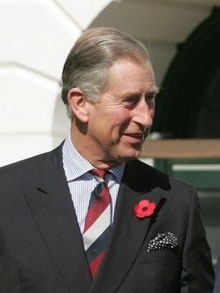
Charles,_Prince_of_Wales in 2005

Prince Charles in 2005, in White House Rose Garden

The tour of Canada has been billed as Charles’s last chance to convince Canadians that he should be allowed to become their king. I’m not certain whether he will win Canadians over. In fact, he appears to have already made a serious error, for his first speech of the tour loudly praised Canada for sending troops to fight in the Anglo-American War in Afghanistan. Unfortunately for the Prince, most Canadians oppose the presence of Canadian troops in that country. The Prince has given the appearance of trying to interfere in Canada’s internal politics— Canada has announced that it is pulling out of Afghanistan, whereas Britain and the United States are ramping up their efforts there. Most Canadians probably think that a sufficient number of Canadians died for King and Empire in the twentieth century and that we need no sequels.

The Prince, who is the honorary colonel of no less than eight Canadian regiments, will visit several military bases in Canada. By associating himself with a very unpopular cause, Charles is doing himself no favours. The Canadian military and its traditions are a reflection of Canada’s colonial past and the political culture of Atlantic Canada, the most ethnically British part of the country. The problem for the Prince is that Atlantic Canada and the military represent Canada’s past, not its future. Canadians of British ancestry are a dying breed, with a birthrate even lower than that of francophone Quebeckers. The traditions of the Canadian military, such as playing “Rule Britannia” whenever a ship enters port, are literally laughable to Canadians descended from the post-1945 waves of immigration and indeed anyone familiar with the course of world history since, say, 1897.

If Charles wishes to ingratiate himself to the multicultural Canada of the present, he needs to do a walkabout in the shopping centres of Toronto and Vancouver. While in Vancouver, he might apologize for the racist anti-Asian remarks made by his father. The Prince might also talk to the workforce of Calgary’s office towers or the scientists in Waterloo who are working on genetically modifying crops.  This would allow him to see the future being made. Unfortunately, the Prince doesn’t believe in shopping centres and office towers, preferring organic farmer markets and traditional cottage architecture to consumerism, freeways, GM foods, Blackberries, and modern buildings.

Poundbury, the experimental pseudo-medieval town recently built by Prince Charles in Dorset, represents his vision of the future: white people in Tudorbethan homes eating organic food. It has little resemblance to the world inhabited by most modern Britons. It is even more alien to the values of most Canadians.

Opposed as he is to so much of capitalist modernity, Prince Charles is reactionary in the deepest sense of the word. He is also represents the most pathetic last vestiges of British militarism. He would be a singularly inappropriate head of state for Canada, a country that values technology, consumerism, multiculturalism, and peace. His values are antithetical to our most fundamental values.


North American Currency Union

26 10 2009

The Globe and Mail has published a lengthy essay by Konrad Yakabuski on North American currency union. This piece, like of all of Mr Yakabuski‘s articles, is distinguished by clear writing, careful analysis, and very thorough research.

Yakabuski outlines a very compelling economic case for currency union. However, I suspect that any concrete proposal for a currency union would be derailed by nationalist opposition in Canada, Mexico, and the United States. Nationalist sentiment would trump economic logic. In fact, I think that we Canadian forget just how much anti-NAFTA sentiment there is in the USA. Consider Lou Dobbs:


A British Diplomat Comments on Canada

22 10 2009

The British government has recently declassified a large volume of correspondence from British diplomats stationed abroad. Some of these diplomats had very unflattering things to say about their host countries. One of the documents released was a memorandum on Canada written in 1984 by the British High Commissioner in Ottawa. Lord Moran spoke about the mixed legacy of Pierre Trudeau, Quebec nationalism, and the First Nations. Moran’s comments about Canada were largely neutral or even positive, but he described individual Canadians as rather “boring” and said that the lack of the fierce competitive spirit found in other countries has promoted a culture of mediocrity in Canada. He observed that, in Canada, the calibre of the people who go into politics is inferior to those who make careers in private industry. I think that this observation is absolutely correct- the calibre of people in public life in Canada has always been quite low and result is that the typical Canadian politician is poorly educated, a poor public speaker, physically unattractive, and devoid of accomplishments outside of politics.

The document also mentions Canadians’ destructive attitude to the environment, making special mention of my city, Sudbury (see paragraph 12).  You can read it online.


A National Securities Regulator for Canada

16 10 2009
There was a story in the news today that reminded me of the need to update Canada’s antiquated, steam-engine age constitution. The story concerned the regulation of securities.
Toronto Stock Exchange in 1856. Image from Library and Archives Canada

Toronto Stock Exchange in 1856. Image from Library and Archives Canada

Toronto's Financial District Today

Toronto's Financial District Today

Canada has always been something of an anomaly in the sense that it is the only industrialized country without a national securities regulator. In Canada, securities and securities markets are regulated by the provinces, which is widely regarded as an arrangement that makes the country less competitive internationally.

For years, the possibility of creating a national securities regulator has been discussed, but without anything being done: Ottawa was scared that such a move would be denounced in Alberta and, of course, Quebec, as an unconstitutional assault on provincial autonomy. The federal government is now taking steps to regulate securities. It announced today that it will ask the Supreme Court to rule on the constitutionality of creating a national securities regulator. (See here, here, here, and here).

I strongly support the idea of a national securities regulator and commend the Harper government for moving on this issue. (For the record, I tend to think that unitary states are more efficient than federations. There would probably be many benefits if the provincial governments were abolished).  However, I’m a bit disturbed by the fact some commentators appear to think that the creation of a national securities regulator is a done deal. There is already lots of talk about the transition team.

Supreme Court of Canada

Supreme Court of Canada

We don’t know yet how the Supreme Court will rule on this issue or how the current SCC justices feel about the issue of centralization vs. provincial rights. If the courts say yes, Canada may have a national securities regulator within a few years, but the whole thing may be derailed by an election. Moreover, even if the courts give the green light and Ottawa passes the required legislation, Quebec, which is now recognized as a nation within Canada, will probably retain its own regulator.

Predicting how power will be distributed between the federal and provincial governments is a

John A. Macdonald, 1875. Image from Library and Archives Canada

John A. Macdonald, 1875. Image from Library and Archives Canada

tricky business. Some of our greatest statesmen have had a poor track when it came to making predictions in this field. In December 1864, when Canadians were debated whether to proceed with Confederation, John A. Macdonald that the federal constitution outlined by the Quebec Conference would soon become a unitary state.  In a letter to a conservative politician in Toronto who wanted to create a unitary state right away, Macdonald said that proposed provincial governments would not last for long. He wrote:

“If the Confederation goes on, you, if spared the ordinary age of man, will see both Local Parliaments & Governments absorbed in the General power. This is as plain to me as if I saw it accomplished but of course it does not do to adopt that point of view in discussing the subject in Lower Canada.”

Sir John A. Macdonald Papers, vol. 510 Macdonald to M.C. Cameron, 19 December 1864.

For better or worse, Macdonald’s prediction did not come to pass. Instead, the provincials governments grew so powerful that some of them began to act as if they were sovereign states. Lower Canada Quebec maintains quasi-diplomatic offices abroad, seeks representation in international bodies such as Unesco, and considers itself to be a nation, not just a province.


Women’s History Month

15 10 2009

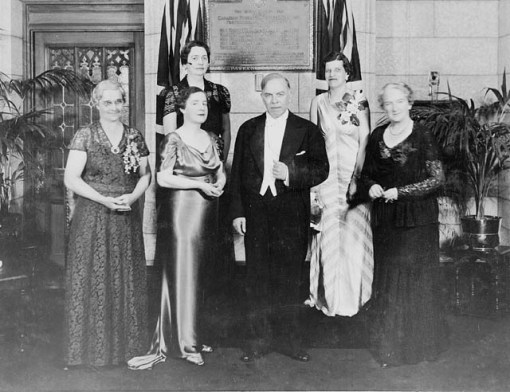
In honour of women’s history month, the Ottawa Citizen newspaper published this quiz designed to test your knowledge of ‘heroines’ from Canadian history. The image associated with this article features the Famous Five, the five women who fought in the 1920s for the opening of Canada`s unelected upper house (the Senate) to women. (See here also).

PM King with Famous Five

Mackenzie King with the Famous Five

I have mixed feelings about the uncritical praise that has been lavished on the Famous Five rather than on the millions of other women who have lived in Canada. This is, in part, because I favour abolishing Canada’s upper house and moving to a unicameral legislature. (I understand why some people incline towards the Guy Fawkes school of parliamentary reform). I certainly believe that if Canada is going to have an unelected upper house, then women should be allowed to sit in it!  The question, however, is whether eliminating the ban on female Senators in the 1920s served to delay the abolition of a fossil institution by eliminating its most egregiously anachronistic feature.  Senate abolition was proposed in the 1920s by Prairie populists and others on the political left and is still supported by the NDP. This is one of the few issues on which I agree with the NDP. All of the provinces now have unicameral legislatures- Quebec abolished its unelected upper house in 1968. Unicameralism seems to work well at the provincial level. As far as I know, no province has proposed re-introducing bicameralism.

As well, I’m not a big fan of the “living tree” doctrine of constitutional interpretation that Lord Sankey used to arrive at his decision in Edwards v. Canada, the case commonly called the Persons Case. It seems to me that it has made it easier for judges to read their own values into constitutional texts. Whether the living tree doctrine and the consequent judicialization of Canadian politics will be good for women or Canadians more generally remains to be determined.

Let’s abolish the Senate and then focus on getting more women into the House of Commons the PMO, where the real power is.

P.S. The Ottawa Citizen quiz mentions Marie-Joseph Angélique, a Montreal slave executed for arson in 1734. The students in my pre-Confederation course are currently writing an essay about her trial and execution.

Image Source: Library and Archives Canada.


Is Traditional Scholarship Dead?

7 10 2009

That is the subject of a debate taking place tonight at the British Library in London. Listen Here


Two Good News Stories About Canada

6 10 2009
Canadian Lake

Canadian Lake

Canadian historians have documented Canada’s many failings as a society (Japanese internment, Chinese Head Tax, Native residential schools, sexism). They have been right to do so, because no country is perfect.  However, I think that sometimes we lose sight of all of the good things about Canada. Since 1945, Canada has evolved into a very admirable society. Foreign travel and looking at international statistical tables drive home the point that Canada has done many things correctly.

Two stories in the news today serve to remind us of Canada’s positive aspects.

United Nations Building, New York

United Nations Building, New York

The first story relates to the release of the UN quality of life rankings. According to the UN, Canada ranks fourth highest in the world. (We were beaten by Norway, Iceland, and Australia).  See here. Although Canadians should not be complacent about the future, we should give ourselves a pat on the back. More importantly, historians and other academics should initiate a debate about precisely why Canada is so high in the rankings? What do we have in common with the other top-1o countries? A number of competing explanations are possible, all of which have policy implications. This is something historians should think about.

Flag of Argentina

Flag of Argentina

One doesn’t want to gloat about the misfortune of another country, but Canadian historians should take a look at this New York Times article about Argentina’s economic history. A century ago, Argentina was wealthier than Canada. Now it is much poorer. Argentina is very similar to Canada in terms of resource base, chronology of settlement, and (broadly speaking) culture. If we want to explain why Canada has does well economically, we ought to know something about Argentina’s  history.

The second story relates to a UN agency’s report on Canadian immigration policy. Canada is a model to the rest of the world of how to accept new immigrants and migrant workers, according to a new report from the United Nations Development Programme. To read the report, click here. I’m certainly not saying that Canada’s immigration system is perfect or that the country is free of racists. However, when we compare Canadian attitudes towards newcomers with the political culture in similar countries, there is much we can feel proud of. Unlike the United States, we have no xenophobic Minutemen patrolling the borders looking for Catholic Mexicans. Unlike the United Kingdom, we have no political force analogous to the Islamophobic British National Party. Unlike France, we have no Jean-Marie Le Pen. Click here to see Le Pen discuss the “invasion of Europe” by immigrants.

The UN isn’t the only one extolling Canada’s relatively liberal approach to immigration as a role model for other countries. Philipe Legraine, a British classical liberal, praised Canada’s policy in Immigrants: Your Country Needs Them, a book designed to convince people in other industrialized countries to adopt a more welcoming policy towards immigrants.  Reading the passages in the book about Canada made me feel quite proud lucky to be Canadian.


Stephen Harper on Colonialism in 2006

5 10 2009

Harper changed his mind on colonialism.

I recently posted about the controversy surrounded Stephen Harper’s  declaration in Pittsburgh that Canada had no history of colonialism. Harper’s remarks clearly imply that colonialism is a bad thing, which is the mainstream view, at least among most small-l liberals.

In the 2006 speech quoted below, Stephen Harper praised the British Empire and associated himself with the “unfashionable” view that colonialism could be a good thing. Comparing this speech with Mr Harper’s more recent remarks shows the extent to which he and his party have moved to the political centre since 2006. Harper regarded colonialism as essentially good in 2006, but as a bad thing in 2009.

———————————

Address by the Prime Minister at the Canada-UK Chamber of Commerce

14 July 2006
London, UK

Ladies and Gentlemen, this is actually my first speech to a business audience outside Canada since becoming Prime Minister. And it is only fitting that it’s to your distinguished organization. Because the Canada-UK Chamber has been promoting commerce between our nations for almost 90 years. And because the business relationship between our countries dates back to the very founding of Canada.
In fact, for two centuries prior to our confederation in 1867, much of Canada was effectively owned, operated and governed under the red ensign of a London-based corporation, the mighty Hudson’s Bay Company. Our co-sponsor tonight, the Canada Club, owes its founding in 1810 to the fur traders of the North-West Company, the main rival and eventual partner of the HBC.

Still, business is but one aspect of our combined history.That history is built by layer upon layer of common experiences, shared values and ancient family ties. In my own case, the Harper family traces its known forefathers back to the northern England and southern Scotland of the 1600s. But a far greater orator than I – or any Harper of the past 400 years – once described Canada-U.K. relations this way:
The ties which join [Canada] to the mother country are more flexible than elastic, stronger than steel and tenser than any material known to science. Canada bridges the gap between the old world and the new, and reunites the world with a new bond of comradeship.

The speaker, as you might have guessed, was the incomparable Winston Churchill. The occasion was a speech in Ottawa in 1929, part of a cross-country tour of what he called “the Great Dominion.” He gave 16 speeches in 9 cities.  Every one of them was delivered to sold-out rooms and repeated standing ovations. On that same tour, Mr. Churchill reminded Canadians of what they owed to Britain. At the heart of our relationship, he said: “is the golden circle of the Crown which links us all together with the majestic past that takes us back to the Tudors, the Plantagenets, the Magna Carta, habeas corpus, petition of rights, and English common law…all those massive stepping stones which the people of the British race shaped and forged to the joy, and peace, and glory of mankind.”

How right he was.

Britain gave Canada all that – and much more.
Including: Parliamentary democracy; A commitment to basic freedoms; The industrial revolution; and
The entrepreneurial spirit and free market economy. Not to mention Shakespeare, Dickens, Kipling, Lewis, and Chesterton.

Of course, we haven’t accepted all of our inheritance from Britain.  The take-up rates on rugby and association football are certainly not as high as ice hockey. And Canadians remain utterly baffled by cricket.

But seriously and truthfully, much of what Canada is today we can trace to our origins as a colony of the British Empire. Now I know it’s unfashionable to refer to colonialism in anything other than negative terms. And certainly, no part of the world is unscarred by the excesses of empires. But in the Canadian context, the actions of the British Empire were largely benign and occasionally brilliant. The magnanimous provisions of the Quebec Act of 1774 ensured the survival of the French language and culture in Canada – to the everlasting benefit of our country. And the treaties negotiated with the Aboriginal inhabitants of our country, while far from perfect, were some of the fairest and most generous of the period. This genius for governance shown by the mother country at the time no doubt explains in part why Canada’s path to independence was so long, patient and peaceful. And it explains why your Queen is still our Queen, and why our “bond of comradeship” remains as sturdy today as it was in Mr. Churchill’s time.

——————————–

Here are some links to new media items regarding the colonialism controversy.

Aaron Wherry, Maclean’s.

Colleen Simard, Winnipeg Free Press.

Le Monde, Paris.

Vancouver Sun.

Update:

The Western Standard, a far-right publication based in Alberta, has published some thoughts on the Harper-colonialism controversy.