Should the Entire English-speaking World Adopt American English?

7 07 2010

They are currently debating that point on The Economist website. Check out the live discussion.

MagicMonkey, a modest Canadian commentator on the discussion thread, believes the world should adopt  Canadian English on the grounds that it is “an ideal compromise between British English and American English”.


New History of Banking

5 07 2010

Unsettled Account: The Evolution of Banking in the Industrialized World since 1800
Richard S. Grossman

Cloth | 2010 | $39.50 / £27.95
400 pp. | 6 x 9 | 44 line illus. 18 tables.

e-Book | 2010 | $39.50 | ISBN: 978-1-4008-3525-6

Commercial banks are among the oldest and most familiar financial institutions. When they work well, we hardly notice; when they do not, we rail against them. What are the historical forces that have shaped the modern banking system? In Unsettled Account, Richard Grossman takes the first truly comparative look at the development of commercial banking systems over the past two centuries in Western Europe, the United States, Canada, Japan, and Australia. Grossman focuses on four major elements that have contributed to banking evolution: crises, bailouts, mergers, and regulations. He explores where banking crises come from and why certain banking systems are more resistant to crises than others, how governments and financial systems respond to crises, why merger movements suddenly take off, and what motivates governments to regulate banks.

Grossman reveals that many of the same components underlying the history of banking evolution are at work today. The recent subprime mortgage crisis had its origins, like many earlier banking crises, in a boom-bust economic cycle. Grossman finds that important historical elements are also at play in modern bailouts, merger movements, and regulatory reforms.

Unsettled Account is a fascinating and informative must-read for anyone who wants to understand how the modern commercial banking system came to be.


AHR still the historical journal with the greatest impact

4 07 2010

My fellow members of the American Historical Association will be pleased to learn that “the American Historical Review continues to have the highest “impact factor” among history journals, according to the new Journal Citation Reports from Thomson Reuters.

The impact factor measures how often articles in a particular journal are cited by peer-reviewed journals in their database. While this is a rather crude gauge of the actual value of recent articles in these journals, it provides one of the few objective measures for testing the overall influence of journals.

The AHR ranks well above the other history journals measured in the report. The second-highest ranked journal in the study was the Journal of Environmental History, which had an impact factor of 0.750 (as compared to a factor of 2.114 for the AHR).

An eclectic array of articles provided particular lift to the Review’s ranking this year with three or more citations. The article earning the most attention was William J. Novak’s “The Myth of the “Weak” American State,” in the June 2008 issue, which is also the subject of a forum in the June 2010 issue (now in the mail)”

See here.


1930s Redux?

3 07 2010

“The world’s rich countries are now conducting a dangerous experiment. They are repeating an economic policy out of the 1930s — starting to cut spending and raise taxes before a recovery is assured — and hoping today’s situation is different enough to assure a different outcome.”  From David Leonhardt in the New York Times. See here.


Thoughts on the Size of Nations

1 07 2010

My PhD thesis was on Canadian Confederation. [You can read the book based on it if you really want]. Confederation took place in the 1860s and 1870s, when the separate colonies in British North America agreed to federate and give up control over many important matters to a central government in Ottawa. My PhD thesis was focused on the political economy of Confederation.

I’m also a card-carrying interdisciplinary historian. History is an empirical discipline, which is one of the reasons ordinary people can enjoy books written by history professors. However, I also believe that, in many cases, it is appropriate for historians to draw on theories created by other social scientists, particularly political scientists, economists, and anthropologists. Theory can help us to make sense of the jumbled facts of reality and to discern broader patterns. I’ve long been interested in the fact there was a worldwide trend towards territorial unification in the 1860—the unification of Italy and Germany and Canadian Confederation all took place at roughly the same time. My hunch is that new technologies had a great deal to do with this  trend. Some contemporaries thought that this was the case.

By the time of Confederation, British North Americans had come to associate the revolutionary effects of Morse’s electric telegraph, which was commercialized in the 1840s,  with the creation of the larger political units. In 1862, Amor de Cosmos, the editor of Victoria’s British Colonist advocated the union of the colonies of Vancouver Island and British Columbia on the ground that it was “the age of the electric telegraph and the railroad.” Shrinking distances required larger political units. In the debates on Confederation in the parliament of Canada in early 1865, a supporter of Confederation named Charles Alleyn declared that “the telegraph has annihilated time, railroads and steamers have devoured space.” He said that these new technologies had caused a worldwide drive for “territorial aggrandizement, this gathering together of the disjecta membra of nations.” Alleyn referred to the recent steps to unify Italy and Germany, Russia’s absorption of small countries in the Caucausus and Central Asia, as well as the strengthening of central government authority in Mexico and the United States.  Another supporter of Confederation, Hector Louis Langevin, spoke of the vast improvement in communications which had occurred since the union of Upper and Lower Canada. In 1841, telegraphy in Canada had consisted of a single semaphore used to relay messages between the Quebec Citadel and some nearby islands. But as Langevin observed, the capital could now communicate instantaneously with “the most remote districts” of the Province. Political union with the other colonies, he suggested, was the natural extrapolation of this technological development, of the death of distance.

Given my interest in interdisciplinary history and the processes of territorial unification and sub-division, I was naturally intrigued by a recent post over on the Thousand Nations blog. This blog was put together by a group of people who believe that, in general, the more nation states there are in the world, the better off we will be. There reasoning is similar to that of the people who favour competition in the mobile phone business—with more competition for your business, consumers will benefit from better service and lower prices. The creators of this blog say that the world is a much better place today, when there are nearly 200 members of the UN, than when there were just sixty UN member nations, in the late 1940s. In fact, they argue that the world would be better off if this trend continued and there were 1,000 sovereign countries in the world. To achieve this, each American state, Canadian province, and French department would have to become independent and start issuing passports. The creators of the blog also say that it would be tragedy if the world’s existing states were consolidated into a few big continental blocks, a North American Republic, a federal  European Union, etc.

I’ve always been inclined to the view that it is usually better to have many small political units than a few big ones. I came to think this way after reading some of the works of the late Jane Jacobs. My small-is-beautiful philosophy is but one of the reasons I think that Canadian Confederation was a mistake foisted on British North America by a clique of megalomaniacs. You may or may not share my view that it is better to have more states than fewer, but the Thousand Nations blog has certainly posted some interesting data in the last few days. For instance, have a look at these numbers:

Decade-by-decade breakdown of how new UN member states were created:

Decolonization:
1970s: 23
1980s: 8
1990s: 2
2000s: 0

Secession:
1970s: 1
1980s: 0
1990s: 20
2000s: 3

Reunification (each decreases the # of states by 1)
1970s: 1
1980s: 0
1990s: 2
2000s: 0

The recent blog post that caught my eye examines the political economy literature on why states consolidate and split up. The post was written by Brad Taylor. Several political scientists and economists have advanced general theories trying to explain what accounts for territorial consolidation and sub-division.  Taylor begins his literature survey by pointing out that: “While the size of nations is normally taken as an uninteresting brute fact by political economists, there have been some notable attempts to explain what causes a country to be a particular size and what size a country should be.” Taylor then examines the theories of such writers as David Friedman, Alberto Alesina, and Enrico Spolaore. David Friedman, it should be noted, is the son of the late Milton Friedman and the father of Patri Friedman, one of the creators of the ThousandNations website.

I’ve read all of the scholars Taylor discusses before. To repeat, I am very open to the possibility that there is a grand political-economy theory that explains why territorial consolidations such as Canadian Confederation take place.

The theories discussed in Taylor’s post are all rather interesting, but to my mind none of them is terribly convincing or fits the facts of the cases with which I am most familiar. Until a political economist comes up with a more plausible general theory, we will have to fall back to the position that each act of territorial consolidation and division should be regarded as a special case, sui generis, to be studied and understood on its own terms without references to other nation-building acts of territorial unification.




Acanademics on the G20 Protests

30 06 2010

Acanademics has a funny post on the G20 protests in Toronto.


Two New Active History Posts

30 06 2010

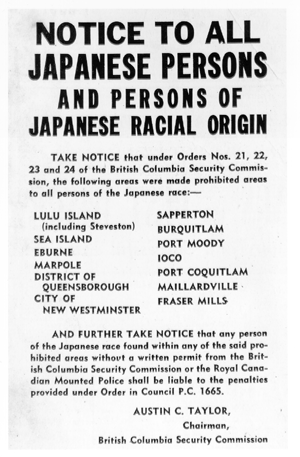
Japanese Canadian Fishing Boat Being Seized, 9 December 1941

The activehistory.ca blog recently carried two posts that caught my eye. The earlier post is by Laura Madakoro and deals with government apologies for historical injustices such as Japanese internment and Bloody Sunday in Northern Ireland. It is a fine piece of work on comparative social memory that is also rather personal. Ms. Madakoro writes: “My grandfather was a fisherman in Tofino (on the west coast of Vancouver Island) when the Japanese attacked Pearl Harbour. His boat was taken by the Canadian government. My father, who was 2 years old at the time, and his parents were interned.”

Cacao Production

The second post links historical with ongoing injustices and is about the use of coerced labour (i.e., slaves) in the production of chocolate. Karlee Sapoznik’s post notes that consumers boycotts against slave-produced sugar were part of the abolitions campaign. She also reports that “up to 40% of the chocolate we purchase, bring into our homes and eat may be contaminated with slavery”. I like this post because it reminds us that slavery is still a live issue, not something that was totally finished in 1834 or 1865.

40% evil? Or just 40% lipids?

Activehistory.ca has become a very good blog.


Nazi Weather Station in Labrador

29 06 2010

The owner of the Beachcombing blog has asked me to link to a post about one of the more curious footnotes about the Second World War in Labrador. In 1943, the Germans set up an unmanned weather station on the coast of Labrador. The remains of the station were only found in 1981. See here.


Textbooks in the Ipad Age

28 06 2010

Should paper textbooks be replaced with e-books suitable for Ipad? Some historians appear to think so. Check out historian Sean Kheraj’s new blog post on the subject.

Dr. Sean Kheraj of UBC

I like some aspects of this idea. A digital textbook on Ipad can include cool moving images like this:

The relevance of animated maps to the teaching of history hardly needs additional comment.

Moreover, digital textbooks _might_ be a way of reducing the costs of textbooks, which is currently way too high. However, the savings to students from going paperless might be outweighed by the costs of new technologies is everyone has to invest in Ipads or other electronic readers.

As well, I can sniff a conspiracy of textbook companies here. Textbook publishers are notorious for issuing new editions of core textbooks in quick succession in order to sabotage the development of a secondary market. This is a big problem in economics and chemistry courses. The discipline of chemistry doesn’t change that quickly, so students ideally should be able to save money by purchasing versions of the course textbook published a few years back. However, some courses are designed around the newest version of each textbook, which forces the students to buy a new book. This is planned obsolescence at its worst.

Ok, this ad from 1958 isn't for a GM product, but you get the idea

It reminds me to a General Motors in the days of Alfred P. Sloan– each year there were lots of superficial changes to the cars designed to encourage people to sell last year’s model.

A typical university bookstore-- scene of a thousand fleecings

In the Canadian history survey course I teach, I use a textbook called Origins : Canadian history to Confederation by R. Douglas Francis, Richard Jones, Donald B. Smith,   6th ed. (Toronto : Nelson Education, 2009). On the first day of class, I urge the students to try to buy used copies of this book, either online or from someone on campus. I also tell that it is ok if they buy the 5th edition, which came out in 2004. When I give weekly textbook readings in the course outline, I give relevant page numbers for both editions of the book. I’m certain the publishing company would prefer it if I told my students to only use the 6th edition and to buy only new copies, but I understand that they need to save cash. There isn’t a big difference between the 5th and the 6th editions.

One problem with switching over from hard-copy textbooks to books on Ipad is that it will kill off the secondary market. When I pay to download a song to my Ipod, I am buying a bundle of rights I can’t resell. Textbooks and digital rights management will allow textbook companies to do what they have always dreamed of doing– shutting down the secondary market.

The textbooks on Kindle project at Princeton flopped. Let’s keep in mind that Princeton is a rich American university, where people tend to have more money for technological experimentation than they would at a typical Canadian university.

Another potential pitfall is this– looking at a computer screen for too long is hard on the eyes. I’m told that the Ipad is different that it is less painful to look at for extended period, but until I’m convinced of this I won’t be investing in an Ipad. If I could rent an Ipad for 24 hours I might be willing to experiment with the technology, but spending $500 on something that might hurt my eyes is simply too expensive.


James Belich, Replenishing the Earth

25 06 2010

I recently got into a discussion over email about James Belich`s recent book Replenishing the Earth, which is a good book that everyone should read.

Here is a description of the book from the Oxford University Press website.

“Why are we speaking English? Replenishing the Earth gives a new answer to that question, uncovering a “settler revolution” that took place from the early nineteenth century that led to the explosive settlement of the American West and its forgotten twin, the British West, comprising the settler dominions of Canada, Australia, New Zealand, and South Africa.

Between 1780 and 1930 the number of English-speakers rocketed from 12 million in 1780 to 200 million, and their wealth and power grew to match. Their secret was not racial, or cultural, or institutional superiority but a resonant intersection of historical changes, including the sudden rise of mass transfer across oceans and mountains, a revolutionary upward shift in attitudes to emigration, the emergence of a settler “boom mentality,” and a late flowering of non-industrial technologies–wind, water, wood, and work animals–especially on settler frontiers. This revolution combined with the Industrial Revolution to transform settlement into something explosive–capable of creating great cities like Chicago and Melbourne and large socio-economies in a single generation.

When the great settler booms busted, as they always did, a second pattern set in. Links between the Anglo-wests and their metropolises, London and New York, actually tightened as rising tides of staple products flowed one way and ideas the other. This “re-colonization” re-integrated Greater America and Greater Britain, bulking them out to become the superpowers of their day. The “Settler Revolution” was not exclusive to the Anglophone countries–Argentina, Siberia, and Manchuria also experienced it. But it was the Anglophone settlers who managed to integrate frontier and metropolis most successfully, and it was this that gave them the impetus and the material power to provide the world’s leading super-powers for the last 200 years.

This book will reshape understandings of American, British, and British dominion histories in the long 19th century. It is a story that has such crucial implications for the histories of settler societies, the homelands that spawned them, and the indigenous peoples who resisted them, that their full histories cannot be written without it.”

My view is that this book is an impressive piece of research. Belich had to do a massive amount of reading on many countries. It is a powerful reminder of the problems with parochial “national” histories, so I wish more people would read it. That being said, I don’t think his explanation for the emergence of the Angloworld is that convincing. He states at the start of the book that he wants to explain why it was English-speakers rather than Spanish-speakers or someone else who colonized North America and Australasia. This is a very good research question. In 1750, Spanish-America was a giant and Anglo-America was a pygmy. A few generations later, the English-speakers were no longer upstarts. Why the Anglosphere was able to overtake the Hispano-sphere is a big question that deserves an answer. Unfortunately, explanation Belich presents in Replenishing the Earth isn’t terribly convincing. What made the English more successful imperialists in the period after 1750 than any other group? Belich doesn`t really say, except for talking about export-oriented natural resource based economies.

This explanation doesn`t really hold water, because the Spanish, the French, the Portuguese all had similar commodity-type economies. Was it Protestantism that made the English better imperialists than the post-1750 Spaniards? I doubt it, but a religious explanation would be less implausible than the one Belich has offered. Belich is skeptical of Douglass North`s institutional explanation for the relative rise of Britain and its offshoots. He is right to be skeptical of this and any other theory, but I think that he is too dismissive of it. I also think that Belich`s book would have been stronger had he incorporated more about technology and the origins of the knowledge-based economy in 18th century Britain into his book. I think that the rise of the “Enlightenment Economy”in the 18th century provides the best, single-factor explanation for the rise of the Angloworld. I`m not saying that we should embrace any single-factor explanation, but if we had to select one factor, I would have to say it would involve the phenomena discussed in Joel Mokyr`s new book The Enlightened Economy.  So there are some big problems with Belich`s book, however, he has started a potentially very interesting debate. It`s particularly interesting to me now that I`m getting into comparative history, comparing Latin America with Canada (and Anglo-America).

To sum up my views– read Belich`s book, but read it along with the new work by Mokyr.

Anyway, I should get back to work writing a lecture on the history of irrigation in western North America.