Press Gangs in Canada

18 05 2010

The Canadian Historical Review Volume volume 91, Number 2 / June 2010 is now available

This issue contains  a very interesting article by Keith Mercer, “Northern
Exposure: Resistance to Naval Impressment in British North America,
1775-1815”

1780 Caricature of a Press Gang

Abstract : Focusing on resistance, this article examines naval impressment
in British North America from 1775 to 1815. Although neglected in Canadian
historiography, press gangs sparked urban unrest and political turmoil in
seaports such as Halifax, St John’s, and Quebec City. Impressment reached
into most coastal areas of British North America by the early nineteenth
century and its sailors and inhabitants employed a range of strategies to
resist it. They also confronted it directly, sometimes with violent results.
Press gang riots in St John’s in 1794 and Halifax in 1805 led to a
prohibition on impressment on shore for much of the Napoleonic Wars. Popular
protest served as the catalyst for official resistance to the British Navy
and had a lasting impact on civil-naval relations in the North Atlantic
world. While the study of popular disturbances in Canadian history usually
begins in the mid-nineteenth century, this paper shows that they were
important in earlier generations as well. This was often the result of
tensions caused by imperial warfare and quarrels with military personnel.

The other articles in this issue of the CHR also look interesting: ‘Rising Strongly and Rapidly’: The Universal Negro Improvement Association in Canada, 1919-1940 by Carla Marano; No Longer a ‘Last Resort’: The End of Corporal Punishment in the Schools of Toronto by Paul Axelrod; and Fireworks, Folk-dancing, and Fostering a National Identity: The Politics of Canada Day by Matthew Hayday.


Michael Bellesiles is Back

17 05 2010

A number of years ago, there was a scandal about historian Michael A. Bellesiles’s book Arming America: The Origins of a National Gun Culture. Bellesisles got the Bancroft Prize for this book, but then it was revealed that he had faked a lot of his evidence, so he lost his prize and his academic credibility.

It turns out that Bellesisles is back and has a new book coming out. See here and here.


New Book on the HBC

14 05 2010

The records of the Hudson’s Bay Company formed the basis of a new book by Ann Carlos and Frank Lewis. I haven’t read the book yet, but it looks very promising.

Abstract:

“Commerce by a Frozen Sea is a cross-cultural study of a century of contact between North American native peoples and Europeans. During the eighteenth century, the natives of the Hudson Bay lowlands and their European trading partners were brought together by an increasingly popular trade in furs, destined for the hat and fur markets of Europe. Native Americans were the sole trappers of furs, which they traded to English and French merchants. The trade gave Native Americans access to new European technologies that were integrated into Indian lifeways. What emerges from this detailed exploration is a story of two equal partners involved in a mutually beneficial trade.

Drawing on more than seventy years of trade records from the archives of the Hudson’s Bay Company, economic historians Ann M. Carlos and Frank D. Lewis critique and confront many of the myths commonly held about the nature and impact of commercial trade. Extensively documented are the ways in which natives transformed the trading environment and determined the range of goods offered to them. Natives were effective bargainers who demanded practical items such as firearms, kettles, and blankets as well as luxuries like cloth, jewelry, and tobacco—goods similar to those purchased by Europeans. Surprisingly little alcohol was traded. Indeed, Commerce by a Frozen Sea shows that natives were industrious people who achieved a standard of living above that of most workers in Europe. Although they later fell behind, the eighteenth century was, for Native Americans, a golden age.”

Ann M. Carlos
is Professor of Economics at the University of Colorado at Boulder and University College, Dublin. She is originally from Canada and did her PhD at Western. Frank D. Lewis is Professor of Economics at Queen’s University, Ontario.

I’m looking forward to getting my hands on this book.

To order, go here.


Sir John A. Macdonald Honoured in Scotland

12 05 2010

John A. Macdonald, 1875. Image from Library and Archives Canada

Canada’s first prime minister was to be honoured Wednesday at a special ceremony in the Scottish Highlands.

Macdonald– may his spirits live on.
On a related note, someone is trying to rename Wellington Street in Ottawa after Macdonald. Apparently he is offended by having a street named after the Iron Duke or something. The irony is that Macdonald likely admired Wellington a great deal.


Why Did Rating Agencies Do Such a Bad Job Rating Subprime Securities?

12 05 2010

I bet this paper will be downloaded frequently.

———————-

Why Did Rating Agencies Do Such a Bad Job Rating Subprime Securities?

by Claire A. Hill University of Minnesota, Twin Cities – School of Law

University of Pittsburgh Law Review, Forthcoming
Minnesota Legal Studies Research Paper 10-18

Abstract:
“Why did rating agencies do such a bad job rating subprime securities? The conventional answer draws heavily on the fact that ratings are paid for by the issuers: Issuers could, and do, “buy” high ratings from willing sellers, the rating agencies.

The conventional answer cannot be wholly correct or even nearly so. Issuers also pay rating agencies to rate their corporate bond issues, yet very few corporate bond issues are rated AAA. If the rating agencies were selling high ratings, why weren’t high ratings sold for corporate bonds? Moreover, for some types of subprime securities, a particular rating agency’s rating was considered necessary. Where a Standard & Poor’s rating was deemed necessary by the market, why would Standard & Poor’s risk its reputation by giving a rating higher (indeed, much higher) than it knew was warranted?

Finally, and perhaps most importantly, giving AAA ratings to securities of much lower quality is something that can’t be done for long. A rating agency that becomes known for selling its high ratings will soon find that nobody will be paying anything for its ratings, high or low.

In my view, that issuers pay for ratings may have been necessary for the rating agencies to have done as bad a job as they did rating subprime securities, but it was not sufficient. Many other factors contributed, including, importantly, that rating agencies “drank the Kool-Aid.” They convinced themselves that the transaction structures could do what they were touted as being able to do: with only a thin cushion of support, produce a great quantity of high-quality securities. Rating agencies could take comfort, too, or so they thought, in the past – the successful, albeit short, recent history of subprime securitizations, and the longer history of successful mortgage securitizations.

“Issuer pays” did not so much make the rating agencies give higher ratings than they thought were warranted as it gave the agencies a “can do” mindset regarding the task at hand – to achieve the rating the issuers desired, working with them to modify the deal structures as needed. That the issuers were paying motivated the agencies to drink the Kool-Aid; having drunk the Kool-Aid, the agencies gave the ratings they did. My account casts doubt on the efficacy of many of the solutions presently being proposed and suggests some features that more efficacious solutions should have.”

More here.


Why Britain has a coalition government and Canada does not

12 05 2010

Consider this scenario. A general election gives a centre-right political party the largest number of seats in the House of Commons, albeit less than the majority needed to pass laws. Doing what is customary after an election defeat, the incumbent government, which is a centre-left party, resigns. The leader of the centre-right party forms a coalition with the third-place party. The coalition produces a stable majority and gives the third-place party several seats around the Cabinet table. The coalition agreement is slated to run for five years.

This scenario has recently unfolded in Britain. David Cameron now leads a Conservative-Liberal Democrat coalition government. In contrast, coalitions are very rare in Canada.  In the Canadian election of 2006, Stephen Harper ‘s Conservatives got the largest number of seats but less than a majority. Rather than forming a coalition to produce a majority, he opted to govern as a minority, securing the support needed to pass each piece of legislation on an ad hoc basis. The result has been chronic instability and a second general election that largely duplicated the results of the first.

Palace of Westminster

Why didn’t Stephen Harper arrange a coalition instead of governing with a minority? Why didn’t he do a David Cameron? The differences in personality between Harper and Cameron may be factor.  As well, the ideological gulf separating the Canadian Conservatives from their only realistic coalition partner, the hardcore socialist NDP, is far greater than the distance between the British Conservatives and the Liberal Democrats. However, the major reason Harper did not negotiate a majority coalition relates to history. Canada has a long history of fairly successful minority governments and almost no history of coalitions. In contrast, Britain had coalition governments for part of the 20th century, albeit none of them were in living memory, the last coalition having come to an end with the Second World War. The wartime coalition led by Churchill left a fairly positive impression with British people—after all, it had dealt with an existential threat to Britain.

Parliament Hill in Winter

The only real coalition in Canadian history, the Union government of the First World War, is tainted in the historical memory by its association with Conscription and linguistic conflict. Minority governments have fared better in Canada than in the UK. The Pearson government in the 1960s had a productive legislative record and Pearson is now regarded as one of the greatest Canadian Prime Ministers. Even Stephen Harper, a Conservative, compares himself to Pearson.

Pearson

The last minority government in Britain, which existed for a few months in 1974, was a dismal failure, although it must be said that governing Britain in 1974 would be far more challenging than governing Canada in the 1960s, when the economy was booming.

British people have experience with coalitions because the governments of Scotland, Wales, and Northern Ireland are all coalitions. Indeed, power-sharing was central to the deal that created the Northern Ireland assembly. No province in Canada has a coalition government, although there was a coalition government of sorts in  Ontario between 1985 and 1987.

Another key difference between Westminster and Ottawa is that nationalist parties are a minor force in UK politics (the Welsh and Scottish nationalists have only a handful of seats, as do the parties that want Northern Ireland to leave the UK). In contrast, there is only one nationalist party in the Canadian parliament and it has lots of seats.

For Canadian reactions to the coalition in the UK, see here, here, and here.


Nassim Taleb Speaks About His Conversation With David Cameron

12 05 2010

David Cameron (above) became Prime Minister of the UK last night. The more I hear about Cameron, the more impressed with the guy.  What sort of man is Cameron? Cameron rebuilt the British Conservative Party by moving it to the centre and by embracing environmental issues. In fact, Cameron argues that conserving the planet should be a conservative priority. Another clue to Cameron’s character is his reading habits. I recently learned that Cameron has read The Black Swan: The Impact of the Highly Improbable by Nassim Nicholas Taleb.

Nassim Nicholas Taleb is one of our generation’s leading thinkers. Actually, Taleb is probably the world’s best example of a public intellectual since John Maynard Keynes. Taleb is a bestselling author, a university professor in risk engineering, a philosopher of science who works in the fields of probability and statistics.  He is also a Wall Street hedge fund manager or “quant” with a proven track record of success.  Among other things, he predicted the 2008 sub-prime meltdown.  He reminds me a little bit of Keynes in that Keynes was an active stock trader as well as being an academic economist.

Taleb has had some very intelligent things to say about how we manage risk as a society. He has invoked the precautionary principle in explaining why we should act to avert climate change even if all of the science isn’t. He draws fascinating parallels between different types of complex systems– financial, social, the climate in the course of articulating a _radically_ conservative view of the world that is based around disturbing existing systems as little as possible. Taleb’s theories suggest that the so-called conservatives of the United States are not really conservatives at all because they are willing to countenance massive man-made change in the climate.

It turns out that David Cameron has had a long conversation with Taleb. I’m pleasantly surprised that a working politician would read books of the sort Taleb writes and then take the time to invite the author for a conversation.  Cameron is a truly impressive figure.

In this clip, Taleb talks about his conversation with Cameron.

Here, Taleb explains his term Black Swan.


Should We Care What Debt Rating Agencies Say About National Governments?

11 05 2010

The financial turmoil in Greece has focused attention on bond markets and credit rating agencies. The yields on Greek government bonds have shot up, meaning that it costs the Greek government to borrow money because investors think that a default is fairly likely.

The election of a minority parliament in Britain has created fears that that the agencies that rate the creditworthiness of sovereign debtors could downgrade UK bonds from the current AAA status. The Guardian’s Katie Allen reports: “The prospects of a weak coalition government has rattled UK markets, sparking growing fears that a downgrade to Britain’s coveted top-notch credit rating could follow.”

There have been repeated references to bond-rating agencies in the discussion of the various proposed coalitions in Britain. There was relief when one of the bond-rating agencies announced that the hung parliament would not affect the UK’s credit rating. “The fate of the UK’s gold-plated sovereign debt rating will not be decided until the end of 2010 despite a hung Parliament, Standard & Poor’s said.”  See also here.

Political commentators are quite right to pay attention to the reaction of the bond markets to political events. In the last few centuries, capital markets have proven to be a sensitive register of political and even military events.  For instance, during the American Civil War and the Second World War, the prices of the combatant governments’ bond fluctuated as news from the battlefield arrived. Financial markets can be spectacularly wrong when it comes to predicting the future (as the Sub-Prime Mortgage Crisis suggests), but overall they are useful tools. Capital markets exploit what James Surowiecki calls “the wisdom of crowds” because they aggregate the intelligence of large numbers of people. They also rely on the self-interest of investors: because people are putting money on the line, they are more likely to put aside sentiment (what they want to happen) and focus on what will happen.

The price of Confederate government bonds reflected events on the battlefield during the American Civil War. Image Courtesy Vanderbilt University Library.

However, I’m not certain that we should pay any attention at all to the bond-rating agencies, as they have had a spectacularly bad track record of predicting defaults by sovereign and other major borrowers. Just a few weeks ago, executives from a credit rating agency testified before Congress about their role in the sub-prime mortgage crisis. The rating agency is accused of having given unjustifiably high ratings to the mortgage-backed securities that were at the heart of the sub-prime mortgage crisis.  Gullible investors saw the ratings and then purchased the securities. When the dead-beat homeowners who were the other end of this complex financial chain defaulted on their mortgages, people came to realise that the securities were not nearly as safe as had been made out. Just today there was word that Moody’s, one of the bond-rating agencies, is being investigated by the SEC.

Much of the criticism of credit-rating agencies in recent months has revolved around the conflict of interest inherent in the agencies current business model, whereby borrowers rather than lenders pay the agency to issue ratings.  To my mind, this is only one of the problems with ascribing too much credibility to the statements that come out of bond rating agencies. Here are some other big problems with having credit rating agencies assign ratings to the debts of governments in large industrialized countries.

1)      Decisions are credit-rating agencies are made by relatively small teams of people, so you don’t have the benefit of the “wisdom of crowds” effect.

2)      There are currently few penalties for making a rating that turns out to be inaccurate. A bad rating agency is unlikely to lose business since the business of rating sovereign debt is very oligopolistic, meaning it is dominated by only a handful of firms. There is little competition, which means that a rating agency can deliver inaccurate ratings without fear of losing business to other firms. Moreover, the legal penalties for making an inaccurate prediction are unclear. It is true that the California state employees’ pension fund and other investors who lost money in the sub-prime mortgage meltdown are trying to sue the relevant credit rating agency, but it is unclear whether this lawsuit will be successful. The rating agency can always deflect charges that its rating was dishonestly high by pleading that they made the rating in good faith and that no human being is infallible.

3)      The agencies that rate sovereign debt are supposed to compete with each other, but it appears that they cooperate in rating countries.  Martin Weiss, the head of one such agency,  recently published an open letter calling on Standard and Poor’s, Moody’s, and Fitch to downgrade U.S. government debt. See here.

4)      Can political bias influence a rating agency’s statement? I wouldn’t want to question the professional credibility of Martin D. Weiss or anyone else as a rater of bonds, but it would be interesting to know if he is a registered Republican, a registered Democrat, or an Independent.  Being based in the academic world, I am very familiar with the phenomenon of professors who tailor their lectures and research to suit a political agenda. With historians, this is particularly likely when it comes to people dealing with recent periods of history and the histories of their own countries.  Academics can allow ideology to bias their judgement because there are few penalties for doing so.  The uncompetitive nature of the rating-agencies game and the fact there are few clear legal penalties may give a similar sense of licence to the handful of individuals who rate sovereign debtors. The fact that Weiss is an American means that his comments about the US government are likely to be coloured by his personal background. Perhaps ratings of sovereign creditworthiness should only be made by non-citizens of the country in question. Swiss experts should rate the US, and US experts should rate the Swiss government’s chances of defaulting. I must also say that Americans seem to get more emotional about their politics than the Swiss– this needs to be taken into account in thinking about how Americans speak about their own country’s chances of defaulting.

5)      Sovereign bond rating agencies haven’t been around for that long. According to Timothy J. Sinclair, the author of an excellent book on bond-rating agencies, rating agencies only really began rating government debt in the 1970s and 1980s. The fact that sovereign bond ratings were not around before the great defaults of the early 20th century makes it hard to tell whether ratings of sovereign debt are any good.

6)      The social, political, and monetary consequences of a default on government debt by a major industrialized country would be so massive as to destroy the legal and economic foundations of the bond-rating agency. To put things in human terms, I’m not certain what life would be like for a bond-rating agency employee in New York or London in the event of the collapse of the US government’s ability to pay interest on its debt.  Would the legal system still be in operation? Would paper money be worth much? Or would firearms and tinned food be more valuable in the new environment? How would the bond-rater be able to get off Manhattan Island?

This means that the ratings (i.e., predictions) issued by the agency aren’t worth that much. It’s like asking a bookmaker to tell you the odds of a nuclear war that destroys all live on earth. He is free to promise to pay you pretty much any sum of money he can think of in the event of such a war, because you won’t be around to collect it. Rating agencies may do an adequate job of predicting the chances of default on the part of a particular homeowner with a mortgage, company’s bonds, or even a small country like Greece.  I’m not certain rating agencies are equipped to predict the probability of truly catastrophic events of the sort that might wipe out the agency. Similarly, prediction markets can’t predict events that would wipe out the prediction market itself. This is the major problems I have with the prediction-market concept advanced by Robin Hanson. Prediction markets can’t deal with the once-in-a-lifetime Black Swan events.

I have one other point—Timothy Sinclair should complete the promising-looking website on ratings agencies he has started.


Are University Students Getting Lazier or More Productive?

10 05 2010

Students at Michigan State University, 1950s

A study has found that full-time university students devote less time to academic work than they did in 1961.

The Falling Time Cost of College: Evidence from Half a Century of Time Use Data

Philip S. Babcock, Mindy Marks

“Using multiple datasets from different time periods, we document declines in academic time investment by full-time college students in the United States between 1961 and 2003. Full-time students allocated 40 hours per week toward class and studying in 1961, whereas by 2003 they were investing about 27 hours per week. Declines were extremely broad-based, and are not easily accounted for by framing effects, work or major choices, or compositional changes in students or schools. We conclude that there have been substantial changes over time in the quantity or manner of human capital production on college campuses. ”

There are two possible explanations for this phenomenon. One, students are less serious than they once were. Two, they can get the same amount of work done in less time thanks to modern technology. Ever try writing an essay on a typewriter? How about looking up a book in a non-compterized library catalogue? I’m just old enough to have done the card catalogue thing (in Grade 9 in 1990) but I can tell you it’s more work than an online OPAC. Let’s not forget about Jstor either.

Engineering Students at the University of Iowa, Present Day

Library Card Catalogue in Use in a Monastery in California, Present Day

Update (7:42pm, 10 May):

Here is a link to an ungated version of the paper. Let me quote from it:

“It is possible that information technologies have reduced time required for some study tasks. Term papers may have become less time-consuming to write with the advent of word processors, and the search for texts in libraries may have become faster with help from the internet. We doubt that this tells the whole story because the largest portion of the decline took place prior to 1981 (before the obvious technological advances would have been a factor) and because the study time decline is visible across disciplines, despite the fact that some disciplines feature little or no writing of papers or library research (e.g., mathematics). We do not, however, rule out these factors.”

Here is a key sentence:

“While it is not clear why study times have plummeted, we argue that the observed 10 hour-per-week decline could not have occurred without the cooperation of post-secondary institutions.”

One limitation of this paper is that it is largely based on US data. It would be intructive to see whether there has been a decline in work input in university systems where second-marking is the norm (e.g., the UK). Given that the technology available to students in basically the same world wide, this would seem to be a good  way of testing the authors’ suggestion that the decline in study time is  the result of “a non-aggression pact” between “many faculty members and students: Because the former believe that they must spend most of their time doing research and the latter often prefer to pass their time having fun, a mutual non-aggression pact occurs with each side agreeing not to impinge on the other.”

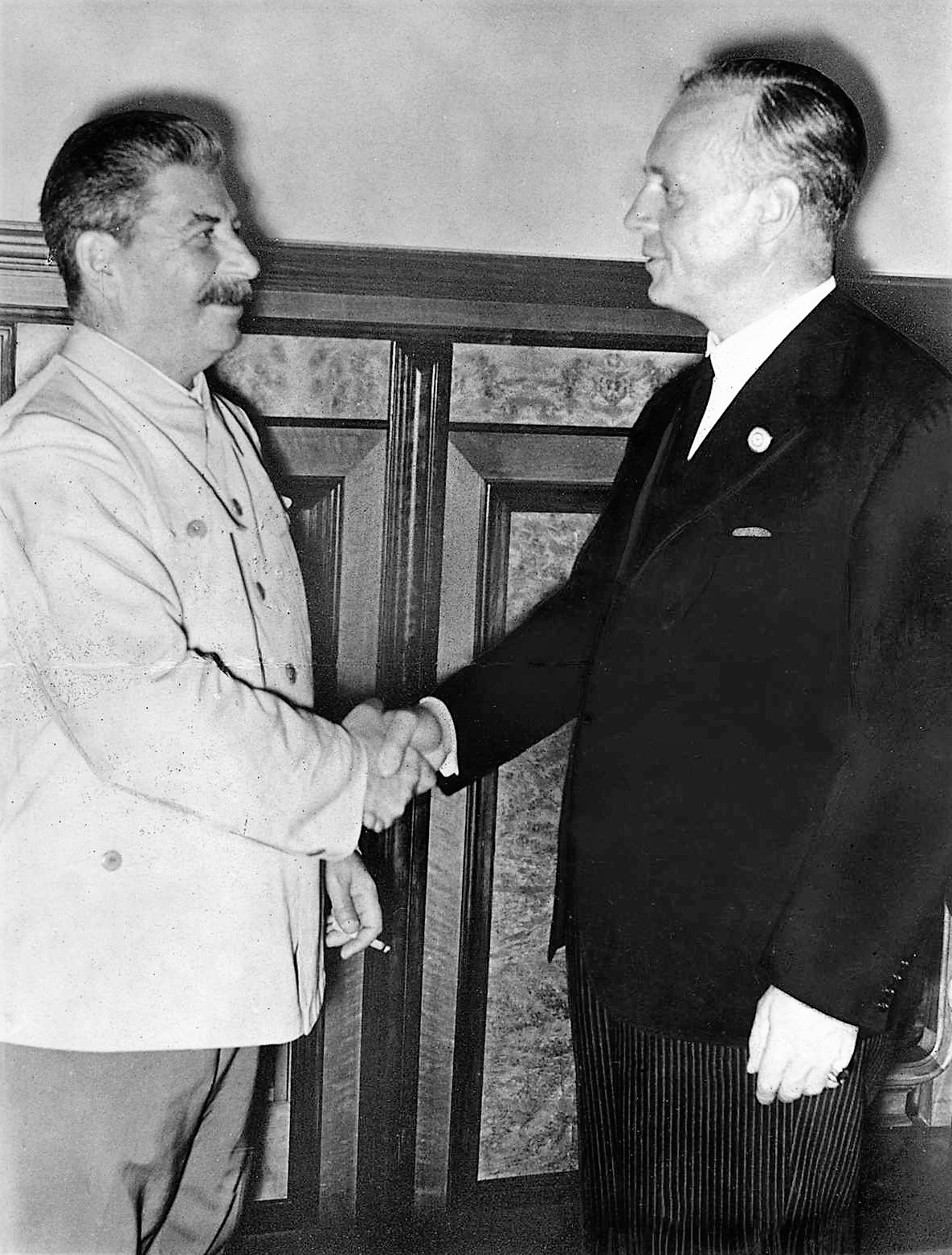
I like the authors’ term non-aggression pact. I know that it is a common one in game theory, but whenever I hear it I think of the 1939 Molotov-Ribentropp Non-Aggression Pact.

Stalin and Ribentropp, 1939


Canadian Historical Association 2010 – Meeting of Business Historians

7 05 2010

I am cordially inviting you to attend the meeting of the Business Historians’ group at the forthcoming CHA in Montreal. The meeting will take place on Sunday, 30 May between 12:30 and 14:00 in room H-423.

I understand that you may not regard yourself as primarily a historian of business. In the last fifteen years or so, the sub-discipline of business history has evolved to become far more inclusive by expanding into topics that overlap with what is commonly called social history. In recent years, the papers presented at the Business History Conference in the U.S.  have dealt with such historical issues as race and business, women in corporate America,  corporate social responsibility and the environment, gender in commercial advertising, and other matters far removed from traditional business history. The integration of social and business history in the last fifteen years has helped to make business history more relevant to other historians, which is one of the reasons why the number of papers related to business history (broadly defined) presented at the annual conference of the American Historical Association has increased of late.

The Canadian Historical Association has long had a sub-group devoted to business history. However, it has not been terribly active in recent years. I am the new chair of the business history group, having assumed my duties earlier this year. One of my goals is to bring about a renaissance in Canadian business history similar to that experienced by the business history community in the United States. I feel that by embracing other branches of history, Canadian business history will be able to increase its relevance to the discipline as a whole.

Historians who are not business historians in the strict sense of the term might be interested in attending the meeting of the business historians’ group. At the meeting, we shall be discussing how to re-invigorate this group. I am thinking that we should begin the process of organizing a roundtable on the future of Canadian business history for next year’s CHA.

As well, I would invite you to join the new Canadian Business History group on Google Groups.

http://groups.google.com/group/cbh-hac?pli=1

Best regards,

Andrew Smith