Conference on The Car in Modern Society

30 04 2012

Centre for International Business History
at The University of Nottingham
16 May 2012, 11.30-4.30pm


Cars have become a consumer good, a status symbol and often an economic necessity. They have had a huge impact on social mores, economic development and urban structures. This workshop aims to complicate our understanding of the
perceived importance of the car through a set of global case studies.

SPEAKERS

Professor Maggie Walsh
(Cultures, Languages and Area Studies, University of Nottingham)
‘’Gender and American Automobility: Cars, Women and the Issue of Equality’.

Dr Sue Townsend
(Department of History, University of Nottingham)
‘Japan: A Post-car Society [Kuruma banare]?’

Professor Simon Gunn
(Director, Centre for Urban History, University of Leicester)
‘’The Car and the City in 1960s Britain’.

If you would like to attend, please contact: sheryllynne.haggerty@nottingham.ac.uk


Critical Distance and the Academic Study of Entrepreneurship

29 04 2012


As a historian who studies entrepreneurship, I try to keep up-to-date on what other social scientists are saying about it. Kate Maxwell of the Kaufmann Foundation’s entrepreneurship programme  recently blogged about the gap between the academics who study entrepreneurship and actual flesh-and-blood entrepreneurs.


In my reading of the entrepreneurship literature I have been struck by the large gap between entrepreneurs and people who study entrepreneurship. The group of people who self select into entrepreneurship is almost entirely disjoint from the group of people who self select to study it. Such a gap exists in other fields to greater and lesser degrees. Sociologists, for instance, study phenomenon in which they are clearly participants whereas political scientists are rarely career politicians but are often actors in political systems.


But in the case of entrepreneurship the gap is cause for concern. My sense is that all too often those studying entrepreneurship don’t understand, even through exposure, the messy process of creating a business, nor, due to selection effects, are they naturally inclined to think like an entrepreneur might.


What Kate Maxwell said here sounds reasonable.  Yes, academics who study entrepreneurs should probably speak to entrepreneurs. However, I think that it is also important for scholars of any social phenomenon to maintain their critical distance. The last thing we want is for scholars of entrepreneurship to fall into the trap of hero worship. 


Dani Rodrik on Ideas and Interests

27 04 2012

Dani Rodrik has published a great post about the respective roles of ideas and interests in shaping government policy. See here.  Every historian should read it, as he is talking about an issue that historians have to grapple with: what causes people to act in a particular way– is it ideas/culture/values or simply pressure-groups in the background?

Proponents of the Rational Actor model of human behaviour say the latter, most cultural or religious historians would say the former. This is a question that we ask about the behaviour of a wide range of actors, ranging from nation-states to companies to individuals.

Rodrik writes:

The most widely held theory of politics is also the simplest: the powerful get what they want. Financial regulation is driven by the interests of banks…  this explanation is far from complete, and often misleading. Interests are not fixed or predetermined. They are themselves shaped by ideas – beliefs about who we are, what we are trying to achieve, and how the world works. Our perceptions of self-interest are always filtered through the lens of ideas.

Similarly, imagine that you are a despotic ruler in a poor country. What is the best way to maintain your power and pre-empt domestic and foreign threats? Do you build a strong, export-oriented economy? Or do you turn inward and reward your military friends and other cronies, at the expense of almost everyone else? Authoritarian rulers in East Asia embraced the first strategy; their counterparts in the Middle East opted for the second. They had different conceptions of where their interest lay.

Rodrik’s ideas are broadly similar to John Maynard Keynes, who he references in his piece. Keynes underscored the power of economists and philosophers when he wrote that  their ideas “both when they are right and when they are wrong, are more powerful than is commonly understood. Indeed the world is ruled by little else… practical men, who believe themselves to be quite exempt from any intellectual influences, are usually the slaves of some defunct economist”. [i]

Rodrik is making a very good point here.  For historians, the issue is how we balance two interpretative traditions traditionally seen as incompatible. The Rational Actor model, which is popular with many political scientists and economists, holds that individuals decisions are best understood if we proceed on the assumption that they are entirely self-interested.[i]

The Rational Actor model suggests that the appeals to the common interest, high principles, ideologies, religious values, or the teachings of philosophers that politicians sprinkle into their speeches are  meaningless verbiage designed to throw observers off the money trail.

In the US historiography, there is a major debate about whether US constitution should be interpreted as a function of the economic self-interest of the individuals who gathered in Philadelphia to write it or whether understanding the constitution’s origins involves looking at the influence of Montesquieu and Aristotle and other Great Thinkers. Robert A. McGuire published a really convincing book arguing the economic self-interest thesis in  Form a More Perfect Union: A New Economic Interpretation of the United States Constitution. Oxford: Oxford University Press, 2003. There is a good survey of the historiography there.

Although narrative political historians  rarely  formalize their working theory of human behaviour in explicit terms, many scholars of Canadian Confederation lean toward the Rational Actor view. Commenting in 1963 on the learned references to Shakespeare and Greek philosophers in the legislative debates on Canadian Confederation,  historian Peter Waite dismissed them as “twaddle” and just so much hot air.[iii] Waite’s comment suggests that the real reasons for Confederation will be found not in the public debates but in the backroom deals about railways, transfer payments, and jobs for pals.

A very different approach to political history suggests that new ideas and cultural shifts are what drive political and social  and, constitutional change.  For example, consider Janet Ajzenstat`s recent book, The Canadian Founding: John Locke and Parliament. Here, Professor Ajzenstat argues that John Locke (1632-1704) was the political thinker who did the most to inspire to Confederation.


Just as the proponents of the Rational Actor model have favourite examples to support their view, those historians who emphasize the causal power of ideas have their own supporting data points. The campaign to abolish the trans-Atlantic slave trade and then slavery would be a great piece of evidence to use to support the “ideas matter” thesis: few historians today would suggest that the abolition of slavery in the British Empire was motivated by economic self-interest, which is what Marxist historians once argued. Indeed, the abolition of slavery in the British Empire is now regarded as a case of religiously-motivated “econocide” (i.e., the killing of a profitable economic system for ethical reasons). In other words, values not material interests determined how the relevant actors, in this case the majority of members of the British parliament, acted. [vi]

I don’t suppose that the perennial debate of the relative importance of ideas and interests in determining human behaviour will ever be resolved, but it’s worthwhile thinking about this issue.

[i] Ira Katznelson and Barry R. Weingast “Intersections between historical and rational choice institutionalism” in            Preferences and Situations : Points of Intersection between Historical and Rational Choice Institutionalism edited by Ira Katznelson and Barry R. Weingast (New York : Russell Sage Foundation, 2005).

[ii] Forrest McDonald, Alexander Hamilton : a Biography (New York : Norton, 1979), 202-3

[iii] Quoted by Ged Martin in introduction to The Confederation Debates in the Province of Canada 1865 (Montreal: McGill-Queen’s University Press, 2006), p. xxiii.

[iv] Robert L. Spaeth, “Ideas Have Consequences — Or Do They?” College Teaching 34 (1986): 17-19.

[v] John Maynard Keynes, The General Theory of Employment, Interest and Money (London: Macmillan and co., limited, 1936), 383.

[vi] Seymour Drescher, Abolition : a History of Slavery and Antislavery (Cambridge: Cambridge University Press, 2009).


[i] John Maynard Keynes, The General Theory of Employment, Interest and Money (London: Macmillan and co., limited, 1936), 383.


A Few Thoughts on the Academic Spring

26 04 2012

Recently, there has been quite a lot of attention in the media and the blogosphere about the whole issue of open-access journals. The issue is this: academics in taxpayer-funded universities produce research in the form of articles that they publish in journals run by for-profit corporations. The said corporations then sell the research, which they got for free, for a princely sum. Journal subscriptions are expensive, which means that most taxpayers are unable to read the research they have paid for unless they are members of a university community.  The Economist magazine, which is hardly known for its left-wing views or hostility to the profit motive, recently denounced the whole academic publishing industry, noting that profit margins in it extremely high. Of course, they are high: most of the actual work (writing articles, editing journals, doing the peer-reviewing) is done by volunteers.

Faced with the escalating costs of journal subscriptions, which is eating a big hole in university library budgets, some academics are saying that they want to boycott this whole system and publish all future research in open-access journals. Open-access journals put articles online so that everybody can read them. No account, no fees, no passwords. The paywall is gone.

Tim Gowers, a Cambridge mathematician, sparked the current wave of protest against the academic publishing industry with a blog post in January in which he basically declared war on Elsevier, one of multinationals that publishes a stable of journals. Gowers said that he was going to boycott Elsevier journals and would refuse to publish in them or do peer-review.  Within 24 hours, another academic had set up a website, The Cost of Knowledge, so that academics could join the boycott. The movement against journal paywalls, which some have dubbed the Academic Spring, has gathered movement since then. Harvard University, the Wellcome Trust (which funds science), and the British government have endorsed the principle of open-access. For a round-up of recent developments, see here.

I’m broadly supportive of this movement. I also kinda like the thinking behind a proposal by Peter Coles, a theoretical astrophysicist who says only open-access research should count towards the Research Excellence Framework, or REF. The REF is a census of research worth that the British government uses to determine how much money to give to each university department for research. If a department has produced lots of books and articles and these articles are judged to be of first-class quality, then the government will give that department a fairly generous appropriation over the next few years. The elegant beauty of Coles’s proposal is that it would incentivise academics to put their best papers into open-access journals.

However, I’m not entirely convinced that we should adopt the ideas of the open-access movement. Consider the proposal by Peter Coles, who seems to think that research will only ever be presented in the form of articles. That may well be true in his field, but in history there is still a lot of weight attached to the monograph. A paper book can’t be free to the public, although I agree that academics should be encouraged to write books that will be sold at reasonable prices. (Full disclosure: I’m currently working on two books, a strictly academic one that will sell for a high price and a book with more popular appeal that will appear in paperback).

There is another problem with the Open-Access movement.  It isn’t free to run a journal, even an online journal that dispenses with the cost of ink and paper. Editors, copyeditors, programmers, etc., all need to be paid. This raises the question of who is going to pay for open-access journals.  Governments have provided a bit of funding for open-access scholarly publishing. For instance, the wonderful new open-access Journal of Historical Biography was funded by the Social Sciences and Humanities Research Council of Canada (SSHRC).  For more details of SSHRC’s grant program for open access journals, see here.

However, in an age of austerity in most of the research intensive nations (e.g., the US, the UK, etc), governments probably won’t be willing to fund the production costs associated with all the journals that might want to become open-access. Even in the best of times, national governments would be unwilling to pay much to support open-access scholarly journals, since academic journals, if they are in English, are produced for the benefit of readers throughout the world. No single-nation state has an incentive to make academic research a global public good, any more than New York City Hall would undertake to pay from street-lighting throughout the United States.  Moreover,  one can count on the academic publishing industry lobbying against government grants to open-access journals. “We can’t compete with taxpayer funded open-access journals. We pay taxes”.

This means that we will have recourse to the author-pays model, whereby the author of an article pays a fee to publish it. In most cases, it is the employer of the author who pays. Universities have a strong incentive to pay for the publication of articles written by their professors, as they have already invested so much in the production of the article in terms of the professor’s time, money for research costs, etc.

Let’s assume for the sake of argument that all academic journals move to the open access model. This will mean that universities have to devote less money to library budgets and more money to faculty research budgets, the budgets within universities that right now support things like, say, a historian travelling to a distant archive or a scientist buying rats for an experiment.

Libraries, like all university departments, are very territorial, and will resist having their budgets cut so that funds can be transfer to another branch of the university. We can expect this to be the case even if the new regime, open access, will save money for universities overall.

I envision nasty bureaucratic infighting if open-access publishing ever becomes common in the scholarly world.  I’m not saying open-access is a bad principle, but a shift to it would have unintended consequences. University administrators need to start thinking about them now.

Moreover, some universities are clearly net producers of knowledge, whereas others are net consumers. There is a free-rider problem there that the open-access model can’t quite address.




North American Studies Seminar Series, University of Oxford

26 04 2012

Monday, 30th April

Side Effects: Mexican Governance under NAFTA’s Labour and Environmental Agreements
Mark Aspinwall Professor of Politics, University of Edinburgh
Location: Latin American Centre Seminar Room, 1 Church Walk

Tuesday, 8th May
American History Research Seminar: The Internal Enemy: Chesapeake Slavery and the War of 1812
Alan Taylor Professor of History, University of California – Davis
Location: Nissan Lecture Theatre, St Antony’s College
Special Time: 4:00 PM

Monday, 14th May
When Nations and Biology Meet: Exploring the Social and Cultural Politics of New Genetic Technologies in Canada
Amy Hinterberger Research Fellow, Institute for Science, Innovation and Society, University of Oxford
Location: Dahrendorf Room, Founder’s Building, St Antony’s College

Tuesday, 22nd May
Special Lecture: The North American Idea
Robert Pastor Director, Center for North American Studies, American University
Location: Nissan Lecture Theatre, St Antony’s College

Unless indicated, all seminars will take place from 5:00 PM to 6:30 PM.


General inquiries may be directed to north.american.studies@sant.ox.ac.uk. or to Halbert Jones, Senior Research Fellow in North American Studies halbert.jones@sant.ox.ac.uk


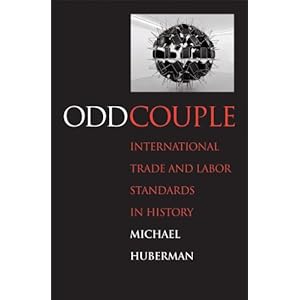
Michael Huberman on Globalization and Working Conditions.

23 04 2012


I’d like to bring your attention to an important new book on economic history by Professor Michael Huberman of the Université de Montréal.

Here is the abstract:

It has become commonplace to think that globalization has produced a race to the bottom in terms of labor standards and quality of life: the cheaper the labor and the lower the benefits afforded workers, the more competitively a country can participate on the global stage. But in this book the distinguished economic historian Michael Huberman demonstrates that globalization has in fact been very good for workers’ quality of life, and that improved labor conditions have promoted globalization.

Huberman shows that the growth of international trade in the pre-1914 “golden age” of globalisation was accompanied by the introduction, in many countries, of a wide range of regulations designed to protect workers. e.g., factory inspection, mandatory safety equipment, child labour laws, workers’ compensation legislation.The really controversial part of the book is the part where Huberman argues that the timing here wasn’t coincidental either– the globalization drove the adoption of these measures.

This is one of those works on economic history that has some pretty direct relevance for public policy: it suggests that continued moves towards globalization will NOT result in the erosion of workplace standards. To my mind, this book qualifies the argument made by  Dani Rodrik that there is a tension between globalization and social protection. Rodrik’s reading of economic history is that: democracy, national sovereignty and global economic integration are mutually incompatible: we can combine any two of the three, but never have all three simultaneously and in full.

This is an interesting book and I plan to incorporate it into a lecture in my history of globalisation class. However, I’m still a bit skeptical.

I have two initial reactions/criticisms of Huberman’s thesis.

1) Huberman’s evidence is a bunch of data points mainly from the West, the North Atlantic world. This region was the centre of the world economy in this period, as is suggested by the title of the famous book Globalization and History: The Evolution of a Nineteenth-Century Atlantic Economy by Kevin H. O’Rourke and Jeffrey G. Williamson. What about today, when the BRIC nations are an increasingly important part of the world’s manufacturing system?

2) I seem to recall that starting in the 1870s, British manufacturers tried to persuade the British government to impose health-and-safety and child labour laws on factories in British India. Their aim in doing so was to undermine the competitive advantage that unregulated Indian textile mills had over mills in Britain, where child labour had been banned. The Indian entrepreneurs resisted this move by the British. Indeed, as Lord Salisbury said,

There is no subject more commonly discussed, and writers 
in the native journals dwell on the wickedness of the 
English who are trying to stifle native manufactures in 
India under the guise of philanthropy. I am, therefore, 
glad that my noble friend is coming forward in this matter, 
for his philanthropy is, at all events, above suspicion ; 
he cannot be suspected of joining in the dark conspiracy 
and trying to stifle the infant manufactories of India in 
the interests of Manchester...

quoted in J.C. Kydd,  A History of Factory Legislation in India. [Calcutta]: University of Calcutta, 1920., p. 7

How does the episode of child labour legislation in British India fit with Huberman’s thesis?

You can read a summary of Huberman’s findings here.


R. Daniel Wadhwani on the Historical Origins of the Home Mortgage Mess

23 04 2012

BHC member R. Daniel Wadhwani has published an important blog post on the history of home mortgages in the United States.

He shows that the problem of over indebted homeowners, which was at the centre of the 2008 financial crisis, is very old: Herbert Hoover held a conference on the issue in 1931. As he Wadhwani notes, We often think of the expansion of easy mortgage financing as a relatively recent development, but the growth of indebted homeownership has older and more complicated origins.

I liked this post but I disagree with one of Wadhwani’s conclusions. Some people, most notably Niall Ferguson, have argued that the cultures of the United States and the other English-speaking countries have become too focused on home ownership. Ferguson notes that a larger proportion of the population in countries such as France and Germany are renters and suggests that we would be better off if fewer people in the Anglo countries tied up all of their money in houses.  See here and here.

Wadhwani  appears to disagree with Ferguson’s proposal that governments should promote renting and discourage buying.

Simple attempts to “fix” the American inclination for ownership by promoting renting seem naive in historical perspective. Long-held preferences for ownership in family economic planning; the cultural and political support for owning; and the economic interests of financial institutions have made indebted ownership a persistent feature of the U.S. economy — despite the crises it has experienced (and created) over the past century. A recent Pew Research Center poll found that 81 percent of Americans still believe that “buying a home is the best long-term investment a person can make.”

I don’t think that Niall Ferguson would say that changing the culture away from its fixation on home ownership would be simple.  Moreover, Wadhwani’s argument that the culture of homeownership is too ingrained to change seems a bit fatalistic to me. Economic norms can shift quite rapidly, actually, provided there is determined political leadership and smart public policy. Homeownership ideology need not be a permanent feature of a national culture.

R. Daniel Wadhwani is Fletcher Jones Assistant Professor at University of the Pacific and is the author, most recently, of “The Institutional Foundations of Personal Finance,” published in the Business History Review.


Image of the Day

23 04 2012

Chemnitz, the East German city formerly known as Karl-Marx-Stadt, voted for this image on their savings bank credit card


David Brooks on the Value Added by Higher Education

20 04 2012


The NYT’s David Brooks has published an interesting column on the benefits, perceived and real, of attending “college,” which is, of course, what Americans call university. See here.

This is the most interesting paragraph, from my point of view:

Colleges are supposed to produce learning. But, in their landmark study, “Academically Adrift,” Richard Arum and Josipa Roksa found that, on average, students experienced a pathetic seven percentile point gain in skills during their first two years in college and a marginal gain in the two years after that. The exact numbers are disputed, but the study suggests that nearly half the students showed no significant gain in critical thinking, complex reasoning and writing skills during their first two years in college.

Brooks makes a good point, although space constraints kept him from including some of the most damning data from the Arum and Roksa study:

  • 45 percent of students “did not demonstrate any significant improvement in learning” during the first two years of college.
  • 36 percent of students “did not demonstrate any significant improvement in learning” over four years of college

According to the study, the main reason for lack of academic progress of students was lack of rigour: “32 percent of students each semester do not take any courses with more than 40 pages of reading assigned a week, and that half don’t take a single course in which they must write more than 20 pages over the course of a semester.”

Students today much less time doing academic work than university students did in the 1960s.

Read more about the study here.

I like how Brooks’s column focuses on ways in which higher education can be improved. Brooks should be commended for not succumbing to the temptation to declare that universities are a colossal waste of time and money.  As we all know, there are many such critics. Indeed, some of the university-haters are putting their money where their mouths are and setting up anti-scholarship (i.e., paying bright students who could attend an elite university to go and do something else for four years). Peter Thiel, the Silicon Valley tycoon who has a bachelor’s degree in philosophy from Stanford, is perhaps the most famous of the university haters.

Peter Thiel

I’m glad that Brooks didn’t jump on the university-hating bandwagon. I completely share his belief that university can and should be reformed, not scrapped. It disturbs me that so many people on the political right are university-bashing right now.


The ROI on Higher Education

19 04 2012

According to an article in the Atlantic, “A study from the Hamilton Project found that $100,000 spent on college at age 18 would yield a higher lifetime return than an equal investment in corporate bonds, U.S. government debt, or hot company stocks.”

Why wasn’t the return on magic beans and Florida swampland compared as well? Seriously though, I don’t think that this data refutes the argument that higher education increases an individual’s earning power mainly through signalling pre-existing abilities to employers rather than by actually developing the person’s skills. On the signalling model, see here.