Technology and the Vanishing Hand

21 05 2012

Dick Langlois, an economist at the University of Connecticut, recently posted something about the Vanishing Hand on the Organizations and Markets blog.  His term Vanishing Hand is a reference to both Adam Smith’s famous theory of the invisible hand and Alfred Chandler’s term the visible hand.

In his 1776 book, Smith had viewed the economy as involving a vast number of small and autonomous firms linked together by markets. This paradigm corresponded to the reality of that era, for the most part.  With the exception of a few chartered trading monopolies such as the Hudson’s Bay Company, the companies of the 18th century were small concerns, typically occupying only a single address, and using the simplest type of corporate structures (sole proprietorship or a partnership).  As the business historian Alfred Chandler demonstrated in his 1977 masterpiece, The Visible Hand: The Managerial Revolution in American Business, the 19th century saw the rise of large corporations that were radically different: they were active in many geographical locations (think of a railway),  were vertically integrated, they had many owners (shareholders), and were managed by a complex hierarchy of managers.  Large firms exist, as Ronald Coase showed many years ago, because they help to reduce some of the transaction costs that are part of the market economy.

The development of  large Chandlerian  corporations, which was prompted by a mixture of legal and technological changes, led to the displacement of the free market by corporate bureaucracy as the most important coordinating mechanism in the economy. Chandler called the managers of these firms the Visible Hand, a play on Smith’s terms.

Since 1977, advanced economies such as the United States have moved away from the model described by Chandler. In fact, Chandler published just a very peak of the model of economic organization discussed in his book. In the last 30 years, corporate bureaucracies have become less important as a coordinating mechanism in the economy and markets are more important.

Many of the big, vertically-integrated firms have been broken up via outsourcing– rather than make all of their upstream components themselves, they have decided to start buying those components in the market. That’s what Langlois means by the term Vanishing Hand.

As Langlois wrote:

One of my longest-running interests has been the relationship between economic change, including technological change, and the boundaries of the firm. In broad strokes, my story is this: when markets are thin and market-supporting institutions weak, technological change, especially systemic change, leads to increased vertical integration, since in such an environment centralized ownership and control may reduce “dynamic” transaction costs; but when markets are thick and market-supporting institutions well developed, technological change leads to vertical disintegration, since in that environment the benefits of specialization and the division of labor outweigh the (now relatively smaller) transaction costs of contracting. This latter scenario is what I called the Vanishing Hand.


The most commonly accepted theory for the vertically-integrated corporation has diminished in importance in the last 30 years relates to technology.  This is certainly what Langlois argues. In his recent blog post, Langlois points to some recent research that appears to support his belief that it is technological change that is driving this process. Langlois is talking about a working paper by Ann Bartel, Saul Lach, and Nachum Sicherman, called “Technological Change and the Make-or-Buy Decision.” Their research was based on a dataset of Spanish firms from 1990 to 2002.

Here is a summary of their paper:

A central decision faced by firms is whether to make intermediate components internally or to buy them from specialized producers. We argue that firms producing products for which rapid technological change is characteristic will benefit from outsourcing to avoid the risk of not recouping their sunk cost investments when new production technologies appear. This risk is exacerbated when firms produce for low volume internal use, and is mitigated for those firms which sell to larger markets. Hence, products characterized by higher rates of technological change will be more likely to be produced by mass specialized firms to which other firms outsource production. Using a 1990-2002 panel data set on Spanish firms and an exogenous proxy for technological change, we provide causal evidence that technological change increases the likelihood of outsourcing.

You can read an ungated version of the paper here. It  shows that the authors studied a wide range of industries, from electronic components, where the measured rate of technological change was fast, to furniture, where the measured rate was slow.

Using patent filings as a way of measuring the amount of technological change in an industry, these authors found that Spanish firms in industries which were experiencing rapid economic change tend to outsource more ceteris paribus than firms operating in industries where the products didn’t change much in this period.

I’m pretty sympathetic to the idea that technological change is the main driver of the vanishing hand. It seems plausible to me.  It is now much easier to engage with the market than it was in 1977, thanks to the internet. You can go online and read customers’ reviews of firms you are considering outsourcing to.  It is relatively difficult to steal from a standardized shipping container, which makes firms more likely to outsource to a distant supplier. However, I don’t think that the research Langlois cites in his blog post does much to support the theory that the move away from the industrial structure discussed by Chandler is driven by technologies that have lowered transaction costs.

First, patent filings are not a reliable gauge of technological innovation in an industry,  company, or country. For instance, there are many firms that specialize in filing totally bogus patent claims so they can then sue the makers of products. The growth of TFP in an industry would be a better measure of the rate of technological progress.

Second, the Spanish industry-level data  is basically about the products made by companies in various industries.  The companies are grouped into industries by what they make. It doesn’t really examine the changing use of technology to coordinate the production of these products, which would be more relevant, in my view.  The technology involved in producing furniture probably hasn’t changed much in the last few decades.  The technology to make portable music players has changed rapidly, as transistor radios gave way to Walkmen and then Ipods. However, the technologies used to market these products and to purchase inputs have changed dramatically: you can buy and sell stuff on eBay, etc. Some firms that sell very traditional products, e.g., wine, have been very innovative at using technologies to change how they deal with customers and suppliers.  For instance, some wineries now use websites to sell directly to consumers, bypassing the middleman.





Barry Ritholtz on the Repeal of Glass-Steagall

21 05 2012

Glass Steagall law kept commercial or depository banks in the United States separate from their more speculative Wall Street investment banks. It was passed in the aftermath of the wave of bank failures in the early 1930s. It promoted financial stability and worked well until it was repealed. The repeal of Glass-Steagall is commonly associated with a law passed by Congress in 1999. As Barry Ritholtz shows in a recent blog post, the 1999 Gramm-Leach-Bliley Act was really the culmination of a series of changes aimed at watering down the principle that investment and commercial banking should be kept separate.


Call for Papers: Varieties, Alternatives, and Deviations in Marketing History

18 05 2012
AS: Copenhagen Business School is one of the leading centres for research into business history. They will be hosting a very interesting conference in 2013. I’m posting the details here. The organisers are Leighann Neilson of Carleton University Stefan Schwarzkopf of Copenhagen Business School.
Copenhagen Business School

Copenhagen Business School

Call for Papers: Varieties, Alternatives, and Deviations in Marketing History
16th Biennial Conference on Historical Analysis & Research in Marketing (CHARM)
             
May 30 – June 2, 2013
Hosted by Copenhagen Business School
In 2013, the Conference on Historical Analysis and Research in Marketing (CHARM) celebrates its 30th Anniversary. To celebrate its jubilee, we invitebusiness, marketing, social science, and humanities scholars from all backgrounds to join us in Copenhagen for a friendly, collegial and interdisciplinary research conference. In celebrating three decades of marketing historical research at CHARM, we call on scholars from around the globe to cast a critical look back into marketing’s past and forward into its future.
Papers on all aspects of marketing history and the history of marketing thought in all geographic areas and all time frames are welcome. In keeping with the conference’s theme, we especially welcome papers that deal with the following aspects of marketing and its history:      
          varieties of marketing cultures and histories
          writing the past: constructing histories in/for marketing
          the role of relationships and networks in marketing
          marketing and political parties, co-operatives and civil society organizations
          marketing and political dictatorships (from Communist East Europe, to the right-wing dictatorships of interwar Europe, and liberal dictatorships like Pinochet’s Chile)
          marketing, black markets and precarious work and economies in the past (prostitution, black markets, forgery etc.)
          marketing history outside North-America and Europe
          marketing history ‘from below’: how do consumers and citizens respond to and interact with firms and brands
          marketing and imagined communities; nations and cities as brands
          marketing and social criticism, before and after No Logo
          marketing and devious, illegal behaviour (shop-lifting, copyright-theft, brand imitations etc.) 
We also encourage submissions that discuss methodological, pedagogical and historiographic questions in marketing.
Doctoral students with a particular interest in research methods in marketing history and marketing theory are invited to attend a two-day workshop which immediately precedes the conference. There will also be a special track for the presentation of doctoral projects at the conference itself. For more information on the doctoral workshop see www.charmassociation.org. 
All paper submissions will be double-blind reviewed and a proceedings volume will be published. Full papers (25 page maximum) or extended abstracts may be submitted. Authors may choose to publish either full papers or extended abstracts in the proceedings. To provide reviewers with sufficient information, extended abstracts should be: 1,200-1,500 words in length and include the research purpose, source material or data, and sample references.
Please note: submitting a full paper to the proceedings volume does not preclude a submission of your paper to a journal. The copyright of a paper published in the CHARM proceedings remains with its authors, and over the years many CHARM conference papers have made their way into marketing, historical, sociological and other journals.  
SUBMISSION DEADLINE: Sunday, December 16, 2012.
Direct submissions to Leighann Neilson, Program Chair and Proceedings Editor: charmconference2013@gmail.com
All submissions, full papers and extended abstracts, must be in double-spaced Microsoft Word format. All must contain a cover page to include (1) manuscript title; (2) author(s) name and title, (3) contact information, (3a) corresponding author (for co-authored works), (4) author(s) status (student, faculty or independent scholar), (5) paper vs. abstract designation, (6) one or two recommended reviewers. All cover pages should also include the following statement: “In the event this submission is accepted for presentation and publication in the CHARM Proceedings, I (or a co-author) intend to present our work at CHARM 2013.” Please use the “Properties” function in Word to remove author information from the document file.
Outstanding full papers may be invited for publication in the Journal of Historical Research in Marketing or in the Journal of Macromarketing. Full papers are also eligible to be considered for either the Stanley C. Hollander Best Paper Award (best overall paper) or the David D. Monieson Best Student Paper Award (best paper by a graduate student). The David D. Monieson Best Student Paper Award eligibility requires that the paper be authored solely by a graduate student(s) and that student authorship be noted on the cover page upon submission.
For additional information about the Conference see the CHARM webpage www.charmassociation.org, or contact:
Program Chair & Proceedings:        
Professor Leighann Neilson
Associate Professor in Marketing 
Sprott School of Business
Carleton University
Ottawa, Canada
Local Arrangements Chair:
Stefan Schwarzkopf
Associate Professor in Business History
Copenhagen Business School
Copenhagen, Denmark


The Eurozone Crisis and the Misleading Historical Analogy of the Austro-Hungarian Empire

15 05 2012

Right now, the attention of the financial world is focused on the political crisis in Greece, where there is every sign that the next government will reject the terms of the EU bailout, effectively pulling Greece out of the Euro and plunging the Eurozone into crisis. There has been a lot of commentary and analysis of the crisis in the press, but not enough of this analysis looks to history. The Euro isn’t the first currency union ever, so it worthwhile looking to see how past currency unions have operated.

With this in mind, I would like to bring your attention to an interesting new blog post by Richard Roberts, a financial historian who is also the Director of the Centre for Contemporary British History at King’s College London. His lengthy post, which was carried on the History & Policy blog, talks about the currency union that existed in the Austro-Hungarian Empire between 1867 and 1917.

Austro-Hungarian Banknote from 1880

Roberts reminds us that after the constitutional reforms of 1867, the Hapsburg Empire was made up of two sovereign governments that shared only a monarchy, army, diplomatic service, legal system and currency. Both Austria and Hungary had their own parliaments, governments and national debts. Robert’s is suggesting that the multinational Hapsburg Empire was, in a sense, a precursor of the modern Eurozone. Roberts examines precisely how this central bank of Austria-Hungary functioned and then concludes that “the case of Austria-Hungary demonstrates that a currency union between different states can last, and prove stable, over a sustained period”.

Richard Roberts

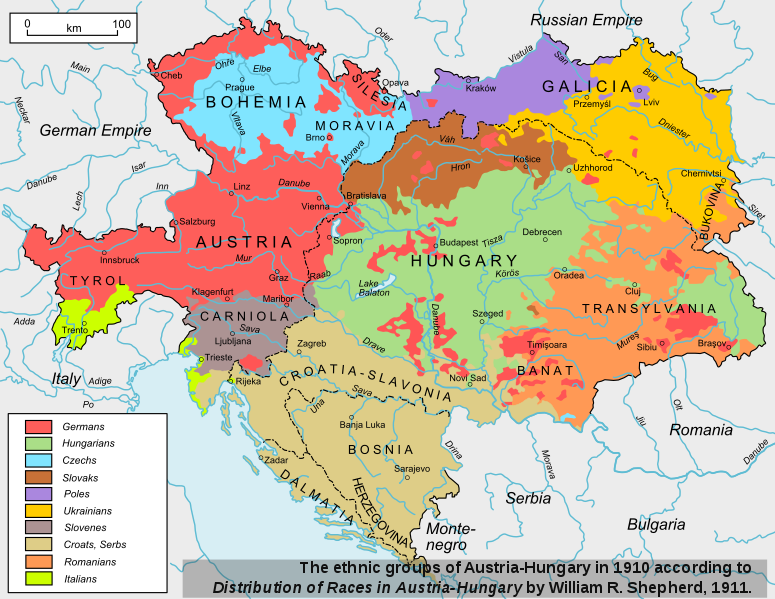
Roberts’s conclusion will doubtless cause some readers to feel a bit optimistic about the Euro’s chances of surviving. I’m not convinced that the historical analogy Roberts is making is actually much help in trying to understand the Eurozone. The Austro-Hungarian monetary union included just two fiscal units, Austria and Hungary, although there were many ethnic groups living in both units.

In contrast, the Eurozone includes a much larger number of nation-states, each with their own parliament, system of taxation, national debts, armies, etc. More importantly, the Hapsburg Empire wasn’t a democracy, which helped to make its adherence to the gold standard possible. As Barry Eichengreen has shown, one of the reasons so many 19th century Western nations choose to endure the rigorously deflationary monetary policies required by the gold standard was that they weren’t yet democracies: most male wage earners didn’t have the right to vote, which meant that the social classes most likely to be hurt by fiscal and monetary restraint (the poor) didn’t have much say in how their countries were governed. (Some Western countries did have universal male suffrage in this period, but found ways of diluting the political power of wage earners: for instance, Prussia gave extra votes to the wealthy).

Once universal adult suffrage coupled with competitive elections came along, it became politically impossible to sustain the gold standard. This is why most Western countries were politically unable to remain on the gold standard during the Great Depression of the early 1930s: by that point, workers and the poor, who would have suffered from the policies necessary to remain on gold, had acquired too much power. Since then, these groups have acquired even more political clout.

The situation was very different in Austria-Hungary.  Even in 1917, the Hapsburg Empire was still be run by a coalition of Austrian and Magyar aristocrats. It really can’t be compared to the Eurozone, which includes 17 social-democratic countries in which groups such as pensioners and public-sector workers have both the right to vote and actual political power.

European Central Bank, Frankfurt

I have a lot of respect for the scholarship of Richard Roberts. However, I think that in this case he needs to go back the drawing board and find a better historical analogy for understanding the Eurozone’s predicament.


Should History Professors Teach Students to Lie?

15 05 2012

T. Mills Kelly is a respected history professor at George Mason University. He is an expert on eastern European history and has published all of the usual scholarly books and articles with academic presses.  He also teaches an undergraduate history class about historical hoaxes and lies. The students also do a group project that involves creating a historical hoax and disseminating it online. Previous group projects include websites, Wikipedia entries, and YouTube videos designed to educate the public about a totally non-existent pirate who allegedly sailed the waters of Chesapeake Bay in the 1870s.  They even forged primary sources and put them online as part of all of the con. Apparently this hoax fooled a bunch of locals, who were intrigued to learn something new about their region’s history, and the newspaper USA Today, a national daily with millions of readers.

This year’s group project involved the creation of a fictitious serial killer. The students attributed several unsolved killings of real women in New York to this killer. They posted information about the person online and the story took on a life of its own.

Here are the learning goals for the class, taken directly from the syllabus:

Learning Goals
I do have some specific learning goals for this course. I hope that you’ll improve your research and analytical skills and that you’ll become a much better consumer of historical information. I hope you’ll become more skeptical without becoming too skeptical for your own good. I hope you’ll learn some new skills in the digital realm that can translate to other courses you take or to your eventual career. And, I hope you’ll be at least a little sneakier than you were before you started the course.

When I heard of this class, my initial reaction was that it was absurd for a historian to teach students to fabricate hoaxes. In fact, I was outraged by what Kelly was doing. I now realize that there is a method to this madness and that his class advances some really important learning objectives, including the inculcating of digital literacy and a healthy scepticism regarding online sources of information. I bet the students who took this class learned to take everything they read in USA Today or indeed any newspaper with a big grain of salt. That’s good. We don’t want our students to become grassy-knoll conspiracy theorists, but they should think very critically about all sources of information.


Jon Gertner’s The Idea Factory: Bell Labs and the Great Age of American Innovation

14 05 2012

In this video, Jon Gertner talks about his new book The Idea Factory: Bell Labs and the Great Age of American Innovation. It’s a history of the Bell Labs research facility.


Tsedal Neeley, Englishnization, and Official Languages

5 05 2012

Tsedal Neeley, a Harvard Business School prof, has published a certain to be controversial article in the current issue of the Harvard Business Review that pretty much says that everyone in the world should learn to speak English, dammit. I’m oversimplify, but this is the thrust of her piece, in which she points out that companies as Airbus, Daimler-Chrysler, Fast Retailing, Nokia, Renault, Samsung, and SAP have made English their official languages. Her argument is that for a country or a company to prosper in the global economy, they need to adopt the global lingua franca. 

The horrible term “Englishnization” come from Japan, where some large companies have recently adopted English as their official languages. Uniqlo, a Japanese clothing retailer, is one example: Uniqlo, interestingly enough, is a rare example of a Japanese fashion chain that has managed to become a global player, with stores in Europe and North America as well as Asia. The number one cheerleader for Englishnization is Hiroshi Mikitani, the CEO of Rakuten, which is the Japanese equivalent of eBay. Mikitani is a self-made entrepreneur whose whims are law at his company, which makes him somewhat unusual in Japan, where decision-making by committee is the norm. Mikitani’s English is probably pretty good, since he is a graduate of the Harvard Business School. Anyway, in early 2010, he decided that his company would henceforth operate in English. He decreed an English-only policy at Rakuten. It was introduced overnight. Workers arrived for work at the company and were confronted with English-only signs in the elevators and English-only menus in the cafeteria.

As The Economist’s “Johnson” blog points out, Englishnization can have a major negative consequence for employee morale: being forced to operate in a second language can sap the confidence of an employee instantly.   

I know that introducing an official language in a company isn’t the same as an official language in a nation-state. However, there are some parallels that organizational studies scholars should consider.

Canada has lots of experience on the effects of language policies and bilingualism on organizations. In the 1960s, a Royal Commission on bilingualism accumulated lots of social-scientific data on the theory and practice of bilingualism in organizations around the world. (For instance, they sent experts to study bilingualism in the Belgian post office and the South African military).

I suspect that Canadian academics, especially but not exclusively those in business schools, would have a lot to contribute to this debate about how official language policies can change organizations for the better and for the worse.  


David Willetts and the Global Intellectual Commons

3 05 2012

David Willetts, the UK’s Science Minister, had endorsed the open-access movement in academic publishing.  See here, here, and here. Indeed, he did so in a speech to the Publishers Association, the lobby group that represents some of the companies that are currently in the business of academic publishing. Willetts has enlisted the services of Wikipedia founder Jimmy Wales, who will help with the details of a system that will make all taxpayer-funded academic research in Britain available online to anyone who wants to read or use it. The theory is that taxpayers have a right to read the research their money has paid for.

One of the issues that Willetts is confronting is the free-rider problem: if one research-producing country, in this case the UK, makes academic research a public good by putting it on the internet for everyone to see, citizens of other countries will be able to take advantage of their generosity will continue to charge people in the UK to read their research.

Willetts said:

“There are clear trade-offs. If those funding research pay open-access journals in advance, where will this leave individual researchers who can’t cover the cost? If we improve the world’s access to British research, what might we get in response?”

I understand why Willetts would say this, but I think that his concerns are misplaced. First, making it easier for foreigners to read and cite British research will increase the collective global impact factor of British academics. Second, Britain may build up goodwill in the world by putting its research online for free.  The BBC World Service and the BBC website add immensely to Britain’s soft power in the world. Third, showcasing academic research online would be great advertising for British universities, which crave the income that foreign students bring. (Higher education is one of Britain’s leading exports). Lastly and most importantly, the world of intellectual inquiry is not a zero-sum game. If, say, a British biologist puts some information online that helps a researcher in India to do something that contributes to the finding a cure for cancer, British taxypayers, at least those who have cancer, will benefit.

David Willetts also said

“Giving people the right to roam freely over publicly funded research will usher in a new era of academic discovery and collaboration, and will put the UK at the forefront of openresearch. The challenge is how we get there without ruining the value added by academic publishers.”

This is absolutely correct. The employees of Elsevier and the other much-vilified companies that publish academic research behind paywalls do add value beyond that supplied by the authors of articles on the unpaid volunteers who do peer review. For one thing, the copyediting done by these corporations makes research look more presentable.  It is entirely right and proper that these firms be compensated for this service. The question is whether they should be compensated via the people who read academic articles or by the taxpayer. The UK is a net exporter of academic research, which adds tens of millions to the UK’s current account each year.

What we have right now with the academic journals hidden behind Jstor and other paywalls is a tragedy of the anti-commons. I’ve always looked at the Academic Spring (and the whole issue of IP more generally) through the lens of the literature on the tragedy of the anti-commons. A great book on this issue is Michael Heller’s The Gridlock Economy  How Too Much Ownership Wrecks Markets, Stops Innovation, and Costs Live.

Collectively, we would all be better off if we turned this anti-commons into a global commons.  However, it is also fair that we compensate existing stakeholders, including the academic publishing industry, as we move from one regime to another. In fact, doing so is politically expedient, for without the promise of compensation, the stakeholders will fight hard to preserve the status quo.

One hopes that the Finch Working Group  comes up with a model that is both fair and efficient.

You can read more here.


Questionable Priorities

2 05 2012

I see that the Canadian government will be paying for Prince Charles and Camilla to visit Canada this year. It is ironic that the same government has just decided to cancel all funding to the British Association for Canadian Studies, the organization that promotes awareness of Canada in Britain by, for instance, paying university libraries to stock books about Canada. In fact, the cancellation of the Understanding Canada program will curtail Canadian studies throughout the Commonwealth.  Given that Canada’s current government claims that it wishes to strengthen ties with Britain and the Commonwealth, it was an odd decision to end funding for the one body that combats the deplorable ignorance of and indifference to Canada that is so rampant in the UK. A professor of international relations here recently confessed to me that he “couldn’t name the President of Canada.”

You can read the official announcement of the cut here.


Arrived in the mail today: a Made in China Sir John A. Macdonald Desk Ornament

1 05 2012

image