James Belich gets the Beit Professorship

9 06 2011

James Belich, the author of Replenishing the Earth,  has been appointed to one of the top history jobs in the world in his field. In October, he will take up the Beit Professorship of Commonwealth and Imperial History at Oxford University. He is currently Professor of History at Victoria University’s Stout Research Centre for New Zealand Studies.

The Beit Professorship provides research leadership in Commonwealth, imperial and global history and is awarded to a historian of exceptional and international reputation. The position is described here.

The position was established in 1905 and Belich will be the seventh historian to hold it. According to Wikipedia, Belich’s predecessors were:

As I have said in an earlier blog post, Replenishing the Earth is a wonderful and magisterial book. In my humble opinion, Oxford has just made a great hiring decision!


IHR Live Stream: Text Mining the Old Bailey Proceedings

9 06 2011
London’s Institute of Historical Research has long been famous for its seminars. It is now starting to podcast and live-stream these presentations.  On 14 June 2011 Professor Tim Hitchcock (Hertfordshire) will be giving a presentation to the Digital History Seminar on text mining the Old Bailey Proceedings project.9 June, 2011 by Dr Matt Phillpott


Please join us next Tuesday for our third Digital History seminar live stream.  In this session Professor Tim Hitchcock will talk about the Old Bailey Proceedings as a digital project.  This project, developed by the University of Sheffield has reached National headlines and has proven itself a valuable and popular resource. 
 
This will be the last of the Digital History series this semester which is proving both popular and interesting.
 
To join us please check out our live stream page on Tuesday 14th, around 5.15pm British Summer Time.

For more info, click here.


I fail to see the point of professional economists

9 06 2011

The entrepreneur Luke Johnson has a column in the Financial Times. Yesterday’s column was particularly amusing, as he bashed pretty much the entire economics profession. The opening sentence was “I fail to see the point of professional economists”. It went downhill (or uphill, depending on your perspective) from there.

Here are some of his pearls of wisdom:

“And the most dangerous economist of modern times is surely Alan Greenspan, the former head of US Federal Reserve who cheered America over a cliff.”

“Give me the company of artisans who create tangible things, like the bakers and chefs with whom I work in my restaurant companies. They might lack some of the rhetorical finesse of the economics commentators we read or hear through the media – but their practical skills are of vastly greater value to society than the pseudo-science espoused by Krugman et al. ”

Johnson also wrote: “The fact that most economics textbooks barely mention entrepreneurs – and when they do they miss the point – shows that most “dismal scientists” are out of touch and unversed in the real workings of marketplaces.”

Actually, this last point is a good one indeed.

Although other academics certainly study entrepreneurship, most economists do not.  Indeed, I wrote something about this a few months ago. The following is from a piece I wrote on the intellectual precursors of Joseph Schumpeter, who helped to pioneer the academic study of entrepreneurship in the 1940s.

Given that their teachings had massive implications for business, it is striking that early economists in the English-speaking world rarely spoke about businessmen as a class, let alone particular firms, when analysing the economy. Instead, they dealt with abstractions such as the laws of supply and demand, balance of payments, equilibrium, and comparative advantage. The apparent expectation was that market forces would “naturally” bring different factors of production together and then transport goods to where the price was highest. Nowhere in The Wealth of Nations is the function of the entrepreneur directly discussed, an omission that was repeated in the works of most English-speaking economists of the nineteenth century. [1]

Alas, market forces can only really operate with the aid of flesh and blood human beings. It appears that writers on economic topics in the French speaking world were much more aware of the importance of the individual entrepreneur. Jean-Baptiste Say (1767-1832), a French economist, discussed the role of the entrepreneur in creating value by shifting resources into faster-growing parts of the economy.[2] The word entrepreneur entered the English language very slowly: when the Say’s works were translated into English in 1836, the translator decided to render “entrepreneur” as “adventurer”, a term reminiscent of the investors who had “adventured” or lent money to the Hudson’s Bay Company.[3][4] John Stuart Mill (1806-1873), further refined the concept of the entrepreneur in his 1848 Principles of Political Economy. Mill provided a much clearer distinction than either Cantillon or Say between true entrepreneurs and those  business owners (such as shareholders of a corporation) who assume financial risk without actively participating in the  management of a company.[5] Despite its use by such an influential thinker as Mill, English-speaking economists did not really pay that much attention to the category of the entrepreneurs until the 1940s. According to the Oxford English Dictionary, the most common meaning for entrepreneur in the nineteenth century was “one who ‘gets up’ entertainments, esp. musical performances”.[6]

Mill, it should be noted, devoted just a few pages in his massive tome to the concept of the entrepreneur. At no point in this book did Mill mention the inventor  James Watt (1723-1819) or any of the other entrepreneurs whose innovations were dramatically transforming the world around him.

An economics textbook published by Frank Fetter in New York City 1904 referred to “enterprisers”, but did not really explore entrepreneurship in great depth, confining its discussion to just a few pages out of six hundred.[7] Moreover, this book was unusual in that it spoke about “enterprisers” at all, which is one of the reasons why Fetter has been called “a forgotten giant.”[8]  The economic profession’s  collective sin of omission in this era is striking given that captains of industry such as Rockefeller had then made themselves into  household words in the United States, which was by now the world’s most advanced economy. Despite the visibility of the surnames of particular entrepreneurs such as Ford, Heinz, or in Canada, Eaton in their own homes, early twentieth century economists were simply not that interested in entrepreneurs. Nor did they pay much attention to the reasons why the old-style market economy characterized by  a large number of tiny family firms had been transformed by the rise of the Big Business, that is the emergence of vast impersonal corporations owned by absentee shareholders and managed by salaried executives. Totally committed to their aprioristic approach, English-speaking economists preferred to focus on thought experiments and deductive reasoning about how people would behave in a given circumstance.[9]


[1] Charles A. Tuttle, “The Entrepreneur Function in Economic Literature,” The Journal of Political Economy 35, no. 4 (1927): 504.

[2] Evelyn L Forget, The Social Economics of Jean-Baptiste Say: Markets and Virtue (London: Routledge, 1999).

[3] As the translator noted in a footnote, “the term entrepreneur is difficult to render in English ; the corresponding  word, undertaker, being already appropriated to a limited sense. It signifies the master-manufacturer in manufacture, the farmer in agriculture, and the merchant in commerce ; and generally in all three branches, the person who takes  upon himself the immediate responsibility, risk, and conduct of a concern of  industry, whether upon his own or a borrowed capital. For want of a better  word, it will be rendered into English by the term adventurer” .Jean Say, Traité d’économie politique.  A treatise on political economy  or The production, distribution, and consumption of wealth. By Jean-Baptiste Say. Translated from the fourth edition of the French, (Philadelphia, Grigg & Elliot., 1836), 78.

[4] N. S. B. Gras, “Capitalism-Concepts and History,” Bulletin of the Business Historical Society 16, no. 2 (April 1, 1942): 24.

[5] Bert Hoselitz,  “The Early History of Entrepreneurship Theory, Explorations in Entrepreneurial History”, 3,no. 4 (April 15, 1951), pp 193-220

[6] Second edition, 1989; online version November 2010. <http://www.oed.com:80/Entry/62991&gt;; accessed 17 February 2011. Earlier version first published in New English Dictionary, 1891.

[7] Frank Fetter, The principles of economics : with applications to practical problems (New York: Century, 1904), 265-272.

[8] See blog post by Prof. Jefferey Herbener, http://mises.org/about/3231. Accessed 14 February 2011.

[9] Geoffrey Martin Hodgson, How economics forgot history: the problem of historical specificity in social science (Routledge, 2001).




Big Canada, Little Canada, and the Canadian Constitution

8 06 2011

I’ve blogged in the past about the Canada-EU trade agreement (CETA).

I thought that I would bring your attention to a recent article on CETA by Robert Hage. Hage is a former Canadian ambassador and director general for both Europe and legal affairs in the Department of Foreign Affairs and International Trade. His article contextualizes the current negotiations and talks about the importance of the Quebec-France relationship to the launching of the talks.

The EU has overcome centuries of mutual hostility and nationalist rivalries to create a single market spanning 27 countries with 500 million people. It is the ultimate post-conflict reconciliation project.  Canada not yet achieved an EU-style single market in goods and services thanks to interprovincial trade barriers.

Hage says something very interesting about the role of Canada’s provincial governments in the negotiations. Traditionally, relations with foreign countries were regarded as exclusively a matter of federal jurisdiction rather a matter shared between the federal and provincial governments. The 1867 Canadian constitution (the British North America Act) doesn’t really specify which level of government should have control over foreign policy because at the time it was drafted, Britain represented Canada in the international arena. Canada’s written constitution merely states that:

The Parliament and Government of Canada shall have all Powers necessary or proper for performing the Obligations of Canada or of any Province thereof, as Part of the British Empire, towards Foreign Countries, arising under Treaties between the Empire and such Foreign Countries. 

Since 1867, Canada’s courts have had to make a series of decision about exactly how far federal control over foreign relations should extend. The situation in Canada has, historically, been similar to that of Australia, another country where the written constitution is ambiguous about which level of government controls foreign affairs. As Ryan Morrow argued earlier this year, “in Australia, centralized treaty-power encourages a centripetal dynamic and dysfunctional intergovernmental relations. Conversely, in Canada, treaty-powers promote a modestly centrifugal dynamic which protects the federal balance and necessitates intergovernmental relations premised on federal and provincial equality.” In other words, power over foreign policy in Canada has gradually moved away from the central government and to the sub-national units, whereas the opposite has been the case in Australia. A key differences between Canada and Australia is that Canada is a bi-national federation: Quebec and other provinces have long campaigned for a great role in international diplomacy. Quebec maintains a network of quasi-diplomatic offices abroad.

With the CETA talks, Canada’s provincial governments have, for the first time, been given seats at an international negotiating table. Hage regards this as a major step in “functional federalism” going beyond the strict constitutional provisions of the federal “trade and commerce” power Canada’s written constitution.

If you look at Canada House in Trafalgar Square in London, you will see that the flags of Canada’s provinces are prominently displayed, which is symbolic of the role that the provincial governments now play in Canadian diplomacy.

Canada House


Digital Humanities: the State of the Field

7 06 2011

As regular readers of this blog will know, digital history/digital humanities is one of my interests. I’m most interested in quantitative discourse analysis and crowdsourcing.

I’ve often thought about how we can define “digital humanities”. What is it? When and where did it begin? What direction is it going in? Are there any controversies/debates within the digital humanities field? Is there a good literature survey/guide to this rapidly growing field?

Nathan Johnson, is about to join the Depart­ment of Eng­lish at Pur­due Uni­ver­sity as an assistant professor. He studies and teaches about “infor­ma­tion infra­struc­ture, rhetoric, sci­ence, and tech­nol­ogy”. Johnson has written an interesting bibliography of sources related to such questions.  I have pasted it below, but you can see it in its original context here.

Because of my disciplinary bias as a historian, I think that the best way to define “digital humanities” is to explore how the field has evolved since it was created. Unfortunately, the Wikipedia page for “digital humanities” is rather weak on historical background, although we do learn there that before c. 2011 “digital humanities” was known as “humanities computing”.

I therefore read a recent blog post by Eric Johnson, the webmaster at Monticello historic site (the home of Thomas Jefferson) with interest.  Johnson was blegging for advice about how to go about writing such a history. It will be interesting to see what Johnson does with the advice he has been given.

Watch this space!


THATCamp

7 06 2011

THATCamp (The Humanities And Technology Camp) is a user-generated unconference for technologists and humanities professionals, including academics, librarians and archivists, and museum staff.

The first THATCamp was held at the Center for History and New Media at George Mason University in 2008. In 2009, the concept went viral and THATCamps began to spring up in other locations in the United States, Europe, and Australia.

I’m interested in attending a THATCamp in the UK. A THATCamp was held in London in July 2010, but I can’t find whether a similar camp will be held this summer. The list of upcoming events on the THATCamp website doesn’t list anything in the UK.


Important New Resource for Canadian Historians: Labatt Brewing Company Archival Collection

3 06 2011

Labatt Breweries of Canada has donated much its corporate archives to the University of Western Ontario, according the UWO’s website:

Until four years ago, the material Labatt had gathered since its founding – along with other materials acquired as a result of acquisitions of smaller Canadian breweries over the years – resided in thousands upon thousands of boxes, drawers and filing cabinets across the country.

Amongst some of the collection, the artifacts include John Labatt’s personal letter book (1883-1906) containing company correspondence; a brewery book (1884-1895) providing details of daily production and year-end summaries; a stereoscopic slide viewer (1950s) used to train staff to identify aluminum can defects; draft minutes of the first Board of Directors meeting (1911); and the certificate of registration of the ‘Blue’ trademark.

‘Project Dusty,’ as affectionately branded by Labatt’s, brought those disparate pieces together. The company, along with professional archivists, gathered, catalogued, itemized and organized virtually all its irreplaceable corporate documents.

With the help of professional archivists Labatt gathered, catalogued, itemized and organized virtually all its irreplaceable corporate documents. The materials illustrate the evolution of corporate governance and management models, and include market research; commercial advertising which mirrors Canadian cultural values and trends; research, technology and engineering materials related to brewing processes and innovations; and iconic images of corporate branding, packaging and memorabilia.

The Labatt Brewing Company Archival Collection is now stored and managed within the Archives and Research Collection Centre at The University of Western Ontario. Labatt also donated $200,000 to Western to assist in digitizing portions of the collection, which will help preserve some of the key content and make it more accessible.

Read more here.


Good News, of a Sort

3 06 2011

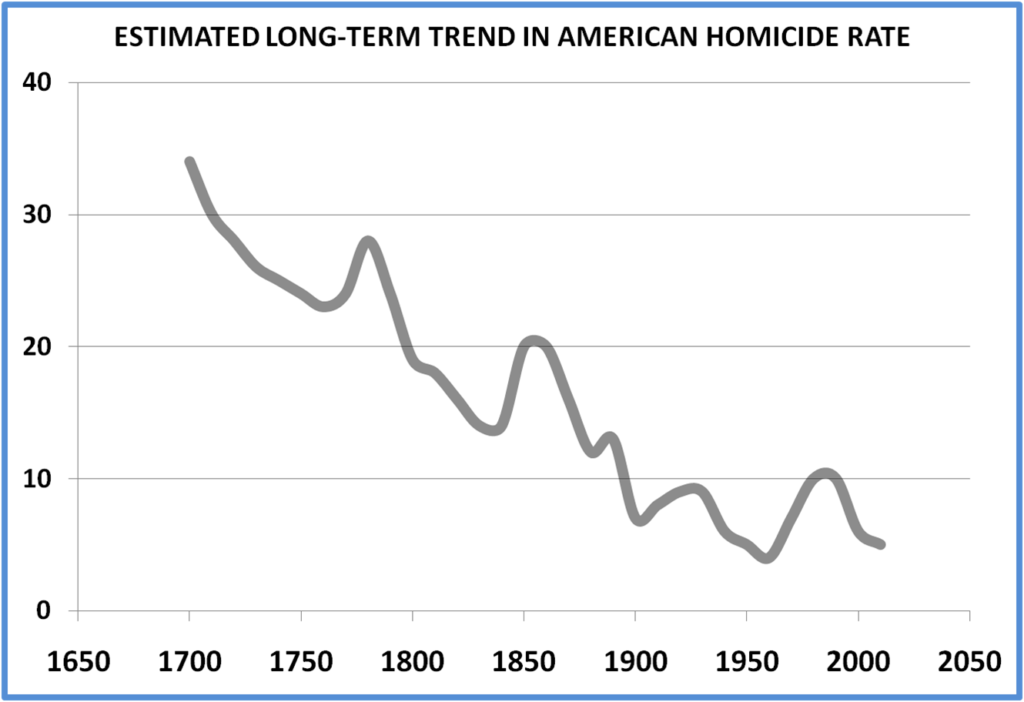
I spotted this interesting graph on the Marginal Revolution blog. It was reproduced from here.

Homicide Rates


The graph is based on research by Claude Fischer,  a professor of sociology at the University of California, Berkeley.

Alex T, one of the bloggers at MR summed it up this way: The bottom line is that there has been a big and welcome decrease in homicide rates in Europe and America over the past several centuries. To put these numbers in perspective, however, note that the homicide rate in New Orleans today is 52 per 100,000 and in Detroit it’s 40 per 100,000 so even with a lower average there is lots of variation. Brazil today is around 22 per 100,000 not too far from America in the 19th century. The homicide rate in El Salvador is 71 per 100,000, in Jamaica (!) 60 per 100,000 and in Honduras 67 per 100,000 — all higher than fifteenth century Europe. Thus, the past was a more violent place but not so violent as to be unknown to the present.

Claude Fisher said this:

The drop in violent crime in the U.S. after about 1850 was not as fast or as consistent as it was in Western Europe. That is when the striking violence gap between the U.S. and Europe opened up. The graph also shows that progress was hardly uniform, as there were many upswings of violence. Spurts often coincide with wars and the aftermaths of war – notably having many demobilized soldiers, trained and armed fighters, roaming the land.


I have a few thoughts about the data that went into this research.

1) Can we estimate homicide rates in pre-1492 America with any confidence? If not, can we estimate the rate in inland locations away from the Euro-American court system (e.g., Colorado in 1800) at later dates? Were deaths among Blacks and American Indians recorded as homicides in the 19th century?

2) What is the definition of “homicide”? Does it include politicized violence? If so, how overtly political does the violence have to be? Would deaths at the Battle of Gettsyburg count? Probably not? But what low-level, neighbour-on-neighbour violence during the Civil War? What about bank robberies by Jesse James, who regarded himself as the last Confederate? There is a whole spectrum of politicized violence ranging from organized warfare to lynchings and modern day cop-killings that  might be listed as homicide.


Interesting New Book from Cambridge University Press, 2011

1 06 2011
Julian Go,  Patterns of Empire: The British and American Empires, 1688 to the Present. Cambridge: Cambridge University Press, 2011.

“Patterns of empire comprehensively examines the two most powerful empires in modern history: the United States and Britain. Challenging the popular theory that the American empire is unique, Patterns of empire shows how the policies, practices, forms, and historical dynamics of the American empire repeat those of the British, leading up to the present climate of economic decline, treacherous intervention in the Middle East, and overextended imperial confidence. A critical exercise in revisionist history and comparative social science, this book also offers a challenging theory of empire that recognizes the agency of non-Western peoples, the impact of global fields, and the limits of power”-


Tim Leunig on Higher Education Funding

1 06 2011

Tim Leunig is an accomplished economic history who has given a great deal of thought to the issue of what sorts of policies encourage economic growth. He has published on the following topics: The effects of new technology on productivity in Britain, 1800-2000; Effects of industrial structure on the British cotton industry; anthropometric history; the performance of railways in Britain, 1840-2009; economic geography. In 2008, he created a media fire storm in Britain by suggesting (in a non-peer reviewed publication of the think tank Policy Exchange) that whole towns in the economically depressed north of the country be levelled and their populations be relocated to greater London, where there are more employment opportunities. This proposal earned him several death threats and was denounced by politicians including David Cameron, who is now Prime Minister.  Cameron, who was visiting a town in northern England the day teh report was released had this to say about it and Leunig.

This report is rubbish from start to finish,” he said, repeating the charge four times in two minutes. “I think the author himself said it might be a bit barmy. It is barmy.” Referring to the report’s co-author Tim Leunig, he added: “I gather he’s off to Australia. The sooner he gets on the ship the better.”

Most of what he has said is pretty sensible, however.

At LSE, his teaching duties include:  EH101 The Internationalisation of Economic Growth (co-lecturer: Professor Albrecht Ritschl) ; EH240 British Business and Contemporary Economic Performance; EH304 The Economic History of North America: from Colonial Times to the Cold War (co-lecturer: Dr Chris Minns;  EH464 The Historical Context of Business.

Personally, I think that every politician in the world should have to take and pass EH101, Leunig’s first year course. You can watch the lectures and get course documents by logging into LSE’s Moodle as a guest.

Because of his research interests, Leunig is well qualified to speak about the future of higher education, which is currently being restructured in the UK.  I therefore read his recent working paper on the economics of higher education with great interest. (It was published by Centre Forum, which is associated with the Liberal Democrats). I note with interest that much of what he says in the report is consistent with what I have said earlier on this blog.

Here is an excerpt from the summary:

We cannot say for sure how much a university education should cost. But we note that BPP are offering courses at fees below £4,000 a year, and that London Metropolitan University has announced that it will be charging less than £6,000 a year. In addition, the fees per hour of tuition at St Paul’s Girl’s School imply university fees of around £5,000 a year. Fees of £9,000 are not necessary, and should not become the norm. But to avoid this we need to create real, sustainable incentive mechanisms to deliver fees that make sense for students and taxpayers. This paper sets out how to do that.

You can read the full report here.

Leunig also writes for the Guardian newspaper.