Why Does Higher Education Cost So Much?

19 02 2011

That’s being debated by readers on the New York Times Economix blog right now. The blog post that started the conversation is a dialogue between David Leondhardt of the NYT and Professors Robert B. Archibald and David H. Feldman, two economists at the College of William & Mary. Archibald and Feldman are the authors of “Why Does College Cost So Much?

This book seeks to explain why the total cost of delivering higher education (which is funded by a mixture of tuition fees, philanthropy, and taxpayers) has escalated much faster than the rate of inflation. The authors are not interested in the very important, but nevertheless separate question, of what the appropriate balance of these three main sources of funding would be. (This is a hot topic of political debate right now, especially here in the UK, where the burden is being shifted from the state to students).  Instead, Archibald and Feldman are concerned with the more fundamental issue of the actual cost of educating a student rather than the issue of who picks up the bill.

One of the issues addressed in the dialogue is why technology has don’t more to drive down the cost of delivering university education. After all, there are lots of other products, services as well as goods, that are far cheaper than they were 30 years ago because of technology. Think of long distance phone calls. In terms of the number of hours the average person needs to work to buy it,  a tonne of steel or a loaf of bread  is far cheaper now than it was before the Industrial Revolution. The price of certain services has also fallen as well.  So why have some services, such as higher education, stayed expensive?

When asked why technology hasn’t made higher education cheaper to deliver, Dr. Feldman had this to say:

Higher education certainly is affected by technological change, and this can indeed reduce cost. For instance, like most industries, we no longer use an army of typists to process paperwork. But the primary effect of technological change in higher education is not cost reduction. Instead, new technologies and techniques change what we do and how we do it. In many ways, colleges and universities are “first adopters” of new technologies because our faculty needs these tools to be productive scholars and teachers. Our students need these tools because they are used in the labor market they will be entering. In a sense, universities must meet an evolving standard of care in education that is set externally. The term “standard of care” is not an accident, since it reflects the way new techniques also affect the kindred service of medical provision.

The dialogue is pretty US-specific and is undermined by a near total lack of international comparative data, but there are some interesting ideas of more general applicability here. I would love to ask Archibald and Feldman “So if the cost of higher education is spiralling in the US far faster than inflation, which country has done the best job of controlling costs in higher education?”

In the US debate on healthcare reform, people make lots of international comparisons (e.g., “if we had single-payer like Canada, health care would consume a lower percentage of GDP” or “Singapore’s healtcare system is the most cost effective, so let’s copy that”). When it comes to the debate over the costs of higher education in the United States , few of international comparisons are made, which is odd because the higher education fields is actually highly internationalized in terms of the workforce, student body, etc.

For blogosphere reaction to the Archibald-Feldman book, see here, here, and here.

One of the more interesting reactions to the Archibald-Feldman book came from the blog Marginal Revolution, where Tyler Cowen alluded to the fact that it many fields there a big surplus of unemployed PhDs has persisted for many years without any impact on the price of higher education or average class sizes.

“There are plenty of wanna-bee professors discarded on the compost heap of academic history.”  Yet the best discard should not be much worse, and may even be better, than the marginally accepted professor.  Such a large pool of surplus labor would play a significant role in an economic analysis of virtually any other sector.

Cowen’s point has a certain logic to it– if there were a glut of crude oil due to over-production, we would expect the price of fuel to fall, with savings ultimately being passed on to the consumers. Motorists would respond to the new lower price for fuel by driving more or driving the same and spending the money elsewhere. Labour is the single biggest cost in higher education– so why isn’t the surplus of qualified instructors translating into either lower costs or smaller class sizes? This is an interesting question of economic analysis. I don’t pretend to have an answer to it, because I’m a historian rather than an economist.

My own theory about the escalating costs of US higher education is that landscaping is one area where economies should be made. Do universities really need elaborate gardens, fountains etc? Is it just to ask either students or taxpayers to pay for fancy buildings? Some of the universities in the US I have visited are far too nice.

Notre Dame Stadium

 

The Godzillatron Screen at Texas Tech Football Stadium Exists to Distract Students from their Studies

Facilities for spectator sports eat up a lot of money in the US higher education system as well. Some universities have huge stadia for football games.  These are funds that could be going into scholarships for poor kids. If Obama wanted to be really bold, he could call for an end to inter-collegiate athletics as a temporary austerity measure. With luck, this temporary measure could become permanent.



Tyler Cowen and the Great Stagnation

18 02 2011

Did the rate of technological innovation slow down around 1973?


1973 AMC Gremlin. Photo by Christopher Ziemnowicz

I’m much more interested in economics and economic history than the average historian, certainly the average historian based in a pure history department. However, every so often there is a book about an economic-historical topic that is so important that every historian ought to read it, regardless of how far their particular research specialism is from the domain of economic history. I think that one such book recently appeared. Tyler Cowen’s new e-book has attracted considerable attention in the American and international press and may well become the most talked about non-fiction title of the year.

For references to this book in the press, see here, here, and here.  For blogosphere reaction, see here, here, and here. I also suspect that the ideas in this book may influence public policy debates in the coming years. So if you have to read one book about the economy this year, this would probably be the one to read!

Tyler Cowen’s book The Great Stagnation: How America Ate All The Low-Hanging Fruit of Modern History,Got Sick, and Will (Eventually) Feel Better is currently available online in Kindle from Amazon. This means you have to download it to your computer rather than getting a hard copy in the mail. I will refer to the technology Cowen has adopted to publish ideas a bit later in this blog post, because I think it calls into question Cowen’s thesis that technological innovation plateaued around 1970 and that American material lives haven’t really changed that much since then.

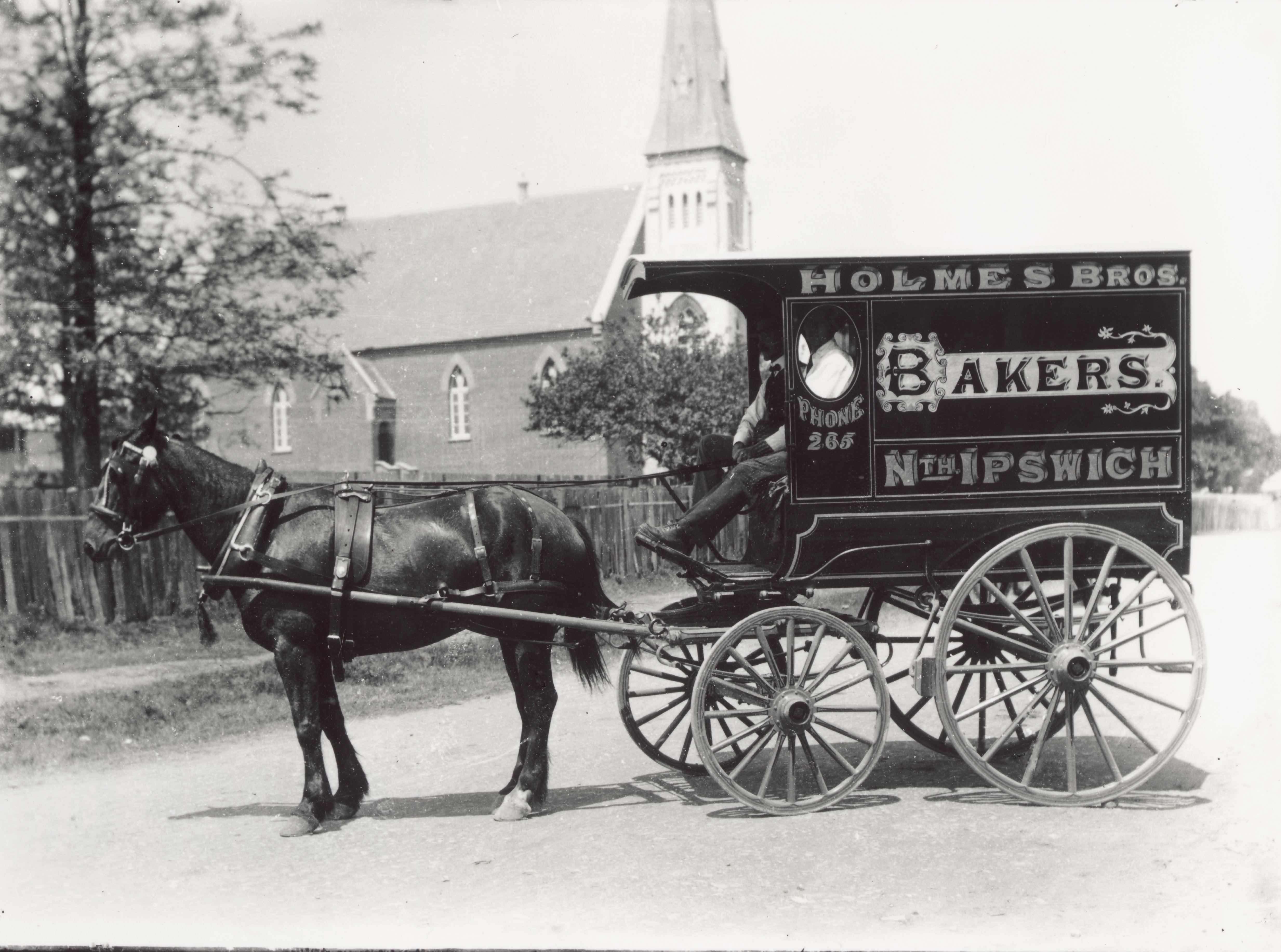
In an interview about the book Cowen gave a few days ago (see here) he shares an anecdote about his grandmother. (Cowen was born in 1962, which gives you a rough idea of when his grandmother lived). Cowen remarks that his grandmother, who was from rural Wisconsin, died in a society that was radically different from the one in which she had been born.  Rural Wisconsin in the early 20th century was a world of horse-drawn buggies, gas lamps, and iceboxes. Hunger was common even in the United States. Cowen’s grandmother died in a world of freeways, air conditioning, supermarkets full of cheap food, and colour TVs in wood-grain cabinets.

Cowen’s point is that since his grandmother died, everyday life in the United States has remained more or less that same. Median incomes, which increased dramatically over the course of his grandmother’s lifetime, have remained stagnant since the 1970s, which means that the material lives for most American families hasn’t changed that much in the last 40 years. GDP per capita, life expectancy, they have all continued to go up, but at a far slower rate than in the period before the 1970s. We appear to have hit a sort of plateau, at least according to Cowen.


Suburban Sprawl

Cowen admits that a few little gadgets have come along (mobile phones, Skype, YouTube,  downloadable music, books on economics becoming available through Kindle), but he says that these really haven’t added that much to the welfare of the average person.  In terms of the number of square feet of living space, the number of pieces of furniture in their living room, the amount of meat they have for dinner, things are pretty much where they were in the 1970s.

IBM 360 Computer, late 1960s

Five main points about this book occurred to me.

First, predicting a long period of technological stagnation is not new. In each generation, there are people who confidently declare that technology has peaked and that nothing new remains to be invented. They have been proved wrong, so far.

Second, I’m certain how reliable the GDP stats cited by Cowen are. Obviously GDP per capita is a pretty important metric, but there are many goods and services it doesn’t capture. Many of the post-1970 technologies that give me happiness (talking on Skype with distant families, keeping in touch with friends on Facebook) or that make my work easier (e.g., Jstor) cost very little, certainly compared to the price of a 1958 Chevrolet Bel-Air. It is hard to compare the price of a base-model Chevrolet in 1958 with a base-model Chevrolet today, since the latter car has airbags and a CD player. GDP stats don’t do a good job of capturing these sorts of qualitative improvements in products. There is a tremendous irony in Cowen using the internet to distribute a book claiming that we are in a state of technological stagnation. A blogger named Dirk has dealt with this issue much more eloquently than I could in his post on The Great Stagnation. Dirk asks whether a teleportation machine that would allow one to travel instantaneously to any point on the planet would raise or lower GDP.

My hypothetical example was a teleportation machine. What if some physicist discovered some new laws to the universe and suddenly invented one?  A few hours later I discovered that on page 11% Tyler writes: “It would make my life a lot better to have a teleportation machine.”

So at least for a drunken moment I was thinking along similar lines. So I ask: what then? Would a teleportation machine improve median income?  My guess is that the invention of a teleportation machine would increase median income a lot if it were costly to manufacture. If it were cheap to manufacture and cheap to use, it probably wouldn’t increase median income much, just like the internet. Yet it would surely increase the standard of living for nearly everyone. So now I’m confused. Isn’t it a good thing when great innovations happen to also not cost much to implement? Isn’t that a win/win?

Third, I think that the title of this book has a parochial American element. I’m not saying that Cowen is a parochial person who is only aware of developments in the US. In fact, Cowen mentions globalization and outsourcing in this book. He also recognises that some of the innovations that have made the lives of Americans (and others) better in recent decades were developed by non-Americans, chiefly Europeans and Japanese. But perhaps the problems he is talking about are common to the developed world as a whole, not just the US. The title of this book is misleading, since it suggests that it was only Americans who ate the low-hanging fruit.

It seems to me that one of the big themes of the last 60 years of world history in convergence towards American living standards. Sadly, Cowen says little about this. What do I mean by convergence? In 1950 there was a massive gap between American living standards and those of most other countries, with the trivial exceptions of Canada and Australia, two other white settler economies which had per capita incomes similar to some US states. In 1950, the gap between bombed-out Western Europe and the United States was huge. Japan was even poorer.  During WWII, there was an obvious physical difference between Americans of Western European ancestry and Western Europeans: the Americans were taller. Although GDP per capita is still a bit higher in the US than in these other countries, the gap in living standards has narrowed, especially when we take non-GDP measures of well-being, such as average height, into account.

In fact, people in some Western European countries today are taller than white Americans, which suggests that young people there now eat better than Americans. It used to be that Japanese people were much smaller than Europeans, but Japanese men born in the 1970s are nearly as tall as Englishmen born in the same decade. As more and more countries acquire quasi-American standards of living (drive-thru Starbucks), we can expect more countries to converge in this way.

Fourth, I’m wondering about the political implications of Cowen’s argument that developments in the fields of science and technology are to blame for the post-1973 slowdown in the growth of American living standards. At least one blogger has already dealt with this issue, but here are my thoughts.

People on the left of the political spectrum in the US have their own explanation for why economic growth has slowed down since the mid-1970s: growing inequality and the Republicans’ attacks on the redistributive state. Paul Krugman and others argue that the stagnation in median incomes since the 1970s has a political origin: Reaganite Republicans.

In what has been the conventional wisdom among left-wing Americans who think about such issues, the United States between the New Deal of the 1930s and the 1970s was dominated by centre-left policies: labour laws were pro-union, union membership was high, and tax rates were very progressive, which meant that measurable inequality was low. There was a consensus in favour of Keynesianism and the idea that the government needed to put purchasing power into the hands of the poor, so that they could stimulate the economy. During this same period of centre-left policies, the United States saw massive improvements in human welfare for the average person.

Since 1980, Republican free-marketeers have dominated the US.: taxes and social programs have been cut and inequality has gone up at the same time that the rate of economic growth has fallen. (For inequality, see this graph, which shows that while the average income in the US has increased dramatically since the 1970s, the gains have essentially been confined to the elite).


According to left-wing Americans, had the US persisted with FDR-Kennedy-Lyndon Johnson style after 1980, the country would today have a more dynamic economy and would be a more equal society. Progressive take the stagnant living standards of the typical American and fact Dutchmen now tower over visiting Yanks as proof of the bankruptcy of the Republican/libertarian agenda.

Cowen, who is a prominent libertarian, says that the true causes of the post-1973  slowdown have nothing to do with the policies of Reagan and the Bushes or the distribution of wealth within American society. Instead, the post-1973 stagnation in median incomes in the United States is due to a slowing of the conveyer belt of inventions linking the laboratory to the average person. Cowen’s claim has massive political implications.

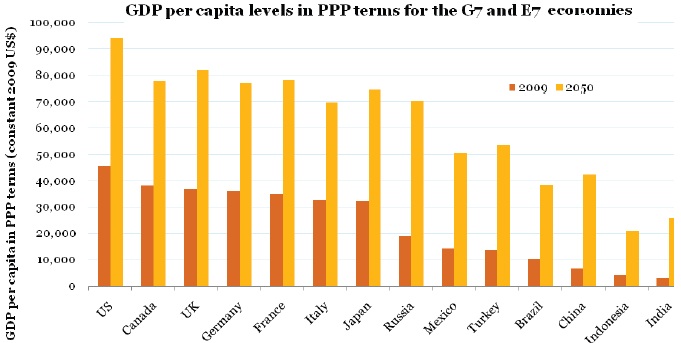
Fifth, a think tank recently released some predictions about GDP per capita in various countries in 2050 (see image below).


GDP Per Capita in 2050

I’m skeptical of all such efforts to guess what the ratio of, say, German to American per capita wealth will be in 40 years because I suspect that countries will be using totally different technologies to compete in 2050. I wonder what Cowen would think of these prediction games.


The Determinants of Entrepreneurship: Leadership, Culture and Institutions

18 02 2011

I am currently working with a colleague on a book about Canadian entrepreneurial history. The book, which should be published later this year, will present 61 short biographies of Canadian entrepreneurs who lived before 1930.

For this reason, I was interested to read Andrew Godley’s review of José L. Garcia-Ruiz and Pier Angelo Toninelli, editors, The Determinants of Entrepreneurship: Leadership, Culture and Institutions. London: Pickering
and Chatto, 2010. x + 236 pp. $99 (hardcover), ISBN: 978-1-84893-071-1.

I’ve decided that I will have to read this book, even though none of the essays directly relate to Canadian or the other national countries that normally relate to my research. (The geographical focus of the book is on southern Europe). I want to read this collection of essays because I’m interested in the methodological issues it raises, for the essays in it explore the impact of national, ethnic and religious cultural values and education levels on entrepreneurial activity. The essay by James Foreman-Peck and Peng Zhou looks interesting because it explores entrepreneurial culture.

Canada’s population of entrepreneurs has been ethnically and linguistically diverse, so any historian of Canadian entrepreneurship needs to grapple with the international literature on the impact of culture on entrepreneurship.

The author of the review I have cited,Andrew Godley,  is Professor of Management and Director of Research at the Henley Centre for Entrepreneurship, Henley Business School, University of Reading, UK. He has authored many studies of historical entrepreneurship, including Jewish Immigrant Entrepreneurship in London and New York: Enterprise and Culture (Palgrave, 2001).


John Ashworth on Confederate Errors

17 02 2011

In a post on the NYT’s Disunion blog, Professor John Ashworth  explores the critical errors that led the Confederacy into a disastrous war with the Union.  Ashworth is a professor of American history at the University of Nottingham and the author of Slavery, Capitalism, and Politics in the Antebellum Republic.

Ashworth’s post, which makes some great points about pro-slavery propaganda, contains some great images, such as this one from the image collection of the Library of Congress:


Historical Image of the Day

16 02 2011
Place: Bronte (Oakville, Ont.) Creator: Ministry of Education Format: Black and white print Reference Code: RG 2-71 Item Reference Code: COB-2 “]


Historical Image of the Day

16 02 2011

Photograph | Ocean and river steamers, Montreal, QC, about 1878 | VIEW-813.1


Canadian Network for Economic History / Réseau Canadien D’Histoire Économique

16 02 2011

The program of the next conference of the Canadian Network for Economic History / Réseau Canadien D’Histoire Économique looks really interesting.
A Conference in Memory of Mary MacKinnon and Alan Green

2011 Conference Program
Thursday, June 2 – Saturday, June 4

University of Ottawa Building and Room TBA

Thursday, June 2

Coffee
8:30 am – 8:45 am

Welcome and Opening Remarks
8:45 am – 9:00 am

Session 1: 20th Century Canadian Migration

9:00 am – 10:30 am

Chair: Herb Emery (Calgary)

Alan Green and David Green (UBC)
“Immigration and the Canadian Wage Distribution in the First Half of the 20th Century”

Byron Lew (Trent)
“Interprovincial Migration in Canada: 1901-1951, and Beyond”

Alexander Armstrong (Queen’s, PhD Candidate) and Frank Lewis (Queen’s)
“The Characteristics of European Immigrants to Canada in the 1920s: A Cross-Country Comparison”

Break
10:30 am – 10:45 am

Session 2: Supplying Human Capital

10:45 am – 12:15 pm

Chair: Kris Inwood (Guelph)

Chris Minns (LSE)
“The Consequences of the Feminization of School Teaching: Evidence from British Columbia, 1900-1930”

Almos Tassonyi (Ontario Ministry of Finance and Calgary, PhD Candidate)
“Education Finance in the Slump: Ontario, 1921-1941”

Jessica Bean (Denison)
“Not Much Use Disliking It: Labor Supply among Female Home Workers in London, 1897-1908”

Lunch
12:15 pm – 1:30 pm

Business Meeting
1:30 pm – 2:00 pm

Session 3: Financial Intermediaries

2:00 pm – 3:30 pm

Chair: Patrick Coe (Carleton)

Livio DiMatteo (Lakehead) and Angela Redish (UBC)
“The Evolution of Financial Intermediation: Evidence from 19th Century Ontario Microdata”

Michael Bordo (Rutgers), Angela Redish (UBC) and Hugh Rockoff (Rutgers)
“Why Didn’t Canada Have a Banking Crisis in 2008 (or in 1930, or 1907, or 1893)?”

Mauricio Drelichman (UBC) and Hans-Joachim Voth (Pompeu Fabra)
“Dumb Money and Bankers’ Profits in Early Sovereign Lending: The Case of Genoese Loans to Philip II”

Break
3:30 pm – 3:45 pm

Session 4: Savings Behaviour

3:45 pm – 5:15 pm

Chair: David Jacks (SFU)

Herb Emery (Calgary) and Stuart Wilson (Regina)
“Sickness Insurance vs. Self-Insurance and the Role of Precautionary Savings”

Gregory Clark (UC Davis) and Gillian Hamilton (U of Toronto)
“Wealth and Fertility in New France”

Ann Carlos (Colorado), Erin Fletcher (Colorado, PhD Candidate) and Larry Neal (Illinois)
“Share Portfolios in the Age of Financial Capitalism”

Informal Dinner
The Courtyard
21 George Street, Byward Market
7:00 pm
Friday, June 3

Sessions to be held as part of the 2011 CEA Annual Meetings
Room and Building Location Announced in CEA Program

CEA/CNEH 1: The Development of Institutions

9:00 am – 10:30 am

Chair: Gillian Hamilton (U of Toronto)
Discussants: TBA

Christian Dippel (U of Toronto, PhD Candidate)
“Elite Persistence Under De Jure Institutional Change: The Post-Slavery Plantation Colonies”

Fabio Braggion (Tillburg) and Lyndon Moore (U de Montreal)
“The Economic Benefit of Political Connections in Late Victorian Britain”

Patrick Coe (Carleton) and Shaun Vahey (ANU)
“The Argumentation of Economic Historians”

Break
10:30 am – 11:00 am

CEA/CNEH 2: Globalization

11:00 am – 12:30 pm

Chair: Ruth Dupre (HEC)
Discussants: TBA

Kris Inwood (Guelph) and Ian Keay (Queen’s)
“Transport Costs, Trade Policy and Canadian Industrial Development: Iron and Steel in a Small Open Economy, 1870-1913”

Concha Betran (Valencia) and Maria Pons (Valencia)
“Comparing Past and Present Wage Inequality in Two Globalization Periods”

David Jacks (SFU)
“Defying Gravity: The Re-Orientation of Canadian Trade in the Interwar Period”

Lunch
12:30 pm – 2:30 pm

CEA/CNEH 3: Invited Lecture in Memory of Mary MacKinnon

2:30 pm – 4:00 pm

Introduction by Chris Minns (LSE)

George Boyer (Cornell)
“Work for their Prime, and Workhouse for their Age: A Regional Analysis of Elderly Pauperism in Victorian Britain”

Break
4:00 pm – 4:30 pm

CEA/CNEH 4: Invited Lecture in Memory of Alan G. Green

4:30 pm – 6:00 pm

Introduction by Frank Lewis (Queen’s)

Timothy Guinnane (Yale)
“The Historical Fertility Transition: A Guide for Economists”
Saturday, June 4

Sessions to be held as part of the 2011 CEA Annual Meetings
Room and Building Location Announced in CEA Program

CEA/CNEH 5: Importing and Exporting Human Capital

9:00 am – 10:30 am

Chair: Ian Keay (Queen’s)
Discussants: TBA

Catherine Massey (Colorado, PhD Candidate)
“The Effect of Immigration Quotas on Immigrant Skill Composition: Evidence from the Frontier”

Javier Torres (UBC, PhD Candidate)
“Immigrants’ Occupations in 1911 Canada”

Hamish Maxwell-Stewart (Tasmania)
“Morbidity and Mortality on Convict Voyages to 19th Century Australia”

Break
10:30 am – 11:00 am

CEA/CNEH 6: War, Prohibition and Keynes

11:00 am – 12:30 pm

Chair: Almos Tassonyi (Ontario Ministry of Finance and Calgary)
Discussants: TBA

John Cranfield (Guelph) and Kris Inwood (Guelph)
“Stayers and Leavers, Diggers and Canucks: The 1914-1918 War in Comparative Perspective”

Ranjit Dighe (SUNY Oswego)
“Business Week, the Great Depression and the Coming of Keynesianism to America”

Benoit Dostie (HEC) and Ruth Dupre (HEC)
“The People’s Will: Referendums and Alcohol Prohibition in International Perspective”

Lunch
12:30 pm – 2:30 pm


Sean Kheraj on Teaching and Footnote Checking in the Digital Age

15 02 2011

Sean Kheraj has posted some great ideas about how we can use the proliferation of online primary sources to help students to be more critical of the interpretations offered in secondary sources.

In the old days, tracking down a primary source to see whether a historian had accurately represented and correctly interpreted the content was very labour intensive. One had to copy down the bibliographic details from the footnote, find a library that had the source in question, and then do your comparison. Needless to say, this was far too much work for an undergraduate reading a scholarly article for a weekly seminar.

Technology has changed this. As Kheraj writes:

Given the terabytes of digitized historical primary sources now available online through fantastic repositories, including Early Canadiana Online, American Memory by the Library of Congress, and Internet Archive, historians could also attempt a similar experiment with “scientific history”. Alongside our footnotes, we could provide hyperlinks to the direct sources… This semester…. I asked my students to first read the following article:

Dick, Lyle. “Nationalism and Visual Media in Canada: The Case of Thomas Scott’s Execution.” Manitoba History no. 48 (2004): 2-18.

In this article, Lyle Dick discusses the visual representation in Canadian newspapers of the execution of Thomas Scott in March 1870. For the benefit of non-Canadian readers, I should explain that this execution had profound political consequences for French-English relations within Canada.

Kheraj states that:

Dick argues that the image published on the cover of the Canadian Illustrated News on 23 April 1870 had a profound impact on central Canadian perceptions of Riel and the Métis resistance. This image galvanized English Canadian opposition to Riel’s efforts at Red River and motivated calls for his arrest.

I then asked students to consult a couple of sources Dick uses directly from the Canadian Illustrated News, which have been digitized by Bibliothèque et Archives nationales du Québec:

“The Red River Difficulty” Canadian Illustrated News, 15 January 1870, pgs. 1-2.

Canadian Illustrated News, 9 April 1870, pg. 358, columns 1-2.

Canadian Illustrated News, 23 April 1870, pg. 385.

We then compared the 1870 articles to Dick’s arguments and sustained a very engaging discussion about the role of visual media during the Red River resistance.

I would imagine that the point Kheraj was trying to communicate to his students was not that Dick’s representation of this image was wrong, but that it is possible to interpret a given primary source in multiple ways.

Although this example comes from a class on Canadian history, this technique could be adapted to the teaching of many different types of history.

Digital history empowers undergraduates and, indeed, all students of the past by making primary sources more readily available to the masses. The key thing is to provide the intellectual training so that people can handle the flood of new material.


New Video on Transcribe Bentham

13 02 2011


Historical Image of the Day

12 02 2011

Photograph, glass lantern slide | Saw mill at Chaudière Falls, near Ottawa, ON-QC, about 1878 | MP-0000.25.879