John A. Macdonald: Fresh Perspectives and New Legacies

4 12 2010

I just came from a wonderful workshop called “John A. Macdonald: Fresh Perspectives and New Legacies”. I have pasted the program below. The workshop saw the presentation of some really fantastic research on various aspects of the life of Sir John A. Macdonald. This event shows that there has been a revival of interest in Macdonald among both historians and the general public.

I and Roger Hall would like to thank Prof. Patrice Dutil, the lead organizer, for all of his efforts. I would also like to thank SSHRC for supporting our workshop.

The conference took place at Oakham House, Ryerson University in Toronto.

One of the highlights of the conference was buying a copy of Ged Martin’s just published book on Macdonald. Ged was our keynote speaker and kindly came in from Ireland for the occasion.


Ged Martin

Toronto, December 3-4, 2010

Day 1 – Friday 3 December 2010

8:00 – 8:45 Breakfast & Registration

8:45 – 9:00: Greetings from Ryerson University (Alan Shepard, Provost and VP Academic)

Introductions and Acknowledgements: Patrice Dutil (Politics and Public Administration, Ryerson University); Roger Hall (History, University of Western Ontario); Andrew Smith (History, Laurentian University)

9:00 – 10:30 Session 1: “Macdonald as Statesman”

Barbara Messamore (History, University of the Fraser Valley) “Sir John A and the Governors General”

Patrice Dutil (Politics and Public Administration, Ryerson University) “Macdonald the Manager: The Genesis of Executive Machinery”

Elsbeth Heaman (History, McGill University) “Macdonald, Taxation, and the rise of the Liberal State”

Discussion Moderator: Andrew Smith (History, Laurentian University)

10:30 – 10:45 Break

10:45 – 12:15 Session 2: “Macdonald and the idea of the West”

Herbert Emery (Economics, University of Calgary) “Macdonald and the Development of the West”

Ben Forster (History, University of Western Ontario) “Macdonald’s National Railway Policy”

Bill Waiser (History, University of Saskatchewan) “Macdonald, the Environment, Science, and the North”

Discussion Moderator: Roger Hall (History, University of Western Ontario)

12:15 – 1:30 Working Lunch: Richard Gwyn, Author and Journalist, “Macdonald @ 200”

1:30 – 3:00 Session 3: “Macdonald and the Challenge of the Aboriginal Peoples”

J.R. Miller (History, University of Saskatchewan) “Macdonald as Minister of Indian Affairs and the shaping of Canadian Indian Policy”

Donald B. Smith (History, University of Calgary) “John A. Macdonald and Aboriginal People: A Study in Personal knowledge and personal relationships”

Heather Devine (History, University of Calgary) “Macdonald and the Métis People: An Ethnographic Perspective”

Discussion Moderator: Carl Benn (History, Ryerson University)

3:00 – 3:30 Break

3:30 – 5:00 Session 4: “John A meets the web 2.0”

Roger Hall and Andrew Smith (The Champlain Society) “A 21st Century Approach to Editing Macdonald”

Angelina Munaretto (Library and Archives Canada), “Is Sir John A. ready for the Social Media?”

Brainstorm (Patrice Dutil, facilitator)

5:30   Cocktail

6:00 – 7:30  Working Dinner: Speaker: Ged Martin (National University of Ireland Galway), “Macdonald as a Mirror of Canada”

Day 2 – Saturday, December 4, 2010

9:00 – 10:30 (Working Breakfast) Session 5: “Macdonald and Adversity”

David Wilson (Department of History and Department of Celtic Studies), University of Toronto, “Macdonald and the Fenians”

David Warrick (Humanities, Rhetoric and Composition, Humber College), “Macdonald as Young Litigator: The politics of Prince Edward County”

Brad Miller (Department of History, PhD Candidate, University of Toronto) “False Starts and Trial Balloons in Macdonald’s First Government”

Moderator Facilitator: Jane Errington (History, Royal Military College)

10:30 – 10:45 Break

10:45 – 12:15 Session 6: “Macdonald and Identity/Mosaic Politics”

Colin Grittner, (Ph.D. candidate, McGill University) “Sir John A. Macdonald, Canada’s 19th century franchise, and women’s enfranchisement”

Timothy J. Stanley (Faculty of Education, University of Ottawa) “John A. Macdonald, Chinese Exclusion and the Origins of Canadian White Supremacy”

Carmen Nielson (Department of History, Mount Royal University) “Macdonald as Deviant: Political Legitimacy and Identity politics in late-19th century cartoons”

Moderator Facilitator: Brian S. Osborne (Professor Emeritus, Queen’s University)

12:15 – 1:00 Lunch

1:00 – 2:30 Session 7: “Macdonald, the Politician”

Michel Ducharme (Department of History, University of British Columbia) “John A. Macdonald and the Concept of Freedom”

Jacob V. Ginger (Department of History, PhD Candidate, Queen’s University) “Macdonald and the origins of Liberal-Conservative Thought”

Sean Conway (Queen’s University) “The political skills of John A. Macdonald: the Appreciation of Politicians”

Discussion Moderator: David MacKenzie (History, Ryerson University)

2:30 –2:45 Break

2:45-4:00 Session 8: “Macdonald’s Place in Canada’s Social Memory”

Yves Pelletier (PhD candidate, History, Queen’s University), “Re-imagining Macdonald: The Evolution of the Public Memory of Sir John A. Macdonald, 1891-1967”

Arthur Milnes (Centre for the Study of Democracy, Queen’s University) “The Mission of Making John A. Relevant”

Discussion Moderator: Bill Waiser (History, University of Saskatchewan)

4:00-4:10 Closing Remarks


Knick Harley on Joel Mokyr, The Enlightened Economy: An Economic History of Britain

2 12 2010

—— EH.NET BOOK REVIEW ——
Title: The Enlightened Economy: An Economic History of Britain, 1700-1850

Published by EH.NET (December 2010)

Joel Mokyr, The Enlightened Economy: An Economic History of Britain,
1700-1850 Princeton: Princeton University Press, 2010. xii + 564 pp. $45
(hardcover), ISBN: 978-0-300-12455-2.

Reviewed for EH.Net by C. Knick Harley, Department of Economics, University
of Oxford.

In this big book Joel Mokyr provides a masterful summary of our current
understanding of events from the Glorious Revolution to the Great Exhibition
that led to the emergence of modern economic growth in Britain. The book
advances the thesis that “the Industrial Revolution … that placed
technology in the position of the main engine of economic change” (p. 5)
was driven by “the changing set of beliefs we associate with the
Enlightenment” (p. 478). Although there is little new primary research in
the book, its broad summary of relevant topics and recent research (the
references run to 43 pages) make it both an unrivaled introduction to this
important historical topic and a masterful synthesis that experts will need
to internalize.

The coverage of the literature, both in breadth and depth, is close to
comprehensive. As one would expect from Mokyr’s recent work, there is
extensive discussion of the social basis of knowledge, technology and the
nature of inventors and the sources of their training and inspiration. There
are admirable and balanced discussions of eighteenth-century British society.
Issues of the nature of the political structure, its evolution and its impact
on incentives to economic action are presented in a comprehensive and
balanced manner. There are excellent chapters on gender and the family and
civil society, as well as more expected chapters on agriculture,
international trade, commerce and finance. The book does not use estimates of
aggregate output and its composition as the center of its focus but these
issues are well-discussed as part of a wider narrative. The development of
industry and industrial technology receives rather less attention than one
might have expected and the cotton textile industry does not take a point at
the center of the focus. Nonetheless, the reader will have a good overview of
the relevant developments in industrial technology.

Mokyr is happy to keep the Industrial Revolution as the focus of his
narrative, although it is perhaps significant that the phrase does not appear
in the title. Just what he means by the Industrial Revolution is at times
somewhat unclear. Overall, the volume consciously takes the entirety of the
years from 1700 to 1850 as its focus. Nonetheless, from time to time, the
shorter Industrial Revolution (implicitly, say, 1770 to 1830) appears as
pivotal in the transformation, although reasons why the impact of these years
took time to materialize are stressed. Overall, however, the book emphasizes
what distinguished the Industrial Revolution from other episodes of
technological preciosity was not so much the accomplishments of a short
period of technological effervescence but the emergence of a society in which
knowledge and technological progress continued to improve. This was a social
process that emerged over a long historical process.

But what of the idea of the Industrial Enlightenment? This idea serves as
Mokyr’s organizing principal throughout the book (in the book’s twenty
chapters, the word Enlightenment or Enlightened — with a capital letter —
appears in five chapter titles, in the first sentence of an additional three
and elsewhere in the first paragraph of another four) and is seen as a prime
mover in social change that caused the Industrial Revolution at a fundamental
level. Unfortunately, the meaning of Enlightenment in this context remains
somewhat elusive. It is clearly intended to allude to the eighteenth century
Age of Enlightenment but Mokyr stresses he does not have in mind direct
causation from the world of ideas that characterized the salons of the
Enlightenment, although ideas did permeate. The Industrial Enlightenment in
Mokyr’s usage means a society in which there predominated a frame of mind
that believed in progress attained through useful knowledge gained by
observation and experimentation — and incorporated into social and political
ideas of rational reform. His book persuasively demonstrates that these ideas
were central to economic change in eighteenth- and nineteenth-century
Britain. The reader cannot, however, help wondering if causation from
Enlightenment, as an intellectual stance, to economic change actually
existed. The so-called Industrial Enlightenment seems almost to describe the
nature of successful change at least as much as its cause. The world of ideas
and the world of practical knowledge probably reinforced one another and both
reflected some underlying characteristics of the society. Making the
Enlightenment, however, so dominantly the central organizing theme of the
discussion of economic change is not always persuasive and is intrusive at
times.

The book is not fully persuasive in its argument that an Industrial
Enlightenment that was particular to Britain should take pride of place in
understanding the emergence of modern economic growth in the eighteenth
century, but it makes a strong case for the view that an understanding of
that change requires a long perspective and that the history of ideas and
their place in society needs to be at the core of the story. Persistent
change depended on continued technological advance which in turn depended on
knowledge and the process by which it developed.

Overall this is an important book. It will provide students with an
unexcelled overview of the state of the literature at the moment.
Specialists will admire its sweep of scholarship and find many insights to
ponder.

C. Knick Harley has written extensively about the Industrial Revolution and
the nature of technical change. Harley is currently a fellow of St Antony’s College, Oxford.


Crowdsourcing Wikileaks

1 12 2010

In earlier posts, I spoke about the use of crowdsourcing by historians and archivists. One example of crowdsourcing is Transcribe Bentham, which ask volunteers to transcribe correspondence from the Bentham archive.

Canada’s Globe and Mail newspaper is now getting into the crowdsourcing business. It is asking the public for help plotting Wikileaks documents on a Google Map.

From the Globe website:

Add to our collaborative map of the most interesting WikiLeaks diplomatic notes

The Globe and Mail is using Google Maps to plot some of the quarter million U.S. diplomatic cables released by WikiLeaks. We’d like your help! If you come across any interesting cables relating to Canada or other countries, simply edit this collaborative map.

Here’s how: To plot a point, log into your Google/Gmail account in the top right corner, click “Edit” and select and drag the blue placemark tool at the top left of the map to the most relevant location. Fill in the title field with the year of the cable and a short descriptive headline. Then add a few sentences describing the cable. If possible, use the rich text editing option to add a link to the actual cable from wikileaks.org. Click “OK,” then “Save” and then “Done”.

Click here to edit the map.

I have mixed feelings about for-profit corporations asking unpaid volunteers to help build up content on their websites. However, it is interesting that the crowdsourcing meme has spread to a major news organization.


Michel Ducharme on Liberty

1 12 2010

I have finished reading Michel Ducharme’s new book Le concept de liberté au Canada à l’époque des Révolutions atlantiques (1776-1838). It is an important and valuable contribution to our understanding of Canadian history in this epoch.

This book is useful on several levels. First, it provides a pretty good narrative history of Upper and Lower Canada from the 1770s, when the American Revolutionaries invaded Canada and attempted to persuade its people to side with their cause, and the anti-British Rebellions of 1837-8. Ducharme’s narrative is based on recent scholarship and it effectively supersedes the older narrative histories, such as Gerald M. Craig’s 1963 history of Upper Canadian politics or the research that Fernand Ouellet did the 1970s.

Another advantage of this book is that Ducharme examines both English-speaking Upper Canada and predominantly Francophone Lower Canada in the same volume rather than treating the developments in the two provinces in isolation from each other. Another advantage of this book is that it situates Canadian developments in a trans-national Atlantic World context. This certainly makes sense, as one can’t understand Canadian politics without knowing what is going in France, Britain, and the United States in the same period. After all, ideas circulated around the North Atlantic world.


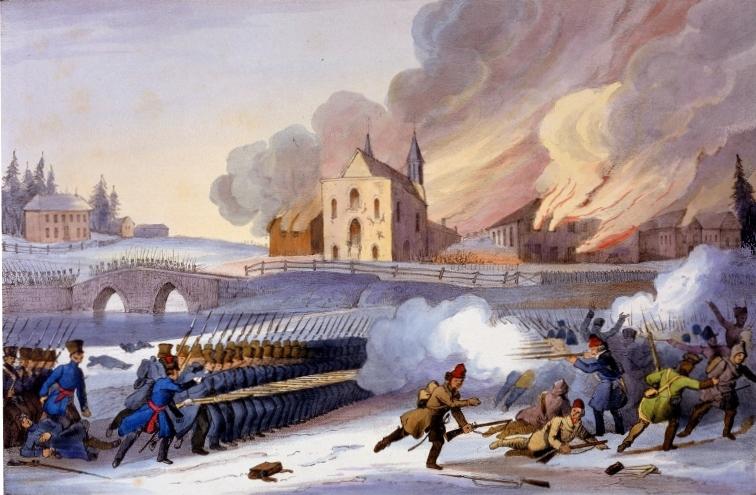
Battle of St-Eustache, 1837 Rebellion

Political conflict often involves competing definitions of the same word (e.g., “equality” or “democracy”). Ducharme is interested in an important question: how did different definitions of “liberty” influence politics in Canada in this period. For centuries, there has been a consensus in Western culture that “liberty” is a good thing. The consensus breaks down, however, when people start to define what exactly they mean by liberty.

In 1816, the French classical liberal Benjamin Constant contrasted the liberty of the ancients with that of the modern world. Constant stated that people in classical antiquity defined liberty in terms of the collective freedom of a polity (e.g., the freedom of Sparta from Persian rule). Constant said that in modern times a new definition of liberty focused on the rights of the individual had emerged. Confusion arises when people used the same words for two radically different things.

In his 1958 “Two Concepts of Liberty”, Professor Isaiah Berlin demonstrated that there were at least two major schools of though when it came to defining “liberty”.

Berlin

Ducharme argues that political conflict in Upper and Lower revolved around competing definitions of liberty. On the one hand, there were those who used what he calls modern liberty. On the other were those who used an older definition of liberty developed by republicans. He argues that radicals such as William Lyon Mackenzie and Louis-Joseph Papineau, moderate reformers such as William Baldwin, and establishment Tories such as John Strachan all believed in “liberty”. However, the last two groups subscribed to the modern definition of (individual) liberty, while the radicals, who ultimately rebelled against British rule in 1837, believed in an older definition of liberty that can be traced back to the ancient world.


William Lyon Mackenzie

Ducharme’s analysis is sophisticated because he shows that the competing definitions of liberty did not align perfectly with  partisan groupings—some of the reformers in Upper Canada believed in modern liberty, the more reformers did not. Ducharme associates the competing definitions of liberty with the ongoing debate over commercialism: was the development of a commercial capitalist society desirable?

Moderate reformers and the Family Compact Tories certainly welcome the growth of commerce, the intensification of the division of labour, the emergence of modern capitalist society. Ducharme suggetes that those who subscribed to the ancient definition of liberty, however, were proponents of pre-commercial and largely agrarian society. According to Ducharme, William Lyon Mackenzie denounced the growth of cities, business, and luxury goods, which were destroy virtue and leading to the corruption. Ducharme provides some quotations from the corpus of Mackenzie’s writings to support this interpretation.

If Ducharme is right that Mackenzie was indeed anti-commercial and a proponent of “ancient liberty” as opposed to “modern liberty”, then it makes sense to regard the 1837 rebellion in Upper Canada as an example of an agrarian uprising against the rise of commercial capitalism. However, I am not entirely convinced by Ducharme’s analysis. It seems to me that the ideas of William Lyon Mackenzie cannot be understood without referring to the policies of President Andrew Jackson. There is a great deal of evidence to suggest that William Lyon Mackenzie’s economic and political ideas, particularly his opposition to the monopolistic Bank of Upper Canada, were influenced by Jacksonian Democracy. Andrew Jackson was, famously, opposed to the existence of a central bank in the United States: his veto of rechartering of the Second Bank of the United States in 1832 ignited a political firestorm. Andrew Jackson opposed the Bank’s charter not because he was opposed to the growth of a modern commercial economy or even the existence of bank. Rather, Jackson was against the existence of government-granted monopolies and other examples of what he regarded as undue state interference in the economy. At one time, it was common for historians to regard Jacksonian Democracy as an expression of anti-commercial, anti-business, agrarian ideology.

Andrew Jackson


This was, of course, the viewpoint of historian Arthur Meier Schlesinger, who died in 1965. Thanks to more recent historical research, we know now that Jackson and his followers were just an enthusiastic about capitalist development as their political opponents. In fact, Jackson embraced policies of economic laissez-faire precisely because he though that de-regulating the economy would unshackle businessmen and spur economic growth. It is no more accurate to say that Jackson was anti-capitalist than to suggest the Tea Party people in today’s United States are against business and commercial society because they opposed the Wall Street Bailouts. The Tea Party is supported by many small businessmen who are hard core supporters of economic laissez-faire. I would suggest that the supporters of Jackson and William Lyon Mackenzie in the 1830s were similar in terms of their ideology and class backgrounds.

I think that Ducharme’s book would have been stronger had he integrated a more extended discussion of Jacksonian Democracy into his analysis. After all, Jacksonian ideas influenced people in the two Canadas. Moreover, Jacksonian Democrats in New York State and Vermont provided crucial military assistance to the rebels of 1837-8. Among the Americans who participated in cross-border raids designed to assist the rebels were a significant number of members of the Locofoco Party, a branch of the Jacksonian Democrats who were staunch advocates of economic laissez-faire. Somewhat curiously, I could not find the name Andrew Jackson in the index of this otherwise excellent book.

Notwithstanding this quibble, I would like to compliment Ducharme for having produced such an important book on Canadian history.


John Allemang on Deirdre McCloskey

30 11 2010

This is a follow-up to my recent post on Deirdre McCloskey, an economic historian whose ideas have informed my own understanding of the past. McCloskey is widely respected among economic historians but her ideas are not widely known outside of universities. That’s why I was pleasantly surprised to see an article about McCloskey’s ideas in today’s Globe and Mail. See here. The author is John Allemang.


Online discovery portal provides unprecedented access to Canada’s documentary heritage

30 11 2010

Ottawa, November 30, 2010 – Canada’s heritage institutions are collaborating to provide unprecedented access to their digital collections through the Canadiana Discovery Portal.

The Canadiana Discovery Portal is a free service that enables users to search across the valuable and diverse digital collections of Canada’s libraries, museums, and archives. The Portal is the best single source for Canada’s documentary heritage for researchers, students, and the general public. In October 2010, it surpassed the 60 million-page mark, providing access to a wealth of digital material such as books, journals, newspapers, government documents, photographs, maps, post cards, sheet music, audio and video files about our nation’s heritage.

The Canadiana Discovery Portal was developed and is managed by Canadiana.org, an organization founded by the Canadian research library community. “Access to this valuable Canadian content would not have been possible without the leadership demonstrated by Canada’s research libraries”, says Lynn Copeland, President of Canadiana.org. “It is thanks to their determination and the collective vision expressed through Canadiana.org that this project has come to fruition.”

Canadiana.org is continually adding new collections to the Portal. Current contributors include Canada’s largest libraries, archives, and museums. Whether looking for information about family genealogy or investigating a specific topic in the history of Canada, the Canadiana Discovery Portal is an essential tool for research in Canada.

For more information, contact:
Kathleen Shearer
Communication Consultant, Canadiana.org
Tel: 613-235-2628
Email: kathleen.shearer@canadiana.ca


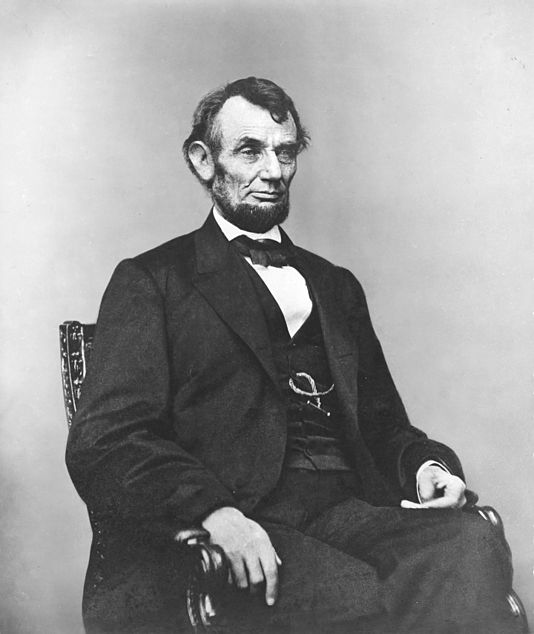
The Fiery Trial: Abraham Lincoln and American Slavery

30 11 2010

Another new book about Lincoln I need to read…

A mixture of visionary progressivism and repugnant racism, Abraham Lincoln’s attitude toward slavery is the most troubling aspect of his public life, one that gets a probing assessment in this study. Columbia historian and Bancroft Prize winner Foner (Free Soil, Free Labor, Free Men) traces the complexities of Lincoln’s evolving ideas about slavery and African-Americans: while he detested slavery, he also publicly rejected political and social equality for blacks, dragged his feet (critics charged) on emancipating slaves and accepting black recruits into the Union army, and floated schemes for colonizing freedmen overseas almost to war’s end. Foner situates this record within a lucid, nuanced discussion of the era’s turbulent racial politics; in his account Lincoln is a canny operator, cautiously navigating the racist attitudes of Northern whites, prodded–and sometimes willing to be prodded–by abolitionists and racial egalitarians pressing faster reforms. But as Foner tells it, Lincoln also embodies a society-wide transformation in consciousness, as the war’s upheavals and the dynamic new roles played by African-Americans made previously unthinkable claims of freedom and equality seem inevitable. Lincoln is no paragon in Foner’s searching portrait, but something more essential–a politician with an open mind and a restless conscience.


Wikileaks and Historians

30 11 2010


Julian Paul Assange, Editor of Wikileaks

Who will be the biggest losers from Wikileaks? According to blogger and PhD student Guy Walters, the answer is future generations of historians. Read more here. Walters is probably right– sensitive discussions may now be moved from email to phone calls.


Primary Sources Are Going Online

29 11 2010


Library and Archives Canada Building, 395 Wellington Street, Ottawa, Ontario

Library and Archives Canada recently completed the digitization of the papers of Sir John A. Macdonald.

Macdonald in 1883. Image from LAC. Mikan: 3218716


"Come Into My Office" Image of the Office of Sir John A. Macdonald

Previously, scholars wishing to look at the correspondence of Macdonald had to look a microfilms of the originals. There is now a database online that allows you to download images of the correspondence in PDF format.

The search engine for the Macdonald correspondence looks like this:

I have pasted an image of an actual document in the Macdonald correspondence below. In this case, it is a rare letter that Laurier sent to Macdonald.

Laurier to Macdonald, 7 February 1884

LAC’s wonderful decision to put the Macdonald papers online is part of a growing trend to digitize primary sources and place them online. The Library of Congress has put Abraham Lincoln’s Papers online. See here.

The wonderful thing about the LoC’s Lincoln Papers search engine is that you can view both images of the primary sources as well as plain text transcriptions of each item of correspondence. For instance, I found this letter from a private citizen in Canada to Lincoln dated 25 Feb 1863.

Here is the transcription of the letter, which was completed the folks at the Lincoln Studies Center, Knox College. Galesburg, Illinois.

P. Tertius Kempson to Abraham Lincoln, Wednesday, February 25, 1863 (Support and autograph request from Canada; endorsed by Elbridge G. Spaulding)

From P. Tertius Kempson to Abraham Lincoln, February 25, 1863

Fort Erie C. W.

Feby 25th 1863.

Honoured Sir,

Englishmen and Canadians are charged that their sympathies have been with the Southern Rebellion and Slavery and my cheeks flush with shame for my countrymen, when I own that this has been too much the case– Thank God, there are numerous glorious exceptions and as a proof of this I take the liberty of sending you a Copy of a Speech delivered recently by the foremost man in Canada and I am happy in being able to assure you that it contains the sentiments and views of thousands of Canadians and millions of British Subjects;

Yes! honoured Sir, you have our earnest and most constant prayers that you may entirely succeed in ridding the Great and Glorious Union of the foul Canker worm of Slavery.

I had the honour and happiness of a personal introduction to you when you passed through Buffalo; May I ask you to enable me to perpetuate the remembrance of yourself and the honour I then enjoyed by giving me a line or two in autograph that I may be able to leave to my children & my childrens children, as a heir loom in remembrance of the great apostle of Liberty of the 19th Century–

By confering upon me this small favor, I shall ever be yours most respectfully & gratefully

P. Tertius Kempson

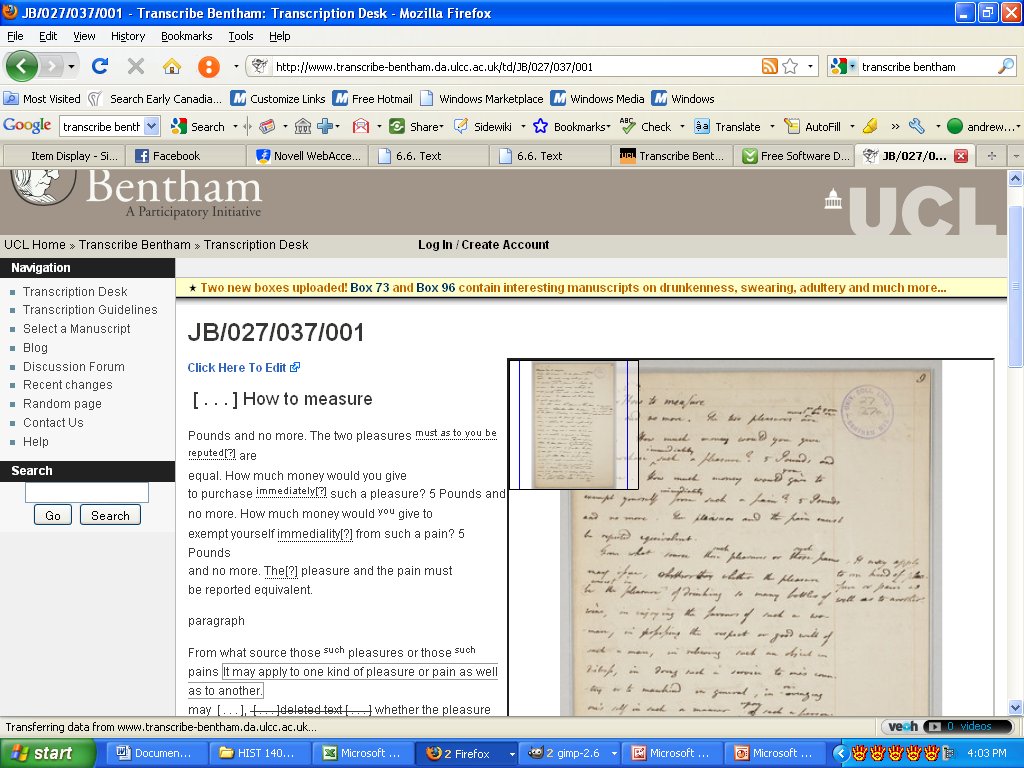
Another wonderful recent initiative is the Transcribe Bentham project, which seeks to transcribe the papers of Jeremy Bentham, the great philosopher. In this case, the transcription is being done by crowdsourcing. Image of all of the correspondence in the Bentham collection was placed online on a website that allow interested members of the public to try their hands at transcribing the documents. The results are monitored by trained archivists and paleographers to maintain quality control.

Transcribe Bentham Project


Review of _ Commerce by a Frozen Sea: Native Americans and the European Fur Trade_

29 11 2010

Title: Commerce by a Frozen Sea: Native Americans and the European Fur Trade Published by EH.NET (November 2010)

Ann M. Carlos and Frank D. Lewis, Commerce by a Frozen Sea: Native Americans and the European Fur Trade.  Philadelphia: University of Pennsylvania Press, 2010. viii + 260 pp. $50 (hardcover), ISBN: 978-0-8122-4231-7.

Reviewed for EH.Net by Peter J. Hill, Department of Business and Economics,
Wheaton College (Illinois).

Some economic histories are valuable because they provide insights into
events and places previously not fully explored, while others contribute
through a well-formulated test of economic propositions. In /Commerce by a
Frozen Sea/, Carlos and Lewis have given us a marvelous melding of the two.
The authors have written a carefully researched and well-organized discussion
of the early fur trade in the very northern reaches of North America as well
as a fascinating use of basic economic theory. The book extends our
understanding of the overall extent of the trade and the interaction between
the European traders — primarily the French and British — and indigenous
tribes.  Europe wanted furs, primarily beaver, and the resident tribal
groups valued the commodities available from the more economically-developed
countries.

When Adam Smith published his /Wealth of Nations/ in 1776, he devoted a bit
more than a page to the Hudson Bay Company, which was over a hundred years
old at that point, having been created by royal charter in 1670. Smith places
his discussion of the Company in his section discussing the costs and
benefits of joint stock companies, and thinks the Hudson Bay Company probably
had a reasonable level of profits, despite some of the principal-agent
problems inherent in such organization.

Smith could have made the Company and its relations with the Native Americans
in the region around Hudson Bay a prime example of one of his basic
assumptions about human nature, “the propensity to truck, barter, and
exchange one thing for another” (Smith, 1937, 13).  He also argued that
the division of labor is limited by the extent of the market  and he would
have found in the activities of the Hudson Bay company a surprisingly robust
case study of entrepreneurial efforts to further extend the market and hence
the division of labor.

/Commerce by a Frozen Sea/ is, at its core, an account of the gains from
trade when two very different cultures with very different resources and
productive abilities come into contact. And that contact itself was not
exogenous, but driven by farsighted individuals who were able to organize
trade across thousands of miles in the most difficult of circumstances. The
Hudson Bay was frozen for most of the year, so the outposts or
“factories” along the edges of the Bay depended upon the yearly vessel
that would bring rations for the Europeans stationed at the factory as well
as trade goods. These goods were often ordered specifically by the Indians
the year before. The ship would then load the furs that had accumulated at
the trading post for the return trip to Europe.

Carlos and Lewis provide useful insights into several issues surrounding
eighteenth-century fur trading. First, the Indians were careful traders and
industrious harvesters of furs and were very sensitive to price fluctuations,
both of the goods they were selling and the commodities (needles, guns, axes,
textiles) that they wanted to receive. There is no evidence that the natives
were an indolent lot, trading to a point of satiation, and then ignoring more
opportunities for exchange. Instead the trade was between two relatively
equal groups and the Indians were careful shoppers who knew what they wanted
and what the relative prices were at French as compared to British trading
posts.

Second, alcohol played little role in the trading patterns. Some natives
traded for alcohol, but their overall consumption was quite modest and the
Hudson Bay Company did not try to use alcohol as a lubricant for trade. In
fact, The Company acted as a firm that cared a great deal about long-term
relations and thought that the use of alcohol during trading created
suspicion and made future trades less likely.

Third, there was little violence in the trading relations. The Hudson Bay
outposts were far apart and had only 20 to 30 men at them. Hence, if the
Native Americans would have wanted to overwhelm a post and plunder the store
of tradable commodities they easily could have done so. They, like the
European traders, however, saw the gains from a long-term relationship and
did not want to jeopardize the possibility of future trades.

Fourth, the English clearly understood gains from specialization, and
believed that the Native Americans could harvest beaver and other furs much
more cheaply than European trappers. Hence, the trading posts were just that,
a place where two cultures could interact to provide substantial gains for
both groups.

Finally, there was a general understanding of the problem of
over-exploitation of an open access resource, and where the British has a
monopoly on trade they were careful to discourage over-trapping. In regions
where there was an interface with French traders, and when a single tribe did
not have complete control of an area, over-exploitation did occur. Also, some
of the cultural norms of the tribes that allowed harvesting for survival
meant that it was difficult to establish and enforce well-defined property
rights to fur-bearing animals, particularly beaver.

Carlos and Lewis also provide interesting insights into long-term growth
issues. They call the eighteenth century “the golden age” for the tribes
in northern regions. Their per capita income compared favorably to working
class British. That was because they controlled a valuable resource,
primarily beaver pelts that were valued in Europe for hats. Once that
resource was exploited and most of the gains from trade had been realized,
there was little basis for ongoing economic growth, hence over the long-run
the tribal communities did not experience the increases in per capita income
that occurred in Western Europe and the parts of North American with
permanent European settlers.

This is a delightful book to read. It is fascinating in terms of its insights
into the trading culture of a particular place and time and it also provides
useful correctives to many misconceptions about various aspects of that
trading.

Peter J. Hill is Professor of Economics at Wheaton College (IL) and the
author, with Terry L. Anderson, of The Not So Wild, Wild West: Property
Rights on the Frontier (2004).