Risk, kinship and personal relationships in late eighteenth-century West Indian trade: The commercial network of Tobin & Pinney

26 12 2010

“Risk, kinship and personal relationships in late eighteenth-century West Indian trade: The commercial network of Tobin & Pinney”
That’s the title of an interesting article in the current issue of Business History by Albane Forestier, who is a research fellow at the French Atlantic Research Group at McGill University.

Abstract:
Which strategies enabled merchants to sustain commercial expansion in the risky context of Atlantic trade? This study evaluates the role of kinship and long-term relationships as solutions to the problems posed by long-distance trade, when there is a common national and legal framework. Tobin & Pinney did not rely much on family connections to develop and support their operations. As former planters themselves, they took advantage of the contacts and ‘friendships’ they had established with planters and agents in Nevis before setting up in the commission trade in Bristol, and their success was based on repeated interaction and their former proximity to the Nevis planter class. This risk reduction strategy however limited the partners’ ability to expand their business beyond Nevis.

Based at McGill University in Montreal, and drawing on the faculty and resources of all four universities in the city (McGill, the Université de Montréal, Concordia University, and the Université du Québec à Montréal), the French Atlantic History Group acts as a forum for new research in the history of the Francophone Atlantic world in the early modern period (1500-1830). The program includes a series of four biannual workshops, a visiting speaker series, a conference, and support for research, graduate students and post-doctoral fellows.

Nevis


New Research on John A. Macdonald

24 12 2010

John A. Macdonald, 1875. Image from Library and Archives Canada

Ged Martin, Professor Emeritus at the University of Edinburgh has recently published a string of new research on Macdonald.  These include:

“Macdonald and his Biographers” [review article] BRITISH JOURNAL OF CANADIAN STUDIES, xvi (2001), pp. 300-19. Essential reading for all PhD students in Canadian history.

“Sir John Eh? Macdonald: Recovering a voice from History” BRITISH JOURNAL OF CANADIAN STUDIES, xvii (2004), pp. 117-124. In this article, Martin determines whether the adult Macdonald spoke with a Scottish accent, a more North American one, or something in between. Researching this paper required very careful archival research as no recordings of Macdonald’s voice exist.

“John A. Macdonald and the Bottle” JOURNAL OF CANADIAN STUDIES, xl (2006), pp. 162-185. This article on Macdonald’s drinking is always very popular with undergraduates. The students in my honours seminar voted it their favourite reading.

“John A. Macdonald: Provincial Premier” BRITISH JOURNAL OF CANADIAN STUDIES, xx (2007), pp. 99-122

“Archival Issues in John A. Macdonald Biography” JOURNAL OF HISTORICAL BIOGRAPHY, i (2007), pp. 79-155 www.ucfv.ca/history/JHB}

“John A. Macdonald: Scotsman or Canadian” (University of Edinburgh Standard Life Lecture in Canadian Studies, 2004.

“John A. Macdonald and Kingston Voters” HISTORIC KINGSTON, lviii (2010), pp. 56-63

I just finished reading Martin’s new book about Macdonald.

FAVOURITE SON? JOHN A. MACDONALD AND THE VOTERS OF KINGSTON 1841-1891  (Kingston, Ont., Kingston Historical Society, 2010, 214 pp.)

Martin’s book is local history at its finest. On one level, it isn’t really fair to call this “local history” since that term often conjures up images of antiquarians arguing about insignificant details. Martin’s book is essentially the study of the relationship between Macdonald, the creation of the Canadian nation state, and this particular community. The book deals with an interesting paradox in Macdonald’s career: as Macdonald’s national and international stature increased, he became progressively less connected to popular with Kingstonians. Kingston, a city in relative economic decline since the 1840s, ceased to be a focus of Macdonald’s energies. Macdonald relocated his law office and residence to Toronto. Kingston voters reciprocated his growing disengagement from them by voting Liberal, which forced Macdonald to seek nomination in safely Conservative ridings in distant parts of the country.

Martin’s book was interesting to me as a historian of Canada and its place in the North Atlantic world. One learns something about Canada’s relationships with the United States, the United Kingdom, and even the Vatican here. Don’t let the title fool you into thinking that this is a book just for residents of the city.

The parts of the book I liked the most were the sections devoted to Macdonald’s career as a businessman, in particular his involvement in Kingston-based Commercial Bank and the Trust and Loan Company of Upper Canada. The Commercial Bank failed in October 1867 in part because Macdonald’s government refused to provide it with the financial lifeline it needed to deal with a liquidity crisis. Macdonald, who owed a great deal of money to this bank, probably would have favoured government aid, but the members of his Cabinet who hailed from the financial centres of Toronto and Montreal were powerful enough to thwart this idea and Kingston’s sole independent financial institution was allowed to fail.

The case of the Commercial Bank raises the interesting question of what Kingston’s got from being represented in parliament for so many years by the Prime Minister. Very little, it would seem. Kingston, which had once been the largest city in Upper Canada/Toronto experienced relative economic decline through Macdonald’s political career. By the early twentieth century, it had become an economic afterthought halfway between the great economic centres of Toronto and Montreal. Kingston probably would have experienced relative economic decline regardless of who was the Prime Minister, since its backcountry consists of rocky soil and marginal farms. What is striking, however, is that Macdonald did so little to try to help the city’s economy aside from a few high visibility projects, such as the controversial dry dock built at the end of his career.

This raises another question for me– to what extent have the ridings/home towns of other Canadian Prime Ministers benefitted from pork barrel spending. When Jean Chrétien was Prime Minister, he arranged for theme park with a high observation tower to be built in the very centre of his riding, Shawinigan. This project created a local landmark, but only a few long-term jobs.

Similarly, Brian Mulroney arranged for a federal prison to be built in his riding, Baie-Comeau.

Baie-Comeau Prison

This provided a nice injection of cash into the local economy, but it certainly did not arrest the steady decline of that pulp-and-paper town, which has a declining population. It would seem that being represented by a Prime Minister does very little for the long-term economic prospects of a Canadian community.

It would be interesting to know whether the Canadian political system’s bias towards targetting public works spending to the ridings of Prime Ministers is stronger or weaker than the similar bias that undoubtedly exists in other countries? Has any political scientist has compared the level of pork-barrel spending in the ridings of Canadian Prime Ministers with similar practices in other Westminster-style democracies.

In the US, the districts of members of Congressional Committees tend to funnel lots of pork-barrel spending to this districts: the bias in military spending towards the districts of members of the Armed Services Committee is striking. According to political scientist Brian Roberts, when Senator Henry “Scoop” Jackson, the ranking Democrat on the Senate Armed Services Committee, died suddenly in September 1983, the share prices of arms merchants based in his home state of Washington declined. The share prices of contractors based in Georgia, the home state of the next-most-senior Democratic Senator on the committee, Sam Nunn, shot up.

Roberts, B.E. (1990) “A dead senator tells no lies: Seniority and the distribution of federal benefits” American Journal of Political Science 34: 31–58.

P.S. Arthur Milnes of Queen’s University has created a Macdonald-themed walking tour of Kingston. You download it to your Ipod and then walk the streets of the historic city centre. You can choose your narrator for the tour from a growing list that includes the Rt. Hon. Jean Chretien, the 20th Prime Minister of Canada, the Hon. Peter Milliken, 34th Speaker of the House of Commons and the local MP, and hockey personality Don Cherry. See here.




Albert Schrauwers

24 12 2010

The December 2010 issue of the business history journal Enterprise & Society contains a number of interesting articles, one of which is  by Albert Schrauwers of York University, “Regenten” (Gentlemanly) Capitalism: Saint-Simonian Technocracy and the Emergence of the “Industrialist Great Club”

This is from the abstract:

This article traces the transformation of [Dutch] aristocratic financiers into Saint-Simonian-inspired industrialists under the leadership of their Merchant King over the course of the nineteenth century, as they replaced this network of canals with an equally dense national network of railways… Legitimated by a technocratic ideology they co-opted the corporate form utilized by the Crown to rule while avoiding parliamentary oversight, and thereby shifted the Dutch state from autocracy to oligarchy.

I recently reviewed Schrauwers’s important book ‘Union Is Strength’: W. L. MacKenzie, The Children Of Peace, And The Emergence Of Joint Stock Democracy In Upper Canada. The review appeared in Labour/Le Travail, vol. 65.

Schrauwers is clearly a prolific and wide-ranging scholar.


Are Peer-Reviewed Journal Articles Obsolete?

20 12 2010

The answer to this question is “yes” according to biophysicist Cameron Neylon, the author of the blog Science in the Open.

He said the current system of communicating the results of scientific research via journal articles is a 17th-century solution to a 17th-century problem. “Printing was adopted because researchers got tired of sending letters to each other… Publishing was essentially letter aggregation. When there became too many letters, peer review was introduced. You can argue that the biggest innovation since then has been the removal of ‘Dear Sir’ from the beginning of articles.”

Dr Neylon believes that if scholarly communication were redesigned from scratch for the digital age, it would look radically different. Most significantly, the monopoly of the journal article would be smashed….

Read more here. This article is focused on the sciences, but since social scientists and humanities scholars have adopted the scientists’ system of peer-reviewed journal articles, Neylon’s arguments certainly have relevance for us historians.


CFP: “Transformation: State, Nation, and Citizenship in a New Environment”

17 12 2010

“Transformation: State, Nation, and Citizenship in a New Environment”

A conference sponsored by the Avie Bennett Historica Chair in Canadian History,
Department of History, Faculty of Liberal Arts and Professional Studies, will
be held from October 13-15, 2011 at York University in Toronto.

DESCRIPTION

Canadian Political History has changed over the last fifteen years. With a
growing research interest in social history and for those who came to be
categorized as “ordinary” people, some have lamented that the study of “great
men” seems to have ended and, as a result, that political history had
disappeared as a field of research. Although these concerns have received much
attention, especially outside of academia, new venues were being investigated
by scholars preoccupied with the study of the state, the development and
implementation of public policies, strategies used by state components to
foster a sense of belonging less centered around ethnicity and more around
civic values, and strategies used by large segments of societal groups in order
to shape policies and state symbols in a way that they would permit them
identify themselves with these new symbols. Concluding that political history
has disappeared is quite premature.

This conference entitled “Transformation: State, Nation, and Citizenship in a
New Environment” will give researchers an opportunity to reveal the breadth and
the level of sophistication that has developed within political history over the
last decade. At the same time, it will reveal the discipline’s transformation.

The state has been fundamentally transformed and shaped by Keynesianism, then
neoliberalism and now neo-Keynesianism. These transformations also reflect the
fact that the state – a sovereign entity that controls a well-defined territory
recognized by the international community- has seen its actions, powers and
abilities circumscribed by supranational entities, and regional, continental,
and international treaties.

PAPER TOPICS

The main geographical area is Canada but comparison with other state entities
will be considered. There is no specific time period. Since the conference
intends to demonstrate new innovative venues pursued by scholars in political
history, proposals might deal with one of the following topics:

-The welfare state, its development and transformation over time especially in
the context of neoliberal policies

-The creation and implementation of public policies

-The liberal order and the usefulness of national narratives in order to
understand Canadian historical experience

-State repression and strategies developed in targeting groups defined as
subversive, or social agents and individuals who agreed to assist state
components in their repression of dissent

-Nationalism and citizenship and how these concepts have been conceptualized
over time

-Political culture and how Canadian culture has been conceptualized

-Political history as a discipline and changes that the discipline has undergone
over time

-Expertise, its development and its capacity for shaping public policies
The environment, science and public policies

-Science and its use in the development and implementation of public policies

-Federal-provincial relations in the context of mega constitutional negotiations
and free trade agreements

-Aboriginals, self-government, land claims, and the political process

SUBMITTING A PROPOSAL

Panel and roundtable submissions should include a session title, a brief
description of the panel or roundtable, abstracts for each paper of no more
than 300 words, and a brief biography or one-page c.v./resume for each
presenter before March 1, 2011.

Individuals should submit a title, a 300-word abstract plus a brief biography or
one-page c.v./resume before March 1, 2011.

Please send your proposal to hist2011@yorku.ca

Applicants will be notified of the acceptance of their proposal in April 2011.
Papers accepted for this conference may be requested for subsequent publication.

CONFERENCE ORGANIZERS

Dimitry Anastakis, Department of History, Trent University
Matthew Hayday, Department of History, University of Guelph
Marcel Martel, Department of History, York University
Jennifer Stephen, Department of History, York University
Will Stos, Department of History, York University


Geopolitics of Facebook

15 12 2010


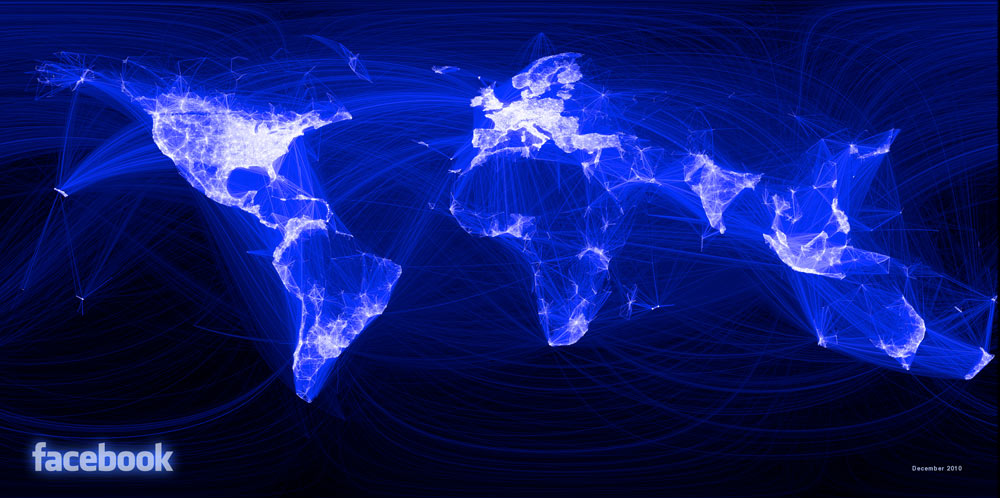
Facebook Friendships Plotted on a Map of the World

Check out this cool map that shows Facebook Friendships. Each white dot represents a certain number of Friends. The white lines represent friendships.

I have a few observations.

First, Facebook is still predominantly a Western club. Europe and the Americas are lit up like Christmas trees. Africa has few members outside of South Africa, largely because it is extremely poor.  Facebook has few members in China, not because the Chinese can’t afford computers but because Facebook is basically illegal there because the regime thinks it is politically subversive. In contrast, there are a fair number of Facebookers in India.

Second, alphabets appears to matter as well. Japan has a moderate number of Facebook accounts, but the density of members there is surprisingly low given the fact that Japan has the highest density of broadband in the world (and really fast broadband at that).  Japan has its own social networking sites that are geared to its language/alphabet.

Third, I was struck by a vast number of FB users in Indonesia. I suspect that FB has done well in this country because the official language there is based on the Roman alphabet.

Fourth, I would be interested to see a similar map for Canada. It would be interesting to see how the country’s internal language frontier influences the pattern of “friendships”.


Alan Taylor on the War of 1812

11 12 2010

I have just finished reading Alan Taylor’s new book The Civil War of 1812: American Citizens, British Subjects, Irish Rebels, & Indian Allies. It’s an important and well-written book, albeit one with one flaw I will discuss below.

As the bicentennial of the war approaches, I am certain that many people will turn to this work as a reference. This book incorporates recent scholarship, such as Carl Benn’s wonderful study of the Iroquois in the War of 1812. It is also based on extensive archival research in both Canada and the United States. Although Prof. Taylor is an American, he certainly cannot be accused of bias towards the United States in terms of his choice of archival source or overall interpretation.  Indeed, if one did not know that the identity of the author, it would be hard to guess his nationality. Patriotic Americans looking for celebratory stories will be disappointed by this volume, as will anti-American Canadian undergraduates  looking for heroes to add to the Canadian nationalist pantheon.  For instance, Taylor shows that most of the people living in what is now Ontario were essentially neutral during the war– or at the very least they tried to avoid getting involved in the conflict. Taylor destroys what remains of the militia myth, the once-common idea that the farmers of Upper Canada sprang to the defence of the Empire in 1812.

Taylor’s thesis is that the War of 1812 was less of a conventional war between nation states than a civil war — or rather a continuation of the civil war that was the American Revolution. Many of the participants in the War of 1812 had fought in the  Revolution and were spoiling to finish feuds that had been started a generation earlier. In other cases, the militiamen were the children of the Tories and Rebels of the Revolution.  Some of the family feuds that became wrapped up in the War of 1812 had their origins in upstate New York in the 1770s, the source of many of the United Empire Loyalists.

The War of 1812 was also a clash of ideologies. It was a struggle between the new and relatively egalitarian ideology of republicanism, which was represented most clearly by the Jeffersonian Republicans, and the defenders of the monarchy in North America. The two decades before the outbreak of the war saw what was effectively a Cold War between Empire and Republic in North America. In 1812, a range of factors including land hunger, American discontent with Britain’s alliance with Natives in the Old North West, and the issue of sailors’ rights caused this war to become a hot one.

The ideological nature of the war placed the Federalists, the conservative faction who had lost power to the Jeffersonians in 1801, in an awkward position. The Federalists’ anglophilia and admiration for the British aristocracy led them to oppose President Madison’s war against the British Empire. Indeed, some Federalists engaged in behaviour that was tantamount to treason: in late 1814, when politicians from Federalist-dominated New England seriously considered secession from the United States. Many Federalists and others in border communities arrange a sort of modus vivendi or local peace with the nearby British forces, which helps to explain why there was relatively little fighting along the St Lawrence River. The War of 1812 also exacerbated  the existing political divisions within Upper Canada between Loyalists and “late Loyalists” and the various shades of Reformers: some anti-establishment politicians in Upper Canada actually sided with the invading Americans. Most people in Upper Canada, however, were economic migrants from the United States who had come north seeking cheap land. Their attitude towards the conflict between the distant governments in London and Washington was essentially one of neutrality– they sought to avoid military service or indeed getting tangled up in the struggle. Taylor points out that US war aims were ambiguous– some of the military and civilian leaders of the US favoured the permanent occupation of Upper Canada, but others were opposed to the idea of joining this territory to the union. The ambiguity of the Americans’ public statements on this issue likely served to discourage some in Upper Canada from throwing in their lot with the American invaders.  Why risk a postwar prosecution for treason by helping an enemy that may or may return the conquered territory to the British at the bargaining table?

The War of 1812 was fought between two peoples speaking the same language and connected by close family ties. In some cases, it was literally a war of brother against brother.  First Nations warriors fought on both sides of the conflict. French Canadian habitants had their farms devastated by both nation’s armies. The Irish in North America were also divided by this conflict: many rebels of the 1798 Irish rebellion against British rule fought in the US army in this war. At the same time, most of the British regiments in Upper Canada were Irish.

The thing I liked best about this book was Taylor’s explanation for why the US did not do the obvious thing and try harder to seize control of the St Lawrence River, the supply line linking Lower Canada to the British armies in Upper Canada. I have always been baffled by the decision of the Americans to have devoted resources to repeated attempt to attack Upper Canada along the Detroit and Niagara Rivers rather than simply seizing control of the St Lawrence at, say, Prescott, Brockville, or Gananonque.

Taylor provides us with a plausible explanation for this curious decision: much of the land on the American side of the St Lawrence River was being developed by a financier who wanted to keep the actual fighting away from the properties he was attempting to sell to settlers. This financier had political clout in Washington because he was also the source of many of the loans the Republican administration was using to fight the war. Taylor shows that the low-tax ideology of the Republicans caused them to try to fight this war on the cheap, which severely hampered the US war effort.

This book gives us a very good account of the major campaigns and battles that took place along the northern frontier of the United States.  It also outlines the political history of Upper Canada from 1783 to 1812 in crystal-clear terms. As such, it will be essential reading for future generations of Canadian historians, not to mention scholars interested in the history of the Great Lakes States. However, this book’s coverage of military events in other parts of the continent is noticeably weak. For instance, we learn almost nothing about the burning of Washington and the Battle of New Orleans, important events mentioned only in passing by Taylor. Similarly, the decision of the Creek First Nation in Mississippi  to seize the opportunities created by the War of 1812 and launch their own campaign against the United States goes unexamined. Perhaps Taylor’s decision to focus on the northern US stems from the fact he is originally from Maine.

Taylor proves that the War of 1812 in the Great Lakes region had the characteristics of a civil war. However, one suspects that had he expanded his coverage to include the British amphibious landing at Washington or, so, the war in Louisiana, this thesis might have been undermined.

Overall, this is an excellent book. It reads well and would be suitable for undergraduates and members of the general public interested in this war.


Historian Ged Martin on the Death of Sir John A. Macdonald

8 12 2010

Historian Ged Martin was in Kingston, Ontario earlier this week to promote his new book about John A. Macdonald.  Favourite Son? : John A. Macdonald and the Voters of Kingston 1841-1891 (Kingston, Ont. : Kingston Historical Society, 2010).

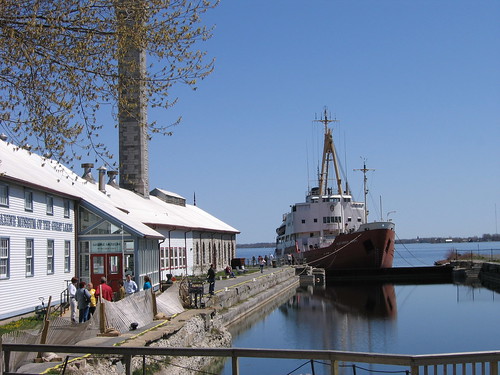
In the book, Martin argues that Macdonald’s death in 1891 was hastened by stress caused by the knowledge that a corruption scandal was about to become public. The scandal centred on “Andrew C. Bancroft”, a non-existent person who had been awarded a contract to build a dry dock in Kingston by the federal government’s Department of Public Works, which was then headed by the notoriously corrupt Hector-Louis Langevin.  The dry dock is now the Marine Museum of the Great Lakes.


Kingston Dry Dock

For press coverage of Martin’s book launch in Kingston, see here.  The reader comments section of the article is amusing, especially where someone challenges Martin to a duel.


The Downfall Meme

7 12 2010

As a historian, I am interested in the proliferation of  Downfall parodies on YouTube. Downfall is a 2004 German film about Hitler’s last days in the bunker in Berlin. There is a gripping scene in which Hitler goes on a rant and berates his subordinates.

Since 2004, over a 100 parodies of this scene have appeared on YouTube. The parodies typically involve the imposition of subtitles related to a modern social or political event. For instance, in 2008, when there was a constitutional crisis in Canada, a YouTube clip purporting to show Prime Minister Stephen Harper meeting with his cabinet quickly appeared online.  The original German soundtrack was left untouched, but the words were intended to represent Mr. Harper’s thoughts at this time.  The same trick has been done with managers and coaches of professional sport teams that have lost big games. The gag is particularly funny when the person being mocked has a reputation for having an authoritarian personality.

Perhaps the most controversial Downfall parody to appear online has Hebrew subtitles. It relates to the parking situation in Tel Aviv.

It is now exam season in Canadian universities. A former student just sent me a clip of a new Downfall parody that purports to show the reaction of a student to their exam being cancelled due to snow. This clip is getting a lot of hits on YouTube right now because many universities in Ontario are now closed due to a massive snow storm that began on 5 December.

I have mixed feelings about the Downfall parody craze. While I enjoy a good joke as much as the next guy, it seems to me that all of these parodies may be trivializing a very evil regime.

Here are some links to newspaper stories about the Downfall parody craze. Here, here, and here.


CFP War of 1812 Conference

5 12 2010

2012 will be the bicentenntial of the beginning of the War of 1812-14.
Once described as the ‘forgotten’ war, there are already indications
that there will be widespread commemoration ceremonies across North
America, mostly sponsored and organized by national, state and
provincial governments, by tourist organizations, and by local
historical societies. We have therefore decided that it would be an
appropriate time to hold an international conference that revisits the
scholarly literature and scholarly debates over the causes, conflicts
and consequences of the War as well as the way in which the War has
been remembered and commemorated in Britain, Canada and the United
States over the past two centuries. As the Conference title indicates,
we are particularly interested in papers that challenge existing
interpretations and offer new approaches. It is our intention to
produce a volume of essays selected from those given at the Conference.

The conference will be held at the University of London from 12-14
July 2012. These dates were chosen to overlap with the annual
conference of the Transatlantic Studies Association, which will be
held in Cork from 9-12 July 2012 so that scholars who wish to do so
can attend both.

Further details on the Transatlantic Studies Association can be found
on its website at www.transatlanticstudies.com.

The conference on ‘The War of 1812: Myths and Realities’ will be held
in partnership with the Institute for the Study of the Americas at the
University of London, Canterbury Christ Church University, and the
National Maritime Museum in Greenwich. If you are interested in
proposing a paper, please send along a paragraph describing your
proposal and a short c.v. to either Phillip Buckner (phillipbuckner@hotmail.com
) or to Tony McCulloch (tony.mcculloch@canterbury.ac.uk) no later than
12 July 2011.