New Research Project

16 10 2010

I am starting a new research project. Between Ethnocentrism and Commercial Cosmopolitanism: the Ethnic, Racial, and National Identities of Anglo-Celtic Businessmen in Asia, 1865-1914. This project, which is still in the research design/preliminary investigation stage, will be the major focus of my research time for the next five years. I’m planning to provide updates on the progress of this project on this blog.


Basically, I plan to research a book that will examines how white English-speaking businesspeople thought about and interacted with their East Asian peers from 1865 to 1914. (I have used the term Anglo-Celtic because it is a bit more accurate than the more familiar “Anglo-Saxon”. I’m also using the term “businessmen” rather than “businessperson” because commercial activity was highly gendered in this period and basically all of the individuals I will be examining were male).


Pedder Steet, Hong Kong, 1870s


This project is an outgrowth of my earlier research on the history of transnational business and globalization and my publications on race. The focus of this book will be on businessmen from Canada, the United States, and Britain, although I may find some information about Australasian businessmen as well.


Premises of Augustine Heard and Co., Hong Kong, 1860


The basic research question is to figure out the extent to which the racist ideas that were so common in this period actually influenced the day-to-day dealings between East Asian and Anglo-Celtic businessmen.

In the period under discussion, racism was rife in Western countries: the United States, Canada, and the Australasian colonies all introduced laws discriminating against East Asian immigrants.  Influenced by social Darwinist ideas about race and Orientalist views of Asia, most Westerners regarded themselves as superior to “Orientals”. At the same time, the Anglo-Celtic countries traded extensively with China and Japan. Although some of this trade mediated by state, in most cases it was conducted by private firms. All of this commercial activity required Western merchants to interact with their East Asian peers. In some cases, their dealings were one-off transactions and cash deals.


Dai-ichi Mutual Life Insurance Company Building, Tokyo


In other cases, however, long-term contracts were signed and joint ventures were established. The Hongkong and Shanghai Banking Corporation, which had branches in many treaty ports in China, used compradores, who were typically already wealthy Chinese merchants, to deal with locals.  In a few cases, corporations in which some of the managers were East Asian, others white, were formed. All of this raises the question of how attitudes towards race influenced business. One possibility is that Anglo-Celtic businesspeople in East Asia essentially ignored the racist messages they were getting from their home culture. Another possibility is that the ethnocentric ideas of the period had a measurable impact on their day-to-day business operations.  I suspect that when I get into the archives, I am going to find that some businessmen in East Asia harboured quite racist attitudes and suffered commercial for it, while others had a more cosmopolitan attitude. I’m especially interested in the period around 1905-6, when there was a massive boycott of U.S. products in China to protest the immigration laws of that country.

In designing this research project, I read the works of historians such as Geoffrey Jones, Sherman Cochran, Mira Wilkins, and many others. However, the book that did the most to inspire this project was Kevin C. Murphy’s recent book on the American merchant experience in Japan between 1858 and 1899.
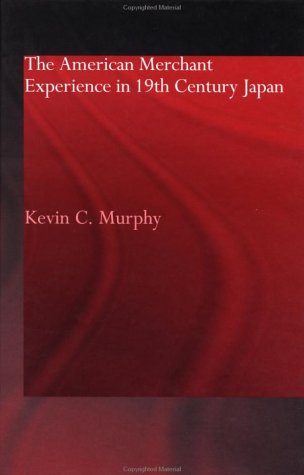
Murphy is a historian of the nineteenth-century United States whose research on American merchants in Japan was an outgrowth of his interest in race in the US. (His first book was on the Civil War and had nothing to do with Asia). Anyway, this book by Murphy covers the period of the “unequal treaties”, which gave Western merchants living in designated Japanese ports an exemption from Japanese laws. Only in the 1890s was Japan strong enough to demand the revision of these treaties. By 1858, when American merchants first entered Japan, a sophisticated market-based economy and large merchant class had already emerged in Japan. (In terms of its economy, Japan in 1860 was the Asian nation most like Western Europe). Murphylooks how race influenced how Americans interacted with this indigenous business class. He
contextualizes the attitudes of the American merchants by referring to the ongoing campaign against
Asian immigration in the United States. He argues that the Americans’ disdain for the Japanese caused
them to rely on middlemen called “boekisho” or ‘foreign goods merchants” to sell their wares to
Japanese consumers.

Murphy attributes the unwillingness of Americans to deal directly with consumers to the racist ideas then hegemonic in the United States. Murphy also documents the importance of “bantos” or “chief clerks”, the Japanese employees who were mainly responsible for negotiations with Japanese merchants. He shows that bantos employed by American firms were typically not classed as front-office employees, even though they were employed in clerical tasks that required literacy. He also shows that the typical American merchant in Japan was at the mercy of his banto because few of them bothered to learn any Japanese. The picture of the American merchant that emerges from Murphy’s
study is that of an arrogant and ethnocentric clique of expatriates who held aloof from the general
population, refused to learn more than a few words of Japanese, and suffered commercially as a result.

Murphy’s book is very interesting, but it suffers some limitations: a) his focus is just on Japan, whereas it would be helpful to look at the other East Asian treaty ports b) he looks only at US businessmen, when we know that by 1914 Englishmen outnumbered American merchants in Tokyo. It would be interesting to compare the attitudes to British and Americna businessmen in East Asia to see if the greater success of the British had cultural roots.

The companies I plan to examine include:

United States:

British American Tobacco

Singer Sewing Machine

Oriental and Occidental Steamship Co.

Standard Oil

British:

Alfred Holt and Co.

John Swire and Sons, Ltd.

Chinese Engineering & Mining Company Ltd.,

Lever Brothers.

Canada:

Canadian Pacific Steamships

Sun Life Insurance Company of Montreal, Ltd.


CPR's Empress of China, c. 1904, en route between Vancouver and Yokohama


The case studies relate to different industries (consumer goods, banking, shipping, insurance) for diversity/representativeness.  Each case study will be based on archival materials and printed primary sources. The archives I plan to consult are manuscript collections in Britain and North America.  My research should interest the following groups of scholars: social historians of Canada, the United States, and Britain; historians of globalization; historians of international political economy; historians of business. This project may also be of interest to historians of China and Japan, but I have conceived it as mainly as a contribution to the histories of North America and Britain.

If all goes as planned, in 2016 or so, I should publish a book on this topic. I hope that you buy it!



Rocco Rossi

14 10 2010

Rocco Rossi has dropped out of Toronto’s mayoral race, conceding his ideas are failing to gain traction in a mayoral campaign that’s become a battle between two candidates tussling over an angry, polarized electorate…. The announcement comes hours after an Ipsos-Reid poll placed him at 4 per cent – far behind frontrunners Rob Ford and George Smitherman, who appear to be in a dead heat. See here.


Rocco Rossi


Rocco Rossi’s departure from the race has implications for both Toronto and Canada as a whole. Municipal elections in Ontario are not fought on party lines: all candidates stand as independents, but people have a rough idea of where they sit on the ideological spectrum. Rossi was, if anything, somewhat to the right of front-runner Rob Ford on economic issues: both men are centre-right politicians, but Rossi proposed privatizing Toronto Hydro, something Ford opposes.

Rocco Rossi’s CV is rather more impressive than that of Rob Ford, as it includes merit scholarships to UCC, McGill, and Princeton, stints at Boston Consulting, Labatt/Inbev, and service on the board of the United Way. To date, Mr. Rossi has not had dealings with the police in Florida or elsewhere. This raises the question of why Ford was able to gain more support than Rossi.

One suspects that the major reason why Ford proved much more popular than Rossi or any of the other centre-right candidates is that he was willing to challenge the Canadian consensus in favour of open immigration. It is his stance on the issue and on no other that differentiates himself from all of the other candidates.  His views appear to have resonated with voters in a city that still attracts the lion’s share of immigrants to Canada.

Here are some of Ford’s comments on immigration:

“Right now we can’t even deal with the 2.5 million people in this city. I think it is more important to take care of people now before we start bringing in more people.”
“Those Oriental people work like dogs. … They’re slowly taking over.”

Ford’s comments have resonated with the public for several reasons.

First, many people in Toronto have legitimate concerns about the level of immigration because of the challenges population growth imposes on infrastructure: city streets are much more crowded than they were a generation ago largely due to immigration rather than natural increase (the fertility rate among old stock Canadians is quite low). Immigration has driven up the cost of housing, which benefits existing home-owners but which also victimizes young people looking to buy.

Other Torontians oppose immigration because of simple racism.  We would like to think that there is no racism or xenophobia in Canada, but that sadly isn’t the case.  International studies have found that the level of xenophobia in Canada is lower than in other countries, but they have also demonstrated the persistence of anti-immigrant/anti-foreigner sentiment in Canada.  See this study by the Conference Board of Canada.

It is almost certain that Rob Ford’s popularity has something to do with his anti-immigration stand, since on most of other issues, Ford’s policies are identical to those of the other candidates.

Since the 1960s, when Canada developed non-racial immigration policies,  all of the major political parties at the national and provincial levels have supported the idea of a relatively open policy towards newcomers. They might have differed on other issues, but Pierre Trudeau, Brian Mulroney, Bill Davis, and Bob Rae were all in favour of maintaining a high net immigration rate of roughly 1% of Canada’s population per annum.

The fact there is a consensus within the political class and the business and academic communities in favour of this immigration policy has prompted some Canadians to develop a very self-congratulatory attitude when it comes to assessing Canada’s great experiment in mass immigration.

Rob Ford’s popularity is a sobering reminder that there is indeed still a bit of xenophobia in some quarters of Canadian society, even and perhaps especially, in its largest city.


My Teaching in the Week Ending 8 October 2010

9 10 2010

HIST 1406: Canadian History Survey

My lecture on Tuesday was called Rival Empires. It examined the Seven Years’ War.

The lecture on Friday was on the impact of the American Revolution on the territories that later became Canada. I also asked the students to look at this map related to my lecture on the American Revolution. See here.

HIST 3266: History of Western North America class

My lecture on Monday used the life story of Sir Sam Steele to explore the histories of the Canadian West and the Mounted Police.

Sam Steele

My lecture on Wednesday was on the life and times of Horace Tabor, Colorado’s Silver King. In this lecture I spoke about such themes in mining history as technological change, labour relations, and ethnicity.

HIST 4135: British North America: the Road to Confederation

The theme of this week’s seminar was religion in the Province of Canada.

We discussed the following readings:

Roberto Perin, “Elaborating a Public Culture: The Catholic Church in Nineteenth-Century Quebec” in Religion and Public Life in Canada : Historical and Comparative Perspectives edited by Marguerite Van Die (Toronto : University of Toronto Press, 2001), 87-105

Suzanne Zeller, “Environment, Culture, and the Reception of Darwin in Canada, 1859-1909” in Disseminating Darwin: Place, Race, Class, and Gender, ed. Ron Numbers and John Stenhouse (Cambridge University Press, 1998), 91-122
William Westfall, “Constructing Public Religions at Private Sites: The Anglican Church in the Shadow of Disestablishment” in Religion and Public Life in Canada, 23-49

Doug Leighton, “The Manitoulin Island Incident of 1863: An Indian-White Confrontation in the Province of Canada” Ontario History 69(1977):113-124.

We also listened to student presentations on the lives and times of Ignace Bourget,  John Strachan,  Sir John William Dawson,   Rev. Peter Jones (Kahkewaquonaby), Rev. Robert Burns.


Canadian Economic Nationalism: the View from Bay Street

7 10 2010

We often associate Canadian nationalism with intellectuals and with left-wing people such as Maude Barlow. Of course, economic nationalism has long had supporters in the business community. That’s why I was interested in this forthcoming story in Canadian Business magazine:

Canadian chief executives and corporate leaders are concerned about the possible sale of Potash Corp. to a foreign buyer, and they want the federal government to take action to stop the sale.

When asked recently in a Compas Inc. poll whether the Canadian government should step in to block the sale of the nation’s largest fertilizer company to Sinochem, [Canadian] CEOs agreed strongly, with a mean of 5.7 on a seven-point scale…the CEOs also felt the government should do what it can to block a sale to BHP Billiton, responding with a mean of 4.6.

Read more here.


The Increasing Public Profile of Lord Tweedsmuir

6 10 2010

I’m interested how research by academic historians reaches the average person .   I’ve noticed an increasing number of media references to Lord Tweedsmuir’s role in the origins of Canadian multiculturalism.

Tweedsmuir, who had achieved fame as a novelist under his birth name John Buchan, was Canada’s Governor-General in the late 1930s. He used his largely ceremonial position to preach in favour of tolerance and the right of immigrants and First Nations to retain their cultural traditions.

Lord Tweedsmuir

In many ways, his ideas were a precursor to the policy of official multiculturalism introduced by the Trudeau government in 1971, but the context was completely different. In 1971, racism and discrimination had become anathema throughout the Western world. Thanks to the huge worldwide cultural shift that took place in the 1950s and 1960s, lunch counters in the Deep South were desegregated and laws outlawing employment discrimination were passed in most Western democracies.  The US, Canada, and Australia all shifted from racist to non-racist immigration policies. Historians have advanced competing explanations for this cultural shift: the Cold War, decolonization, revulsion at the Holocaust or a mixture of all three.

The 1930s, in contrast, were pretty much the peak of racist and ethnocentric thinking in the Western world. Racist and ethnic nationalist ideas were pretty common everywhere, even in those Western countries which remained  democracies. Eugenics laws and quasi-mystical ideas about Aryan supremacy were widespread. Even Mackenzie King, Canada’s Liberal PM, opposed Jewish immigration because he was worried about the “admixture” or “alien blood” polluting Canada’s genetic stock. (It should be noted that while King was opposed additional non-Aryan immigration, he courted the votes of Jewish people and did not advocate doing anything to reduce Canada’s then existing Jewish population).  Most Canadians in the 1930s were, at best, advocates of assimilation (e.g., residential schools for Natives and regular schools for immigrants  designed to destroy their cultures) and at worst supporters of sterilization, exclusion, and deportation.

This context is what Lord Tweedsmuir’s advocacy of tolerance so striking.

In the 1930s, Tweedsmuir told an audience in rural Manitoba, “You will all be better Canadians for being also good Ukrainians.” Tweedsmuir also encourage First Nations people to retain their cultures, which flatly contradicted the assimilation agenda that the federal government was then forcing on the Natives.  Tweedsmuir was truly a man ahead of his time.

Until a few years ago, nobody paid much attention to Tweedsmuir. Then a history professor named Peter Henshaw started published some articles about Tweedsmuir that were read and popularized by journalists. See here. Jason Kenney, the Immigration Minister, quoted Tweedsmuir in a speech in 2008. There is even a reference to Tweedsmuir in the new Canadian Citizenship Guide for immigrants. One of the problems with this guide is that while it mentions Tweedsmuir, who was a precursor of multiculturalism, but it doesn’t mention Trudeau, the Prime Minister who actually implemented the policy!  But the interesting thing is that Tweedsmuir is mentioned at all.

Today’s Globe contains an article on religious minorities that quotes Tweedsmuir’s famous advice to the Ukrainians of Manitoba. See here.

Check out Henshaw’s research in : ‘John Buchan and the British Imperial Origins of Canadian multiculturalism’, in N. Hillmer and A. Chapnick, eds, Unfinished Business: The Making and Unmaking of Canadian Nationalisms in the Twentieth Century (Kingston: McGill-Queen’s, 2007).


South Yorkshire and the Nickel Belt: Parallels to Avoid

5 10 2010

That is the title of a great new blog post on ActiveHistory.ca

David Zylberberg’s comparison of the histories of coal mining and South Yorkshire and nickel mining in Ontario is interesting. However, he makes an observation that is perhaps not quite accurate. He says:

the two situations are not identical as the exact government role varies and geological differences matter in mining regions. However, there are a number of lessons from South Yorkshire that could apply to the current situation. The most important one is to be aware of the regional implications of macroeconomic policy. When the coal mines closed, there were not new jobs to replace them and the national growth that has occurred since was heavily concentrated in London and south-east England. This meant that those who immediately suffered from policy changes were not the later beneficiaries, helping to create a political culture of regional hostility and poverty. Sudbury’s mines will not close in the near future but jobs are being lost in reorganization. And while Sudbury’s mining service sector has the potential to benefit from new operations around the country, what benefits occur from Harper and Clement’s liberalization of ownership are likely to be concentrated in the financial and corporate centres of Toronto and Calgary.

See here.

I think that this misses the point about hollowing-out and the loss of corporate HQs from Canada. One of the perceived problems with foreign ownership of Canadian mining companies is that the “high-quality” head office jobs are generally moved from Canada to the home country of the multinational. The blue-collar mining jobs stay where the minerals are. These jobs can’t be outsourced,because the principle of globalization does not apply to manual workers in the mining sector.  (Because of immigration laws, Vale can’t bring in Brazilian miners to work a Canadian ore deposit and pay them Brazilian wages, whereas Canadian Tire can outsource all of its manufacturing needs to China).

Vale is essentially a creature of the Brazilian government. It was formed in 1942, when the United States, Britain, and the other industrialized countries were pre-occupied with fighting Hitler and thus too busy to protest about the Brazilian government’s actions. (It helped that Brazil had declared war on Germany and the US  had something called the Good Neighbor policy, which involved tolerating economic nationalism in Latin America).

Vale was privatized in 1997 but it still retains strong links to the Brazilian state. Brazil created Vale because it wanted the country to be home of a mining multinational rather than simply a place where mining multinationals based in the First World did business.

Arguably, it may not make much difference to the actual miners whether they are administered by a corporate bureaucracy based in Toronto or by a corporate bureaucracy headquartered in Brazil or Switzerland or the City of London. Similarly, the elimination of corporate head office jobs in Toronto may not affect restaurants, real estate agents, etc, in a mining town like Sudbury.

However, the elimination of head offices in Toronto could have a major impact on that city and on all the people who sell services to Bay Street workers. One of the reasons Toronto has been able to escape the fate of most of the other Great Lakes cities (e.g., Detroit, Cleveland, Buffalo) was because it is the financial capital of a separate country  rather than simply a regional service centre.  Without the border, Toronto would simply be another fifth-rate American rustbelt town.  The existence of a separate currency in Canada and regulations limiting foreign ownership have helped to make Toronto necessary.

The major beneficiaries of restricting foreign ownership in mining would likely be white-collar workers in Toronto rather than people in the mining communities themselves.

I’m reminded of the distinction Ed Broadbent drew at the time of the 1988 Free Trade election. He said that Mulroney was on the side of Wall Street (US capital), the Liberals were in the pocket of Bay Street (Canadian capital), and he was on the side of Main Street (the common man).

Perhaps Canadian nationalists should support a Bay Street first strategy?

There are some great works on Canadian mining history, including a recent book chapter by Jeremy Moaut, “Whitaker Wright, Speculative Finance and the 1890s Mining Boom in the City of London,”
in Raymond E. Dumett, ed., Mining Tycoons in the Age of Empire, 1870– 1945: Entrepreneurship, High Finance, Politics and Territorial Expansion.

I’m a big fan of comparative history,which I why I have done a bit of reading on Australian mining history (Blainey’s The RushThat Never Ended). Some historian really needs to write a book explaining why Australia has produced BHP, a global mining giant, whereas Canada has not been able to do likewise.

If you will pardon the mineral metaphor, such a book would be worth its weight in gold.


BHP, Potash, and Vale Inco

4 10 2010

Stories about the pitfalls of foreign ownership of Canadian mines have been in the news recently.

Export Development Canada, a Crown Corporation, has announced that it will be lending Vale Inco, a Brazilian firm, a billion dollars to expand its nickel mining operations in Canada. Vale is a “national champion” that was created by a Brazilian government concerned about foreign control over that country’s mining sector. The support the Conservative government is giving to Vale has aroused the ire of unions, especially since workers in Sudbury, Ontario recently ended a long and bitter strike against Vale. The bitterness surrounding the Vale strike had prompted some to call for a stronger policy limiting foreign takeovers of Canadian mineral companies. Foreign takeovers of Canadian companies require the nominal assent of Industry Canada, a branch of the federal government, but this assent is almost always a formality, since Industry Canada is staffed by neo-liberals who are ideologically opposed to foreign ownership restrictions. According to the Globe and Mail:

Only once in the 25-year history of the Investment Canada Act has the federal government tried to use the act’s legal powers to force a company to live up to its commitments. Ottawa sued U.S. Steel for shutting down Stelco’s operations and cutting jobs and reneging on spending commitments. But the case is still inching its way through the courts and it is unclear if the government will be able to force the American company to change course.

See here.

Canadian economic nationalists are very fond of quoting Don Argus, the former head of the Australian firm BHP. In 2008, Argus, who is Australian, warned his compatriots of the dangers of allowing that country’s mining industry to be taken over by foreign firms. “Australia will incur a substantial opportunity cost and in the worst-case scenario, our resources will fall into overseas hands and we will also become a branch office – just like Canada.” In this case, Canada was being used as an example of what not to do.

Sometimes what is good for the goose is not good for the gander. BHP is now bidding for Potash Corporation, a former Saskatchewan Crown Corporation. The CBC’s Don Newman has recently published an essay arguing that the Saskatchewan and Canadian governments should prevent the purchase of PotashCorp by BHP.

I’ve noticed something interesting about the press coverage of the proposed BHP-Potash deal. Some observers seem to think that BHP’s acquisition of PotashCorp would result in increased production and a big drop in the price of potash. Right now, PotashCorp and the other Canadian potash producers form an OPEC-style cartel called Canpotex. Canpotex restricts output to keep prices high, which means that Potash’s facilities in Saskatchewan are currently idle, with many of the miners on unemployment benefits.

An article in the Globe and Mail has suggested that the sale of Potash to BHP would break the cartel and result in the introduction of the different philosophy into the industry, namely, going for volume rather than price. Potash would then produce at capacity, which would mean lots of jobs and even overtime for the workers.

See here.

Other observers, such as Bloomberg, believe that the purchase of Potash by BHP would actually make the industry more oligopolistic and would increase prices even more.

The world’s eight largest potash miners, whose market control already exceeds that of oil cartel OPEC, are poised to tighten their grip on prices of the crop fertilizer as proposed mergers consolidate sales channels.

See here.

I’m not certain who is right– Bloomberg or the Globe and Mail. I would probably trust Bloomberg for the simple reason that it is in the business of supplying news to a small group international investors and which isn’t trying to influence political debate any one country.

All of these articles are silent on the moral dimensions of a cartel that serves to increase the price of fertilizer and food in developing countries.


Teaching for Week Ending 1 October 2010

1 10 2010

HIST 1406: Canadian History Survey

My lecture on Tuesday was called, “The Children of Aataentsic: the Rise and Fall of the Huron Confederacy”. It provided students with a detailed overview of the political system, trade, and social customs of the Huron Confederacy and an explanation of why they were defeated by the Iroquois.  Drawing on the research of Bruce Trigger and others, I spoke about a wide range of matters, including Huron attitudes to pets, the political role of women, and sexuality.

Sainte Marie Among the Hurons

My lecture on Friday was about the evolution of social institutions such as the seigneurial system in New France.

A survey I ran through SurveyMonkey indicated that the material presented on Tuesday was the most interesting lecture to date in the class.

HIST 3266: History of the North American West

James Douglas

On Monday, I gave a lecture comparing and contrasting the careers and values of two important figures from British Columbia history, Sir James Douglas and Amor De Cosmos. This lecture dealt with such themes as the evolution of whiteness in gold rush societies, Native-White relations in BC, the role of the Royal Navy, the suppression of slavery in British Columbia, BC’s entry into Confederation, the construction of the CPR, and the campaign for restriction on Chinese immigration. In the lecture I stressed the influence of naval power on the history of Native-White relations in British Columbia.

On Wednesday, our focus shifted to the Prairies with a lecture on Poundmaker, a Plains Cree leader who was imprisoned for his supposed role in the 1885 rising.

Poundmaker

HIST 4135

In my fourth-year seminar on North America in the 1860s, our focus was on economic development in British North America. The students discussed the following secondary sources:

Douglas McCalla, “Upper Canadians and Their Guns: an Exploration via Country Store Accounts, 1808-1861” Ontario History 97 (2005): 121-37.

Peter George and Philip Sworden, “The Courts and the Development of Trade in Upper Canada, 1830-1860” Business History Review 60 (1986): 258-280.

Lawrence H. Officer and Lawrence B. Smith, “The Canadian-American Reciprocity Treaty of 1855 to 1866” The Journal of Economic History 28 (1968): 598-623

Peter Baskerville, “Americans in Britain’s Backyard: The Railway Era in Upper Canada, 1850-1880” Business History Review 55 (1981): 314-336

We also discussed this primary source:

Charles John Brydges, Letter from Mr. Brydges in Regard to Trade Between Canada and the Lower Provinces Montreal : [s.n.], 1866.  In this pamphlet, Brydges discussed some of the economic benefits that would result from Confederation and the construction of the Intercolonial Railway.

In addition, we listened to student presentations on the Lives and Times of the following individuals: Isaac Buchanan;  Sir Samuel Cunard;  Charles John Brydges; Walter Shanly.

Honours Thesis Supervision

I also met the fourth-year student whose thesis I am supervising. Her thesis is on George Taylor Denison III (1839 –1925), a Canadian soldier, judge, and Confederate sympathizer.  Denison was one of Toronto’s strongest supporters of the Southern cause during the American Civil War. Denison was later involved in the repelling the Fenian Raids and the suppression of the North-West Rebellion. As a police magistrate in Toronto, Denison was noted for extreme bias in handling of cases: retired British soldiers and wealthy people were treated leniently, but Irish Catholics and Blacks were given harsh sentences. In his old age, Denison became  staunch supporter of Imperial Federation– the idea of giving Canada and other colonies of white settlement representation in the British parliament.

Denison’s colourful career had many aspects any one of which could be the subject of an honours thesis. In the interest of narrowing the research remit down to a manageable topic, the student has decided to focus on Denison’s role in assisting Confederate agents in Canada to raid communities on the other side of the border. During the Civil War, Denison’s farm home, Heydon Villa, on his father’s estate in west Toronto, became a haven for Confederate agents, exiles, and sympathizers and a clearing house for smuggled documents. Denison and his friends attempted to purchase a steamship called the Georgian for use as a Confederate privateer on the Great Lakes.

——-

Update:

Folks may be interested in leightonmanitoulin, darwin4165, and mclarensegregation.


Coat of Arms of the New Governor General

1 10 2010

The Canadian Heraldric Authority grants coats of arms to individuals and corporations in Canada. It is based in Rideau Hall and reports to the Governor General.

Any Canadian citizen or corporate body can petition for a grant of new arms or registration of existing arms. Eligibility for a grant of arms is based on an individual’s contributions to the community.  Only those with a grant from the Authority are allowed to use coats of arms in Canada.

The authority has released an image of the coat of arms of the new Governor General, David Johnston. It looks good.

The Authority has also issued an explanation of the different elements of the design, telling us what they mean and how they relate to Dr. Johnston’s life. For instance, we learn that the unicorns

represent dreams, vision, and imagination. They are also a Christian symbol and an emblem of purity, and can therefore represent integrity and faithfulness. Their red colour represents Canada.

The text also says that:

The astrolabes on their shoulders are symbols of exploration, including the idea of intellectual exploration. They allude to the history of Canada, especially to Samuel de Champlain, who used such an astrolabe.

I thought that the reference to Champlain was kinda interesting, especially since I speak about Champlain, his astrolabe, and the social memory of his astrolabe in class. An astrolabe that is thought to have belonged to Champlain was discovered around the time of Confederation in Ottawa and has since become an important symbol in that city.

However, I was a bit concerned about the following part of the text that accompanies the coat of arms:

The pattern of interlaced diagonal stripes symbolizes the central role of family and other relationships in Mr. Johnston’s life, as well as his interest in communication networks and his belief in the interconnectedness of knowledge.

Is family really more important to Johnston than it is to anyone else?

Two of my favourite Canadian coats of arms are below:

Emily Carr University of Art and Design

Nunavut Coat of Arms


Geoffrey Jones on _Beauty Imagined_

30 09 2010

In his video, Harvard business historian speaks about his research on the history of the global business industry.

Jones does cutting-edge scholarship that will be of use to scholars in a wide range of disciplines. His new book, _Beauty Imagined_ , incorporates cultural history, social history, and is transnational in its approach.

https://i0.wp.com/news.harvard.edu/gazette/wp-content/uploads/2010/04/BeautyImagined_300_BookFull.jpg