Rich Indians

30 09 2010

That’s the title of a forthcoming book from University of North Carolina Press. The author is Alexandra Harmon.

The book looks fascinating and I’ve already pre-ordered it. Here is a synopsis:

Long before lucrative tribal casinos sparked controversy, Native Americans amassed other wealth that provoked intense debate about the desirability, morality, and compatibility of Indian and non-Indian economic practices…

This wide-ranging book looks at controversies concerning Powhatan economic status and aims during the Virginia colony’s first years, the ambitions of some bicultural eighteenth-century Creeks and Mohawks, prospering Indians of the Southeast in the early 1800s, inequality among removed tribes during the Gilded Age, the spending of oil-rich Osages in the Roaring Twenties, resurgent tribal communities from Alaska to Maine in the 1970s, and casinos that have drawn gamblers to Indian country across the United States since the 1990s. Harmon’s study not only compels us to look beyond stereotypes of greedy whites and impoverished Indians, but also convincingly demonstrates that Indians deserve a prominent place in American economic history and in the history of American ideas through the twentieth century.


Transcription in a Digital World

28 09 2010

I would like to bring your attention to an excellent post on the ActiveHistory blog about digital transcription. The post is by Krista McCracken, a public history consultant and who is currently working as a Digitization Facilitator for Knowledge Ontario. She begins her post with this:

“You are cleaning out the attic of your house and find a diary from the early 1900s written by a distant relative.  What do you do with the diary? How do you make it useful to the general public? Donating it to a museum or an archive is a good start.  However, in order for the diary to be useful to a wider audience it needs to be transcribed.  A transcribed document can be made full text searchable, copies can be made of the text, and the entire document becomes accessible to a wider audience.  Transcription can be a time consuming and a painstaking process.   But, once a document has been transcribed its usefulness increases exponentially.”

Krista shares some interesting information about how Optical Character Recognition has facilitated digital transcription. She also includes information about crowdsourcing, which is the strategy of outsourcing tasks, traditionally performed by an employee or contractor, to a large group of unpaid volunteers, through an open call. Krista tell us about the Bentham Project, which allows interested members of the public to try their hands at transcribing scanned images of the great intellectual’s correspondence.  In an effort to harness the spirit of competition to generate lots of  quality transcriptions, the Bentham Project awards points to the best transcribers.

According to the Bentham Project’s blog post of 22 September 2010, the top transcriber was “currently Maureencallahan who has already racked up 2700 points for her contributions! Snefnug and Auto-icon are in joint second place with 2600 points.”

As someone who is helping to plan something similar to the Bentham Project for a major Canadian historical figure whose career was spent largely in the pre-typewriter age, I was very interested to read Krista’s informative post.

More details of the Canadian project will appear on this blog at a later date.

Update 1: Check out these blog posts about crowdsourcing and digital transcription. Here and here.

Update 2:

Checkout out the blog of the Transcribe Bentham crowdsourcing project. They have some great images there that allow potential volunteers to get a sense of what the various stages of the project.

Digitisation of Bentham's Correspondence


Corruption Perceptions Index from Transparency International

25 09 2010

The Canadian media have been abuzz about a story in Maclean’s Magazine that alleges that Quebec is the most corrupt province in the country. The lightly researched Maclean’s story includes some anecdotal data about corruption in Quebec and some speculations about why Quebec is corrupt. Alas, no hard data to prove that Quebec is more corrupt is provided. Se here too.

What explains Quebec’s unusual susceptibility to money politics? Deeply entrenched deference to authority? A worldly Catholic tolerance of official vice? There is no grand unified theory: at different times and in different situations, different forces have come into play.

There was even a bit of pseudo-historical analysis in the article:

The roots of corruption run deep in the province. Scrounging for funds to carry him through the 1872 election, the eminently corruptible Sir John A. Macdonald didn’t have far to look: Montrealer Sir Hugh Allan, said to be the richest man in Canada, was even then angling for the contract to build the CPR. Fifty years later, with Prohibition in force and Montreal a flourishing centre of the cross-border smuggling business, Mackenzie King saw fit to put Jacques Bureau in charge of the customs department, with comically debauched results: the scandal that ultimately led to the King-Byng affair.

I hesitate to even dignify this passage with a reply. However, I should point out that both of these examples relate to the federal government. In the case of the Pacific Scandal, all of the major players were Anglophones. Macdonald was from Kingston, Ontario, not Quebec. Upper Canada’s Family Compact and the ruling clique of pre-Responsible Government Nova Scotia were also pretty corrupt as well.

Among other things, Maclean’s suggests that Quebec is corrupt because its people incline towards social democratic values and believe in an activist government.  This argument seems odd because Scandinavian countries are demonstrably among the least corrupt in the world, at least according to Transparency International.

At no point in the Maclean’s article is “corruption” defined, which is odd because before you can measure something you need a definition.

The Maclean’s story would be laughable for its poor research, except that this isn’t a laughing matter any more. Many people in Quebec have taken offense at this article, perceiving it as an xenophobic  attack on Quebec by English Canada. Given that the separatist PQ is in the lead in polls in Quebec, this article seems somewhat irresponsible. It is almost calculated to throw fuel on the fire of French-English discord in Canada.

Corruption is a serious issue, of course, but it is not one that is confined to Quebec. However, we need to put Canada’s level of corruption into perspective. According to the Corruptions Perceptions Index compiled by Transparency International, a respected think tank, Canada is one of the least corrupt states in the world.

I’ve stolen this image of the 2008 rankings from an Irish blogger. There wasn’t that much change between 2008 and 2009.
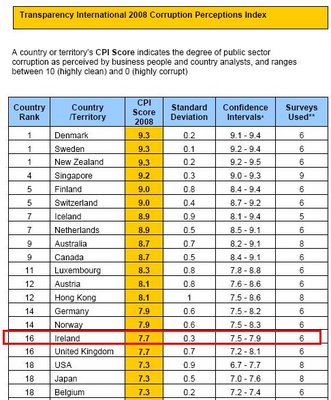
Canadians needs to ask themselves what the top 10 countries on this list have on common, aside from fairly high incomes. (The countries at the wrong end of the list are mostly African). Most of the least-corrupt countries  are Western and, more precisely, Protestant. However, Singapore, a largely Confucian country, is also in the top 10. Switzerland is part Catholic and part Protestant. Some of the countries in the top 10 are ethnically homogeneous, while others are culturally diverse and have large populations of immigrants and their children. Australia, Canada, and Switzerland are among the most diverse large countries in the world.

The United States consistently appears well below Canada in these rankings. I suspect that this have to do with the enormous expenses of running for office in the United States, which leaves politicians feeling indebted to the individuals and firms that finance their campaigns. Perhaps another factor is the absence of a national police force in the United States has sometime to do with this, in part because the British ethos of being a “gentleman” became part of our policing culture.

We need to ask ourselves what makes some countries more corrupt than others before we can even begin to measure, compare, and debate relative levels of corruption within federal nation states.

Sadly, a Canadian magazine desperate to boost circulation and compete with glossy US magazines is not the place for this debate to take place.


My Teaching in the Week Ending 24 Sept 2010

24 09 2010

HIST 1406

I delivered two lectures in the Canadian history survey course. The lecture on Tuesday was about the establishment of New France. In the first lecture, I focused on the life and times of Samuel de Champlain.

Champlain Statue, Astrolabe Theatre, Ottawa

The second lecture was devoted to outlining my expectations for two assignments that will soon be due. I also used this class to stimulate the students’ thinking about these papers. One of these assignments is about the 1749 visit to Montreal of a Finno-Swedish botanist called Pehr Kalm. Kalm’s diary was translated and published in London in the early 1770s. See here. I have asked the students to read the entries that relate to Montreal and then answer a checklist of questions. The assignment is designed to familiarize the students with the use of primary sources.

The other assignment is based on a website called Torture and Truth. It is about a Black slave in Montreal who was executed in 1734 for arson. The students have to read some (translated) primary sources online then come to their own conclusions about her guilt or innocence.  

HIST 3266

I delivered two lectures in my history of the North American West class. The first lecture was on Sacagawea, the Native American woman who accompanied the Lewis and Clark expedition in 1804-6. The second lecture was on the life and times of Sir George Simpson of the Hudson’s Bay Company.

HIST 4135

In this week’s seminar, we discussed the following readings:

J.M.S. Careless, The Union of the Canadas; the Growth of Canadian Institutions, 1841-1857

Ian Ross Robertson, “The 1850s: Maturity and Reform” in The Atlantic Region to Confederation : a History edited by Phillip A. Buckner and John G. Reid (University of Toronto Press, 1995)

J. B. Brebner, “Joseph Howe and the Crimean War enlistment controversy between Great Britain and the United States,” Canadian Historical Review 11 (1930): 300–27.
We also listened to four students give “Life and Times” presentations. These presentations typically last 12-15 minutes and involve a Powerpoint Presentation. This week, we heard about the Life and Times of Robert Baldwin,  Joseph Howe, J.W. Johnston, Sir Louis-Hippolyte Lafontaine.


Richard Sylla on the 1929 Stock Market Crash

24 09 2010

In this YouTube video, NYU business historian Prof. Richard Sylla dispels some myths about the 1929 stock market crash.


Historian Matthew Hayday to Speak About Queen Elizabeth in 3D Documentary

20 09 2010

Historian Matthew Hayday of the University of Guelph will be interviewed tonight for CBC documentary Queen Elizabeth in 3D. This innovative documentary will be shown in 3D: the required glasses are available from all Canada Post outlets.

Professor Hayday will appear on film to provide historical context for the royal tour of 1951 and to explain how Canadians would have reacted to the princess’s visit. At this time, Canada had only recently instituted its own citizenship separate from that of Britain so the royal family was still central to many Canadians conception of their national identity. Hayday’s research is focused on the evolution of Canadian national identity in the period just after the Second World War. He is specifically interested in how a Britain-centred conception of Canadian identity was gradually challenged and to a certain extent replaced by one which incorporated linguistic duality, multiculturalism and diversity, as well as new symbols of nationhood such as a new flag, a new anthem and a national holiday.

Read more here.

QUEEN ELIZABETH IN 3D will air as originally scheduled on CBC Television on Monday, September 20 at 7 p.m. (7:30 p.m. NT) and on CBC News Network on Saturday, Sept. 25 at 10 p.m. ET/PT.

Read more here and here.

It looks interesting, although personally I prefer my 3D movies to be set on the planet Pandora…


Podcasts of Talks at Military History in Canada Conference

19 09 2010

Military History in Canada

This  one day conference was held in collaboration with the Centre for Military and Strategic Studies and the Department of History, University of Calgary and the History of Warfare Research Group, King’s College London.

You listen to the presentations here. No video, just audio, so suitable for driving.


Can the Web Replace Peer Review?

18 09 2010

Some people seem to think that the answer to this question is yes, according to a recent New York Times article. See here.

some humanities scholars have begun to challenge the monopoly that peer review has on admission to career-making journals and, as a consequence, to the charmed circle of tenured academe. They argue that in an era of digital media there is a better way to assess the quality of work. Instead of relying on a few experts selected by leading publications, they advocate using the Internet to expose scholarly thinking to the swift collective judgment of a much broader interested audience.

The Shakespeare Quarterly, which traditionally relied on peer review to maintain quality, is planning to make the next issue of the journal open to comments from anybody. Anyone will be able to log in and comment on the articles in the journal. The identities of the commentators will be open.  See more here.

Replacing double-blind peer review [used by many science journals and the American Historical Review] and single-blind peer review [which is the norm in Canadian history] with web-based feedback from the public is an interesting concept. It is certainly being promoted by some smart people, such as Dan Cohen from the Center for History and New Media and GMU.

However, I’m not certain what to think of the idea of “open review” as the Shakespeare Quarterly has defined it. [There are other definitions of open review].   Allowing consumers of academic knowledge (e.g., history buffs who enjoy reading historical books in their spare time) as well as fellow producers to participate could be very helpful.  I check online reviews of restaurants before I go out to eat– I trust these reviews when I know that a) large numbers of people have reviewed each restaurant and have come to similar conclusions b) the reviews are by customers rather than people in the industry.  When a new restaurant has only one review online, I tend to be a bit skeptical of it– after all, that one could have been written by the mother of the restaurant owner or by one of his commercial rivals. In the former case, it would probably be very positive, in the latter very harsh and negative.

One of the problem with open reviews of academic articles is that an article on a specialized topic might attract only one or two reviewers even months after the article was published. Moreover, these reviewers might be people who are in a conflict of interest situation similar to that of the restaurant owner’s mother.

The unfiltered and semi-anonymous comments sections on websites like Amazon are open to abuse. Consider the case of Orlando Figes, a historian who criticzed other scholars on Amazon using a pseudonym.

Moreover, it takes specialized knowledge to determine whether an article is good or bad. Anyone with a tongue and a keyboard is entitled to judge a restaurant. When it comes to judging the tastiness of restaurant food, no individual’s opinion is more valid than that of anyone else. That’s why we leave the restaurant business largely to market forces. Over time, customers voting with their money will improve the quality of the food.  However, even in the restaurant world we rely on experts and well as public opinion polls to determine what is good– that’s why we send government experts to inspect the kitchens in the back.

Determining the quality of an article on Shakespeare is a bit more complex than finding out whether a burger tastes good. Only a few people know enough about Shakespeare to do it properly.

In 2006, the journal Nature launched an experiment in parallel open peer review — some articles that had been submitted to the regular anonymous peer-review process were put online for open, identified public comment, Amazon Reviews section style.  However, only 5% of authors agreed to participate in this experiment and only half of those articles received comments.  It was like an online review of a restaurant with only one review.  The knowledge that articles were simultaneously being subjected to the traditional peer review process in parallel may also have affected the willingness of scholars to provide feedback.

We sent out a total of 1,369 papers for review during the trial period. The authors of 71 (or 5%) of these agreed to their papers being displayed for open comment. Of the displayed papers, 33 received no comments, while 38 (54%) received a total of 92 technical comments. Of these comments, 49 were to 8 papers. The remaining 30 papers had comments evenly distributed. The most commented-on paper received 10 comments (an evolution paper about post-mating sexual selection). There is no obvious time bias: the papers receiving most comments were evenly spread throughout the trial, and recent papers did not show any waning of interest.

The trial received a healthy volume of online traffic: an average of 5,600 html page views per week and about the same for RSS feeds. However, this reader interest did not convert into significant numbers of comments.

See more here.

I note with interest that the strongest proponents of open reviewing seem to be in humanities rather than physical sciences or medicine. Perhaps this is because the consequences of a bad theory becoming popular in the humanities are less catastrophic than in medicine or engineering.  Humanities research often revolves around issues that are open to subjectivity, where opinions are a matter of taste or ideology, not cold hard facts. I’m not certainly if I would go to a doctor who relied on Wikipedia. We wouldn’t convene a jury of twelve citizens to determine whether a bridge was safe– we would hire a credentialed engineer. Interpreting the plays of Shakespeare seems to be an area in which subjectivity is more acceptable.

I know that the cult of the expert is unfashionable nowadays. It seems to be under assault from the postmodernist left and by people on the right (e.g., Sarah Palin populists). But it seems to be that it is an ideal worth fighting for.


My Teaching This Week

17 09 2010

I am teaching three courses this term. They are HIST 1406: Pre-Confederation Canadian History; HIST 3266: The History of the North American West/Canadian West; HIST 4135: British North America and the Road to Confederation.

Today was our first full week of classes.

HIST 1406: Pre-Confederation Canadian History

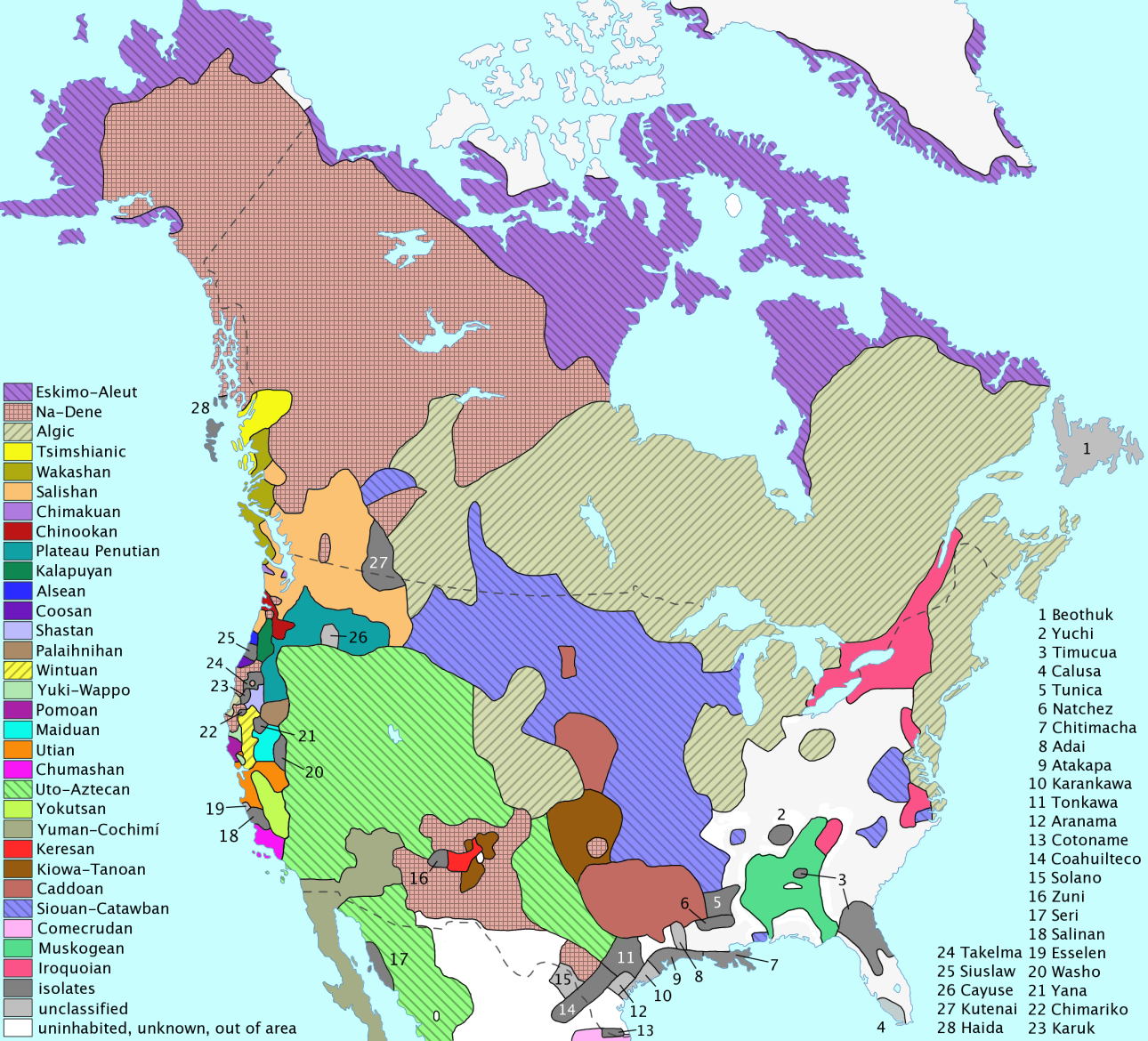
In my lecture on Tuesday, the subject was First Nations history before Contact.

Linguistic Map of North America

In Friday’s lecture, I spoke about the Norse voyages to North America. I used this user-created map on Google Maps to teach about the Norse voyages.

L'Anse Aux Meadows

HIST 3266: The History of the North American West

My lecture on Wednesday was about the life and times of George Vancouver. I used his life story to explore such themes as: the search for an accurate means of determining longitude; the legacy of James Cook;  the sea-otter pelt trade in the Pacific North West; imperial rivalries in on West coast of North America and the competing claims of Russia, Britain, Spain, and the United States; the Nootka Sound Crisis as an episode in Anglo-Spanish diplomacy; the importance of hydrography in the making of the modern world.

George Vancouver

HIST 4135: British North America and the Road to Confederation

Our readings this week were introductory works designed to set the stage for the more specialized sources we will be reading later in the year.  The readings were designed to ensure that all students in the class were familiar with the outlines of the political history of North America in the period from the Compromise of 1850 to the early 1870s.

R. Douglas Francis, Richard Jones, Donald B. Smith, Origins : Canadian History to Confederation, 6th edition, pages 240-378. [ON RESERVE] To learn the basics about Confederation.
W.L. Morton, “British North America and a Continent in Dissolution, 1861-71” History 47 (1962): 139-56. A great tri-national comparative overview of developments in BNA, US, Mexico in the 1860s.

Alan Brinkley, American History : a Survey, 13th edition. Chapter 12 to 15. [ON RESERVE] To learn about the Civil War’s causes, course, and important personalities.

F. M. Carroll, “The Perils of Mid-Nineteenth-Century Anglo- American Relations” International History Review
16(1994): 304-316. A review essay of five works that place the Civil War in an international context. Pretty useful for a class in which we will be thinking about the Civil War’s impact on British North America.


The Political Economy of Arenas

16 09 2010

Andrew Ross, a business historian based at the University of Guelph, has posted some thoughts about the ongoing controversy about the proposals to use federal money to subsidize professional hockey arenas in Quebec. Ross has written an economic history of the NHL, so he can speak with some authority of this subject.

A couple of passages in his blog post caught my eye:

The lack of Canadian support for this aspect of the hockey business seems paradoxical given the general sense that Canadian government is more interventionist than American, and more willing to directly support business. (This is a big generalization, but no time to discuss here.) In sports, this is not the case.

Whenever state funding for arenas comes up, I think of my favourite character from the NHL’s history, Conn Smythe, who was the guiding force behind the Toronto Maple Leafs from 1927 to 1961 and the builder of Canada’s most famous arena, Maple Leaf Gardens. Smythe was a dyed-in-the-wool Conservative (Stephen Harper, take note) who could have been said to have been in favour of “small government” (in our current parlance) and was immensely proud that the Gardens had been built without any kind of state support whatsoever. (However, Smythe’s son and successor, Stafford, and his partner Harold Ballard followed the new American trend and tried to get municipal support for an Arena in Vancouver, but failed.)

Read more here.