Censusgate II, my Reply to Moore, and the Value of a University Education

6 08 2010

I’d like to respond quickly to a couple of things Christopher Moore has said  in response to my blog post on the Canadian census controversy. In my blog post, I had quoted some  histrionic statements about the census  by Stockwell Day, the Canadian government minister had earlier insinuated that Canadian census had “chilling” or Gestapo-like features. I had pointed out that Day, unlike most other politicians in national legislatures, did not attend a university.

I had then said: “one of the things the politicians who are hysterically opposed to the mandatory census have in common is that they did not attend or complete university.”

To this, Christopher responded:

Well…. I agree with him about the foolishness of this decision — and I love his Lincoln’s census entry illustration. But Andrew should maybe apply some of the empirical testing he advocates. Stephen Harper, who pushed for the decision, has a graduate degree in the social sciences (as Andrew indeed notes). Tony Clement, who implemented it, has degrees in political science and law. Maxime Bernier, its early advocate, has degrees in commerce and law. And so on.

I never said that the politicians named by Moore opposed the long-form census for irrational reasons. Moreover, the Prime Minister has yet to take a stand on the census policy of his subordinate ministers, for mysterious reasons which may become clear to future historians.  My post was about Day’s specific reasons for hating the long-form census. There are reasonable arguments to be made in favour of abolishing the long-form census or indeed the census in its entirety. Some of these reasons relate to technological obsolescence. However, suggesting that having a mandatory census has put Canada on a slippery slope to tyranny is outlandish. Comparing your opponents to Hitler or even hinting that they have evil, quasi-Hitlerian designs on the country’s Jewish population does nothing to increase one’s credibility.  It suggests paranoia and historical ignorance, since the Canadian federal government has been running the census since 1871 without the country sliding into dictatorship. Day’s comments are unpatriotic and an unjustified slander of several generations of Canadian legislators. More importantly, they are historically inaccurate.

There are plausible arguments to be made in favour of scrapping the census and there are absurd ones.  I would suggest that a university education would have helped Mr Day to tell the difference. This is why increasing the proportion of people who go to university would produce social benefits.

Christopher Moore wrote:
The argument that the only information society really needs is that provided by markets and prices is one that has thrived in universities. They don’t call it the Chicago School of economics because of deep-dish pizza and electric blues. It’s from the Economic Department of the University of Chicago. The policy engine of the Harper government comes from the Political Science department of the University of Calgary. The London School of Economics includes many acolytes of Friedrich Hayek. Unwise as it is, the Harper government’s hostility to governmental information gathering is something its leaders largely imbibed in university, not despite university.

It is true that members of the Austrian school of economics are skeptical of macro-economics and counting things more generally. However, the Austrian school is a fairly marginal movement in economics. This isn’t to say that they are necessarily wrong, just that they are unpopular. There are few if any Hayek acolytes at LSE nowadays, except insofar that some of Hayek’s ideas have become part of the social consensus. I know for a fact that LSE uses a textbook written by Paul Krugman, a left-of-centre New York Times contributing economist. LSE is not Hayek U. There are, however, social scientists at LSE who use census data or who help out with the IPCC. Consider the environmental economist Nicholas Stern. Moreover, I would imagine that even Hayek would have been in favour of the census, since he also supported socialized medicine and a limited amount of social housing.  Hayek is often misunderstood individual who was not nearly as right-wing as some people would make out. In any event,  as someone who left Austria in the 1930s for the country that invented the modern census, he probably understood the difference between tyranny and the normal activity of democratic government.

Christopher Moore wrote:

The idea that governments do not need to gather comprehensive statistical data is a bad one, but it’s not one that universities inoculate against. And of course universities shouldn’t inoculate against ideas, even unfashionable ones. When Andrew says, I believe that attacking statistical illiteracy through education will improve society in the long run, since it will encourage people to think more rationally. “rationally” seems to mean “as we do,” and that sounds disturbingly close to a faith that universities will make students will think like their professors and that all professors think alike. Fortunately universities are not unsuccessful at the first proposition and not very successful at the second.

Nobody would suggest that a professor ought to force his or her views or underlying values on students. That being said, universities and individual departments do tend to teach students to think alike, or rather to adopt common modes of reasoning and speaking. Each academic discipline has its own habits of thought. An older man who works in business once told me that a person’s undergraduate major influences their approach to management issues. He said that in board meetings he can spot the people who have degrees in history a mile away because they always ask so many damn questions about precedent. A typical comment from a former history major goes like this: “Why was this regional sales office established in the first place? Has anyone proposed closing it before? Let’s talk to the pension department to see if the executive who set up this regional office is still alive and available for consultation.”  Each of the other liberal arts disciplines has their own peculiar habits of thought that graduates bring into the workforce.

There are also certain habits of thought common to all disciplines taught at university. I would like to focus on those habits.

Whether a student is left-wing or right-wing is none of my business.  At secular universities, the religious views of the students are also irrelevant. The job of the university is to teach students to reason and to express their own values more effectively– to take inarticulate young conservatives, inarticulate young socialists, young Muslims, young atheists, etc.,  and to turn them into more eloquent spokesmen for their respective positions, whatever they may be.  I suppose that this involves teaching people to see which arguments in favour of a given position sound reasonable and which ones are outlandish or paranoid.

It is not the job of the university to teach a particular ideology, let alone loyalty to a particular political party. Inculcating certain habits of thought is a legitimate function of a university. One of these habits of thought, which has long been central to Canadian politics, is a commitment to moderation in politics and in political speech. I would say that set of attitudes, which are illustrated so brilliant by Mackenzie King’s 1942 plebiscite on conscription, played a crucial role in the success of Canada as a nation. My own pet theory/hunch is that this moderatist approach to politics stems ultimately from the influence of the Anglican Church and the Anglican version of the Reformation.

A few years ago, I overheard an undergraduate here say “I’m not going to vote for the Liberals, because their leader is a skinny environmentalist faggot.” Exact words. I didn’t say anything because I shouldn’t have been eavesdropping on their private conversation and was busy ordering my own coffee, but I wanted to intervene and say to this girl: “Listen, there are many reasons not to vote for the Liberals, but ones you have just given are absurd.”

I would like to think that the student on that occasion was in her first year. Contrary to what Moore says, universities do indeed change the way people think, which is why university graduates tend to think alike on many issues, even if they do not vote for the same political party.  Attending university changes a person’s vocabulary in a major way. It also alters their way of reasoning.  University graduates are more likely to use sentences that contain the word “however” or qualifying phrases such as “on balance” or “in general”.  Universities teach that “data” is not the plural of the word “anecdote”. So universities do cause people to think alike, at least in some ways. I would say that this is a good thing in a democracy.

University graduates are also more likely to vote and be involved in politics. There is hard data from a variety of countries to prove this point. University graduates are far less xenophobic than other people living in the same country– this is true in at least 40 countries, even when you factor income out of the equation. They are less likely to support people at the extremes of the political spectrum. University graduates have a wide variety of opinions on issues such as the  wisdom of invading Iraq or how to fight climate change, but as a group they are unlikely to think that 9-11 was an “inside job” or that the US government is hiding the Roswell flying saucer or that Obama is a Mulism terrorist sleeper. Based on my own experience, I would suspect that university graduates are also less likely than the average person to compare democratic politicians or minor authority figures, such as census takers, yellow school bus drivers, or store managers, to Adolf Hitler, the last three being Hitler comparisons I have heard over the years.

It seems to me that we should work for a society where the average person is a university graduate, rather than making a fetish of having a parliament that is representative of the general population is terms of socio-economic characteristics, a form of affirmative action that was once promoted by the Reform Party and which has resulted in a non-graduate, Mr Day, rising to high office.





Afghanistan: The Graveyard of Empires?

6 08 2010

“If you want to figure out a way forward for Afghanistan, fake history is not the place to start.”

Have a look at this article on Foreign Policy. It is applied history at its finest, drawing on academic work on the political and cultural history of Afghanistan. The author’s point isn’t that Afghanistan can or will be won by the Western powers. Rather, it is to show that many of historical arguments that have been made to show that the war is unwinnable are rather shoddy.

Ok, now it’s back to work.


Academic Rip Van Winkle

5 08 2010

You should check out a piece that appeared in the Chronicle of Higher Education a few days ago. It certainly got me thinking about higher education.

In An Academic Rip Van Winkle, David Hiscoe discusses his experiences returning to academe after two decades in the private sector. Hiscoe was a contract English literature professor in the early 1980s and then left for the marketing business due to vastly better pay and working conditions. Following the recent collapse of his last private-sector employer, an IT company, he decided to go back to university teaching. He is now director of communications for a large land-grant university.

Hiscoe argues that American universities are being run into the ground by short-sighted cost-cutting managers who bear an uncanny resemblance to the managers who, in his account, recently destroyed so many companies.  I don’t necessarily agree with everything he says, but his piece is a very good one that deals with many important issues in higher education: access, the social function of the university, and the importance of passionate teachers. He also speaks about the ways in which IT changed higher education during his two decades away from university.

I really liked this paragraph of his piece:

“A big part of my day is spent in the university library. Coming in one morning recently, I paused to watch a young man walk up and join three students who had pulled chairs together around a table. As the new arrival settled in, he let out the archetypal “That’s awesome!” cry, loud enough so that I leaned in to see what he was admiring. He was looking at what appeared to be an animated differential equation making itself visual in stages embedded in a PowerPoint chart. As I walked by, he was practically chewing his lower lip off in his enthusiasm and was asking the laptop driver, “How did you do that?””

Hiscoe’s essay generated many comments (31 and counting at present). I was very interested in the observations made by a reader who did his or her first degree in Ireland, a country that famously abolished all university tuition fees in 1996. Many people credit the abolition of tuition fees with helping to increase the percentage of young people going to university. Some even argue that free university contributed to the tremendous economic growth that Ireland experienced in recent decades.

Anyway, here are the Irish reader’s comments in the feedback section at the foot of Hiscoe’s article:

Consider the following comparison, my Alma Mater in Ireland employed seven full-time groundskeepers for a 45-acre campus when I graduated. The first American university I attended had 83 people full-time workers for a similar acreage. The overseas study office I worked at in Ireland as a student, employed three people, one of whom still kept his teaching duties. The American one I also worked at employed roughly 20 people. The Irish Dental School and Teaching Hospital on campus, which served the entire Eastern part of the country, had one joint administrator (a very, very gifted manager); the American university employed three people to do the same job for a much smaller patient population (I know this because the Irish administrator had visited the American school and was mesmerized by what he perceived as its inefficiency). The American dental school eventually closed for lack of funds. Perhaps Academia in America – which has either soaked the state or the customer (and especially its graduate student customers) to pay for its relentless expansion – has lost sight of its mission?

The Irish reader’s comments are consistent with what I know about the abolition of tuition fees in Ireland and how it was paid for. The Irish government paid for this reform mainly by forcing universities to become more efficient rather than simply giving more money to the universities. Through some miracle, the Irish universities cut costs in ways that undermined neither the quality of the education nor the research. Academic salaries were kept at internationally competitive levels (not that different from a UK university or US state college) and class sizes remained at a reasonable size, although I’m told that some small-group seminars were replaced with lecture courses, which meant that each student got less 1-on-1 time with professors.

Abolishing tuition fees while keeping government per-student grants to universities constant is one way of way of reducing higher education’s share of a country’s GDP. In the US, universities account for 3.9% of GDP, which is higher than in Canada or Ireland. There are both advantages and drawbacks to the Irish approach. The US university system, which consumes a relatively high proportion of GDP, is probably riddled with waste and useless expenditure. A few months ago I was a big US university and I noticed just how well-manicured the lawns were. The faculty offices I saw were sumptuous and I bet the senior administrative offices are even nicer.  The stadium was huge and had box seats too.

I was impressed until I realized that all of this luxury and hideous waste was paid for by a combination of students, most of whom have to go deeply into debt to pay their fees, and the state government, which should probably be using the money to cover the vast number of state residents who lack health insurance. I also noticed that the highways between the university and the airport were is a disgraceful condition. So on one level, the current American approach to higher education, Cadillac funding, is a bit immoral.

On the other hand, all of this lavish funding generates a lot of spin off benefits for society, such as the Silicon Valley firms that grew out of Stanford University, a deep-pocketed university that had plenty of cash for professorial research into electronics and the like. Stanford probably could have cut tuition fees back in 1950 but slashing the budget for lab space and by forcing profs to teach more courses per semester, but that would have had a big impact on the future economic health of California.  Cadillac funding for its university sector allows a country to nurture researchers and poach Nobel Laureates.

For some interesting OECD-based data from 2005 and earlier, see here.

Ireland’s “Chevrolet” approach may drive the best researchers out, resulting in a teaching-centric university system.  This may or may not be a bad.  There is one school of thought that says the best strategy for a country is to let other countries do the research and invention and then borrow their ideas. Ireland, which is home to the manufacturing facilities of many US high-tech companies illustrates this approach– the R&D gets done in California and then Ireland’s plentiful supply of computer science graduates do the making.

In addition to the issue of how large a proportion of GDP we should devote to higher education, there is the secondary question of how we go about cutting costs if we decide to squeeze down the universities’ share of the national economic pies. It appears that the Irish and the American models of cutting costs in higher education are radically different.

It is common knowledge that US universities have, since the 1970s, cut costs by reducing the proportion of faculty who are tenure-track, which effectively cuts the hourly wages they have to pay to get a unit of teaching done.

The  US universities have been trying to slash labour costs in order to cope with reduced support from state governments and the need to find money for luxuries such as expensive stadiums.  Many undergraduates in the United States are now taught by people earning little more than minimum wage and who don’t do research. In fact, many so called professors in the US are really PhD students, which means that a person can graduate without having had a class with an academic who has a PhD, let alone someone who is research active.  I think we would agree that it is better to be taught by a professor who is distinguished in his field and who has the leisure to write good lecture notes rather than PhD student who is teaching nine courses just to survive.  Under the US model of cost-cutting, the quality of education suffers, since the students are no longer exposed to research-led teaching, even though “research-led teaching” is a slogan popular with admin people.

It appears that the Irish have cut costs in a different way–students are still being taught by proper, well-paid, research lectures,  skimping on frills such as landscaping and replacing computers less frequently.

Speaking personally, I would be willing to accept a modest cut in pay, benefits, and working environment if that was part of a package of reforms to make all universities in Canada tuition free.  A slightly smaller salary and a few more weeds on campus would be worth it since it would make for a better society in the long run. Needless to say, I would only take such a pay cut if every other professor was also making a similar sacrifices. If everyone else is getting a free computer each year, then I want my free computer too.

At some point, a comparative historian of education will write a book explaining why American and Irish universities  had such different approaches to cost cutting.  Ireland is probably the most American country in Europe, with low tax rates and a very free-enterprise minded type of government.  Yet the education policy is totally different.

I suspect that inter-university spectator sports, which consume so much time, attention, and money at American universities are part of the problem.   It takes a bold university administrator in the tradition of Robert Maynard Hutchins to abolish sports programs. Hutchins was the President of the University of Chicago who shut down its football team in the 1930s and put the money into academic departments, a decision which helped Chicago to become a first-class university.


Red Coats and Wild Birds

5 08 2010

The blog of the Canadian Network in History and the Environment today carries a profile of a PhD student at Queen’s named Kristen Greer. Her PhD thesis “Red coats and wild birds: military culture and ornithology across the nineteenth-century British Empire,” interrogates the intersections between British military culture and the practices and ideas of ornithology, with a particular focus on the Mediterranean region.

Greer’s thesis is interesting because it combines, military, imperial, and environmental history. At conferences, one hears economic, political, and other historians saying “we are all environmental historians now.” This is also true for imperial historians as well.


Franklin Expedition

4 08 2010

In 1845 the Franklin Expedition left in search of the Northwest Passage, but instead of finding a short cut to Asia, the voyage turned into a total balls-up disaster. Franklin and his men were lost and there were several follow-up/rescue expeditions that went in search of Franklin.

I usually devote about 25 mins of my Canadian history survey course to the Franklin Expedition. It’s an important but understudied bit of Canadian history and a damn good story to tell as well. The students seem interested in this type of story.

When I heard that Parks Canada would be searching for the remains of HMS Erebus and HMS Terror I was happy because I reasoned that even the search crews don’t find anything, their search will probably generated video material I can show in lecture.

Last week, the Canadian history blog ActiveHistory.ca had an interesting post by Teresa Iacobelli  about the 2010 Franklin search. See here. The BBC also did a very thorough story on the 2010 Parks Canada search that totally puts CBC to shame. At that time this blog post was written, it was not known whether this summer’s search would produce any positive results.

The Honourable Jim Prentice, the Minister of the Environment, has taken a strong interest in the search. In late July, he flew to the region to inspect the work of the archaelogists  in person. See image below and statement on Parks Canada website.

Recent Photo of Jim Prentice

Today’s Globe and Mail reports that Parks Canada archeologists  found the remains of HMS Investigator on July 25 in Mercy Bay’s Aulavik National Park. Parks Canada has released an image of the wreck.

HMS Investigator, which was one of the ships that was sent out by the Admiralty to find Franklin, was destroyed by ice near Baffin Island. See image below. Most of the crew survived, however, and Captain Robert McClure was able to publish an account of his voyage, which you can download in PDF and other formats here.

HMS Investigator “investigates” several metres of solid ice

Robert McClure, Captain of HMS Investigator. Nice mittens.

I’m an historian, not an archeologist, so I am speaking outside of my area of expertise here. However, it seems to me that finding Investigator would be relatively easy to do, since its captain survived and published a detailed description of its sinking. Finding HMS Erebus will be much harder. It remains to be seen whether Parks Canada will discover anything else before the summer exploration season closes in a few weeks.

Archeological expeditions are very expensive, especially in the Far North. Archival research is relatively cheap. From a value-for-taxpayer standpoint, it seems to me that giving research contracts to historians, archivists, and librarians might be a more cost-effective way of adding to our stock of knowledge about Franklin and 19th century arctic exploration more generally.


Business History Review: A Special Issue on the Oil Industry

1 08 2010

The TOC of the more recent issue of the Business History Review looks very interesting.

Business History Review, volume 84, number 2, A Special Issue on the Oil Industry

Introduction by Diana Davids Hinton

ARTICLES

Keetie Sluyterman, “Royal Dutch Shell: Company Strategies for Dealing with Environmental Issues”

Nathan J. Citino, “Internationalist Oilmen, the Middle East, and the Remaking of American Liberalism, 1945-1953”

Daniele Pozzi, “Entrepreneurship and Capabilities in a ‘Beginner’ Oil Multinational: The Case of ENI”

Lisa Bud-Frierman, Andrew Godley, and Judith Wale, “Weetman Pearson in Mexico and the Emergence of a British Oil Major, 1901-1919”

Michael R. Adamson, “The Role of the Independent: Ralph B. Lloyd and the Development of California’s Coastal Oil Region, 1900-1940”

LITERATURE REVIEW

Marcelo Bucheli, “Oil, Politics, Society, and Multinational Corporations in Latin America: Major Achievements in the
Historiography, 1990-2010”


Korean Taco

29 07 2010

“The meat makes it Korean,” said Mr. Ban, who marinates chuck roll in a soy and garlic sauce that is traditionally used with Korean barbecue dishes. “The tortilla and the toppings are a way to tell our customers that this food is O.K., that this food is American.”

That is from a recent New York Times item about this hybrid dish. I found it amusing that in Los Angeles tortillas are now considered quintessentially American. I wonder what the Tea Party people who fulminate against illegal immigration, Spanish signs in airports, etc., think about that!

Although this story is from the food section of the NYT, which is normally apolitical, I sense a bit of a political subtext here– the journalist is probably trying to tolerance towards immigrants.


Sun Life History

28 07 2010

Sun Life has produced a fun little video about the history of the corporation. See here.

Laurence Mussio of McMaster University has written a 680-page history of the company. It is due to be published in 2011, according the MQUP website. I`m looking forward to getting my hands on that book.  Sun Life has a fascinating history– it expanded overseas quite early in its history and was well established in the West Indies, China, and India in the early 20th century.

Sun Life set up its first office in Bombay in 1892. In 1908, the office moved to an elaborate Italianate building designed by Bombay-based architectural firm of Messrs Gostling & Morris. The building features stained-glass windows and bas-relief statuary of a charging chariot.

I found this picture of the building on the website virtualtourist.com

The building is located here: View Larger Map


The Census Flap illustrates that history professors are useful to society

28 07 2010

John Ibbitson has a good article in the Globe about the Canadian census controversy. The dispute over whether participation in the 2011 Canadian census should be mandatory or voluntary has got me thinking about the place of social science in Canada and about the curriculum of university history departments.

Let me state that the Conservatives’ complaint that the current census questionnaire is morally illegitimate is especially curious, given the Conservative governments were in charge when the censuses of 1991 and 2006 were taken! If the mandatory long-form census is so terrible, why didn’t they make it voluntary in 2006? Why is the Tory 2008 party platform silent on the issue of the census?

Ibbitson calls the showdown over the census a “manufactured crisis” and suggests that it had been cooked up by brilliant political strategists. I believe in Occam’s Razor, so I would tend to regard the crisis as something caused by simple lack of education. I find that ignorance of how things like statistics and the census work is common among people who lack much in the way of formal education.

I once had a summer job cleaning and driving automobiles. One of my colleagues was a nice guy who had left school at 16. I recall a conversation in which he insisted that the ninth digit of the alphanumeric serial number on Ontario driver’s licences denoted the driver’s sexual orientation. Apparently, an even number indicates heterosexuality. I tried to remonstrate and explain that this was all nonsense, but to no avail.

Now one of the things the politicians who are hysterically opposed to the mandatory census have in common is that they did not attend or complete university. They just don’t know anything about economics, stats, data systems, management, or history or the other boring things the professors drone on about.

Consider Stockwell Day. I have no doubt that Stockwell Day is a decent person. I am told that he has great people skills and is a kind employer to his secretaries and other immediate subordinates. He is a nice guy when you meet him in the flesh. The problem is that Day is now called upon to pronounce on a complex system he doesn’t appear to understand. Some of his comments about the census are ridiculous.

Mr Day recently had this to say about the current legislation, which gives Statistics Canada a highly theoretical right to fine or imprison people who do not complete the census: “Do you think it is right that you can threaten your neighbour with jail time if she doesn’t tell you if she has mental issues or not?” he wrote. “Or who does what chores in the house? Or whether she is a Jew or not? Don’t you find that one even a little bit chilling?”

Mr Day is here alluding to the fact that the Canadian census asks people to declare their religion. Questions about religion are nothing new– they were asked when the census was taken in 1851, 1861, 1871. This question is largely a relic of the days of when we were a more religious society and when sectarianism really mattered. Today fewer people attend church, so the importance of the Catholic-Protestant split had faded. But given that some religious groups still have special privileges under the Canadian constitution, it is useful for the government, municipal planners, etc, to know how many people of each religion there are in Canada. Census data about the proportion of Catholics in the population is, in fact, used to plan school capacity in the fast growing suburbs of Toronto.  How much land should we set aside for the Catholic high school in this new subdivision?

The fact that a minister of the Crown would suggest that previous Canadian governments have collected the census for nefarious or “chilling” purposes is outrageous not only because it destroys faith in the Canadian government but because it so factually inaccurate.  There is nothing chilling about, say, the 1981 Canadian census. Its creators were not trying to turn Canada into a Benthamite panopticon or lay the groundwork for a dictatorship of either the extreme right or the extreme left. They just wanted to know what percentage of the population had a fridge.

Day`s insinuation that census data about religion and ethnicity is collected for  sinister purposes is the type of claim I would expect from perhaps one of the more radical Marxist sociologists, not a mainstream politician. Day appears to be hinting that a future dictator might use census data to persecute minorities and that we are living in some sort of Weimar Republic. This is sheer alarmism that will feed the paranoia of every nut out there. Day`s comment is about as credible as the leftwing grad student I once heard comparing the Beavers, the most junior branch of Scouting, to the Hitler Youth. Are not Beavers sometimes transported on highways that are very similar to the Autobahn of the Weimar Republic?

Of course, university-educated people who were born in Canada and who read newspapers will likely recognize Day`s absurd statement for what it is. They know that the Canadian government, which includes a vigorous privacy commissioner, is one of the most data-trustworthy governments in the world.

The danger is that people who are on the margins of our society culturally and economically, such as semi-literate native-born Canadians or refugees from dictatorships, might very well buy into Day`s alarmism and refuse to complete the 2011 census. Friends who have worked as census takers tell me that immigrants from repressive regimes are very reluctant to provide data.  In many parts of the world, the conspiracy theories about the government are sometimes true. As a minister of the Crown, Mr Day has an obligation to put their fears to rest, not to stoke them. Mr Day’s comments are extremely destructive of the levels of social trust that have hitherto characterized Canadian society. He is essentially inviting new Canadians and members of the non-voting classes in society to distrust the State and to fear their neighbour. That will have big implications for future police officers, game officers, teachers, etc., not just for the census officials who go door to door with clipboards. Day`s comments remind me of the Tea Party people in the US who are trying to delegitimize their own government in the eyes of their fellow taxpayers, which is a surefire recipe for increased tax evasion.

It should be stressed that the Canadian government uses the census to produce aggregate data about communities. I know that the word aggregate is a long one with many syllables,  I`m sorry about that, but the concept is an important one. As far as I know, it has never used the census database to identify specific individuals for the purposes of law enforcement, taxation, or military conscription. [If I am wrong about this, please correct me]. Conscription in the First World War was based on a questionnaire that was mailed to all adult males in late 1917. Many of these forms were not returned on time.  When immigrants from Eastern Europe began settling in Canada in the early 20th century, many of them were reluctant to complete the census. Unlike earlier waves of immigrants from Britain and the United States, the Tsar’s former subjects were understandably distrustful of the State. In the lead up to the censuses of 1901 and 1911, Laurier tried to defuse their concerns by explaining what the census is actually used for in a democratic country. We want to find out how much wheat the average farmer produces. We don’t want to steal your men folk. That was his message.

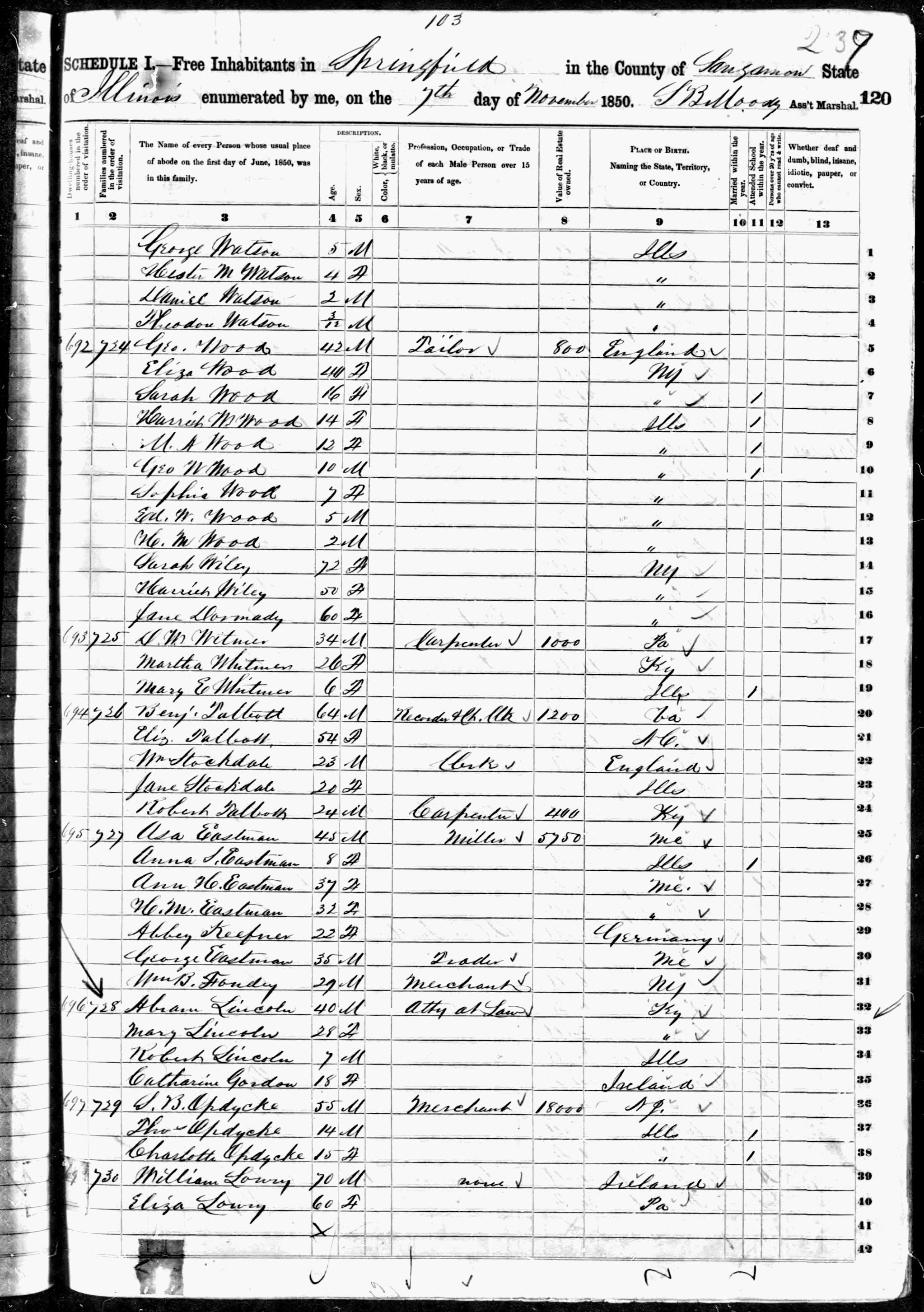
Another thing that needs to be explained is that individual data only becomes available to the public decades later, long after you are dead. You are allowed to look at individual data from the 1850 census for Springfield, Illinois.(see below for the entry for Abraham Lincoln`s household. The data from the 1950 census is still protected.

If you look at the data that has been published over the years by the Dominion Bureau of Statistics/Statistics Canada, you will see the numbers of members of very small ethnic and religious minorities are always rounded up to the nearest ten so that specific individuals cannot be identified. This means that if one person in Iqaluit told the census taker they are Jewish, the Community Profile will say that there are precisely 10 Jews in that census district. This suspiciously round number is designed to protect the privacy of individuals. Rounding up from 1 to 10 in each community probably results in a slight over-estimate of the number of members of very small minorities in the national population.

Even in the bad old days when Canada had explicitly racist laws such as the Chinese Head Tax on the books, the Canadian government has never used census data to track down specific individuals. To have done so would have been to destroy trust in the confidentiality of next census. The government did not use the results of the 1941 census to identify the addresses of Japanese Canadians. It used other records to round them up.

I don’t like to attack specific individuals on my blog, but it should be pointed out that Mr Day lacks a university degree. See here. When I was an undergraduate, I did coursework that involved census data. I also studied quantitative approaches to social research, how to run SPSS on a computer, the use and abuse of numbers in history, etc. Most readers of this blog probably had similar training in numbers, even if they have now half forgotten everything they learned about dependent variables and sample sizes.  I suspect that Day would have benefitted from that sort of training.  Had he had similar opportunities, he likely would have had a better understanding of the census.

Sometime professors in the social sciences and the humanities wonder whether the teaching components of their jobs are worthwhile. Some academics are plagued by self-doubt as to whether their teaching work actually benefits society in any way. After all, we aren`t teaching people how to treat cancer or to inspect aircraft engines for dangerous faults.  Stockwell Day’s absurd comments show why social science teaching is valuable to society. If all social scientists stopped teaching university students, Stockwell Day level ignorance and alarmism would be far more common in our society.

This is one of the reasons I am passionate in my belief that history and other disciplines needs to become more quantitative, not less so. I believe that attacking statistical illiteracy through education will improve society in the long run, since it will encourage people to think more rationally. Of course, narrative political history will probably always be the heart of historical studies, but we do need to also teach students more about ways of studying masses of people. Implementing solutions to environmental and other social problems requires an electorate that can understand numbers and abstract concepts, who can connect the grams of CO2 they produce each time they drive to the store with the megatonnes of CO2 our society emits each year.

Unfortunately, the quality of training in quantitative methods that liberal-arts students receive varies considerably from university to university. The census controversy has got me thinking about how I can do a better way of teaching undergraduates about quantitative as well as qualitative methods to historical research.

I am thinking of teaching a class on quantitative methods for historians. The textbook would be History By Numbers, which was written by Pat Hudson, a social historian who just retired from Cardiff University. The students would also read George Emery`s book The Facts of Life. Emery was the chair of grad studies in the history department at Western when I was working on my PhD. Students would work with census, OECD, Angus Madisson`s stuff, and other data. They would learn different ways of converting historic monetary values into present-day values. The students would also be exposed to the literature on the limitations of census data, such the great article by Bruce Curtis on the totally botched census of 1861, which produced crap data– among other problems, census day in 1861 was in the middle of the winter, which meant the ink of many census officials was frozen. The course would also talk about the social construction of quantitative data and the political history (e.g., the 1860s campaign for Rep by Pop in Upper Canada, which was informed by data from the garbage 1861 census). Students would also learn about the history of statistics methods with a focus on the Scottish Enlightenment.

Let me say that as social scientist (i.e., as someone who elected to do a PhD in a history department located in a faculty of social science rather than a history department in a faculty of humanities), I can only say that I am appalled by the sheer incompetence and stupidity that some members of the Harper cabinet have displayed on this issue. Mr Harper has an undergraduate degree in economics and then did an MA thesis in political science (see here), so one might have thought that members of his cabinet would understand the importance of gathering relatively hard quantitative data. When Harper became Prime Minister, I hope that a new era of evidence-based public policy grounded in hard social science might be upon us.  One might have thought that university graduates would understand why a mandatory census would produce better data than a purely voluntary one. The Tory proposal to make participation in the census voluntary will skew the results of the census, since the self-selected civic minded folk who actually complete the forms are unlikely to be representative of the general population. Their profile is more likely to be like that of the average voter—older and wealthier than the average adult.

Don`t get me wrong. The Canadian census in its current form may or may not be the best way of gathering data. If Stockwell Day were proposing to scrap the data on cost grounds, I would listen to him respectfully.  The United Kingdom is planning to abolish its census on the grounds that this form of data collection is obsolete in the internet age. That is an argument that Canadians ought to consider carefully.  A style of data collection that emerged out of the Scottish Enlightenment may no longer be “fit for purpose” to use a management term.

It would be reasonable for Canada`s Conservatives to attack the current census as technologically obsolete waste of money. It is, however, unreasonable for Stockwell Day to suggest that all previous Canadian governments that have engaged in a form of tyranny by making the census mandatory, especially since his government was in office at the time of the sinister 2006 census!!!

My own view is that it would be better to have no census at all in 2011 than a voluntary participation census. A voluntary census would produce unreliable data and would be expensive to run.

The Pew Center in the US has published a piece on the ongoing census debates in Canada and the UK.


Mary MacKinnon

27 07 2010

“EH.NEWS POSTING —————–
“We announce with great sadness that Mary MacKinnon died on Sunday  July 25 at Royal Victoria Hospital in Montreal.  Mary was diagnosed with leiomyosarcoma, a particularly aggressive cancer, in January of
2010. She had since been undergoing chemotherapy and radiation treatment. Throughout her illness she maintained her characteristic humor, warmth, and concern for others. Mary was only hospitalized a few days before her death, and her family and friends were with her when she died.Mary did her undergraduate work at Queen’s University, Ontario, and received her PhD from Nuffield College, Oxford University. She returned to Queen’s as an assistant professor, and then moved to McGill University in 1989.”

Professor MacKinnon was a great scholar of Canadian economic history, so her death is a loss for the academic world as a whole. I cited a few of her publications and read many more.  She published articles that ought to be read by all historians, political as well as economic. I am thinking in particular of her  co-authored pieces “Dominion or Republic? Migrants to North America from the United Kingdom, 1870-1910,” Economic History Review, 55 (2002), pp. 666-696.  and  “Conspicuous by their Absence: French Canadians and the Settlement of the Canadian West”, Journal of Economic History, 65 (2005), pp. 822-849. In fact, I think that all undergrads should have to read the article on French Canadians in the west, since it deals with a truly fundamental issue in Canadian history– had French Canadians dispersed all over the country instead of remaining concentrated in one province, Canadian history would have been very, very different. The article attempts to explain why so few French-speakers moved into Western Canada, which became a basically English-speaking region of the country.

I only knew her from her publications, but she was a good scholar working in an important but neglected field.