Canadian Confederation Theme Park Proposed by Preston Manning

26 07 2010

Preston Manning, the founder of the now-defunct Reform Party, has proposed the establishment of a theme park in Ottawa to teach visitors to the nation`s capital about Confederation. See here. Manning argues that foreign visitors to Ottawa currently get a distorted view of what Canada is like, since Ottawa is very different from the big, multicultural urban centres in which most Canadians live.

As someone who knows a bit about Confederation, I`m intrigued by this idea. In fact, I hope that my book on Confederation goes on sale in the gift shop of the Confederation theme park, should it ever be constructed.  However, I have a counter-proposal. Let`s establish something called a _museum_.  A museum with professional curators would be a far better way of teaching people about history. I admit that the dividing line between museums and theme parks has become a bit blurry over the years as museum have tried to attract more visitors by becoming more entertaining. Outdoor museums, such as the famous reconstruction of Colonial Williamsburg, have a certain theme park feel.  Nevertheless, there is a fundamental distinction between an outdoor museum and a theme park. A theme park is a commercial entity. A museum is a non-profit entity staffed by people with academic training.

There is nothing wrong with a museum trying to get more visitors in by making history more exciting any more than there is something wrong with my using videos to jazz up my lectures to undergraduates. Inevitably, museums` attempts to popularize history will involve a certain degree of simplification for a mass audience. There is a problem, however, when museum curators begin to sacrifice accuracy in the interests of pleasing visitors or presenting the past in a light designed to serve some political agenda. I`m afraid that if we use the term _theme park_ to describe what Preston Manning is proposing, it help to legitimize the triumph of heritage over history.  What you will end up with be closer to Disneyworld than Colonial Williamsburg.

Manning`s complaint that the foreign visitor to Canada would gain an inaccurate view of Canadian life is a reasonable one. Ottawa currently has museums devoted to the following themes: nature; anthropology (the Canadian Museum of Civilization); war; aviation. Foreign visitors to the capital  take home a particular image of what Canada is like: Canada is place will lots of nature, dinosaur skeletons, First Nations crafts, soldiers, and aircraft. If they visit the federal government`s experimental farm, which is located with Ottawa`s city limits, they will also get the impression that Canada has many farmers. All of this is a somewhat distorted view of Canada. After all, Canada is one of the most urbanized countries in the world, with about 1% of the population engaged in agriculture, far less than France or the USA. Canada is a net exporter of automobiles, but you won`t see this mentioned in Ottawa, but you will see many canoes in the nation`s capital. And even though the military has played a less important role in Canada`s history than in the recent history of any other G20 country with the possible exception of Australia, there is a big military history museum in the middle of the capital. The incongruous of the last bit will doubtless amuse visitors from countries such as Brazil and India, where the military has played perhaps too important a role in recent history. After all, one of the reasons so many people move to Canada is to get away from militarism and conflict.

In the early 2000s, there was a proposal to establish a museum of political history in Ottawa. The idea was that visitors would walk through galleries devoted to each post-Confederation Prime Minister. The panels would be written by a strictly non-partisan team of academic historians. The old train station, which was the location of the 1981 constitutional conferences, was mooted as a possible site for this museum. This proposal was killed off when Paul Martin toppled Jean Chretien and became PM in late 2003.

I have mixed feelings about the possibility of the federal government setting up a political history museum. It seems to be that present-day politics would inevitably influence the content of the exhibits, no matter how many safeguards we put in place.  I would bet that any museum on Confederation would have a pro-Confederation bias and would tell visitors that Joseph Howe and the other opponents of Confederation were mistaken. Any discussion of the more recent periods of Canadian history would be even more contentious.

If the Confederation theme park-outdoor museum is ever set up, I suggest that the designers of the public house attached to the gift shop consult Professor Ged Martin`s ^`John A. Macdonald and the Bottle` Journal of Canadian Studies – Volume 40, Number 3, 2006, pp. 162-185


New Article by Historian Andrew Dilley

26 07 2010

I would like to draw your attention to a new article in the Journal of Economic History by Dr Andrew Dilley of the University of Aberdeen. It is called “‘The rules of the game’: London finance, Australia, and Canada, c.1900–14”

Abtract:
“It is often asserted that, between 1865 and 1914, economic dependence on British capital subjected settler societies to an unofficial imperialism wielded by the City of London. This article argues that both advocates and critics of such models, particularly in the recent controversy over ‘gentlemanly capitalism’, pay insufficient attention to the City itself. Using the Edwardian City’s connections with Australia and Canada, it illustrates the range of financial intermediaries involved and explores their perceptions of political economy in these countries. It concludes that the City’s influence (or ‘structural power’) was limited by its internal divisions and hazy conceptions of political economy.”


Matt Hayday on the Census

23 07 2010

Historian Matt Hayday has posted some thoughts on the Canadian census controversy.


Environmental History Podcast Episode 37: The First World War and the transformation of forestry in British Columbia

23 07 2010

“During the First World War thousands of foresters left Canada to serve in the Canadian Forestry Corps in Europe. The Forestry Corps was set up to help European allies produce sufficient amounts of timber from their forests for the war effort. In Europe, these Canadian foresters were confronted with intensive forest management techniques, known to them but not practiced back home.

In this podcast David Brownstein of the University of British Columbia will explain how the coincidence of the exposure of Canadian foresters to European forestry management practice and the post-war seed collection were to transform Canadian forestry, leading to the abandonment of the policy of natural regeneration.”


Thomas Bender on Historians and the Public

19 07 2010

Some of my previous blog posts have dealt with the place of historical research in the wider society.  Why does historical research matter? Do academic historians have a responsibility to communicate their research to the broader public? Are historians, in particular historians of Canada, becoming too introverted? Are historians publishing too much about themselves and other historians and not enough about actual historical events?

I was intrigued by a recent article by Professor Thomas Bender dealing with the American historical profession’s relationship to the wider public. Here are are some of the most interesting passages from his essay.

“The experience of the past few decades has prompted the worry by many historians and social scientists that academic intellect has turned inward, cutting itself off from a role in public life. This is particularly significant for historians. Most of the social sciences claim “expertise” relevant to policy, which is delivered in a variety of non-public settings or distinct “audiences,” mostly governmental or corporate, as opposed to a public. Historians, however, do not claim that type of knowledge, and they generally lack such audiences or clients. Their narratives and interpretations, which are heavily weighted with contingencies and interdependent rather than dependent variables, are somewhat unwieldy and harder to package as “expertise.” Rather than finely tuned expertise for specific audiences, historians offer broad interpretations, often at a macro level, to a diverse public.”

“The aspirations of the founders of the American Historical Association in 1884 were ambitious and expansive. No conventional state charter of incorporation for them; they secured a federal charter by act of Congress, and they were located in Washington, D.C., where AHA’s offices are now maintained on Capitol Hill. The charter and location are meaningful: the founders intended to influence national history as well as record it. ”

“At the time the AHA was founded the overriding cultural and political project was restoring the union. The price of reconciliation was accepting a regime of white terror imposed on black Americans in the former Confederate states.”
“The ratio of academics to journalists published in leading print media has dramatically declined in the past half century.”

“James worried that the future might belong to journalists, to the exclusion of serious researchers. There is more reason to worry today, and it is, as James knew, the Octopus as much as the gatekeepers and disordered public culture that poses the risk.”

For more observations by Bender, see here.

Hat tip to JW of Vancouver.


My Impressions of the Association of Business Historians Conference

18 07 2010

My Impressions of the Association of Business Historians Conference

I have just returned from the Association of Business Historians conference. This was my first time at this conference and I must say that I was really impressed both the organization of the event and the quality of the papers.

Here are some quick and dirty observations about some of the papers I found  particularly interesting.

The keynote speech was given by Professor Colin Divall (University of York and National Railway Museum)
“To encourage such as would travel a little, to travel more:  Business History, Global Networks and the Future of Mobility” an interesting effort to integrate the histories of transportation and globalization with environmental history.  Divall placed the ongoing efforts to decarbonize transportation (i.e., to reduce the carbon footprints of intensive users of transport such as yours truly) in a historical context.

I liked the panel on Finance, Governance and Takeovers, where Michael Rowlinson, Queen Mary, University of London, The takeover of Cadbury by Kraft: heritage and historiography”. His paper gave us a sense of why companies invest resources in publishing official histories and otherwise telling people about their pasts. Why do companies create “usable pasts” for themselves? Rowlinson showed that Cadbury created an image of history that stressed the firms god-fearing, Quaker origins after an early 20th century ethical scandal about. He showed how the social memory of Cadbury as an ethical company persisted until the firm’s recent and controversial acquisition by Kraft.

I also heard a great paper by Andrew Tylecote (University of Sheffield) “Power, governance and the financial system: why the globalisation of finance worked before 1914 and doesn’t now.”  Before 1914, vast amounts of capital flowed from Europe, where savings were abundant and opportunities to invest were limited, to the settler economies, which needed the capital to build up the economies (e.g., by building railways in Canada and Argentina). This is more or less what economics would predict. Today, vast amounts of capital flow from relatively and underdeveloped economies into the industrialized countries where much of it is used to finance consumer expenditure, which is counterintuitive on many levels.  His paper tries to explain this paradox.

Stephanie Decker (University of Liverpool) “Traditional and non-traditional foreign investors in the economic decolonization of Ghana and Nigeria.” This great paper looked at the turn-key factories built in the 1960s, when Western contractors built steelmills and other factories in Africa countries than then turned them over to the local governments. This wave of projects did very little to benefit the newly independent countries and got them into debt to the west.

Peter Sørensen and Kurt Pedersen (University of Aarhus) „German foreign direct investments into Denmark during the Occupation.‟ This very interesting paper looked at German FDI in occupied Denmark. In most places in occupied Europe, the Germans simply seized assets at gunpoint and did not pretend to respect existing property rights. In contrast, they were very respectively of the existing institutions in occupied Denmark, which continued to have a functioning democracy and market economy for much of the war. During the war, German firms purchased a wide variety of assets in Denmark.

I heard three great papers on “The Importance of Local to Global Networks”
„The mighty instrument of concord: comparative advantage, Corn Laws, and the construction of naturalised free trade‟ Thomas D. Finger (University of Virginia)

„Local credit networks in the first age of global trade.‟
Mina Ishizu (London School of Economics) This paper looked at the British merchants who flooded into Brazil after 1807.
„Islands in a sea of trade: Liverpool‟s business networks in a globalising market, 1750-1810.‟
Sheryllynne Haggerty (University of Nottingham) This great paper looked at business networks and the economic aspects of the rise of anti-slavery sentiment.

I heard some good papers on advertising.

The paper „Cigarette papers: The John Player & Sons advertising archive.‟ Andrew Newnham (University of Nottingham) should interest all smokers, not to mention cultural historians interesting in tobacco.
„From the local to the global at Rowntree & Co. York, c 1900-1969.” Emma Robertson (Sheffield Hallam University) should interest cultural historians of Empire.

The last panel I heard was International Shipping and Absentee Landlords: Assurance, Mortality and Slavery

John Killick (University of Leeds) „North Atlantic steerage fares, mortality, and travel conditions, 1820-1870: evidence from the Cope Line Passenger Service”

This fantastic paper was based on the records of a packet line that carried many emigrants from the British Isles to the United States. The paper challenged the claims of the existing historiography, including the view that shipboard mortality rates were extremely high. The deplorable conditions on board the Coffin Ships that brought Irish famine refugees to North America in the 1840s are the stuff of social memory. This paper suggests that shipboard mortality on most ships was actually quite low and only somewhat higher than would be expected with a similar population on land. The paper also showed the costs in work-time to purchase trans-Atlantic passage fell dramatically in the period studied. In the 1820s, it would have taken almost a year of unskilled work to pay for a trip across the Atlantic. By the 1850s, this had fallen to roughly 80 days of earnings. (I didn’t write down the exact numbers, I’m afraid).

Simon Smith (University of Hull), “The curse of the Caribbean: absentee planting on St Vincent and the Grenadines, 1817-34”

Another great paper. Many slave plantations in the West Indies had absentee proprietors. Historians have traditional regarded the widespread use of agents to manage plantations on behalf of absentees as something that made plantations less efficient and retarded the development of the islands. This paper showed the plantations with absentee owners actually had somewhat higher output per slave than plantations with resident owners.

I also attended the presentations by the finalists for the Coleman prize, which is given to the best PhD thesis on a business history topic completed in Britain. It is sort of the equivalent of the Krooss Prize in the United States. The three presentations I heard were all great, but the research project that most interested me was that of Albane Forestier. Her PhD thesis compared a pre-Revolutionary French merchant house that traded with the French West Indies with a similar British firm. Her paper compared practices related to debt and contract enforcement. It should interest Canadian historians, especially those interested in that old chestnut of Canadian history: why were French-speaking merchants in Montreal largely displaced by an English-speaking bourgeoisie after the British Conquest of New France.  Forestier now lives in Montreal, where she is a Post-doctoral Fellow in the French Atlantic History Group at McGill University.  The winner of the prize was Aashish Velkar, who did his thesis on the standardization of units of measurement in Britain, which is also a great topic.


Classic Books in Business History

15 07 2010

A former grad student in our department who is now teaching English at a Korean University emailed me recently. He said that he had recently become interested in knowing more about business history and would like a list of interesting books.  He is a bright guy but admits that he doesn’t know that he doesn’t know that much right now about business history. His MA thesis was really in the field of political history.  He wants to learn more and he has access to Amazon and a credit card.

I need to recommend a few books that will allow him to sample some business history. He wants books that are solid scholarly secondary and which are moderately enjoyable to read, so literary style matters. The books can be on pretty much any country, American, European, or Asian. I suspect that he would particular like transnational or comparative topics.

Oil Field in Russia, Pre-1914

I’ve decided to share this list here in case it interests other people. If you have other books I should have suggested, feel free to recommend them in the comments section.

The Great Divergence : China, Europe, and the Making of the Modern World Economy by Kenneth Pomeranz.
Princeton, N.J. : Princeton University Press, 2000.

The Visible Hand : the Managerial Revolution in American Business by Alfred D. Chandler, Jr.
Cambridge, Mass. : Belknap Press, 1977.

Multinationals and Global Capitalism : from the Nineteenth to the Twenty-First Century by Geoffrey Jones.  Oxford University Press, 2005.

The Emergence of Multinational Enterprise: American Business Abroad from the Colonial Era to 1914 by Mira Wilkins, Cambridge, Mass. : Harvard University Press, 1970.

The World’s Banker : the History of the House of Rothschild by Niall Ferguson. London : Weidenfeld & Nicolson, 1998.

Sloan Rules : Alfred P. Sloan and the Triumph of General Motors by David Farber. Chicago : University of Chicago Press, 2002.

Do readers of the blog have other suggestions? Which books are missing from my list?

P.S. Since my correspondent is now living in Korea, I thought that he might be interested in East Asian business history. A website was devoted to East Asian Business history was recently launched. It website contains videos of academics talking about their research. Right now there are just three videos online, but more will be coming soon. Of the three videos, the one that is most likely to interest a political historian is this one.  In the video, Tim Wright of the University of Sheffield talks about Chinese companies responded to the Great Depression.

Here is the summary of his talk: “Globalization is nothing new, nor are economic crises.  Up to the late 1920s, the coastal areas of China were closely tied in to the world economy for many years, but this pattern was to some extent interrupted by the Great Depression, which had serious effects particularly on two of China’s staple exports, silk and soybeans. The Depression had, however, a very limited effect on total output in China, whether industrial production or GDP. It was nevertheless a very important event politically, and this was partly because of its effect on businesses in China, both foreign and Chinese owned. This presentation will argue that fluctuations in the value of China’s (silver) currency were crucial in determining the fate of business enterprises in this period. Specifically, those (Japanese-owned) business enterprises that used the gold yen suffered a sharp and catastrophic decline in their competitiveness from the very onset of the Depression in 1929. This brought forward a series of responses that culminated in Japan’s abandoning the gold standard and in the Japanese occupation of North-east China in 1931. In contrast, enterprises, whether Chinese- or foreign-owned, whose business was based on China’s silver-standard currency enjoyed a boom at the very time their Japanese competitors were suffering.  Their problems came in the mid 1930s when the value of China’s currency rose sharply against other currencies that had been taken off the gold standard. This led to a business crisis for these enterprises, whose manifestation was mainly in the form of falling profits rather than falling output. The government response involved a shift towards intervention in the economy on the part of the Nationalist state. The Nationalists’ currency reform was crucial to an improvement in the situation of the Chinese enterprises.”


Conference on Canadian Military History in London

14 07 2010

Military History in Canada

22 June 2010

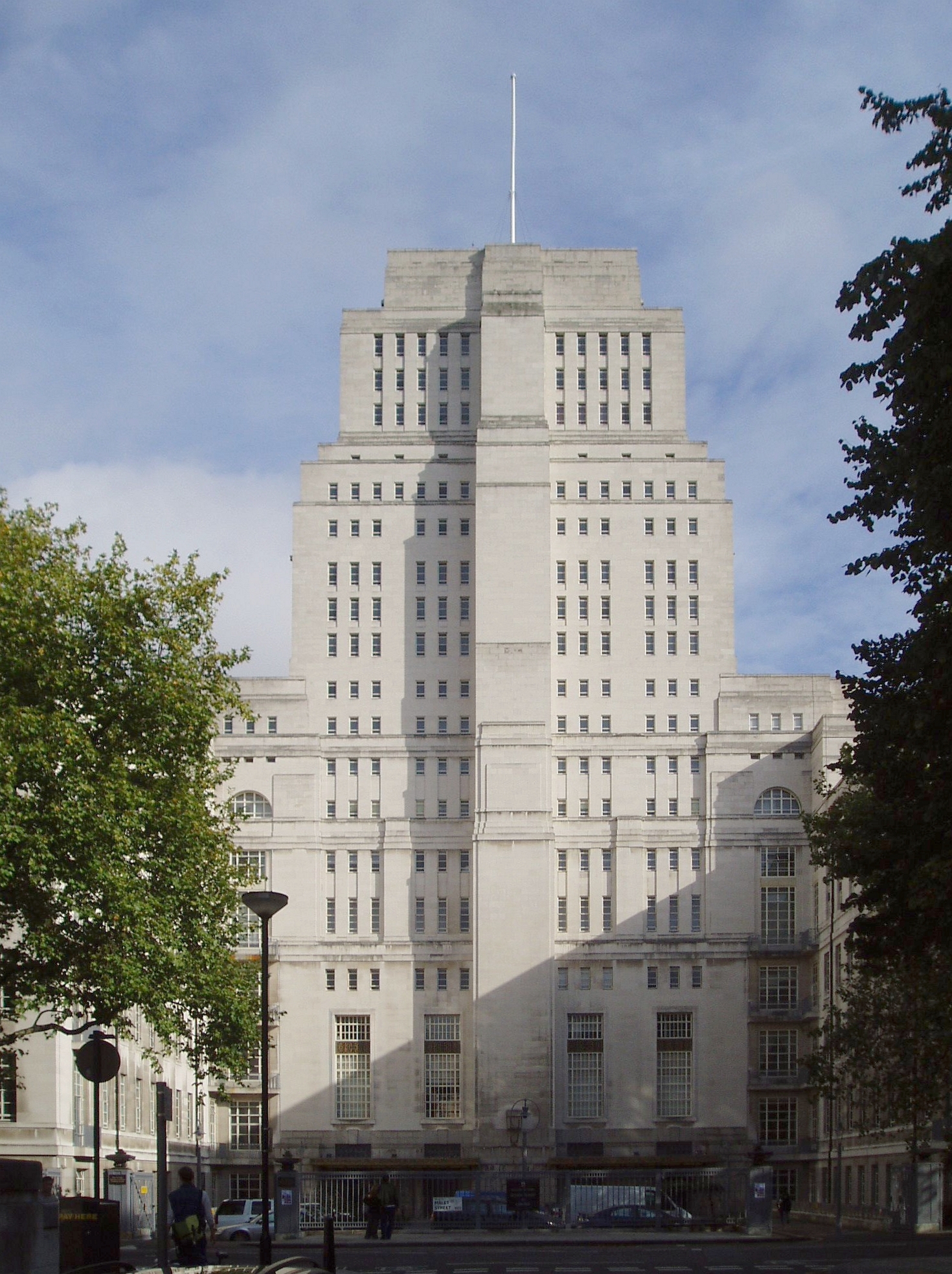
A one day conference in collaboration with the Centre for Military and Strategic Studies and the Department of History, University of Calgary and the History of Warfare Research Group, King’s College London. The conference will take place at Senate House, London, which is near Russell Square Tube Station. When you come out of the station, look for this building. It’s hard to miss.

Senate House, otherwise known as the Ministry of Truth

The registration deadline is tomorrow.

I can’t make it because I have another committment on the day, but there are some interesting papers on the programme.  I also see that Professor Andrew Lambert will be presenting. Lambert is Laughton Professor of Naval History in the Department of War Studies at King’s College, London, and Director of the Laughton Naval History unit housed in the Department. His work focuses on the naval and strategic history of the British Empire between the Napoleonic Wars and the First World War. His work has addressed a range of issues, including technology, policy-making, regional security, deterrence, historiography, crisis-management and conflict. He has lectured on aspects of his work around the world, and made several television documentaries. He has presented papers at a number of conferences held by the University of Calgary and has examined a University of Calgary PhD thesis. His books include: The Crimean War: British Grand Strategy against Russia 1853-1856. Manchester 1990, The War Correspondents: The Crimean War. Gloucester 1994; The Foundations of Naval History: Sir John Laughton, the Royal Navy and the Historical Profession. London 1997; Nelson: Britannia’s God of War. London 2004; Admirals. London 2008; and Franklin: Tragic hero of Polar navigation. London 2009.

I am currently (i.e., this very day) using Lambert’s most recent book to revise my annual lecture on the history of polar exploration in Canada. This lecture focuses on the Franklin expedition, which fascinates my students, so I would be keen to meet the man in question.

Wolfson Room, IHR, Senate House

09.45-10.15:    Morning Coffee & Registration

10.15-10.30:    Welcome by Director of IHR and Seminar Convenors

10.30-11.50:    Panel 1: Military Intellectuals and British Strategy

Chair: Dr. William Philpott, King’s College, London

Andrew Lambert, Laughton Professor of Naval History, Department of War Studies, King’s College, London

A Meeting of Minds? Sir Julian Corbett and the Naval War Course, 1902-1914

Paul Ramsey, Doctoral Student, Department of History, University of Calgary, Canada

Analysing Defence and Thinking Strategically: The Works of Henry Spenser Wilkinson

Daniel Whittingham, Doctoral Student, Department of War Studies, King’s College, London

Charles Callwell and British Strategy

11.50-12.30:    Keynote: Professor David Bercuson, Director of the Centre for Military and Strategic Studies, University of Calgary, Canada

Canadian Military History

12.30-13.30:    Lunch

13.30-14.50:    Panel 2: First World War

Chair: Professor Brian Bond, King’s College, London

Nikolas Gardner, Associate Professor of Strategy, Department of Strategy and Leadership, Air War College, Alabama, USA

Charles Townshend’s Advance on Baghdad: The British Offensive in Mesopotamia, September-November 1915

Meighen McCrae, Doctoral Student, University of Oxford

The Supreme War Council’s Inter-allied War Planning for 1919

Peter Jackson, Reader in International History, Aberystwyth University

Contending Conceptions of Security in French Policy at the Paris Peace Conference, 1919

14.50-15.50:    Panel 3: Economic Warfare

Chair: Professor David French, University College, London

John Ferris, Professor of History, University of Calgary, Canada

Reading the World’s Mail: British Blockade Intelligence and Economic Warfare, 1914-1918

Keith Neilson, Professor of History, Royal Military College, Canada

R.H. Brand, Imperial Unity and Munitions from Canada, 1914-1917

15.50-16.10:    Afternoon Tea

16.10-17.30:    Panel 4: Second World War

Chair: Professor David Bercuson, University of Calgary, Canada

Christine Leppard, Doctoral Student, Department of History, University of Calgary, Canada

Canada and Coalition Warfare: The Italian Campaign, 1943-44

Russ Benneweis, Doctoral Student, Department of History, University of Calgary, Canada

Well-Balanced and Hard-Hitting or Uneconomical and Hypertrophied: Manpower Allocation in the Canadian Army during the Second World War

Abraham Roof, Doctoral Student, Department of History, University of Calgary, Canada

Not What is Desirable But What is Possible: The Soviet Union and British Strategy, 1941-1942

17.30-18.00:    Summary Discussion

Common Room, IHR, Senate House

18.00-19.30:    Drinks Reception

For more details see here.


McKay’s Liberal Order Framework: Promise and Pitfalls

14 07 2010

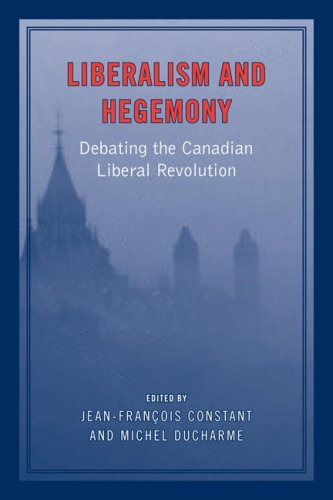
My review of Liberalism and Hegemony : Debating the Canadian Liberal Revolution. Edited by Jean-François Constant and Michel Ducharme. Toronto : University of Toronto Press, 2009 has appeared in the Canadian Historical Review. see here.

I was asked to write a short review by the CHR and the CHR’s quite legitimate space constraints prevented me from developing all of my ideas about this book and about McKay’s Liberal Order Framework, which is the intellectual paradigm that underpins both the essays in the book and a vast body of literature. This is why I am posting this short essay here.

The book I have reviewed in a collection of papers that were presented at a 2006 workshop at McGill University. The workshop was inspired by an article by Ian McKay that appeared in the Canadian Historical Review in 2000.  In that article, McKay argued that Canadian history in the period from c. 1840 to c. 1940 must be understood with reference to the rise and hegemony of liberalism. Although McKay did not define liberalism precisely, it is clear that he was denoting a pro-capitalism ideology similar to what C.B. Macpherson called “possessive individualism” or what others might call classica liberalism. McKay argued that the Canadian state should be understood as a project of liberal rule in North America. Canada was a more of a “liberal Empire” and the expression of a particular ideology than a traditional ethnic nation. McKay’s basic argument was that liberalism drove the creation of Canada as a nation state. He says that Macdonald and his National Policy embodied economic liberalism. McKay alludes to the Soviet Union several times in his works on the Liberal Order Framework. One can see why, for the Soviet Union was an ideological project of rule, a Marxist empire, not a traditional nation state: some people in Russia applied the ideas of German and other thinkers and the created a vast Empire devoted to putting these ideas into practice. In McKay’s telling of Canadian history, the Dominion of Canada created in 1867 served a similar purpose– it was an empire allowed a clique of liberal-minded to implement the ideas of John Locke, Adam Smith, John Stuart Mill, and other liberal thinkers on the peoples of a vast territory. McKay, how is a former Marxist and is old enough to have known the Soviet Union, is making a very interesting comparison here. It’s interesting, but I don’t actually buy it.

McKay

It is hard to understate the importance of the article by McKay. Today, many young Canadian historians situate their work within the Liberal Order Framework. Whereas in the past, a scholar might declare that they were going to provide, say, a Marxist or a feminist interpretation of X, Y, or Z, many emerging historians of Canada say that their research was informed by McKay’s Liberal Order Framework. If you pick a half dozen current Canadian history PhD theses at random, I bet you will find the McKay’s Liberal Order Framework has influenced at least three of them.In some cases, PhD students pay intellectual tribute to McKay’s 2000 article in the title of their thesis– e.g.,  “Mohawk Land Practices and the Liberal Order: An environmental history of Kahnawake”.

Ian McKay is an important and prolific scholar who has said many interesting things in the past. His ideas deserve to be taken seriously. That being said, I am unconvinced by his Liberal Order Framework. In fact, I am uncomfortable with the fact that the “thesis” or “theory” that McKay advanced in 2000 is already being described as a “framework”, which suggests that the accuracy/explanatory power of the thesis has already been established through rigorous empirical testing. 150 years after Darwin published his theory of evolution, we still refer to it as a “theory”. It is a good theory that has held up well in the face of masses of research done by scientists on different continents. Why then have Canadian historians been so quick to elevate this theory into a framework before it has been tried with the acid test of empirical investigation by historians working in different sub-disciplines of history. Few of the adherents of the Liberal Order Framework appear to have given much thought to falsifiability. Falsifiability means that a theory could possibly be refuted by through new empirical research. That something is “falsifiable” does not mean it is false; rather, that if it is false, then this can be shown by observation. In the physical sciences, theories are tested in the lab. In history, theories are tested through the process of primary source research. I would ask those who support the Liberal Order Framework to imagine what sort of evidence could potentially undermine or disprove their thesis.

In the review, I say that the papers in this book exemplify both what is good and what is deeply frustrating about McKay’s Liberal Order Framework.  I argue that McKay and his followers are dealing with some really important issues– liberty, property, individualism, collectivism. Their historical research deserves to be communicated to a broader audience– to undergraduates and to history buffs who peruse the shelves of the big box bookstores such as Chapters. McKay’s research also ought to be considered by scholars working in the United States, Britain, and other countries. I think that the debate currently raging in the American historical profession about the weak American state could be informed by looking at events north of the border.  Canada was an important part of the British Empire and it would be a good thing if historians of the Empire-Commonwealth based outside of Canada paid at least some attention the Liberal Order Framework Thesis debate in Canada.

Unfortunately, this book’s readership is likely to remain confined to professional historians of Canada based in Canada. This is true of much of the secondary literature that has emerged in response to McKay’s Liberal Order Framework. Specialized jargon and unexplained references to Habermas and Foucault make the book inappropriate for both undergraduates and members of the public interested in history.  Moreover, some of the essays are highly introspective–one finds very junior historians talking about their personal reactions to McKay, their first encounters with McKay, the process of being hired by Canadian university history departments. This might be interesting to a handful of academic historians, but it is likely to be boring, indeed, repellant to most other readers. Don’t get me wrong. There are some historians who have led very interesting lives and whose autobiographies would be worth reading. Consider Basil Davidson (1914-2010), the historian of Africa who was also involved in the effort to overthrow white minority rule in Angola and South Africa. Alas, few historians working in Canada today are terribly interesting. We are essentially civil servants who have grown up in boringly normal suburban families, have suburban families of their own, and who now write books with three readers.  Lengthy autobiographical/introspective digressions by such folk are ridiculous. Students are very interested in what we have to say about the past, but they aren’t that interested in us as people. I would be much more interested in reading the about the thoughts and lives of, say, an immigrant entrepreneur who runs a restaurant than about another history professor.

This book is also unlikely to be read by historians outside of Canada, which is a big shame because the historians of the United States and of the British Empire/Commonwealth need to pay more attention to Canada and its place in the North Atlantic Triangle and the relations between Europe and North America. Canadian issues were of tremendous diplomatic importance in the 19th century and it seems to me that if McKay’s Liberal Order Thesis is truly a suitable metanarrative/paradigm for understanding Canadian history in this period, it should have something to say about the diplomatic history of the period.

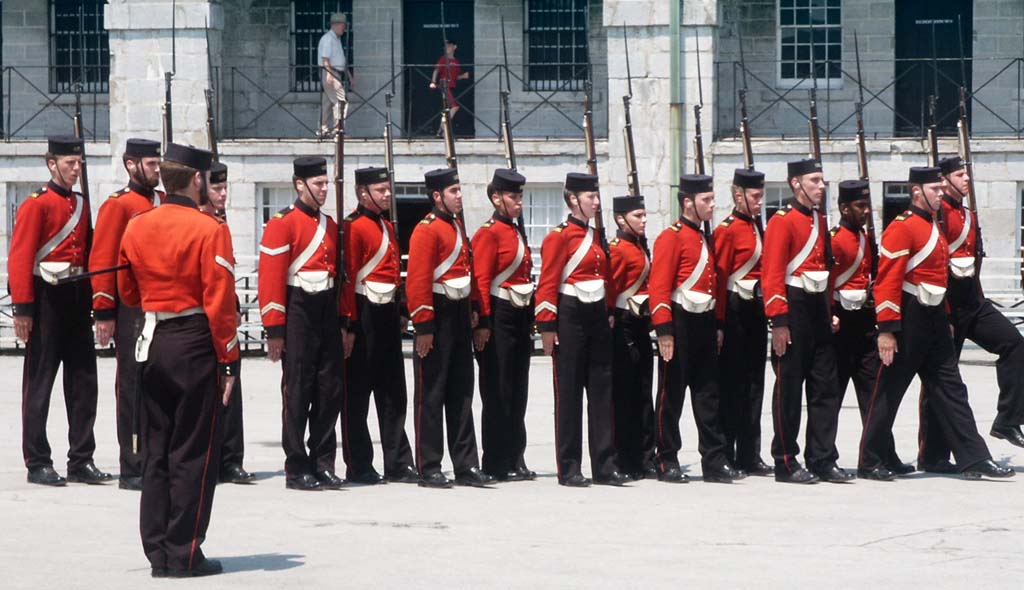
Fort Henry, Kingston, Ontario

Another major problem with this volume is that there is basically nothing about military and naval history in it. This is a shocking omission for several reasons. First, the military, specifically the British military, played a crucial role in the development of Canada in the 19th century. Consider, the city of Kingston, where Professor McKay teaches, a British garrison town that is today physically dominated by the looming hulk of Fort Henry, which was built to protect the settlement from the United States. Kingston is connected by the Rideau Canal to Ottawa, which was planned by the Duke of Wellington. It is not for nothing that the main street of Ottawa is named for the Iron Duke. Second, the military, a branch of the state fully funded by taxpayers and based on a hierarchical chain of command system, is a deeply illiberal institution, which is why 19th century classical liberals were so keen on cutting army budgets. Third, there is a large community of military historians in Canada. Any paradigm that seeks to explain 19th century Canadian history needs to be able to integrate military and naval history if it is going to be taken seriously.

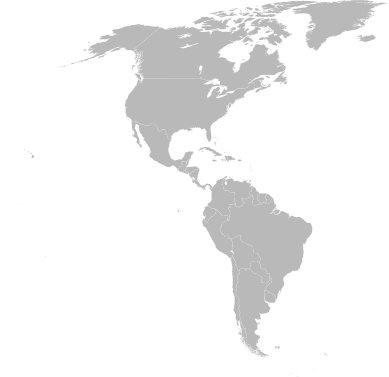
The other problem with this book is the lack of a serious comparative element. In fact, this is a problem that bedevils the entire Liberal Order Framework literature in Canada. First of all, the Liberal Order Framework authors do very little in the way of Canadian-American comparisons. I suspect that if they did more research along these lines, they would find out that the United States was more liberal than Canada in many ways in this period. Government played a somewhat less important role in the American economy, American judges took the idea of freedom of contract much more seriously than Canadian judges, it was much easier to incorporate a business in the United States than in Canada, it was easier to get a divorce. Just as importantly, neither McKay nor his followers engaged in other hemispheric comparisons. Canadian historians of the 19th century should be looking to both the United States and Latin America to make comparisons. McKay and his followers fail to engage in either sort of comparative analysis or indeed any type of comparative analysis at all.

Perhaps the greatest single problem with this collection of essays and most of the scholars who work within the Liberal Order Framework is that  is that none of these scholars really grapple with the fundamental weakness of McKay’s framework, namely, that the hegemony of liberalism in Canada does not really explain why Canada developed as a separate state rather than being absorbed by its superpower neighbour. The United States embodied liberal individualism as least as much as the Dominion of Canada, if not more so. Indeed, there is a vast literature on the ways in which American life has been informed by Lockean and other liberal ideas from the eighteenth century onwards.

That’s why I liked Jerry Bannister’s paper on the “loyalist order framework”, which is part of this collection. Bannister’s Loyalist Order Framework provides a far better explanation for why most of northern North America did not become part of the Republic and instead coalesced into a separate country. He reminds us that the leaders of the scattered British colonies were united by a desire to remain British subjects and that Britishness was central to the Canadian identity until the mid-twentieth century. Bannister is correct to suggest that it is the loyalist order and its legacies, not liberalism, that make Canada distinctive from the United States.

I like Bannister’s paper because I believe that 19th century Canada was the scene of a counter-revolutionary project. The British had lost most of their North American colonies in 1783 and they were determined to hold on to the rest. For their part, the United Empire Loyalists, the conservative clergy of Lower Canada, and other pro-British people in British North America were equally determined to remain British subjects and to escape absorption into the great republic. It is impossible to understand such pivotal events as the War of 1812, Confederation, or even the 1911 election without recognizing that the Canadian nation-state was the product of a big counter-revolutionary project that was, in terms of scale, almost as dramatic as the Counter-Reformation or the Holy Alliance, the league of reactionary European monarchs formed in the 19th century to suppress liberal and nationalist movements.

There were, of course, classical liberal movements in British North America/Canada in the 1783-1914 period. There were some republicans, some people who wanted to join the United States, and some ardent Free Traders who loved the ideas of Adam Smith. Some of these liberals wanted Canada to join the United States. Goldwin Smith is one such example. Others wanted to implement the liberal agenda within the context of the inherited political framework, that is, a semi-autonomous colony within the British Empire.  But these people were sailing against the current. For the dominant ideology, the hegemonic political project, was the counter-revolutionary loyalist one, which wanted to create a rival federation that would keep in the United States in check. The strength of this ideology helps to explain why creole nationalism (i.e., the desire to distance Canada from the Old World) was so weak in Canada when it was fairly strong in the rest of the hemsiphere– by the mid-1820s, most American countries had achieved independence from their respective European mother countries. Canada was the anomaly in the 19th century and leaders such as John A. Macdonald were acutely aware of this.

I would argue that the situation in 19th century Canada, where the contest between loyalist sentiment and the nationalist desire for independence from Europe became wrapped up the struggles between economic liberalism and conservativism, was fundamentally the same as the conflicts then raging in other American societies. If McKay and the brigade of scholars he leads would engage in some comparative analysis, they would begin to realize the problems with the view that John A. Macdonald, who was an ardent anglophile, was also the champion of classical liberalism.

Consider this comparison. Most Latin American republics in the nineteenth century were divided between the liberals, who typically admired the United States, and conservatives, who pined for the old days when viceroys had ruled in the name of distant monarchs and the Church had enforced doctrinal orthodoxy and censorship. The liberals saw themselves as the heirs of the revolutionaries who had overthrown Spanish rule and then established republics modelled on the United States. Their hero was Simon Bolivar, the brilliant commander who had led the rebellion against Spain and who had carried a copy of the Wealth of Nations while on campaign At the other end of the spectrum were the conservatives, who had opposed independence and now accepted it grudgingly. Although the specific issues fought over and party labels differed in each Latin American republic, the conservatives were generally Catholics landlords who wanted to preserve as much as possible of the monarchical ancien regime, whereas the liberals were usually anticlerical city dwellers who were inspired by the American and French Revolutions.  One historian has summarized the agenda of the Latin American liberals thus: “constitutional government, the basic human freedoms, economic laissez-faire, opposition to military and ecclesiastical privilege.“ Throughout the Catholic New World, political and economic liberalism and creole nationalism were linked, although not all Latin American liberals were creole nationalists and not all creole nationalists were liberals. The situation was thus similar to Canada, where French Canadian bishops, the Family Compact, and arch-Tory Church of England ministers worked to strengthen the country’s ties to the Old World, with the classical liberals were more receptive to the idea of colonial independence and/or joining the United States, an entity they associated with free thought, science, technology, emancipation from religious doctrine, and individual liberty..


I have based by statements on Latin American political history on John Lynch, Simon Bolivar: A Life (Yale University Press, 2007);  Hubert Herring, History of Latin America (Random House Inc (T), 1968), 585-7, 595, 306-10; John Chasteen, Americanos: Latin America’s Struggle for Independence, First Edition. (Oxford University Press, USA, 2008), 172-3; Frank Safford, “Politics, Ideology and Society in post-Independence Spanish America” in The Cambridge History of Latin America. Vol. 3, From Independence to c. 1870, edited by Leslie Bethell (Cambridge : Cambridge University Press, 2008, vol. 3.



Moore on the Silence of the Academy

9 07 2010

Christopher Moore has a very interesting post on the Wellington/Macdonald controversy. Let me quote from it:

“What’s most striking about the tempest in a teapot over the possible renaming of Ottawa’s Wellington Street “Macdonald Avenue” — is how much the discussion relies on non-academic historians… it also reflects what we might call “the silence of the academy” these days. Among the army of Canadianists in our university history departments, there are many busy, dedicated and hardworking scholars, but vanishingly few, it seems, who are writing big books or otherwise disseminating ideas that resonate with broader ideas about Canadian history.  I try to cover the waterfront, looking for big, serious, important contributions about the history of this country… and some days the gleanings seem pretty thin, compared to the historical resources we have.”Tea

Moore is touching on a rather important point here. The phenomenon he is describing is not confined to Canada.

In a recent article in the New Yorker, Harvard historian Jill Lepore observed that the Tea Party’s appropriation of the memory of the American Revolution was a travesty of historical interpretation. She argues that Tea Party activists have been able to get away with calling themselves the true descendants of the American Revolutionaries in part because academic historians have given up writing accessible books aimed at the general public. The history professors who actually know about the American Revolution have decided to specialize in writing books with tiny readerships that largely consist of other academics. The result is that many average citizens now get their information about the American Revolution from journalists such as Glen Beck.

She writes: “The American historical profession defines itself by its dedication to the proposition that looking to the past to explain the present falls outside the realm of serious historical study. That stuff is for amateurs and cranks. [Professor Richard] Hofstadter disagreed. He recognized the perils of presentism—seeing the past as nothing more than a prologue to the present introduces evidentiary and analytical distortions and risks reducing humanistic inquiry to shabby self-justification—but he believed that scholars with something to say about the relationship between the past and the present had an obligation to say it, as carefully as possible, by writing with method, perspective, and authority. Hofstadter died in 1970. He was one of the last university professors of American history to reach readers outside the academy with sweeping interpretations of his own time.”

I think that Lepore and Moore are overstating the degree to which academic historians have withdrawn from the task of writing books that are both scholarly and accessible to a wider audience. Professor Gordon S. Wood continues to publish books on the Revolutionary and early national periods that are read by many no academics. Professor Alan Taylor, who also specializes in the same period of US history, also writes a regular column in the New Republic magazine. Professor David Cannadine is often heard on the BBC.