Some of the Guardian’s technology team predict what might be in store for 2010
Vodpod videos no longer available.
more about "Video: Technology in 2010 Predictions", posted with vodpod
Some of the Guardian’s technology team predict what might be in store for 2010
Vodpod videos no longer available.
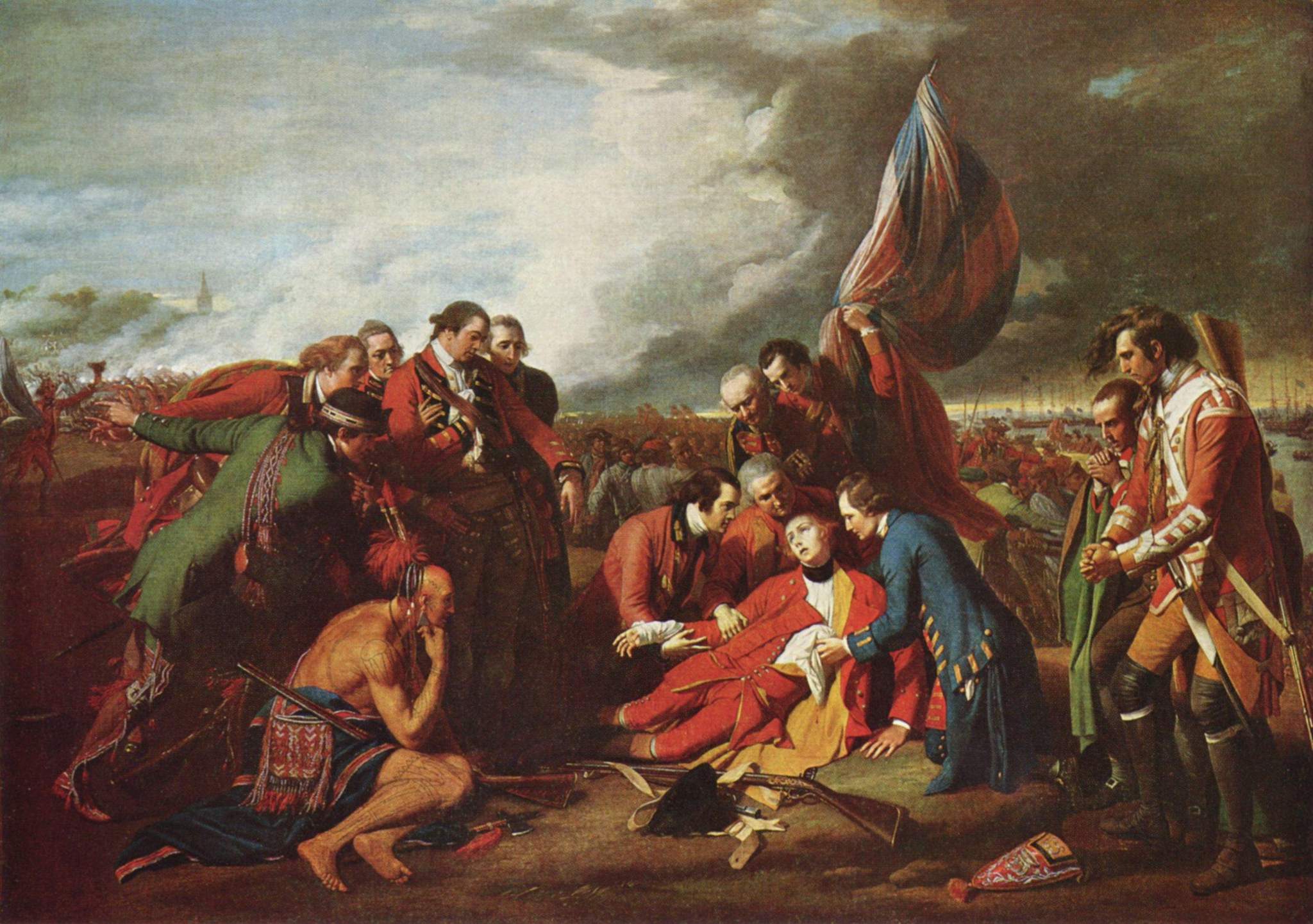
Benjamin West, The Death of General Wolfe, 1771
This is the provocative title of an article in today’s Seaway Times.

Historian Charlotte Gray has published a review of two new books on the search for the Northwest Passage. Gray was the 2003 Recipient of the Pierre Berton Award for distinguished achievement in popularizing Canadian history. She chairs the National History Society, and is a member of the Order of Canada and a Fellow of the Royal Society of Canada.
Robert Whaples of Wake Forest University has published a review of T.J. Stiles‘s fantastic new biography of Cornelius Vanderbilt. I found the book to be immensely enjoyable, despite the touches of hyperbole noted by Whaples. This book reinforces my view that Stiles is a great historian.
Published by EH.NET (December 2009)
T.J. Stiles, The First Tycoon: The Epic Life of Cornelius Vanderbilt New York: Knopf, 2009. xiii + 719 pp. $37.50 (cloth), ISBN: 978-0-375-41542-5.
Reviewed for EH.NET by Robert Whaples, Department of Economics, Wake Forest University.
Economists have always had a hard time dealing with entrepreneurs — as individuals and in the aggregate. We sort of know what entrepreneurship is and that it can have a profound impact on economic performance, but it’s usually just too difficult to model and measure. What we do not understand, we simply ignore and leave to others. After all, we are firm believers in comparative advantage and studying entrepreneurship — even if it is economically important — doesn’t seem to be our comparative advantage. In the view of most economic historians, it is the rules of the game — the incentives and the institutions — that really matter, not the players. American economic history has been cast as the story of millions of diligent and clever beavers working away and transforming the landscape. Take one of them away and nothing of great importance will really change. (In fact, most of us seem to believe that if you take away an entire technological complex, like the railroads, little of much importance would really change.)
Why, then, should economic historians study the careers of entrepreneurs? Not all of us should. But for some, the study of entrepreneurs will illuminate the past and the present — and put life into our cliometric narrative. If any entrepreneur deserves our attention it is surely Cornelius Vanderbilt. As T.J. Stiles aptly puts it: “One person cannot move the national economy single-handedly — but no one else kept his hands on the lever for so long or pushed so hard” (p. 7).
Vanderbilt, born on Staten Island in 1794, had only about three months of formal education. He set to work hauling cargo and passengers across the waters surrounding New York Bay before he was a teenager and immediately showed an ambitious, enterprising streak while working for his father and soon thereafter for himself. He entered the national stage while working for Thomas Gibbons in establishing a steamboat line between New York City and New Brunswick, New Jersey. Vanderbilt began as captain of Gibbons’ boat, but he soon acted as the line’s general agent and played the crucial role in besting the market’s incumbent, flouting its state-back monopoly before this monopoly was famously struck down by John Marshall’s Supreme Court in _Gibbons v. Ogden_ (1824).
In the ensuing decades Vanderbilt emerged as one of the industry’s shrewdest, most relentless operators. Stiles’ descriptions of the free-wheeling competition _and_ collusion in the steamboat industry are enough to make a game theorist’s pay-off matrix explode. The understood rules of the game were that “the first proprietor to occupy a line assumed a sort of natural right to the route. A challenger who lasted long enough could expect an offer of a bribe to abandon the market and, should he accept it, would be expected to abstain from further competition” (p. 103-04). As Vanderbilt’s operations grew, he repeatedly preyed on existing lines — in New Jersey, on the Hudson River and on Long Island Sound — and often took payoffs to go away. But he occasionally straddled the line between honor and duplicity in this game. The record is replete with episodes of buy outs, no-compete payments, and pooling arrangements, but also fierce face-to-face competition along a vector of price, speed, safety, comfort, amenities (many steamboats were essentially floating saloons), and infrastructure along with hidden ownership arrangements and rapid changes in technology. There simply was no lasting equilibrium in this dynamic market. Above-normal profits were fleeting, but Vanderbilt mastered the arts of motivating his employees and partners, holding down costs, making design improvements to his fleet, operating efficiently and building up a deep capital base. “His main strength was, in a word, everything” (p. 140), as he emerged as the “Prince of Long Island Sound” — the key route between Boston and New York — by the mid-1840s.
Soon legends about his physical prowess and indomitable personality arose. The legends became mythic with Vanderbilt’s commanding response to the ripe opportunity of transporting men to California during the Gold Rush. As rivals struggled to build a link across Panama, Vanderbilt overcame a series of daunting political, diplomatic, financial, logistical, and physical obstacles to complete a route to San Juan del Norte, Nicaragua, up the San Juan River, across Lake Nicaragua, and down a plank road to the Pacific. The “Commodore” himself was the first to pilot a steamboat up the Toro rapids (before explosives removed most of the obstacles). The line opened in the summer of 1851, outflanking the Panama route, whose railroad wouldn’t be completed until early 1855. As is the case for earlier and subsequent Vanderbilt endeavors, it appears that the biggest winners were his customers. Unfortunately for Vanderbilt, the longer-term profitably of the line was imperiled by a series of intrigues and the filibustering of William Walker, whose armed force seized control of Nicaragua in 1855. Stiles convincingly argues that Vanderbilt never provided assistance to Walker and was crucial in bringing about his downfall. He also dismisses “one of the most famous letters in the history of American business,” in which Vanderbilt allegedly informed two double-crossing Nicaragua-line partners: “Gentlemen: You have undertaken to cheat me. I won’t sue, for the law is too slow. I’ll ruin you. Yours truly, Cornelius Vanderbilt.” Stiles explains that Vanderbilt “never wrote ‘Yours truly,’ . . . And it never would have occurred to him to give up legal redress” (p. 237).
Stiles is just as convincing in downplaying legends about Vanderbilt’s bawdiness and in discrediting the contention/fabrication in Edward J. Renehan Jr.’s _Commodore: The Life of Cornelius Vanderbilt_ (2007) that Vanderbilt contracted syphilis in 1839 and began to suffer from syphilitic dementia late in life. Renehan has refused to produce the source of this diagnosis — alleged diaries of Vanderbilt’s doctor — and the contention of dementia doesn’t comport with eyewitness accounts of Vanderbilt’s active, lucid behavior. [As if the seal the case, Renehan is now serving time in prison for selling stolen historical letters.]
Vanderbilt was a planner and an improviser. While he oversaw the Nicaragua project, he also launched a profitable trans-Atlantic steamboat service that drove its subsidized competitor to the wall and gained control over a major New York shipyard and the city’s leading engine works. Rather than enjoying a leisured retirement, the Commodore built his fortune up from $11 million in 1853 (about $320 million in today’s dollars according to our colleagues at measuringworth.com) to roughly $100 million at the time of his death in 1877 ($2.1 billion in today’s dollars). This final set of triumphs came in railroading, as Vanderbilt built up stakes in struggling or underperforming lines (the Harlem, the Hudson, the New York Central, and the Lake Shore) and made them profitable. Again and again, he cut costs and improved efficiency. Much of this appears to have come by reining in the principal-agent problem by ousting top executives who had been making self-serving side-deals, from introducing (a la Alfred Chandler) professional managers, and from carefully constructing the optimal amount of infrastructure. These final chapters are replete with episodes of crooked politicians stung while trying to shake down Vanderbilt’s businesses (the two Harlem road corners), sharp dealing during financial panics, and unresolvable family problems.
Although Stiles occasionally interjects a bit too much hyperbole — the deep-pocketed Vanderbilt is portrayed as teetering on the brink of disaster much too often — he has done extensive archival work which enables him to draw a thorough and compelling picture of the evolution of Vanderbilt and his enterprises. Moreover, he has a capable grasp of economic theory and economic history, which allows him to knowledgeably discuss the transformation of the economy, monetary policy, financial panics, business practices and a whole range of other important issues. Stiles’ book joins the ranks of an encouraging string of recent biographies that have overturned misconceptions about important nineteenth-century entrepreneurs, standing alongside Murray Klein’s _The Life and Legend of Jay Gould_ (1986), Ron Chernow’s _Titan: The Life of John D. Rockefeller, Sr._ (1998), David Nasaw’s _Andrew Carnegie_ (2006) and others.
“That Vanderbilt is a great __________ (you must fill in the blank)” (Courtlandt Palmer, quoted on page 1). T.J. Stiles’ definitive biography not only allows us to fill in this blank — it also helps fill in many blanks about how the American economy behaved during the Commodore’s life.
In this video, political pundits Will Wilkinson & James Poulos discuss the movie Avatar.
Vodpod videos no longer available.
Religion has become the sexiest topic of study for U. S. historians, overtaking the previous favourite — cultural studies — and pulling ahead of women’s history in the latest annual survey by the American Historical Association. Younger historians are more likely than older ones to turn to the history of religion. I bet that the tragic events of 2001 have something to do with this development!

According to the AHA survey of the profession, the proportion of academic historians working on topics in religious history is now 7.7%. The figures in other sub-disciplines are political history (4.6%), military history (3.8%), diplomatic history (3.8%), women’s history at 6.4%.
I have two thoughts about these stats. First, can an individual identify with more than one sub-discipline? After all, what is the dividing line between, say, (domestic) political history and diplomatic history? What about someone who does women`s history and the history of technology?!? Second, how would these figures be different in other industrialized countries? The problem with the AHA is that it is so damn US-centric, even though it claims to be a global organization (“the association for all historians” says its website). It would be very interesting to have some hard data to make cross-national comparisons of historians` interests. My impression is that university history departments in Japan are dominated by historians of business and technology. I know that in the UK, history departments are far more traditional in their curricula than in the United States– old-fashioned political and diplomatic history is still the norm. My impression is that in British history departments, there is far more business and economic history than in United States history departments. I`ve heard British historians ridicule their North American counterparts for an obsession with gender, sexuality, postmodernism, and other newfangled historical topics. It also my impression that few historians in France have heard of Foucault.
The stats also show that the US history curricula is still massively Euro-centric– the vast majority of historians are specialists in the history of “Western” countries. There are far more historians of Europe in the United States than historians of Asia, even though Asia`s population is vastly greater (and still growing).

In this video, noted Princeton historian James M. McPherson discusses Abraham Lincoln as a military leader. McPherson has published many books on the Civil War, including his Pullitzer-winning Battle Cry of Freedom.
In this video, McPherson talks about Reconstruction and the legacy of the Civil War.
A few days ago, I went to see the movie Avatar in all its 3D glory. I thought that the special effects in the film were first rate. It was an enjoyable picture on many levels. The cinema where I saw the film was sold-out and the audience, which was almost exclusively Japanese, really seemed to enjoy the picture. The film is an allegory about American imperialism and there were some pretty direct allusions to the Iraq War in it. The fighting in the jungle is probably designed to evoke memories of the Vietnam War, or perhaps early American wars against forest-dwelling American Indians. One does not, however, have to be politically aware to enjoy this film. My Japanese in-laws didn`t really pick up on the political message, but they did like the flying lizards and other neat special effects.
The director of this film is Canadian James Cameron. If he is like most Canadians, Cameron has an ambivalent attitude to the United States and is sensitive to the issue of American imperialism. After all, Canada is a country that was built in the face of American imperialism (manifest destiny). Cameron grew up not far from Lundy`s Lane and Queenston Heights, two battlefields where American imperialism was held in check. Cameron lives and works in Hollywood and like most Canadians, is aware that the United States has many positive things to offer as well.
This is a fun film. That being said, I was a bit disturbed by its political message, which appears to be that business interests drive wars: the war with the indigenous blue-skinned people in the film is driven by a greedy big corporation`s desire to mine on a distant world. Although it is manifestly a work of fiction, this film will reinforce the widely held assumption that Big Business likes war. The truth of the matter is that business interests are rarely behind wars. In fact, businessmen generally want to avoid war at all costs. Historically, business has tended to lobby for peace, although the willingness of business leaders to do so has always been limited by their unwillingness to appear patriotic. Political scientists such as Erik Gartze have found that there is strong correlation between a country being capitalist and pacific inclinations. Moreover, the careful research of diplomatic and political historians into the origins of particular conflicts has helped to dispel the old Leninist view that business drives warmongering. A few firms in a few industries (e.g., gunmakers), may tend to a pro-war view, but most firms hate war. Many of the wars in British and American history that have been attributed to business/corporations/financiers have, upon closer examination, turned out to be the product more of trigger-happy army officers and war-hawk politicians intent on proving their masculinity. The U.S. oil industry, which many people blame for the Bush-Blair invasion of Iraq was, in fact opposed to the idea of invading that country. Many financiers in the City of London were opposed to the Boer War, the conflict most commonly associated with capitalist greed. The same financiers were aghast when the First World War broke out. Wall Street was generally opposed to the Civil War, not least because New York mercantile houses had many customers in the slave states– in fact, the anti-war “copperheads” in New York spoke about that city`s secession from the Union. Lincoln denounced the financiers of Wall Street for their lack of patriotism. It is possible to multiple the examples. My reading of history is that governments not businesses cause war. Wars are created in the public sector by politicians, diplomats, generals, and other non-businessmen.
Historian Jack Granatstein has published some thoughts on Discover Canada, the federal government`s new citizenship guide, in the Winnipeg Free Press. He had this to say about the new guide. “It is a vast improvement over the 1990s study guide that was a vapid embarrassment. Presumably, a new citizenship test will flow from Discover Canada. It might even be a real examination that questions applicants about Canada’s liberal-democratic values — and helps entrench those values in new citizens.”
This is a good article, not least because it talks about the Bouchard-Taylor Commission and the Quebec debate about reasonable accommodation and Quebec citizenship. Too many English-speaking Canadians have ignored these issues. I agree that the Discover Canada guide is better than the old guide, but this isn`t saying much. Eating grass is better than eating dirt. I also like how Professor Granatstein said the new citizenship test “might” question applicants about Canada`s liberal, democratic, and secular values. He was right to introduce a note of qualification and caution here. I expect that the new citizenship will simply test a few random facts. It is hard to test someone`s value using a written test, since people can always lie about what they really think.
Moreover, the Discover Canada citizenship guide is largely value neutral and says very little about Canadian values. It is a recital of facts, many of which are correct. Professor Granatstein writes that the guide “even includes a flat-out condemnation of honour killings”. Well, honour killings are such an extreme example of a behaviour inappropriate in Canada that coming out against this category of murder hardly takes much political courage. Honour killings are also rare. Islamic parents forcing their daughters to wear headscarves, on the other hand, is a really common problem in some cultural communities. Adult children being pressured into arranged marriages or being disowned by their immigrant parents for being homosexual are other big problems. Unfortunately, neither of the two major political parties has the guts to write a REAL citizenship guide, one that would condemn such practices. Instead we get a watered-down guide like Discover Canada. It is a sad sign of how overly tolerant Canadians have become that a short declaration that honour killings are illegal was considered a bold move by the government! I kinda like the Dutch approach, which involves showing prospective immigrants a video that, among other things, shows two men kissing.
One last comment. Professor Granatstein said that “we need to consider carefully how we integrate them [immigrants] into our liberal-democratic and secular society…” I note that Granatstein uses the word society here in the singular. It might be appropiate to refer to British society or German society, but Canada is not a nation, as the House of Commons has itself recognized with a 2006 resolution. Quebec is a nation, which means that there are at least two societies, if not more, in Canada`s territory. The values, traditions, etc., of Quebec society are not those of rural Alberta or even Toronto. For this and other reasons, I believe that the integration of immigrants is a matter best left to the provinces. The federal government has little control over what happens once immigrants are admitted into Canada. Education policy, employment law, whether there should be nativity scenes at city hall, etc., are firmly matters of provincial jurisdiction. Most residents of Canada have little contact with federal institutions aside from the Post Office. The provinces are where it is at.
I’ve compiled a list of Pierre Trudeau clips available on Youtube.The first clip is, of course, the famous “Just Watch Me” interview.
 The Past Speaks