Canada’s History of Colonialism

2 10 2009
First Nations, 1870

First Nations, 1870

Native Groups have called on Prime Minister Stephen Harper to apologize for saying that Canada has “no history of colonialism”.  (Also see here, here, and here). Harper made these remarks at the G20 in Pittsburgh, a recent gathering of the leaders of developed (G7) and emerging economies (including China, India, and Brazil). You can watch Mr Harper’s statement in Pittsburgh here.

First Nations groups say that Harper’s statement overlooks Canada’s long history of domestic colonialism. They have also said that Harper’s “colonialism denial” is incompatible with his recent apology for the residential schools and efforts to engage with aboriginals.

I can certainly see the point that Mr Harper was trying to make. Unlike Britain, the United States, France, and some of the other industrialized countries, Canada never had overseas colonies. The fact that Canada never had a colonial empire does colour the way in which former European colonies, such as India and Singapore, see us. We don’t have the baggage that the other major western countries do.  However, in equating “colonialism” with having overseas colonies in the tropics, Mr Harper may have been making a common mistake, the “saltwater fallacy” that says that if you colonize a territory that is connected to you by land, you aren’t a colonialist. By this definition, Russia and China would not be considered “colonialist” powers, since they colonized contiguous territories, Siberia and Tibet respectively.

Colonialism involved seizing overseas territories in what is commonly called the Third World. But colonialism can also be about the Fourth World, the indigenous communities that live within the borders of industrialized countries such as Canada, Australia, Sweden, and the United States.

Both sides in the debate generated by Mr Harper’s colonialism remark have made excellent points. One hopes that this debate will help to increase the public’s interest in Canadian history.

The image above is from Library and Archives Canada and is the public domain.


Canadian History Image of the Day

1 10 2009
Louis-Joseph Papineau

Louis-Joseph Papineau

This picture was taken in Montreal in 1852, after Papineau returned from exile.

Image is in the public domain and is from Library and Archives Canada.


1981 San Francisco TV News Story about Birth of Internet News

1 10 2009

Today, we take it for granted that we can read newspapers online. Newspaper content was first placed online in 1981. To see a 1981 TV news story about the birth of online journalism, click here.

The reporter in this clip mentions that dial-up internet access costs $5 per hour. Depending on how you convert into present-day values, that’s between $11 and $23 dollars in today’s money. (For a handy online calculator for converting historical monetary values, click here.)


Canada’s Constitution

30 09 2009
British North America Act

British North America Act

Does Canada have a written constitution? According to a recent article in the American Political Science Review by James Fink, Canada’s constitution is entirely customary or unwritten. As political scientist Janet Ajzenstat points out, Canada has a written constitution.

I would add, however, that the unwritten parts of the Canadian constitution are more important than the written documents. This is probably what Fink meant to say.


My Teaching This Week

30 09 2009

Undergraduate Teaching:

This week, I gave two lectures to students my first-year survey course on pre-Confederation history. Monday’s lecture was on the social and economic institutions of New France. Wednesday’s lecture was on the Seven Years’ War and the Conquest of New France by the British. Next week, I shall be speaking about the American Revolution and its impact on present-day Canada.

In my fourth-year seminar on mid-19th century British North America, our focus this week was on Newfoundland in the 1840s and 1850s. The readings for the seminar included Getrude E. Gunn, The Political History of Newfoundland, 1832-1864 (Toronto: University of Toronto Press, 1966), (selected pages); Sean T. Cadigan “The Moral Economy of the Commons: Ecology and Equity in the Newfoundland Cod Fishery, 1815-1855,” Labour/Le Travail 43 (1999): 9-42; and the entry for Philip Francis Little in the Dictionary of Canadian Biography. (Little was the first Premier of Newfoundland after Responsible Government came in).

These readings generated a lively discussion of Newfoundland’s place in the North Atlantic world,  the achievement of Responsible Government in Newfoundland and environmental history. We also had a very good discussion of the concept of the tragedy of the commons and how it can be applied to the study of history. I also distributed copies of a primary source (a 1854 letter from London to Newfoundland’s Governor) in the seminar and asked students to analyze and discuss it. Next week, the seminar shall be discussing economic change in the Province of Canada in the 1840s and 1850s.

I don’t know if I will assign the article by Cadigan again. It’s a very good article, but maybe not appropriate for students lacking the right background knowledge.

Graduate Teaching:

I also met with one of our graduate students to discuss her project on the fur trade. (Her master’s project involves looking at the records of a particular HBC trading post in northern Ontario). We discussed two secondary sources related to her research project, Harold A. Innis, The Fur Trade in Canada: an Introduction to Canadian Economic History (3rd edition, Toronto: University of Toronto Press, 1999) and E.E. Rich, Hudson’s Bay Company, 1670-1870 (Toronto: McClelland and Stewart, 1960). We had a wide-ranging discussion that touched on the changing nature of economic history, the influence of Innis, historians’ depictions of Natives, and the impact of cultural differences on culture. At our next meeting, we shall discuss the more modern secondary literature on the fur trade. I’m enjoying working this very dedicated and intelligent student.


Activehistory.ca

30 09 2009

I thought that I would repost this:

“The activehistory.ca (http://www.activehistory.ca) committee is
pleased to announce that we are actively soliciting papers in all
areas of historical inquiry, including but not limited to several
specific targeted areas. We are looking for short papers on important
historical topics that might be of interest to policy makers, the
media or the general public. Papers (approximately 2,000 – 4,000 words
in length) should engage critical issues facing Canadian society, and
must be written for a general audience.

We are soliciting papers on a wide array of themes, including but not
limited to:

* Aboriginal life, communities and treaty issues
* Climate change and the environment
* Economy, development, taxation and finance
* Education
* Gender and sexuality
* International affairs and security
* Medicine, health care and public health
* Trade unions and employment

Editorial guidelines can be found at http://activehistory.ca/papers/editorial-guidelines/

Papers should be submitted tosubmissions@activehistory.ca.

ActiveHistory.ca is a new website to help connect historians with the
public, policy makers and the media.If you have any questions, please contact us at info@activehistory.ca.   We look forward to hearing from you.”


Canadian History Image of the Day

30 09 2009
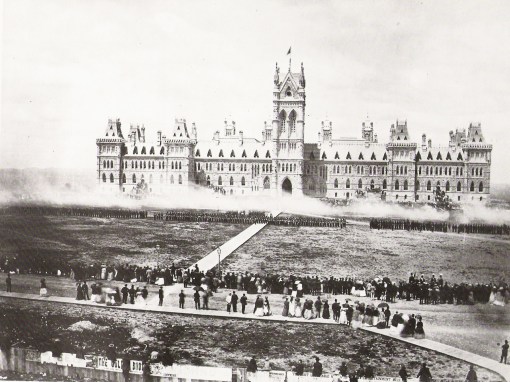
Troops deliver a "Feu-de-Joie" for the Queen's Birthday Review, Ottawa, Canada.

Troops deliver a "Feu-de-Joie" for the Queen's Birthday Review, Ottawa, Canada.

This picture was taken 24 May 1868, the first Victoria Day after Confederation.

This image is in the public domain and is from Library and Archives Canada.


“Globalization and the Making of Canada” Workshop

29 09 2009

I have updated the program of the “Globalization and the Making of Canada” workshop.


Ned Franks on History of Minority Parliaments in Canada

29 09 2009

Ned Franks, Queen’s University political scientist, talks about the history of minority parliaments in Canada on TVOntario’s Agenda. Steve Paikin was, as always, a superb interviewer.


Canadian History Image of the Day

29 09 2009
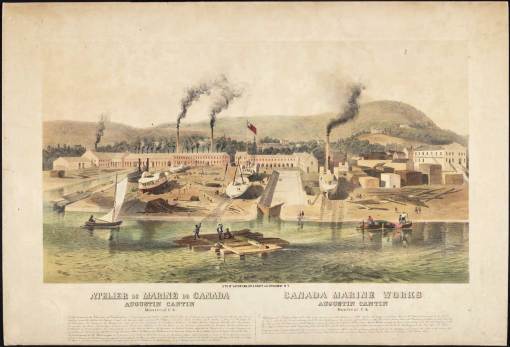
Canada Marine Works, Lachine Canal, 1875

Canada Marine Works, Lachine Canal, 1875

Note that the location is given as “Montreal, C.E.”  In 1867, “Canada East” had become the Province of Quebec. As this lithograph shows, it took time for the new name to catch on in ordinary usage.

Source: Peter Winkworth Collection of Canadiana and the National Archives of Canada.