What would Keynes do if he were confronted with the current economic situation? Have the ideas of Keynes been twisted by modern politicians to suit their own ends? This was discussed by British historian Peter Clark on the BBC`s Today Programme. The most interesting part of this interview was hearing Norman Lamont, one of the great freemarketeers of the 1980s, describe Hayek as a largely forgotten economist. In the 1980s, Hayek`s ideas were in the ascendant and Keynes was being dismissed. (click here to listen)
What Would Keynes Do ?
25 09 2009Comments : Leave a Comment »
Tags: economic crisis, economic history, Keynes
Categories : Uncategorized
Hollywood and History
25 09 2009
Home of Distinguished Historians
I just discovered this list of the top ten historical inaccuracies in films. It was published in the Times in August. I was shocked to learn that Hollywood was not a reliable source of historical knowledge.
The image above is from the Wikimedia Creative Commons.
Comments : Leave a Comment »
Tags: historical inaccuracies in films, history on film
Categories : Uncategorized
Positive Discrimination for Male Students?
24 09 2009Female students now outnumber males in Canadian universities. Some are suggesting that there should lower admission standards for male applicants. For the debate, see here.
I don’t see a problem with having more women than men in university. The fact that many men decide not to go to university may be economically rational. In Canada, there are still big sectors of economy where the ability to do tough physical labour is rewarded quite well. (Think oil sands). Although a few women can do these jobs, these occupations are mostly male. So for an able-bodied young man, the opportunity costs of higher education are greater than for they are for women. That’s why many don’t go.
Comments : Leave a Comment »
Tags: gender gap in education, university admission policies
Categories : Uncategorized
Thomas Paine and the Rights of Hindus
24 09 2009
Thomas Paine
I would like to draw people’s attention to a piece by historian J. M. Opal in Common-place, “Common Sense and Imperial Atrocity: How Thomas Paine saw South Asia in North America”. Opal argues that Paine understanding of British policy in the Thirteen Colonies was influenced by the ongoing British debate about British misrule and atrocity in India.
If Opal’s interpretation is correct, it means that Paine saw the whites of the Thirteen Colonies and Hindu and Muslim populations of India as co-victims of the British Empire.
I found Opal’s argument interesting in light of a book I have purchased and plan to read this weekend, David Armitage’s The Declaration of Independence: a Global History.
The picture of Paine is from the Library of Congress (see here) and is in the public domain.
Comments : Leave a Comment »
Tags: American history, American Revolution, Common Sense, Common-place, global history, Jason Opal, McGill University, Thomas Paine
Categories : Uncategorized
Canadian History Image of the Day
24 09 2009

British Airship Visits Toronto in 1930
Original Caption: “His Majesty’s Airship R-100, over the Canadian Bank of Commerce, the tallest building in the British Empire (Toronto, Canada). 11 August 1930”
This public domain image is available from the City of Toronto Archives, listed under the archival citation Fonds 16, Series 71, Item 7921.
Comments : Leave a Comment »
Tags: Canadian history images, City of Toronto Archives
Categories : Uncategorized
Campus Life
24 09 2009
Rowing Blade in Queen's Tricolour
Queen’s University has cancelled this year’s homecoming party for fears that it will lead to a repeat of last year’s rioting. The Globe story on the cancellation features a detailed map of the area around the university, pointing out known hotspots for trouble. I think that providing this map on the internet is a really bad idea, since it gives trouble-makers from out of a town a better idea of where to go to get into mischief. Was it really necessary to point out the area where bar fights occur most frequently? Did Canada’s national newspaper really need to tell people where on Aberdeen Street the drunken riots are most likely to take place? This is throwing fuel on the fire and telling people it’s water.
As this video suggests, many of the trouble-makers at previous homecomings were outsiders not from Queen’s.
Comments : Leave a Comment »
Tags: future leaders of Canada, Queen, Queen's homecoming, Queen's University, riots by spoilt upper-middle class children, so-called elite institutions of higher education
Categories : In The News
Interview with Historian Greg Robinson
23 09 2009
In this interview, Prof. Greg Robinson talks about his new book, which examines the internment of Japanese North Americans in the United States, Canada, and Mexico after Pearl Harbor. All three countries interned people of Japanese ancestry living on the west coast.
I like the fact that this book takes a pan-North American perspective, looking at all three North American countries. Call it NAFTA history. All too often, historians based in the United States conflate the “United States” and “North America”. Historians in Anglophone Canada are a little better– they make cross-border comparisons with the US but rarely think about Mexico.
Robinson‘s biography is as interesting as this book. He is a native of New York City who now teaches, in French, at l’Université du Québec à Montréal . For a link to Robinson’s personal website, click here.
Image of book cover used with permission of the author.
Comments : Leave a Comment »
Tags: Canadian History, Greg Robinson, Japanese Americans, Japanese Canadians, Japanese internment, Japanese Mexicans, NAFTA history, United States History
Categories : Uncategorized
Making Your Own Japanese Bento Lunch Explained
22 09 2009
For video that explains how to make a bento box and why more Japanese men are doing so, click here.
Comments : 1 Comment »
Tags: bento box, Japanese food, Justin McCurry
Categories : Uncategorized
Wolfe, Montcalm, Remembrance Day 2009 Part II
22 09 2009Christopher Moore has commented on my proposal that the Government of Canada invite the descendants of Wolfe and Montcalm to the 2009 Remembrance Day ceremony in Ottawa.
He had this to say : “Andrew’s well worth a read. But the dead of 1759 who continue to resonate for me are the townspeople killed as their houses crumbled under shellfire during the siege of Quebec, the civilians shot down in skirmishes with the British, the militia who died in their thousands during the whole of the war, even the elderly and the children who died of malnutrition and fevers during the grim winters of that struggle. And that’s not to mention the Acadians, the people of Louisbourg… It would be too bad if our understanding of that became caught up in honouring a French and a British general — or wrangling whether to honour them. Could we not honour an unknown soldier of the Canadian War of the Conquest?”
I certainly agree with Christopher that we should remember all those who died in that battle—my proposal to invite the descendants of the two best-known casualties is intended to raise awareness of all those of who perished, white and Native, general and privates, civilians and military.
Comments : Leave a Comment »
Tags: 2009, Battle of the Plains of Abraham, Canadian historian, Canadian History, Christopher Moore, Plains of Abraham, remembering war in Canada, Remembrance Day
Categories : Uncategorized
Jesuit Archive Opens in Montreal
22 09 2009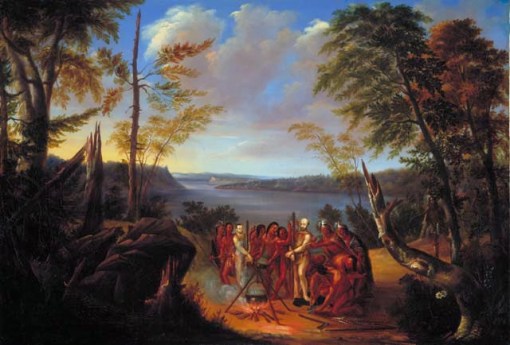
The Martyrdom of Fathers Brébeuf and Lalemant by Joseph Légaré, 1838
The Jesuit Archive of Canada opens today in Montreal. It contains manuscript materials, books, and other primary sources related to the history of the Society of Jesus in Canada from 1611 to present. This archive will be a valuable resource for Canadian historians because the Jesuit Order played a very important role in our country’s history. Fortuitously, the opening of the Jesuit Archive coincides with lectures in my Canadian history survey course in which I discuss the Jesuit missions in New France. In preparation for my lecture yesterday on the destruction of Huronia, I asked my students to look at a volume of the Jesuit Relations in the original French (see here).
For more information about the archives, click here.
The image above is from the Wikimedia Commons and is in the public domain. It is a nineteenth-century representation of the killing of two Jesuit missionaires by the Iroquois in 1649. The Iroquois had captued these missionaries are part of their campaign against the Huron Confederacy. They were burned to death in a Huron village near the present-day Ontario city of Midland. The Catholic Church declared Jean de Brébeuf to be a saint in 1930.
Comments : Leave a Comment »
Tags: archives, Jesuit Archive, Jesuit Order, Montreal, primary sources, Society of Jesus
Categories : Uncategorized
 The Past Speaks


