A Few Thoughts on the TEF (Teaching REF)

18 11 2015

As those of you who follow developments in UK Higher Education know, the British government is currently contemplating a hare-brained scheme a new system of monitoring and regulation designed to improve the quality of [undergraduate?] education in British universities.  The proposed system, which will be called the Teaching Excellence Framework if it is actually implemented, will involve a government agency, HEFCE, measuring and then ranking the performance of universities using a number of criteria. Funding will then follow to universities that do well on this system.
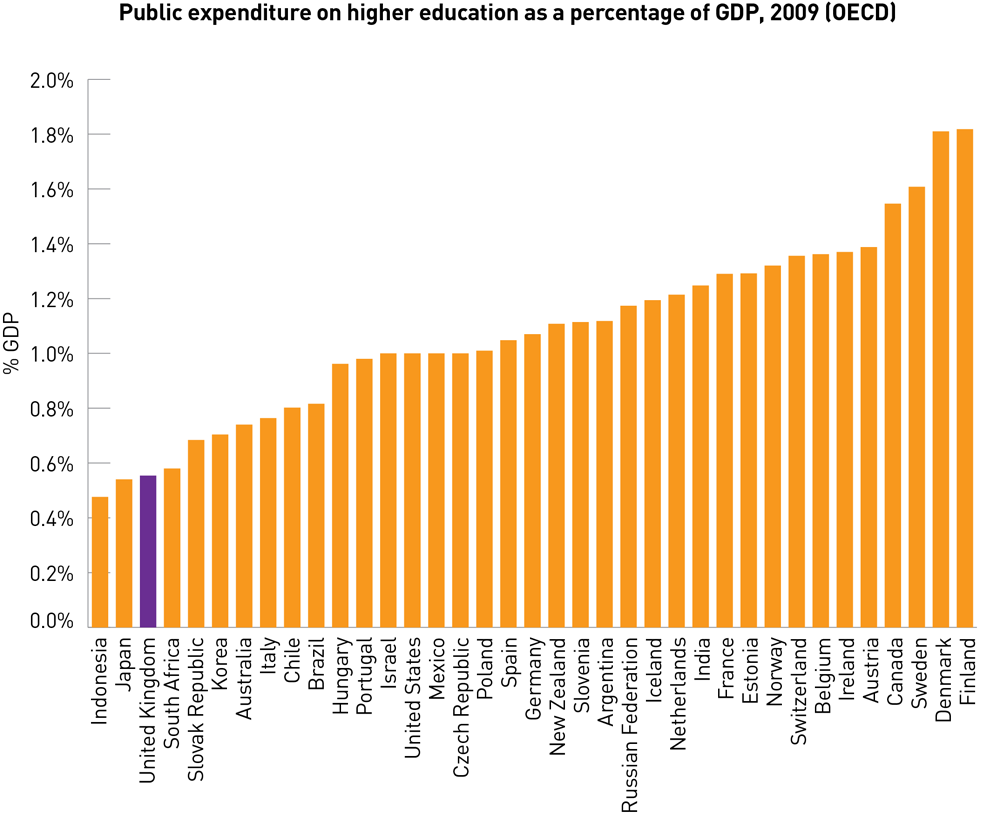
PublicExpenditureHEpercentGDP2009


I understand that there are legitimate concerns about the quality of higher education in the UK relative to other advanced countries with similar levels of GDP per capita. These concerns have been highlighted by recent press coverage about academically superb British students who turn down offers from elite British universities such as Oxford and Cambridge to study in the United States. The Daily Telegraph, which is read by many people in Britain’s ruling Conservative Party, ran an alarmist story on the subject last year. This story reported that more than 10,000 bright British students now study at universities in the United States and that they are attracted by the such things as generous financial aid packages, favourable faculty-student ratios, and the other forms of support that increase student satisfaction. The story also quoted the headmaster of a prestigious boarding school who said “There’s an allure about studying in America and having a broader, liberal arts approach with greater focus on sport, music and artistic prowess. It is a more generous vision of what higher education can be rather than the utilitarian approach we see in the UK [universities].”

If the British government wants to make the student experience in the UK more like that of the United States the correct response to this trend would be for the government to try to increase the percentage of GDP that is devoted to higher education.  (I’m not saying that making British universities more like American ones would actually be a good thing,  as the US student experience encompasses everything from great teaching at liberal arts colleges to racist frat boys in Missouri to crushing student debt loads to Mattress Girl to wonderful libraries to campus shooting sprees). More money would help. As everyone knows, the UK falls short on the higher education GDP table and just four European countries spend less as a proportion of national income. The British government could increase the resources that universities have to devote to students either by increasing public spending on higher education as a percentage of GDP. Alternatively, it could encourage private donors to give more generously to British universities, which would have the net effect of increasing the overall percentage of GDP devoted to universities.  (To his credit, a leading Conservative businessman Lord Ashcroft has given generously to the business school at the University of East Anglia).  Large endowments might allow British universities to close to perceived gap in student experience with the United States.  The British government might incentivize wealthy people to donate to universities through the honours system or  by making it known that wealthy individuals who fail to donate to universities will be exclude from social events involving the Queen.

However, the British government has done nothing of the sort and will continue to fund its higher education sector with a very slender slice of GDP. Instead, the laughable proposal contained in the recent Green Paper is to try to improve the student experience through a species of central planning. A vast and costly bureaucracy will be created to try to measure student satisfaction, which is apparently the best way of measuring the quality of education. (I would have said that retrospective graduate satisfaction, measured say three years after graduation is a better measure). To ensure that academics perform a variety of tick-box exercises, universities will be expected to devote resources to creating costly monitoring and reporting systems.

The proposed regulatory structure looks like this:


As Martin McQuillian notes, this proposal for a new bureaucracy is ironically being justified on the grounds it will somehow create a more competitive market in higher education.

There is a remarkable contradiction in all of this. The government is proposing a substantial apparatus of scrutiny, surveillance, intervention and interpolation, which will occupy untold hours of academic staff time.  It involves delegating new powers to the minister and to BIS and creating a new regulatory landscape that will take years to bed in. In total it represents a very substantial incursion of the state into universities, even if the paper insists that the TEF will be administered at arms length from government. In the name of creating a dynamic market the green paper proposes to build a glorious state bureaucracy.

Ranking systems (remember Consumer Reports product rankings for TV picture quality) do serve a useful service in any market economy as they help consumers to determine value for money before making a costly purchase. Rankings of universities, such as those produced by US News and World Report or the Guardian and Times Higher league tables, can serve a useful function in guiding prospective students to the universities that offer the best student experience. What the British government should do it encourage the development of a competitive market for university rankings.  The best rankings of university teaching quality involve extensive field research, which is very costly, since it involves sending well qualified, and therefore well-paid, academics into countless universities classrooms to do observations. For instance, when researchers at Teachers College of Columbia University and at Yeshiva University, tried to develop a way to compare the educational quality of courses across institutions, they sent observers to sample no less than 587 courses at four different universities.  Even then, there were serious questions about the representativeness of the sampling method and the method of evaluation.  My point is that while the field research needed to produce credible rankings of university teaching quality is expensive, the government may wish to subsidize the production of the rankings in some fashion. However, it should not try to rank university teaching itself, as such an effort represents an attempt to create what is close to a monopoly in the teaching-quality ranking business. Such monopolies are rarely good for the consumers.


EBHA Council Election Results

17 11 2015

The members of the European Business History Association have elected three new council members. They are Veronica Binda (Department of Policy Analysis and Public Management, Bocconi University), Pierre-Yves Donzé (Graduate School of Economics, Osaka University), and Ben Wubs (Erasmus University, Rotterdam). Congratulations to them and thanks to all of the other people who stood for office.


Shout Out to all Historians of International Business

16 11 2015
The Journal of World Business is calling for proposals for Special Issues (see below). As someone who strongly believes that Business History can offer a great deal to scholars in International Business and International Management, I would be interested in forming a team to submit a proposal for a special issue on Business History to this journal. I’m thinking that a team of three guest editors would be ideal for this project. One of them should be an established IB or IM scholar who is interested in historical research methods.
If you are interested in helping me to craft a proposal for the Special Issue of this prestigious journal (ranked 4 in the ABS journal guide), please contact me.
JOURNAL OF WORLD BUSINESS
CALL FOR SPECIAL ISSUE PROPOSALS
Due date: January 15, 2016
Please send proposals to
Kim Cahill, Managing Editor (kimberly.cahill@villanova.edu)
 
The Journal of World Business (JWB) invites proposals for special issues with a due date of January 15, 2016.
 
JWB has a long tradition of publishing high impact special issues on emerging or provocative topics within the editorial purview of the journal. The objective of these special issues is to assemble a coherent set of papers that move understanding of a topic forward empirically and theoretically. Therefore, as a rule, JWB will not publish special issues based solely on papers presented at conferences or workshops. Rather, special issues must be motivated by a clear and compelling focus on an issue that is timely, significant and likely to generate interest among JWB‘s readership.
 
PROCESS
 
Prospective guest editor(s) should submit written proposals that incorporate the rationale for the special issue topic, positions it in the literature, and include some illustrative topics that papers could focus upon.The proposal should also include a draft of the actual call for papers and outline the credentials of the guest editor(s).
 
After the closing date, the JWB editorial team will review the proposals submitted and select one to three for further assessment. This additional analysis may include communication with prospective guest editors, suggestions as to how to strengthen the proposal and/or recommendations for the addition of other guest editors. Following this consultation, one proposal will generally be selected by the Editor in Chief to progress, although the guest editor(s) may still be asked to develop and refine the proposal further. The Editor-in-Chief will generally assign a JWB Senior Editor to serve on the SI editorial team as the Supervising Editor. The Supervising Editor will be responsible for acting as a liaison between the JWBeditorial team and the guest editor(s) and ensuring that JWB editorial standards are maintained through the special issue process. She/he will be actively involved in the entire editorial process, including helping to select which papers are sent for review, identifying and assigning reviewers and in preliminary decisions throughout the review process. However, the ultimate decision to accept or reject papers rests with the Editor in Chief.
 
GUEST EDITOR(S)’ ROLE
 
The guest editor(s) will be responsible for publicizing the call for papers and for generating submissions for the special issue. If appropriate, they may host a workshop for papers being considered for the special issue but attendance at the workshop cannot be a prerequisite for the acceptance of papers. They will also be actively involved in all stages of the review process in terms of inviting reviewers and making preliminary decisions on submissions. The review process will be managed online through the EES system. It is also expected that the guest editors will write an introductory article that will position the special issue in the relevant literature and briefly introduce the papers in the issue. This paper will be subject to editorial review. In order to prevent any perception of conflicts of interest, it is JWB policy that Guest Editors cannot submit to the special issue as authors of papers beyond the introductory article. 


Congratulations to Dimitry Anastakis

10 11 2015

dimitranast

Congratulations to my friend and one-time co-author Dimitry Anastakis. The Trent University business historian has been named to the College of New Scholars, Artists and Scientists of the Royal Society of Canada (RSC).

Professor Anastakis was among 48 new incoming members named to the RSC this fall. As a member, he will work with other experts from across the country to provide guidance on issues of importance to Canadians, and promote Canadian achievements in the arts, humanities and sciences.

“I am honoured to have been elected to the College of New Scholars, and am doubly-honoured to be the first Trent scholar to have been afforded this recognition,” said Prof. Anastakis, who is recognized for his national and international reputation as a leading scholar of Canadian business and economic history, and his ongoing commitment to expanding the boundaries of Canadian history.

Prof. Anastakis’s book, Autonomous State: The Struggle for a Canadian Car Industry from OPEC to Free Trade, released in 2013 was awarded the international Hagley Prize for the best book in business history, and the Canadian Historical Association-Political History Group best book prize, along with being shortlisted by the Social Sciences and Humanities Council of Canada as the best book in the Humanities.  He has published numerous articles and chapters, and his research has been discussed in numerous media outlets including the New York Times.  Prof. Anastakis also serves as the co-editor of theCanadian Historical Review, the flagship journal of his profession.

The College of New Scholars, Artists and Scientists was established in 2014 as Canada’s first national system of multidisciplinary recognition for the emerging generation of Canadian intellectual leadership. It comprises a fourth entity (along with the current three Academies) within the Royal Society, which itself was established in 1882.  The Members of the College are Canadians who, at an early stage in their career, have demonstrated a high level of achievement. The criteria for election is excellence, and membership is for seven years.


Call for Contributors

8 11 2015

AS: I’m forwarding this CFP.
Would you like to play a role in setting out an authoritative, academic history of retail banking in your country or a country well known to you?
Lafferty Group is embarking on a major project: chronicling the rise of mass market retail banking across the world from the early 1970s to today.

If you are interested in becoming a contributor, please get in touch. Alternatively, feel free to forward this web address to friends or colleagues – perhaps other practitioners or indeed academics.

We are concentrating on the last half–century in the initial instance, in order to create an online encyclopaedia. In time, an academic journal, The Journal of People, Money and Culture, is planned and a conference to develop the research further.

Please address your response to Fin Keegan, Managing Editor, email: fin.keegan@lafferty.com.


CFP: From Public Interest to Private Profit: The Changing Political and Social Legitimacy of International Business

6 11 2015

AS: This CFP for a workshop at Toronto’s Rotman School of Management should interest many of my readers. Most of the attendees will be business historians and political economy scholars. We have been told that paper abstracts and CVs should be sent the local organizer, Prof. Chris Kobrak. The other main organizer is Dr William Pettigrew at Kent, who currently holds a large Leverhulme Trust grant to support his very interesting project on the Global Determinants of the English Constitution.

From Public Interest to Private Profit: The Changing Political and Social Legitimacy of International Business

Corporations started their lives as social, political, as well as commercial entities. Organizations like guilds and municipalities concentrated on the local government of economic activity. From the later middle ages, Europeans began to use corporations to stimulate and govern international commerce. Organizations like the Hanseatic League and the Merchant Adventurers Company began to adapt the corporation’s traditional concern with the exercise of local authority to the challenges of pursuing international sources of profit. By the nineteenth century, corporations became less accountable to the societies and states that had once legitimated their privileges and became more self-consciously economic, private, and financial organizations. Since then, many interests have attempted to reintroduce the social purpose of corporations. This has happened with different emphases across geographical and cultural contexts. In continental European countries, for example, the social remit of corporations has proven more durable than in Anglo-Saxon countries. Family businesses with paternalistic policies have emphasized the social dimension of their activities. Over the past two decades, corporate social responsibility has become the latest manifestation of this historic attempt to restore the social role of business. Throughout these developments multinationals have played a special role, because of their size and due to their multicultural social and political impact.

This long-term narrative of the erosion of the local and social dimensions of the corporation suggests a number of important questions.

  1. What role did the internationalization of the corporation play in altering the balance of the three historic dimensions of corporations – the social, political, and commercial?
  1. How did the development of market theories of international commerce in the seventeenth and eighteenth centuries work alongside this internationalization to further detach corporations from their social and political roots?
  1. Why has the social purpose of corporations become so different in different social contexts?

Funded by a grant from the Leverhulme Trust in the UK, and hosted by the Centre for the Political Economies of International Commerce (PEIC) at the University of Kent, UK, and the Business History Group at the Rotman School of Business, this two-day conference in Toronto on 5 and 6 May, 2016 will bring historians, business historians, management scholars, and business practitioners together to discuss these and other questions within a long timeframe and within a cross-disciplinary framework.

Between the seventeenth century and the present, the corporation evolved from a society for government into a profit-seeking entity. How should we understand that history and what is its significance for the 21st century world? A longitudinal history of the multinational corporation not only informs present day businesses about the development of the corporate entity, but also sheds light on its relationships with state authority and public society, offers new insights into the corporation’s broader historical significance, and suggests how its current social and economic roles and responsibilities might develop in the future. Tracing the history of the trading corporation from its sixteenth and seventeenth century genesis through to the present day provides a long-term perspective on the changes and continuities within corporate life as well as some of the pressing policy questions that business historians are well placed to answer: how might the corporation rediscover its social purpose; how feasible is a cross-cultural consensus on the moral and social rationales of transnational businesses; how can global commercial concerns consider their local societal obligations?

This conference will offer an interdisciplinary forum in which to discuss these arenas of corporate life and their change over time. The conversation will offer members of the business community the opportunity to place present day corporate activity into an instructive historical context and to discuss how corporate actors in the past addressed challenges and problems parallel to those facing corporations today. Representatives of corporations will offer their experience about international business to assist the scholarly understanding of how corporations operate and how present day issues and concerns can inform understandings of the past.

The event will include a keynote lecture, an opening panel from business practitioners in which the present-day challenges facing international corporations are discussed. The first day of the conference will focus on the period: 1600-1850. The second day will focus on 1850 to the present day. The conference will end with a summative panel session in which business practitioners reflect on the place of present day corporations in their five-century history.


Chrystia Freeland on Inequality

5 11 2015

Canada’s new minister of International Trade is Chrystia Freeland, a Harvard and Oxford graduate, former Bloomberg executive, and author. (see here) In 2013 she gave a TED talk in Scotland based on her book on increasing inequality, The talk is nuanced, thoughtful, and contains some insights that people across the political spectrum will agree with. Note how Freeland offers olive branches to both the Tea Party and Occupy Wall Street here.  Freeland distinguishes the various causes (technological and political) of rising (within-country) inequality.  She is obviously a superb communicator and is capable of explaining complex trends to a mass audience. Much like the book on which it is based, the talk is long on diagnosis/description and short on cure/prescription: Freeland does a great job of explaining why rising inequality is a problem and what is causing it but the talk sort of trails off when it comes to proposing solutions. In fact, her talk doesn’t really offer any practical solutions aside from calling for some sort of “New New Deal.” Her talk, and the book it is based on, are therefore reminiscent of the more famous work on inequality by Thomas Piketty, which presents tonnes of evidence about rising inequality and then devotes just a few pages to proposing a solution that isn’t terribly practical.

In any event, her TED talk is worth watching, as are the two following videos, which show, respectively, Freeland’s conversation with her friend Larry Summers at Rotman (very serious) and Freeland’s 2014 appearance on the Bill Maher Show (funny).


More Thoughts on HSBC Now

4 11 2015

In an earlier blog post, I mentioned the superb videos about its history that HSBC has placed on YouTube Channel, HSBC Now. (I discovered these videos by accident last week). These videos typically involve an HSBC employee travelling to a site and looking at artefacts related to an individual in the bank’s history who was their antecedent in some sense.

One of the videos focuses on the evolving position of Chinese workers in the bank. This video was particularly interesting to me as I’ve recently published an academic paper on HSBC compradors, the Chinese cultural and linguistic brokers who linked this British-controlled bank to the Chinese business system. (See abstract and link below to the academic article below).

In the video I’m sharing today, Eric Yu, Head of HSBC’s China Desk in Germany, learns about the stories of Peter Lee Shunwah and Zee Tsungyung, whose commitment helped the bank to earn the trust of Chinese customers in the 1920s and 1930s. The video discusses the challenges researchers face in trying to use limited archival materials to reconstruct what these early Chinese employees did. HSBC has a wonderful corporate archive but thanks to war and various other disasters not all of the documents we would want have survived.

Please note that I had nothing whatsoever to do with the creation of these great videos.  If you want to read the paper I mentioned, the details are here:

Smith, Andrew. “The winds of change and the end of the Comprador System in the Hongkong and Shanghai Banking Corporation.” Business History  (2015): 1-28.

Paper abstract: There was a marked shift in attitudes in the capitalist world in the 1960s. In Britain and other Western democracies, workplace discrimination became both illegal and socially unacceptable in the years around 1965. At about the same time, decolonisation accelerated. This article will show how the Hongkong and Shanghai Banking Corporation responded to this changing environment by reforming the way it treated non-British workers in Asian markets. Prior to the 1960s, workers had been assigned to ethnic layers, with ethnic Chinese individuals occupying the lowest group and British expatriates filling all executive posts. In the 1960s, this system was scrapped in favour of a less discriminatory one. This article, which is based on research in the company’s archive as well as other primary sources, will explore how the bank shed the cultural and institutional legacies of colonialism, which included the so-called comprador system.


“Unknown vistas in management and organization history: a workshop.”

24 10 2015

Management and Organization History Cluster Winter School. University of York. Monday 7 December 2015.

“Reports that say that something hasn’t happened are always interesting to me, because as we know, there are known knowns; there are things we know we know. We also know there are known unknowns; that is to say we know there are some things we do not know. But there are also unknown unknowns – the ones we don’t know we don’t know. And if one looks throughout the history of our country and other free countries, it is the latter category that tend to be the difficult ones.”

― Donald Rumsfeld, 2002.

Towards the unknown

The historic turn in Management and Organization Studies (MOS) inaugurated nearly twenty-five years ago appears to have legitimated theoretically sensitive historical studies in a range of management journals, and has seen widespread use of organization theory within business history.

While the philosophical debate about the role of theory narrative, and memory related to method in historical work in MOS will surely continue, we have decided to turn our attention to new vistas, to continue the disciplinary voyage and to ask, simply, what’s next?

The purpose of this Winter School is therefore to identify, outline and discuss the unknowns (both known and unknown) in the field of management and organization history, broadly conceived.

What are the areas and topics about which we are ignorant? Why are they unknown? How might we know them? What new methods and disciplinary collaborations might be required to develop new knowledge? Where will the great disciplinary challenges lie in the coming years? And how shall we address them?

The workshop will be conducted via informal roundtable discussions. Contributions might include (but are not limited to) consideration of historiography, methodology, temporality, historicity, theory, sources, archives, argument(s) and interpretation(s), myths, paradigms, problems, puzzles, inter-disciplinarity, new empirical topics, public history and policy, history and the ‘business humanities’, or any topic which has the potential to open an unknown vista.

We intend that the workshop will lead to an edited volume consisting of short discursive chapters that continue and develop the workshop discussions.

If you are interested contributing individually or with others, or simply to attend, please contact Simon Mollan:

Simon.Mollan@york.ac.uk

The workshop is free. Lunch and refreshments will be provided.


How the Internet Became Commercial

24 10 2015

AS: I have just ordered this intriguing book by Shane Greenstein.

How the Internet Became Commercial: Innovation, Privatization, and the Birth of a New Network (The Kauffman Foundation Series on Innovation and Entrepreneurship)

In less than a decade, the Internet went from being a series of loosely connected networks used by universities and the military to the powerful commercial engine it is today. This book describes how many of the key innovations that made this possible came from entrepreneurs and iconoclasts who were outside the mainstream–and how the commercialization of the Internet was by no means a foregone conclusion at its outset.

Shane Greenstein traces the evolution of the Internet from government ownership to privatization to the commercial Internet we know today. This is a story of innovation from the edges. Greenstein shows how mainstream service providers that had traditionally been leaders in the old-market economy became threatened by innovations from industry outsiders who saw economic opportunities where others didn’t–and how these mainstream firms had no choice but to innovate themselves. New models were tried: some succeeded, some failed. Commercial markets turned innovations into valuable products and services as the Internet evolved in those markets. New business processes had to be created from scratch as a network originally intended for research and military defense had to deal with network interconnectivity, the needs of commercial users, and a host of challenges with implementing innovative new services.

How the Internet Became Commercial demonstrates how, without any central authority, a unique and vibrant interplay between government and private industry transformed the Internet.