Open Borders Charities

26 11 2014

I’m reposting a recent and very interesting blog post by Bryan Caplan,

Argentina officially has near-open borders.  At least on paper, you only need an employer or family member to sponsor you.  The country isn’t as quite First World, but with per-capita GDP around $15,000, Argentina would be a huge step up for most of the workers of the world.
Question: How hard would it be to set up a cost-effective charity to help sponsor the global poor for immigration to Argentina?  Responses from GiveWell, the broader Effective Altruism community, and Argentina experts are especially welcome.


The Use and Abuse of Environmental Knowledge: A Bloomington School Interpretation of the Canadian Fisheries Act of 1868

25 11 2014

The Review of Austrian Economics has just published my article The Use and Abuse of Environmental Knowledge: A Bloomington School Interpretation of the Canadian Fisheries Act of 1868 

Abstract: This paper will focus on the ambitious plan for regulation embodied in the Dominion Fisheries Act of 1868, a law passed by the Canadian federal parliament in its very first year of existence. The 1868 law was intended to bring the nation’s fisheries firmly under the control of officials employed by the new federal government. The paper argues that 1868 law, which was designed to address what would today be called Tragedy of the Commons problems, was a product of the hubris identified by Hayek as “the fatal conceit.” The centralized and bureaucratic approach to governing fisheries represented by the 1868 Fisheries Act did not work well because the knowledge that would have been required for successful management of fisheries was highly dispersed. Drawing on Hayek and the Bloomington School, this paper argues that the experience of Canada’s fisheries sector in the generation after 1868 illustrates the problems with centralized management Common-Pool Resources. In the 1890s, the centralized approach represented by the Fisheries Act of 1868 was replaced by a more flexible and decentralized system Hayek’s theory of knowledge would suggest the reversal of centralization over environmental policy in the 1890s was a positive development that helped Canadians to reconcile the goals of economic development and the protection of the environment. The Hayekian paradigm of knowledge management suggests that control over environmental policy should be devolved downwards to the levels of government closest to resource users.

F.A. Hayek

F.A. Hayek

Special thanks to Viv Nelles, Pierre Desrochers and Mark Pennington for commenting on an earlier draft of this paper. I also received valuable feedback when I presented this paper at a workshop at the Rotman School of Management in Toronto.  Thanks also to the Foundation for Canadian Studies in the United Kingdom for its financial support.


Funny Video about Fairness and Economic Behaviour

21 11 2014

Today, I had that chance to observe the teaching of a colleague here at the University of Liverpool Management School. It was an inspirationally good lecture characterized by excellent use of IT and great verbal delivery. The colleague, who is an economist, was teaching the second-year students about the behavioural economics research that shows that people will refuse to participate in transcations they regard as unfair even if this costs them money. Needless to say, this finding is the opposite of what the Max U model of human behaviour we were taught in Econ 101 says. After reviewing the research that shows that the universal human desire for fairness is also found in primates, she showed this hilarious video about monkey economic behaviour.


Wadsworth Prize

21 11 2014

Congratulations to Professor Richard Roberts (King’s College London) for winning the 2013 Wadsworth Prize for his “Saving the City: The Great Financial Crisis of 1914“.

The BAC Wadsworth Prize is awarded annually by the Business Archives Council to an individual judged to have made an outstanding contribution to the study of British business history in that year.


Request for Information about Edward Chaloner, Liverpool Timber Merchant

19 11 2014

In the middle of the nineteenth century, one of the world’s leading authorities on wood was a Liverpool timber merchant named Edward Chaloner.  Chaloner’s firm, Chaloner and Fleming, branched out from handling timber into the production of commercial intelligence about timber, particularly about the exotic species of wood that became increasingly important to timber merchants after 1842.

His 1850 book on mahogany was the standard reference work on the wood in the era. Chaloner also issued a circular that updated his subscribers about the current state of the timber market. I also know from contemporary newspaper accounts that Chaloner’s  catalogues of timber resembled scientific works of botany in their detail and comprehensiveness. I’m interested in looking at these catalogues and other surviving papers related to Chaloner and his companies. I have learned that these nineteenth-century papers survived as late as 1967, when Liverpool timber merchant Frank Latham published a history of Liverpool’s timber trade. Latham mentions that the 19th century timber catalogues are still in the possession of the successor company.

I don’t know what happened to Edward Chaloner and Co. and its records after 1967. I do know that a company called Edward Chaloner & Co Timber Ltd was registered in 1998, but I don’t know what relation, if any, this now dormant firm had to the old Liverpool company. The registered address of the firm founded in 1998 is in Hartfield, East Sussex, so I strongly suggest that it does not have the papers that were still in Liverpool in 1967. After all, it would have been a lot of work to carry the papers down to Sussex.
I would be very grateful if any readers could point me in the right direction, as I would like to find these papers for my academic research.

This appeal is directed to all parties who may have relevant information, particularly Liverpool timber merchants, descendants of Edward Chaloner, and members of the North West Timber Trade Association.

Andrew Smith, Lecturer in International Business, University of Liverpool Management School

———–

Latham, Frank A. Timber Town: A History of the Liverpool Timber Trade. Liverpool: Institute of Wood Science (Liverpool Branch), 1967.


Cross Border Business in Occupied Europe : Rethinking Continuity and Change

17 11 2014

AS: The University of Toronto recently hosted a workshop on the theme of cross-border business in Occupied Europe during the Second World War. I’m posting information about this event below.

Cross Border Business in Occupied Europe : Rethinking Continuity and Change
A working international meeting, University of Toronto, November 6-8, 2014 

In the past two decades, drawing on a range of previously untapped sources, historians have produced a rich body of work on the challenges, the risks, and the modalities of doing business in a variety of European countries under German occupation.  They have told national stories, comparative stories and more recently, multi-national stories.  In the course of doing so, scholars have engaged some of the trenchant debates about life under Occupation- collaboration, resistance and the space between; the meaning of “freedom of maneouvre” in dealing with a dictatorial regime, the tangled relations of enterprises to their own states and to Germany—to name but a few.
In following the stories of national and multi-national business, historians have increasingly expanded the temporal book-ends of their accounts, beginning in the early 1930s if not before and continuing well past 1945.  Both implicitly and explicitly, their work problematizes conventional wisdom about continuities and discontinuities in the history of cross-border business in Europe.

“Cross Border Business in Occupied Europe” is animated by two sets of questions designed to further the re-thinking.:

First, what is the impact of expanding the temporal book-ends on the questions we pose about the period 1940-1944?   In what ways does the expansion of the time frame privilege a type of path dependent analysis? To what extent has the study of the post-Liberation era affected what historians have “noticed” during the Occupation?

Secondly, what is the impact of broadening our analyses to include multi-national businesses under Occupation? To what extent has study of the multi-national enterprises under Occupation provoked the identification of new tipping points and the rethinking of accepted continuities and changes?


Cross Border Business in Occupied Europe : Rethinking Continuity and Change
Munk School of Global Affairs, University of Toronto, Room 208, North Wing


November 7, 2014

10:15 -10:30 Welcome: Susan Gross Solomon

Session I:  National Stories and Moving Bookends

Chair :

10: 30-12:00

Hervé Joly (Universite de Lyon)
The chemical and artificial textile industries
Stephan Lindner (University of the Bundeswehr, Munich)
Re-Thinking IG Farben

Discussion

12:00- 1:30  Lunch

1:30 -4:15

Marc Perrenoud (Switzerland)
Re-thinking the Terms of Reference and Findings of the ICE

Martin Horn (McMaster University, Hamilton)
Economic Warfare, American Business and Occupied France, 1940-1942

Dawn Berry ( Oxford)
The German occupation of Denmark and The Danish Cryolite Company

3:00 -3:30 Coffee

3:30 -4:15: Discussion :

Discussant/Animator: Peter Hayes

November 8, 2014

10:00 – 12:30:  Session II: From National to Multi-National Stories and (perhaps) Back Again

Ben Wubs (Erasmus School of History, Culture and Communication, Erasmus University, Rotterdam) ABUP in the post-war period
Talbot Imlay (Université Laval, Quebec)
Ford and Ford SAF

Susan Gross Solomon (Munk School of Global Affairs, University of Toronto),
Philips NL and its French tentacles, 1936-1950

Discussant/Animator: Chris Kobrak, Rotman School of Management, University of Toronto)
12:30- 2:00 lunch


New Book Alert: Macdonald at 200

13 11 2014

Macdonald at 200 presents fifteen fresh interpretations of Canada’s founding Prime Minister, published for the occasion of the bicentennial of his birth in 1815. Well researched and crisply written by recognized scholars and specialists, the collection throws new light on Macdonald’s formative role in shaping government, promoting women’s rights, managing the nascent economy, supervising westward expansion, overseeing relations with Native peoples, and dealing with Fenian terrorism. A special section deals with how Macdonald has (or has not) been remembered by historians as well as the general public. The book concludes with an afterword by prominent Macdonald biographer Richard Gwyn. Macdonald emerges as a man of full dimensions — an historical figure that is surprisingly relevant to our own times.

Order it here.

About the editors:

Patrice Dutil is professor of politics and public administration at Ryerson University. His publications include Canada 1911 and Devil’s Advocate. A frequent media commentator on Canadian affairs, he is the president of the Champlain Society and the founder of The Literary Review of Canada. He lives in Toronto.

Roger Hall is professor emeritus of history at Western University and senior fellow at Massey College, University of Toronto. He has been editor of Ontario History and co-editor of The Canadian Review of American Studies. His publications include A Century to Celebrate and The Rising Country. He lives in Toronto.

Table of Contents

Part 1: Macdonald and Society
Chapter 1: Colin Grittner, “Macdonald and Women’s Enfranchisement”
Chapter 2: Donald Smith, “Macdonald’s Relationship with Aboriginal Peoples”
Chapter 3: David A. Wilson, “Macdonald and the Fenians”
Chapter 4: Timothy J. Stanley, “Macdonald, Chinese Exclusion and the Invention of Canadian White Supremacy”
Chapter 5: Michel Ducharme, “Macdonald and the Concept of Liberty”
Part 2: Macdonald and the Economy
Chapter 6: J.J. Ben Forster, “First Spikes: Railways in John A. Macdonald’s Early Political Career”
Chapter 7: E.A. Heaman, “Macdonald’s Fiscal Realpolitik”
Chapter 8: David W. Delainey and J.C. Herbert Emery, “The National Policy’s Impact on the West: A Reassessment”

Part 3: Macdonald and Government
Chapter 9: Barbara J. Messamore, “Macdonald and the Governors General: A Prime Minister’s Use and Abuse of the Crown”
Chapter 10: Patrice Dutil, “Macdonald, his ‘Ottawa Men’ and the Consolidation of Prime Ministerial Power (1867-1873)”
Chapter 11: J.R. Miller, “Macdonald as Minister of Indian Affairs: The Shaping of Canadian Indian Policy”
Chapter 12: Bill Waiser, “Macdonald’s Appetite for Canadian Expansion: Main Course or Leftovers ?”


Hilarious For Academics

11 11 2014

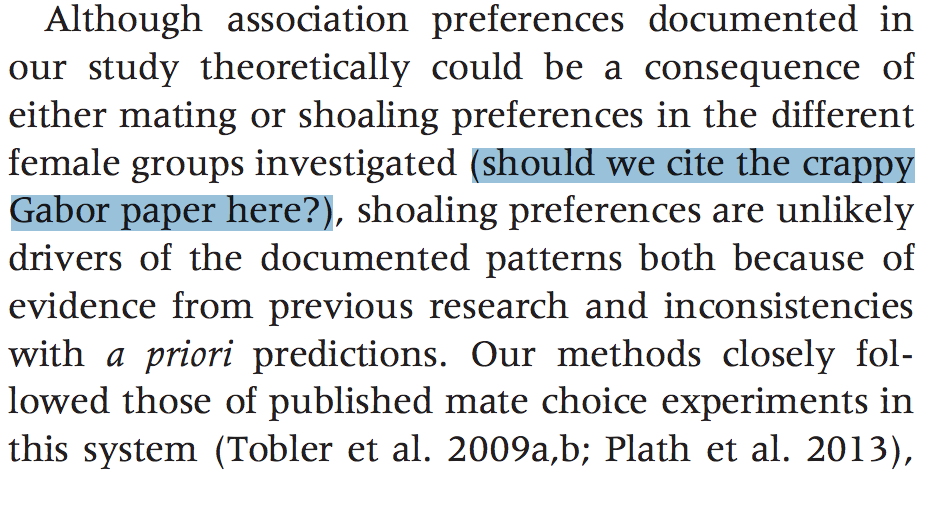
The following image, which is of a published paper, was circulated on Twitter yesterday, along with the words:

“Not sure how this made it through proofreading, peer review, and copyediting

Pro-tip: when co-authoring papers, always speak to the co-author by inserting Comments into the Word document!

Screenshot 2014-11-11 21.34.16

For the record, I consider the use of this image of the text to be “fair use.”


11 November 2014 Reading

11 11 2014

Tower of London Poppies

On Armistice Day, the anniversary of the end of the First World War, it is customary to think of the fallen, and of the ways by which the likelihood of war can be reduced. As armistice day reading this year, I would recommend an excellent new collection of essays called The Handbook on the Political Economy of War edited by Christopher J. Coyne and Rachel L. Mathers. The papers in this collection, which are by scholars working a variety of disciplines and intellectual traditions, are, for the most part, superb.

Here is the book’s Table of Contents:

1. Introduction
Christopher J. Coyne and Rachel L. Mathers

PART I: WHY WARS ARE WAGED
2. Theories and Causes of War
Jack S. Levy

3. The Reasons for Wars: An Updated Survey
Matthew O. Jackson and Massimo Morelli

4. Can’t We All Just Get Along? Fractionalization, Institutions and Economic Consequences
Peter T. Leeson and Claudia R. Williamson

5. Psychological Aspects of War
Iain Hardie, Dominic Johnson and Dominic Tierney

PART II: WAYS OF WAGING WAR
6. What is Guerrilla Warfare?
Anthony James Joes

7. The Economics of Torture
Pavel Yakovlev

8. Terrorism in Rational Choice Perspective
William F. Shughart II

9. The Political Economy of Conscription
Panu Poutvaara and Andreas Wagener

PART III: CIVIL WAR AND REVOLUTION
10. Economic Perspectives on Civil Wars
Nathan Fiala and Stergios Skaperdas

11. Political Economy of Third World Revolutions
Misagh Parsa

PART IV: THE ARMS TRADE
12. The Arms Trade
David Kinsella

13. Arms Trade Offsets: What Do We Know?
Jurgen Brauer and John Paul Dunne

PART V: POLITICAL AND ECONOMIC SYSTEMS
14. The Capitalist Peace
Erich Weede

15. On the Democratic Peace
Sebastian Rosato

16. International Conflict and Leadership Tenure
Randall J. Blimes

17. A Public Choice Perspective on Defense and Alliance Policy
Bernhard Klingen

18. International Regimes and War
James Ashley Morrison and Avery F. White

PART VI: POST-CONFLICT RECONSTRUCTION AND NATION BUILDING
19. Fixing Failed States: A Dissenting View
Justin Logan and Christopher Preble

20. Choice and Consequence in Strategies of Transitional Justice
Geoff Dancy

21. Dynamics of Military Occupation
Michael Hechter and Oriol Vidal-Aparicio

22. Three’s Company? Towards an Understanding of Third-Party Intervention Effectiveness
David Carment and Martin Fischer

23. Credible Commitment in Post-Conflict Recovery
Thomas Edward Flores and Irfan Nooruddin

24. Conflict, Credibility and Asset Prices
Gregory M. Dempster and Justin P. Isaacs

PART VII: ALTERNATIVES TO WAR
25. Disaggregated Trade Flows and International Conflict
Han Dorussen and Hugh Ward

26. Sanctions as Alternatives to War
David Cortright and George A. Lopez

27. International Negotiation and Conflict Prevention
I. William Zartman

28. The Economics of Peacekeeping
Lloyd J. Dumas

Index


Timothy Shenk on the Historians of Capitalism

10 11 2014

In recent years, a group of young business historians in the United States have attempted to re-brand business history at the “history of capitalism.” As part of the rebranding, these scholars have refocus the attention of the business-history community on the issue of inequality.

The Nation, a left-leaning US magazine, has published a very lengthy article on the new breed of historians of capitalism. This l thoughtful article, which is by Timothy Shenk, is about far more than the scholars who are calling themselves historians of capitalism. Indeed, this article is an intellectual tour of the horizon and discusses the ideas of the wide range of social thinkers, from Adam Smith to John Stuart Mill to Larry Summers and Tyler Cowen. (The TV host Jerry Springer also gets a brief mention).  Anyway, this piece should be read by all serious social scientists.

Here is a sample of the article.

Historians of capitalism hail from departments across the country, but the field’s most prominent enthusiast occupies an ideal perch for academic proselytizing. In 1996, a young German-born historian of the United States named Sven Beckert was hired by Harvard University’s history department. The title of Beckert’s dissertation alone was significant: called “The Making of New York City’s Bourgeoisie, 1850–1886,” it nodded to the Marxist historian E.P. Thompson’s classic text The Making of the English Working Class (1963), and it highlighted a concept—“bourgeoisie”—shunned by scholars wary of associating themselves with a Marxist vocabulary. Beckert’s methodology was more indebted to the great figures of modern sociology than to Capital, but at the time Marxism of any kind was unfashionable among historians. It remained so five years later when the book quarried from Beckert’s dissertation was published as The Monied Metropolis.