Some Reflection on Recent Events in Canada

5 07 2021

Part of my research in about the uses of the past, about how companies and other organizations use their histories. A sub-set of that strand of my research is about how organizations respond they have been accused of having committed truly horrible human rights abuses in the past. I also published a paper in Journal of Business Ethics on how executives of the Hudson’s Bay Company, which was founded in the seventeenth century to trade with Indigenous people in present-day Canada, has responded in recent decades to the accusations from Indigenous activists that the original source of the firm’s wealth was the systematic exploitation of Indigenous people. I’ve also published on the political economy of Confederation, the process by which the Canadian state was formed in the 1860s. The cover of a book on the subject that I published is above. I’ve also acted as an expert witness in a Canadian constitutional court case that turned on the interpretation of the Canadian constitution of 1867. My published work on this subject has been characterised, I think, by nuance and a balanced treatment of historical figures as well as the application of a theoretical lens that is critical of the empire-building, illiberal, dirigiste, mercantilist and social-engineering ideas of many of the creators of the Canadian federal state.

I’ve therefore followed with interest the recent controversies in Canada over the legacies of the residential schools for Indigenous children that the Canadian federal government created after the 1860s. In recent months, the graves of children who died of diseases while attending these schools have been identified (the fact that several thousand of these children died while at these schools was previously known, part of the agreed statement of facts produced by the Truth and Reconciliation Commission, and discussed in books published by Canadian university presses). The discovery of the graves led to protests, arson attacks against Roman Catholic churches, the toppling  of statues of Queen Victoria and Queen Elizabeth II, and, in many communities, the cancellation of Canada Day, a national holiday on 1 July that marks Confederation. I’ve been asked what I think about this issue so I am sharing some very preliminary observations here. I’ve organised my thoughts under four headings. 

Departure from What the Standard Model Would Predict

There is a large body of social-scientific research on demands for historical apologies by the governments of liberal democracies. Essentially, this literature contains a large number of case studies of incidents in which activists in a nation accuse the government of having been involved in some horrible human rights abuse in the past. The accusation could relate to, say, the French government’s actions in Algeria before independence, what Britain did in Kenya during the Mau Mau uprising, or the historical mistreatment of African-Americans in the US context. Now reading a bunch of studies from different liberal-democratic countries leads one to discern the pattern that I call the Standard Model.

 The Standard Model goes like this: a group, usually on the left of the political spectrum, makes a public claim that the national government was involved in a horrible human rights abuse in the past. They demand an apology, perhaps with money attached, and symbolic action such as the renaming of streets, the removal of statues, and the cancellation of a national holiday (Bastille Day, Australia Day, whatever). Now the Standard Model predicts that any given individual’s response to these accusation will be largely determined with great accuracy simply by determining where the person is on the country’s left-right political spectrum. If they are a supporter of the main centre-right political party (say the Conservatives in Canada or the UK or the Republicans in the US or France), they will typically say “Well, what happened then wasn’t very good and was clearly wrong. However, we shouldn’t dwell on it too much. The minority group that is complaining about this historical injustice should focus more on making money in the present day”.

In other words, the centre-right person tends to minimize or downplay the present-day significance of the historical injustice. In contrast, supporters of left-wing political parties tend to have the opposite view and they tend to maximize the significance of the historical misdeed. As you go to the extreme left of the spectrum, you get people expressing this sort of sentiment: “What our country did is horrible. We were basically as bad, if not worse, than the Nazis and the minority group that was victimized back then now needs lots of help from us. Our country and other Western countries are in no position to lecture [insert name of authoritarian regime here] about human rights. We should discontinue our national holiday and tear down the statues etc linked to the bad guys responsible for the historical human rights abuses.” We see this pattern here in Britain, in the US, in France, and so forth.

Based on the polling data and academic studies from various countries I’ve seen, the Standard Model usually has pretty strong predictive accuracy (0.8 or 0.7 or something in that range). However, when I look at the terms of debate in Canada right now about residential schools, I get the impression that the relationship between one’s position on the left-right political spectrum and position on historic crimes is broken, or at least, weaker than it is in the other cases covered by the Standard Model. First, which of Canada’s two official languages one speaks seems to predict how you view the historical issue of residential schools: I’ve sampled the debate in  the French-speaking province of Quebec on this issue people there tend to frame this story less about racial issues and more within a narrative about the Roman Catholic church’s history of human rights abuses around the world. Second, in the English-speaking parts of Canada, one’s prior attitude towards the Roman Catholic church, which is still largely independent of one’s position on the left-right political spectrum, appears to be driving attitudes towards this issue. People who never liked the Catholic church, either because they were left-wing feminists or hardcore Protestant evangelicals or  centrist followers of the New Atheism of Richard Dawkins, have worked the newly revealed evidence of abuse in Catholic schools into their existing narratives. Such people maximize the historical injustice now being discussed, even if they are politically conservative. Needless to see, we’ve seen a festival of confirmation bias on all sides that is going to be depressing to any social scientist.  The situation is very awkward for the governing Liberal Party, a traditionally centrist party that has recently lurched to the left, because historically there was a statistically significant linkage between being at least nominally Roman Catholic and voting for that party.

McGill-Queen’s University Press

In 2008, the Canadian government offered an apology and compensation to the Indigenous individuals who suffered because of the residential school system. The government also funded Truth and Reconciliation Commission to  undertake extensive research into the residential schools and to produce an agreed statement of facts that could be basis of discussion about how to go forward. The many volumes of the TRC’s report were published by McGill-Queen’s University Press (full disclosure I’ve published with that press and happen to be an alumnus of one of the universities that owns it). Volume 4 of the report deals with the issue of how many children died while attending the residential schools, what we know about their remains, and what we know about what caused their deaths. This scholarly work, which was published in 2015, would allow interested readers to answer the following questions that have recently been the subject of intense and, sometimes ill-informed speculation, in Canada:

  1. How many children died while attending residential schools?
  2. How did this mortality rate change over time?
  3. How did the mortality vary between the residential schools run by the Catholic Church versus the Protestant-run schools?
  4. How did the mortality rate for these groups of children differ from that of otherwise similar children who lived with their parents and were educated at day schools or did not attend any school? What baseline child mortality rate should we use in determining whether the residential school system increased the mortality rate for Indigenous children?

All of my priors make we think that that a rigorous analysis would reveal that the residential school policy would have increased mortality relative to the counterfactual of allowing parents to educate their children as they saw fit. My priors and my knowledge of the enormous differences between nineteenth-century Protestantism and nineteenth-century Roman Catholicism also make me predict that the effect would be more pronounced for Catholic-run schools than Protestant-run ones. However, until I can see the work of the real experts, we can’t say for certain, let alone talk about effect size. One of the things the recent pandemic has taught all of us is to show greater humility in making causal claims linking particular government policies with changes in the mortality rate. That’s doubly true when we are talking about historical data with big gaps.

Anyway, all of this is to say that the research on the impact of the residential school project on Indigenous child mortality should, I think, be freely available to journalists and all others who want to base their opinions on the best available data and analysis. Unfortunately, both the relevant research and contact details of the academics who did it remain behind paywall which means that is hard for journalists in Canada’s woefully funded newsrooms to access. Volume 4 “Canada’s Residential Schools: Missing Children and Unmarked Burials” which was published by MQUP in December 2015 can be ordered here but is very expensive.  I would strongly encourage the Press to immediately release at least Volume 4 to everyone by putting its contents, including the description of the statistical methodology used online in open-access format. They could do so with a few key strokes!!!!

Recent Events Demonstrate the Need for Research Capacity Building in Canadian Universities

Canadian universities have become weak in the types of quantitative historical research methods that are necessary to investigate issues of this type.  They certainly have less capacity in this regard than do universities in this country. Quant historians such as George Emery, a historian whose research rigour was honoured with an award from a group of leading American economist, have retired and were replaced by scholars with different research capabilites. My impression that there will, after this month, be nobody in a Canadian university who does anthropometric history or the other types of history relevant to answering the questions identified above. Vincent Geloso, who works at a university in Ontario that used to be very strong in economic and demographic history, will soon be leaving for George Mason University’s famous econ department. In response to the recent debates about residential schools, Geloso has recently published some interesting insights into the political economy of settler-Indigenous relations in Canada that draws on his earlier peer-reviewed research in Public Choice. The core ideas he presents here, which involve applying concepts from public choice theory and constitutional political economy, are similar to those that I used in a paper that I wrote about 15 years ago but which never saw the light of day because of hostile peer reviewers. I’m glad that Vincent re-discovered these ideas independently and got them published as they can inform debate on how to go forward. I would add here that some of the research of Prof. Terry Anderson into Indigenous economies can also be of use in thinking about these issues.

The End of Canadian Originalism?

Canada Day holiday on 1 July marks the coming into force of the Canadian constitution of 1867. The holiday and the associated iconography implies that the politicians who created this constitution were heroes, or at least great statesmen whose memory should be honoured. Respecting the drafters of this constitution is thus congruent with the doctrine of constitutional interpretation known as originalism, which holds that in interpreting the meaning of the constitution’s text, judges should act effectively as agents on behalf of those who originally wrote it. Many countries with written constitutions have originalists (see here). There are smart Canadian lawyers and legal academics who are originalists (see here). They include Benjamin Oliphant and Leonid Sirota. Given that statutes of that 1867 constitution’s creators are now being dismantled, I suspect that originalism will die as a doctrine in Canada. When the creators of a document are regarded as evil, rather than imperfect, individuals it is almost impossible for people to continue to be seen as supporting a theory of constitutional interpretation that says that we must understand and defer to how those individuals intended the document to be understood. It fact, I suspect that it would be career harming for an academic working in a Canadian university to continue to be a Canadian originalist in the current context. The demise of Canadian originalism would probably be unfortunate because there are strong theoretical reasons for supporting at least some variant of originalism as William Baude argued in a recent conversation with Julia Galef.



Modern State-Building and the Rise of the Corporation by Taisu Zhang

5 07 2021

Andrew Smith: I’m sharing the details of interesting-sounding online seminar that sadly is in the middle of the night for us here in Europe.

Modern State-Building and the Rise of the Corporation by Taisu Zhang
Live on Zoom on Thurs, July 8, 2021
09:00 Hong Kong/Beijing/Singapore | 10:00 Tokyo | 11:00 Sydney
Wed, July 7 – 18:00 Los Angeles | 21:00 New York
Convert this into your local time

Register here.

The business corporation and the modern state both emerged very late in human history, but quickly became sociopolitically and economically prominent once they did emerge. Taisu Zhang and his co-author from Yale Law School focus on the genesis of the corporation to explore the links between these two institutions. Unlike preexisting theories that view the relationship between the two as a predominantly negative one—that the state’s primary role in the rise of the corporation was to credibly constrain its own use of coercive power—they argue that the state also positively contributed to the corporation’s emergence. In fact, the modern state’s positive contributions were so significant that they were likely indispensable: it is no coincidence that the business corporation did not become socioeconomically prominent until after the ascendancy of modern state building.

Taisu Zhang and his co-author first argue that there will be significant demand for the modern corporate form only after complex, long-duration business collaboration between strangers becomes economically prominent. They then argue that, within the context of trans-communal business relationships, the business corporation can only emerge with robust institutional support from a sufficiently modern state, in the form of legal enforcement, dispute resolution, and information sharing. In this Quantitative History Webinar, Taisu Zhang explores the argument that modern state building is necessary to the success of the modern corporation because the law that enables corporations requires uniform enforcement.

Taisu’s co-author: John Morley (Yale Law School)

Looking forward,
Quantitative History Webinar Series

Conveners:
Zhiwu Chen & Chicheng Ma


In Praise of the ABS Journal Rankings

28 06 2021

In Partial Praise of the ABS Journal Rankings

I recently attended an online conferences of UK management academics where there was a passionate discussion of the Academic Journal Guide, the rankings of management journals produced by the UK’s Chartered Association of Business Schools. This list has always been controversial, particularly whenever a journal is downgraded or upgraded. Similar passions are ignited by the equivalent journal rankings used in other countries, such as Australia’s Business School Deans List or the CNRS list in France. The stakes in the battles over which lists to use and if so how to use them are high because hiring and promotion in many UK business schools is largely a function of one’s ability to publish in whichever journals are highly ranked. The uses of journal rankings as  heuristic or quick proxy for research quality is almost necessary evil in the UK context because the job candidate process is a very short and low cost compared the expensive multi-day campus visits by which job candidates are screened in North American universities.

In recent years, some UK business schools have moved away from using journal ranking lists such as the AJG in the course of making decisions about hiring and promotion. The business school at a leading Welsh university, for instance, has gone so far as to prohibit all references to this or any other journal rankings, or even journal impact factors, in makings decisions about hiring and promotion. The British Academy of Management recently declared that it wants an end to the use of journal rankings. Some other business schools are moving in that direction, although I have been informed that there are now bitter, internecine struggles between different departments within at least on English business school over this issue. The move away from the use of journal rankings is driven, in part, by a growing belief on the part of some academics and some external knowledge stakeholders that the research published in some highly-ranked journals is low in quality. A few years ago, a retired management academic published a scathing article on this subject called “The Triumph of Nonsense in Management Studies”.  This Emperor-Has-No-Clothes article was read and discussed by some policymakers and doubtless has undermined the credibility of a few of the many journals reported in the list.

Another factor that is pushing UK business schools away from using journal lists is government policy, both in England and in the nations with devolved administrations.  The UK’s current Science Minister has heard about the use of journal ranking lists in various academic disciplines and has said that this practice does not promote the interests of taxpayers, British companies, students, and so forth. Speaking to University-Business UK in October 2020, Amanda Solloway spoke of the problems that come from the use of journal ranking lists:  “Researchers tell me they feel pressure to publish in particular venues in order to gain respect to their peers, which wrongly suggests that where you publish something is more important than what you say.” Solloway has ordered a “root-and-branch” review of how academic research in the UK is funded and measured so that it produces more benefits for UK firms and society as a whole. The international task force she has appointed is currently reviewing how the UK’s research funding and measurement system works. It is expected that it will recommend that it will recommend that it become much more like Research for Australia, the Australian government’s system for measuring and funding research, which has attempted to change the focus of academics away from just publishing papers for other academics and towards greater engagement with private industry. The replacement of the Research Excellence Framework with a sort of Research for Britain system would doubtless encourage more management schools to stop using journal lists, especially since some of the highly ranked journals publish research that would be, we would have to say, of zero potential relevance to any manager ever.

While we await word of what the UK’s new research funding system looks like, the UK government has introduced a policy that is clearly incompatible with the use of journal ranking lists: in 2019, UKRI, which under the control of the Minister of Science, ordered all UK universities to both become signatories of the San Francisco Declaration on Research Assessment (DORA) and to take steps to ensure that all units within universities (departments, faculties, etc) were  compliant with the basic principle of DORA, which is that in evaluating the quality of a published research output (say a paper), judgements must be informed solely by a reading of the output rather than any knowledge of who published it.   My understanding is that there are now countless fights going on a various levels within universities across the country about how seriously departments and hiring committees should take the DORA principles to which all universities now pay lip service. I suspect that the model of academic behaviour introduced in Chapter 2 of Cracks in the Ivory Tower by Jason Brennan and Phillip Magness does a good job of explaining the patterns we can see in which academics support DORA implementation and which academics are against it.

Personally, I think that journal guides are likely to remain an important factor that influences hiring and promotion decisions in UK universities and UK business schools in particular. I generally use the theory of regulatory capture (Stigler, 1971) to understand how the UK’s REF system, which was originally developed with the laudable goal of increasing the taxpayer’s return on funding in academic research, works in practice. Perhaps I watched too many episodes of Yes Minister when I was growing up, but I suspect that the journal ranking lists will outlive the tenure in office of the UK’s current Science Minister. Moreover, I’m not 100% certain that getting rid of the use of journal rankings would make hiring and promotion decisions in a world in which the people making the hiring decisions are not forced to internalise the costs to the organisation of hiring people who aren’t very good at research. Right now, the busy people on hiring committees use journal rankings as a proxy for research quality. I think that if their use was banned, they would use some of other proxy for quickly judging research quality. The proxy measures they would likely use would be the prestige of applicants’ undergraduate universities, the prestige of their PhD institution, and, since we are in the UK, social class accent. Pretty soon, business schools would come to be staffed by Oxbridge graduates with Received Pronunciation accents. Right now, they are staffed more by people who are proficient at churning out papers that will be read by a handful of other academics. I’m not certain that change would be a net improvement for society.

If we assume that business schools will continue to use journal rankings lists in hiring and promotion decisions, then which list to use becomes an important question. I think that the ABS list should be used because it is the least problematic of the various lists that are available. Unlike the FT50 list of journals, which is produced by a few newspaper staffers through a very non-transparent process, the procedure by which this list is created is reasonably transparent. The names of the individuals who prepare each iteration of the ABS list are published, which is a very important accountability mechanism totally missing from the FT list. The subject experts whose (admittedly subjective) judgement calls determine the rankings of journals are diverse in nationality and their country of residence. Four work at at universities in Canada and two are in universities in the United States. My sense is that the 2021 version of the list displays much less home country bias than does the equivalent list used in Australia. (I’ve blogged in the past about the home country bias displayed in the Australian list).

 Moreover, at a time when the need for political viewpoint diversity in the humanities and the social sciences is increasingly recognized by academics of all ideological stripes, the Chartered Association of Business School should be commended for ensuring that the team that produces the AJG rankings is ideologically diverse and is composed just of your typical Guardian-reading UK academic. I see that the committee included Professor Eric Chang of Shanghai Jiao Tong University in mainland China and Professor Donald Siegel of Arizona State University. The latter is very conservative Republican who has been extremely critical of the lockdown measures most countries have used to control the spread of the virus, while Chang sits on Chinese government bodies (!!!).   I’m certainly no fan of either President Trump or the Chinese government but my confidence in this list is boosted by the fact that team that produced it so ideologically diverse and isn’t just composed of centre-left liberals who work in British and Canadian universities. We know that ideological diversity reduces the dangers of groupthink.


Baillie Gifford, The Thinking Man’s Investment Management Firm

23 06 2021

Baillie Gifford is a partner-owned, partner-managed investment management firm based in Edinburgh. It has a great track record of making smart long-term investments, having invested early in Amazon and Tencent. It also has a long-term orientation that means that knowledge of economic and technological history is relevant to its decision-making. One of my current research projects has given me tremendous respect for how this firm and others in Edinburgh uses history in making long-term investment decisions. Here is a key passage from the profile of Baillie Gifford in today’s FT.

“Actual investors think in decades. Not quarters.” Before the pandemic, this sign hung over the door to Baillie Gifford’s Edinburgh headquarters, where the atmosphere is closer to a library than an adrenalin-charged trading floor. Investors are more likely to be reading an academic paper or browsing a history book than screaming orders down the telephone.”

I’m looking forward to getting back to Edinburgh and meeting some of these individuals. I’m also looking forward to visiting the Library of Mistakes, which is located in the heart of Edinburgh’s financial district and is designed to promote knowledge of financial history.


New Paper: Historical Narratives and the Defense of Stigmatized Industries

15 06 2021

I’m proud to announce the publication of our paper in Journal of Management Inquiry that explains how entrepreneurs in stigmatized industries can try to fight stigmatization.

Abstract: This study examines how managers and entrepreneurs in stigmatized industries use historical narratives to combat stigma. We examine two industries, the private military contractors (PMC) industry in the United States and the cannabis industry in Canada. In recent decades, the representatives of these industries have worked to reduce the level of stigmatization faced by the industries. We show that historical narratives were used rhetorically by the representatives of both industries. In both cases, these historical narratives were targeted at just one subset of the population. Our research contributes to debates about stigmatization in ideologically diverse societies, an important issue that have been overlooked by the existing literature on stigmatized industries, which tends to assume the existence of homogeneous audiences when researching the efforts of industry representatives to destigmatize their industries.

You can read the full paper here.


Why Individual Organizations Not The State Should Cover The Costs of Historic Crimes

10 06 2021

Vancouver Art Gallery community memorial to the 215 buried children discovered at Kamloops Residential School. The main memorial consists of 215 pairs of children’s shoes, along with various accessories including teddy bears, books, images, and flower Image Source.

In recent weeks, a sensational discovery on the grounds of a Canadian residential school has gathered international attention and has raised important questions about where the responsibility should be placed. From the late nineteenth century onwards, the Canadian government had a policy of requiring all Indigenous children to attend school. In Indigenous communities in which there wasn’t a European-style school, that meant that children were forcibly taken from their families and sent to boarding schools that were designed to Christianize the children and to assimilate them into Euro-Canadian culture. In many cases, these state-subsidized schools were run by churches, often the Roman Catholic Church. The Roman Catholic Church, which still has a privileged constitutional status in parts of Canada, enjoyed tremendous political power in Canada in the period in question due to the nature of the political settlement that produced the modern Canadian constitution in 1867.

 Regardless of whether the residential schools were managed by celibate Catholic clerics or by Protestants who were married family men, the entire system was deplorable. Even when the residential schools were well managed by the standards of the time (e.g., well ventilated, adequate food, no sexual abuse, etc) the residential school policy was a deeply illiberal one that is today universally condemned across the Canadian political spectrum. The residential schools policy can be condemned on multiple grounds. The policy violated a number of important principles, including Indigenous rights, parental autonomy, the departure from the principle that the state should be religiously neutral, etc etc. Moreover, the child mortality rate in these schools appears to have been far higher than the baseline rate that would have prevailed in Indigenous communities at that time. Simply put, by taking children away from their families and putting them in institutions, the policy reduced the proportion of Indigenous children who reached adulthood. Regardless of whether someone today regards the residential school policy through either a left-wing perspective or a politically conservative lens, the policy is indefensible. A number of years ago, the Canadian government formally apologized for the residential school policy in a highly public ceremony and offered compensation to those who were victimized by this policy. In connection with this apology, the Canadian government launched a Truth and Reconciliation Commission modelled on that once led by Desmond Tutu in South Africa. This commission heard testimony from many survivors. In an effort to reconstruct the facts of the case and to establish exactly what happened in the residential schools, the government commissioned extensive historical research, some of which was executed by people with PhDs and by respected historical consulting firms such as the excellent Public History Inc of Ottawa.

Apparently, the historical research undertaken using oral historical and archival research methods missed out of some of the horrors of the residential school programme. A few weeks ago, the First Nations government near Kamloops, British Columbia announced that archaeologists they had hired had discovered a large number of human remains in unmarked graves on the site of a residential schools. It is estimated that over 200 children were buried on the site, which strongly suggests that the managers of the school, who recorded far fewer than 200 child deaths in official documents, knew that the death rate was unacceptable high, even by the standards of the time, and tried to cover it up. The discovery has generated outpourings of grief in Canada from both Indigenous and non-Indigenous Canadians and has renewed discussions of abuses by other church-run organizations, such as the infamous Mount Cashel Orphanage in Newfoundland, and has raised profound questions about the relationship between church and state in that country. Canada’s monarch must, by law, be a Protestant, the Canadian Crown and the Catholic church have had an extremely cosy relationship since at least 1774, when a new constitutional order was granted to Canada.

Overseas, the revelations out of Kamloops have renewed ongoing discussions about some of the equally terribly things the Catholic church did locally at roughly the same time. The residential school in Kamloops was run by the Oblates, who recruited teachers from Irish convents. The Kamloops mass grave story has resulted in many comparisons the infamous Bon Secours home for unwed mothers in Ireland. A few years ago, radar imaging discovered a mass grave of malnourished and maltreated children that the nuns had mistreated because they had been born out of wedlock and were thus morally tainted in their eyes. The remains of almost a thousand children were found buried under a septic tank, which further eroded the legitimacy of the Catholic Church in Ireland. These births and deaths were never registered with the civil authorities in Ireland, which is precisely the same modus operandi used in Kamloops. So the Kamloops revelations isn’t just a story about the residential schools or race relations.  For obvious political reasons, successive Canadian governments have tried to steer the conversation about residential schools away from comparisons between the Catholic, Anglican, United Church, and secular schools or between making comparisons between the residential schools run by the different orders of the Roman Catholic Church. (For roughly 80% of the last half century, Canada’s Prime Ministers have been Roman Catholic). The long-overdue discussion of that issue is now taking place.

Another discussion is whether additional compensation for the victims of the worst residential schools should come from the state (i.e., all taxpayers regardless of their religious commitments) or just from the incorporated organizations that managed the schools in question, or both but in a weighted fashion. This issue is one that should interest anyone in anywhere in the world who is interested in corporate responsibility or business ethics issues. [Full disclosure: I’ve published in Journal of Business Ethics twice. One of those articles was about the Hudson’s Bay Company’s present-day responsibility for its historic relationships with Indigenous peoples].

Pretty basic law and economics theory strongly suggests that, as a general rule, the onus to provide compensation for corporate misdeeds should be placed on the responsible organization rather than diffused widely across all of society. If our goal is to incentivize organizations to behave better in the future, we need to use this moment to make it clear that the burden of compensation must fall on the organization in question. When I drive too fast, I don’t share the costs of the speeding ticket with everyone on my street. If we shifted to a system whereby speeding ticket costs were shifted from individual drivers to street populations, average speeds and the highway death toll would go up. Allowing the   incorporated organization that ran the Kamloops school, which happens to be the Canadian subsidiary of the Missionary Oblates of Mary Immaculate, or indeed any other organization to say “society or the government made me do it” would set a dangerous precedent that would be observed by other non-profit and commercial organizations right now.

Ideally, we would also like to hold the individual natural persons who had decision-making power responsible as well, but since they are almost certainly deceased by this point, responsibility needs to go up one level to the corporation rather than being shared between the corporation and the individuals.  

In thinking about corporate responsibility for criminal actions that took place long ago, some people might be inclined to apply “statute of limitations” thinking and say that after so much time has elapsed, individuals and corporations should no longer be held accountable for misdeeds. When I say “held accountable” I am refer to both legally liability and to the informal norms that govern when we are expected to compensate others for our misdeeds, since both are potentially relevant here. I think that it would be a mistake to apply statute of limitations thinking or “time limits” thinking in this case. While there are good reasons for thinking that the existence of the statute of limitations rule produces positive social outcomes, there are strong justifications for the modification of that rule that says that the statute of limitations doesn’t apply in the case when the misdeed in question was very serious and has long-term implications. In laws of both England and Canada, the statute of limitation applies to small crimes not big crimes. It basically applies to shoplifting, not murder and that two-tier approach is probably the most efficient one with the right social outcomes.

 Similarly, the social norms that require people to compensate others for their misdeeds also distinguish between minor misdeeds, where claims for compensation must be presented immediately, and really serious misdeeds. I recall a case of a restaurant where it was revealed that the child of the owners had engaged in paedophilia on that property many decades earlier. (The individual malefactor was dead by the time of the revelations by the restaurant was still owned by relatives of the founder).  Although the owning family and the restaurant corporation escaped any legal liability for what the family member had done, social sanctioning kicked in and the business soon folded, despite desperate efforts to retain customers by slashing prices. As it was witnessed by so many organizations in the community, the the bankruptcy of that restaurant firm was, probably, a positive development because it reinforced the salutary norm that says that an organization will be punished for serious misdeeds no matter how long ago they took place. I would imagine that this example increased the incentives for family members to police the behaviour of family members. If we assume that managers care about both short-term and long-term reputational costs to firms, we want to make it very clear that the time limits/statute of limitations principle doesn’t not apply to the most serious corporate crimes.     

Bottom line, the organization that managed the school should be viewed by both policymakers and by ordinary people as primarily responsible for what happened in Kamloops. This organization should be subject to legal liability and informal social sanctioning similar to that applied to the aforementioned restaurant.  Perhaps the state could contribute to the costs of providing the additional compensation that is now being requested but only once the resources of the organization have been exhausted. Any other arrangement would be both unfair to Canadian taxpayers and likely to reduce the incentives of corporations to behave ethically. How the government acts now will change the incentive structure for many organizations.  I think that asking the Canadian taxpayers to cover these costs would be particularly unfair to those taxpayers who have abandoned the Catholic faith of their ancestors, whose ancestors arrived in Canada after the mandatory residential school programme ended, or whose ancestors at the time went on the record by challenging the idea that the production of Roman Catholicism is a legitimate public good that the state should be in the business of subsidizing. During the period in which this residential school was in operation there were many people who objected to any sort of state support for the Catholic Church. From the 1850s onwards most Canadian Protestants subscribed to the belief that the state should provide a level playing field for religions and that different denominations should compete on a free market basis, a doctrine called Free Trade in Religion or Voluntaryism. During the middle of the nineteenth century, there were eloquent proponents of this view in the Free Presbyterian Church and other denominations. Had that principle been applied consistently after the creation of the new Canadian constitution in 1867, social outcomes would have been superior, in my view.       


Business History Special Issue on Varieties of Capitalism

26 05 2021

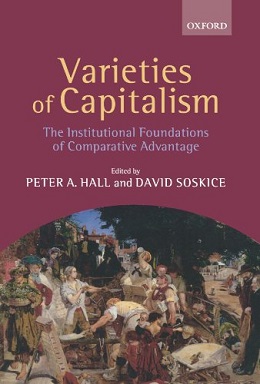
The UK journal Business History recently published a special issue on Varieties of Capitalism. I’ve finally had a chance to take a close look at this really important special issue, which provides some desperately needed historical contextualisation for the Varieties of Capitalism literature. In reading it, I was reminded to two exchanges at conferences. First, I recall a seminar discussion at the BHC in Denver in which we got discussing the Varieties of Capitalism theory with Veronique Pouillard , Richard R. John  and others. We all agreed that the main variants of capitalism discussed by Hall and Soskice and their many followers are much newer than most researchers think. I also recall being at a conference mostly attended by political scientists, sociologists, etc where I astonished other attendees by repeating what Japanese business historians have told me, namely, that in the 1920s Japan was a Liberal Market Economy. That statement blew their minds as it challenged their assumption that national varieties of capitalism are deeply rooted in national political and cultural histories. Personally, I had never been much convinced by the theory that the variant of capitalism in place in a given country had much to do with what had happened many centuries ago as opposed to developments in since the Second Industrial Revolution.

Anyway, congratulations to the team that produced this Special Issue. The editors are Niall G. MacKenzie (Glasgow) ,Andrew Perchard (Newcastle Business School, Northumbria University), Christopher Miller (Glasgow) and Neil Forbes (Coventry). Article contributors were Martin Shanahan and Susanna Fellman, María Fernández-Moya and Núria Puig, and Zoi Pittaki, Pasi Nevalainen and Ville Yliasko, Martin Eriksson, Lena Andersson-Skog and Josefin Sabo, and Beatriz Rodriguez-Satizabal, Julie Bower, and Grietjie Verhoef.


Some Big Unanswered Questions in Business History

3 05 2021

The business historian Peter Scott published the following on social media

“I am interested in what the BH [business history] community considers the most important business/economic history questions that we haven’t yet answered. I am not talking about emerging areas/new perspectives, but important questions for which there are major data or methodological problems to providing answers. Any examples would be much appreciated.”

This is an excellent post, as it deals with empirical questions in BH for which we don’t yet have answers. It seems, to me at least, that following business-historical questions are the ones that most desperately needs answering:

  1. To what extent were decisions by British managers responsible for the slowdown in UK productivity growth relative to Germany and the United States that began in the late 1890s and which is visible in the data produced by Nick Crafts, Stephen Broadberry, etc? The Chandlerian explanation is that British firms were wedded to family capitalism longer than their German and American rivals. Alternative explanations include the hypothesis that the main culprit is educational malpractice:  British business families spent too much money educating their sons in Latin and not enough in chemistry and the other subjects associated with the Second Industrial Revolution. This question involves qualitative business historians using firm-level data in corporate archives to help to answer an empirical answer that our colleagues in the field of economic history cannot answer using their preferred research methods?
  2. To what extent was the achievement by 1950 of leadership positions in most industries by US firms a function of factors other than the favourable geographical position of the United States, which insulated American firms from the most devastating effects of the two world wars? In his rejoinder to the claims of Chandler, Les Hannah argued that the real reason US firms overtook British firms in technological prowess had nothing to do with the trends perceived by Chandler and everything to do with the fact the US, unlike the UK, wasn’t bombed and otherwise devastated during the world wars.
  3. How did decisions taken within British firms cause and respond to the putative Engels’s Pause of the nineteenth century? The Engels’s Pause was a period of about a generation in which working-class living standards stagnated even though GDP per capita and TFP continued to increase. There is intense interest today in this Pause because it appears to be similar to the experience of the United States since about 1980.
  4. Which firms took the lead in developing the global factories associated with the Global Value Chain Revolution of the 1980s and 1990s? Answering this question would involve using largely qualitative methods and firm-level data to deepen our understanding of the unbundling pattern that the economist Richard Baldwin identifies as the Global Value Chain Revolution?
  5. To what extent did managerial decisions contribute to the post-1973 growth slowdown in the United States? Explaining the growth slowdown is literally a trillion dollar question and any business historian who can make a credible contribution to the debate about what caused it and what can be done to solve it would, in my view, be well rewarded in professional terms.

Please note that I am aware that these questions have a very narrow North Atlantic economies comparative focus. I’m certain that business historians who formulated research questions about the so-called Great Divergence would also be doing very important work and would be justly rewarded by the academic labour market. Similarly, I’m aware that these questions all relate to the last 150 or so years and that research questions on older topics, such as the long-term roots of the British Industrial Revolution or the role of the Scientific Revolution in the Great Divergence would also be important.


Some Thoughts Inspired by Listening to Imran Ahmad Khan MP

28 04 2021

Imran Ahmad Khan, Member of Parliament for Wakefield, is a rising force in UK politics. In part because he achieved a historic victory over a Labour incumbent in a very working-class, traditionally Labour town, Khan is seen by many as the future of the modern Conservative Party. He is one of the most visible gay Muslim politicians in the UK. A graduate of the war studies postgraduate programme at King’s College in London, he has particularly interesting things to say about geopolitics.

He recently sat down with retired economic history professor and all-round interesting smart guy Steve Davies to talk about the future of free trade and British foreign policy (listen here). Khan spoke about the UK’s long history of promoting free trade and the long-standing belief that international free trade can help to promote world peace. Historically, this theory informed the robust advocacy of free trade by a range of British and American intellectuals and political leaders from Adam Smith and Richard Cobden to Cordell Hull and other architects of the GATT in the 1940s. In 1990s many leaders in the Western democracies were too confident that the process of integrating into the world economy would make authoritarian regimes peaceful and, eventually, democratic. That optimistic theory pervaded the academic literature in that era, informed the optimistic thinking of the Clinton administration, and was popularized by the journalist Tom Friedman with his Golden Arches theory of world peace.

Today, nobody is quite so sanguine about the ability of globalization and open markets to make the world peaceful and to promote human rights. Instead of becoming more peaceful and more respectful of human rights, authoritarian regimes are becoming more bellicose and more repressive. Rather than being on the cusp of a “South Korea in the 1980s style” transition to democracy, some of the world’s authoritarian regimes have become more belligerent and more domestically repressive as they have grown wealthy via globalization. We see that pattern in a couple of the large, nuclear-armed countries in what was formerly known as the Communist bloc. This pattern is the precise opposite of what capitalist peace theory would lead one to predict.  

Liberal democracies now need to come up with the sensible ways of managing their trade with countries that are both economically important and politically authoritarian.  There are three basic approaches open to us.

One approach is to systematically cut off all of the commercial relationships that currently connect firms and households win the liberal democracies with firms and households in authoritarian regimes, which is the approach advocated by some of the people who were around Trump, such as Steve Bannon. This approach led to Trump announcing a ban on Americans using TikTok, a harmless app that had been developed by a firm that happened to be located in an authoritarian country. Trump’s TikTok ban, which was ultimately blocked by the courts, deprives American consumers of a fun little app and is unfair to the apps creators, none of whom have been shown to be responsible for any human rights abuses.   

 As Steve Davies and Professor (and now Lord) Syed Kamall  have recently argued in a recent book, adopting the approach typified by the TikTok ban would be an act of national self-harm with serious economic consequences. Moreover, it would be a deeply illiberal exercise in collective punishment, as it would punish entirely blameless individuals and firms  who happen to live in authoritarian states. It would also be counterproductive, as such an approach would cut off the flow of liberal ideas to authoritarian regimes. Davies and Kamall rightly stress that last point.

At the other extreme, there are those that say the degree to which people in a given capitalist country interact with firms in an authoritarian firm should be entirely determined by the free market. This approach would mean that if some consumers in the UK want to, say, buy goods produced by unfree labour in an authoritarian regime or if a company wishes to sell high-tech dual use technology to that country, the government shouldn’t interfere with their freedom to do so.  Let’s call that the hardcore or maximalist libertarian approach.

A middle of the road approach says that democratic governments need to set ground rules about what type of trade their citizens are allowed to do with firms and individuals in authoritarian countries. Most Western countries seem to be gravitating towards that approach. The trillion dollar question, however, is how should these rules should be set and which principles should guide their development. Who gets to decide whether a given transaction between citizens of a democracy and citizens of an authoritarian regime gets to go ahead?

Should decisions about which transactions we are going to allow to proceed be made by a centralized process involving a small number of individuals working in secrecy? Or should such decision be made through a more inclusive distributed process? In other words, should the decisions be made by government officials who issue diktat saying “We aren’t going to allow this transaction to go ahead because of national security and stuff” or do we want decisions to be more transparent and to involve multiple veto points?

There are good reasons for thinking that following principles should apply here: consistency with least-common-denominator shared values, transparency, and decentralized enforcement.

There are many problems with the centralized process approach that the US adopted under Trump.  Most obviously, there are the problems with banning specific commercial transactions on vague “national security” grounds is that the justification for such bans are usually unclear and based on classified information. “National security”, an American term that has now spread to many other countries, can be invoked in almost any case, as when Trump limited Canadian steel exports to the US on specious national security grounds.

A more fundamental problem with the centralized approach is that not all citizens may agree with the conception of national security that informs the thinking of the person or persons who are charged with deciding if a given transaction undermines national security. We wouldn’t entrust a single policymaker with the power to block all proposed transactions that are “unethical” in the opinion of a because people’s definitions of what is “unethical” are so diverse. If we are going to interfere with freedom of contract by allowing democratic governments to block some transactions involving our citizens and the citizens of authoritarian states, we need very clear standards that accord with the values of virtually all citizens. (I say virtually all because I know that 100% unanimity is impossible).   

Another problem with the approach typified by the Trump administration’s banning of TikTok on national security grounds is that decision-making about which transactions to a permit is highly centralized and is concentrated in the hands of just a few bureaucrats is almost never a good idea. Such top-down, centralized approaches are usually counterproductive because of what Hayek called the Knowledge Problem and also the enhanced probabilities for bureaucratic self-interest that emerge whenever you entrust decisions to a small group of unelected officials.

So how should democratic states make and enforce rules about what sorts of transactions their citizens are not allowed to contract with individuals and firms in authoritarian countries? There are strong theoretical reasons for believing that the best way of filtering trade between liberal democracies and authoritarian regimes is to create a distributed process for deciding which transactions are going to be banned. Ideally, this process should be grounded in moral principles that command near universal assent rather than vague judgement calls about “national security”. For instance, while many Americans clearly disagree with the principle that defending Latvia from Russia is something that US taxpayers ought to be doing, virtually everyone in that country believes that murdering individuals because of their political views is wrong. That’s why there is now widespread support for Magnitsky legislation in many Western countries. (When a country passes such a law, which are named after a Russian lawyer who was murdered by Russian officials, prevent the individuals who were involved in such crimes from doing business there).

Similarly, there is now nearly universal support for the idea that de facto enslaving people so they can produce a commodity for export is deeply immoral. I’m certain that if you look on the internet hard enough you can find a couple of racists who think that the abolition of slavery by Abraham Lincoln was a bad thing but I think we can all accept that 99% of the citizens of Western democracies now believe that slavery and social systems closely akin to slavery are wrong. Similarly, 99% of citizens in Western democracies believe that genocide is everywhere and always wrong.

The lowest common denominator norms against murder and slavery, not vague ideas about national security or the national interest, should in, my view, by the basis of laws in Western countries for limiting transactions between their citizens and persons in authoritarian regimes.   

We should also make the enforcement of these laws a more distributed process, so instead of relying on government agencies to impose fines on firms and individuals that break the rules, Western countries should create tort systems to incentivize firms and individuals not to enter into commercial transactions that facilitate murder and slavery in authoritarian regimes. Such tort systems could be modelled on the Alien Tort system in the US, which is currently being used in an effort to discourage multinational firms from using commodities produced by unfree labour. (We should all be following the case of Nestlé USA Inc vs Doe, which is now before SCOTUS). The virtue of this approach is that it would force people who believe that a given transaction would tend to result in more murder and slavery in such countries to publish evidence to support their claims. Such evidence might take the form of satellite photos and eyewitness accounts of escapees. As a tort-based approach involves more people in the process than a bureaucratic approach, which should result in better decisions.   Moreover, a tort-based approach harnesses the profit motive of lawyers and private investigators to help gather and assemble evidence of wrongdoing overseas.


Some Thoughts About Laurentian

19 04 2021

My first tenure-track job was at Laurentian University in Ontario, Canada. I worked there for three years before coming back to the UK, where I have pursued my academic career ever since. I grew considerably during my time at Laurentian: my capabilities as a classroom teacher improved immensely and my French benefitted from the fact I was in a bilingual organization. I also benefitted from being exposed to a part of Canada very different from the parts of the country I previously knew, which were basically affluent cities and suburbs.

Northern Ontario School of Medicine, Laurentian University Campus

By Matt Strickland at English Wikipedia, CC BY-SA 3.0, https://commons.wikimedia.org/w/index.php?curid=16728682

  I was saddened to a hear that this university had declared itself to be insolvent was undergoing reorganization under Canada’s CCAA, which is the equivalent of Chapter 11 in the United States or Administration in the insolvency law of England and Wales. I was also saddened by the huge cuts to a wide range of departments and degrees (ranging from civil engineering to midwifery to political science) that have had a negative impact on students, faculty and other stakeholders.

I was distressed to see the blog post by higher education consultant Alex Usher in which he documented that the university’s president and board of directors had presided over a degree of mismanagement that seems to, in the opinion of Usher, constitutes extremely bad business judgement. When a company goes bankrupt or goes into the local equivalent of Chapter 11, the shareholders usually aren’t entitled to sue the directors and top executives. However, they are allowed to sue if they can demonstrate to a court that the managerial judgement calls that caused the organization to fail were so incredibly bad as to constitute really bad business judgement that nobody familiar with the industry in question would regard as a legitimate way to run an organization of that type. We are talking about the difference between circumstances in which people review the managerial decisions that contributed to insolvency and say “Yeah, I can see why they made that bet and it’s too bad it didn’t work out because of unforeseen factor X” versus “Holy crap! I can’t believe a manager in that type of organization would ever do that!” For a theoretically-informed overview of what the law says about business judgement in England, Australia, and Delaware, see this recent paper in the Journal of Legal Studies here.

 Now all universities have suffered because of the pandemic and universities can also suffer due to long-term trends such as declining population in their region. Sometimes universities fail despite the directors and managers diligently discharging their duty of care to the best of their abilities. However, the language that Alex Usher uses in writing about the degree of bad decision-making at Laurentian University leads me to expect that there will be various lawsuits, including class action suits, against the directors and executives of this organization. I express absolutely no opinion here about whether these lawsuits will be successful or meritorious—for informed opinion about that, please talk to an expert on Canadian insolvency law and the duties of directors such as Thomas Telfer.  However, I’m surprised that no such lawsuits have already been announced. I would tend to attribute the fact we haven’t seen such lawsuits yet to the fact that Laurentian’s alumni and other stakeholders tend to live at some distance from the large law firms that have expertise in this specialised area of law. Another factor is that academics, the stakeholder group affected most directly by this event, generally do not use agency theory and the rational actor model to understand how senior university administrators operate. These are the approaches that I have used throughout my academic career to understand what is going on around me. In fact, I often encourage PhD students who want to have academic careers to read chapter 2 of Cracks in the Ivory Tower, a controversial book that applies agency theory to higher education.  While I think that it is possible to go too far in applying agency theory in understanding how universities operate, as the Cracks in the Ivory Tower book does, I think that they have enough predictive power to be useful. I think, therefore, that people who want senior managers at other universities to make better decisions should think about what agency theory says can be done in this case. The academic literature on director liability in UK higher education  and US higher education may be useful in thinking about these issues.

I also think that we need to think carefully about the circumstances in which universities and similar organizations should be allowed to file for Chapter 11 and its local equivalents. I’ve said above that I think that it would be a mistake to say that CCAA should never be available to such organizations. The CCAA process was created in the Great Depression to allow insolvent companies in restructure while remaining in business. It’s less dramatic that traditional bankruptcy. In a company with shareholders to whom the executives must answer and who know their investments will lose much of their value if the firm goes into CCAA, the CCAA process is only going to be used as a last resort. A non-profit university doesn’t have residual claimants with the same sort of control rights, so the ex ante personal costs to a university president and board members of triggering CCAA are lower than in a regular company. The CCAA route, which has massive social costs for creditors and other stakeholders, should only be used as a last resort. I think that it would be reasonable to say that university administrators should be allowed to use it, but only if they are willing to sacrifice some of their personal wealth.

During and after the 2008 financial crisis, which saw governments bailing out Wall Street firms and managers who had made bad choices, people from across the political spectrum complained, quite rightly, that we have a system in which top executives were rewarded by the market when their risky bet paid off and were rescued by the taxpayer when things went bad. “Capitalism for the profits, socialism for the losses” isn’t how a capitalist system is supposed to work as the risk-reward matrix requires personal accountability by top decision-makers. Personal accountability should apply to well-paid managers in the private sector and to those in the public sector as well. I’m astonished that the president of Laurentian remains in his job.

I see that a Canadian MP has introduced a private member’s bill that would clarify that universities should not be allowed to use the CCAA process. I understand there is widespread support for this proposal but I think that the bill should not be supported. First, to say that universities should NEVER be able to use CCAA is an extreme position. This bill, if passed, could force a university to declare bankruptcy at some point in the future.  Moreover, it is a diversion from the more immediate action that is needed. Right now though, we need something immediate to disincentivize other university managers from using CCAA unless it is absolutely necessary. A private member’s bill that would take forever to get Royal Assent isn’t going to work. A personal lawsuit against university administrators for mismanagement launched by donors, faculty, alumni, and other stakeholders would raise the ex ante costs of other university presidents who are considering whether to trigger the CCAA button.  I understand that when Mountain Equipment Coop’s board and CEO used the CCAA option, they were sued by the customers of that beloved brand. I’m not saying the CCAA option should never be available to the managers of universities, cooperative, and other organizations that aren’t profit-seeking companies, merely that it should be a last resort that is only available to the directors at the cost of the loss of their personal money. 

A contact in Canada has brought a very interesting piece in the Globe and Mail to my attention. The article reports that the university’s creditors, which include TD Bank, had extended unsecured loans to the university on the assumption that in lending money to on Ontario university, they were effectively lending money to the Ontario government, which has a very high credit rating. The decision by the Ontario government to allow LU to go into CCAA suggests that, in future, lenders will regard each university as a separate borrower and will attach interest rates and conditions to loan that reflect each institution’s own credit rating. Perhaps Ontario universities will have to start issuing bonds that are rated on the issuer-pays model. US and UK universities already have bond ratings issued by Moody’s (for example, see here).

The article also discusses the political dimensions of this debacle and suggests that the increasing unpopularity of universities with people on the cultural right (think of fans of Jordan Peterson) may have something to do with the decision of the Ontario government not to bail out this organisation at a time when so many other organisations (airlines, restaurant chains, etc) are getting assistance from the taxpayer.  Konrad Yakabuski writes:

The Ford government was roundly despised within the ranks of the academy well before the Laurentian debacle landed on its plate. On the campaign trail, Mr. Ford railed against cancel culture on university campuses in his province. Only weeks after taking office in 2018, his Progressive Conservative government implementednew rules requiring post-secondary institutions to “protect free speech” and “not attempt to shield students from ideas or opinions that they disagree with or find offensive.” That put a lot of noses out of joint on campus, where woke culture rules with an iron fist.

Next up, the Ford government cut tuition fees by 10 per cent and froze them for two years, without topping up university operating grants. For smaller institutions, which already had a harder time than their bigger peers drawing premium-paying international students, the revenue crunch made already tight budgets unworkable. For Laurentian, which appears to have overextended itself on capital projects it had little business undertaking, the COVID-19 pandemic and subsequent loss of foreign students left it with no choice but to call in the bankruptcy experts.

I have long been concerned that universities in the English-speaking countries have been losing their social licence to operate because they have become too closely identified in the public mind with the political left, particularly with the new variant of the left that is closely associated with intersectional theory and identity politics.  It has long been common knowledge that university professors tend to be a bit more left-wing than the average person their age. Registered Democrats have outnumbered Registered Republicans in the US for many decades. However, until recently there were always at least a few prominent right-wing professors at the top universities. Hard data from the US (see here and here) and soft data from other culturally proximate countries suggests that universities have, since 2000, become less viewpoint diverse and downright hostile to conservatives. If the average centre-right voter, or even the median voter, forms that impression that universities nowadays only teach postcolonial transgender settler-colonial sociology and have become intolerant of conservatives, centrists, and even Old School Social Democrats, such voter will tend to believe that universities, unlike obviously socially useful organizations such as airlines, just don’t deserve bailouts in crises. In early May, university leaders here in the UK were very disappointed when the government turned down their request for a comprehensive bailout package and instead offered much more limited support to universities.  

The right-wing of the Conservative party was positively jubilant when they heard that the universities were being denied their request for a cash bailout. They were also pleased that the government said they would allow UK universities to go bankrupt. Now if you take a close look at the fine print in the UK government’s rescue measures announced in May 2020 it is certainly true that they denied the request for a straight bailout, but they also announced a host of below of the radar measures to help universities, such as giving them the right to collect a full year’s tuition fees in September and, crucially, urging university creditors to show “restraint”.  My reading of the situation is that the UK’s Conservative government wanted to show its electoral base that it is going to tough on the bearded Marxists in higher education sector while quietly supporting a sector that has played such a crucial role in the UK response to the pandemic (think of the vaccine developed by Oxford scientists). Something similar may be going on in Canada.

In the case of Laurentian, however, we are talking about a university that is far more ideologically diverse and far more hospitable to small-c conservatives than the highly selective universities that serve more affluent universities. Ontario policymakers should be aware of that Laurentian is a relatively conservative, or at least viewpoint diverse university. It’s not the type of Woke University that Jordan Peterson warned you guys about. At Laurentian, I had a number of senior colleagues who were open about the fact they belonged to socially conservative Protestant denominations. I also had colleagues who were very supportive of the controversial decision to send Canadian soldiers to Afghanistan. In fact, when I was there the president of the university, who is a relative of a famous Canadian social democrat, drove a car that was emblazoned with a yellow “Support Our Troops” ribbon, which in the Canadian context is a signal of relatively conservative political sentiments. I had a colleague who produced a large number of scholarly works that were informed by her Pentecostal faith and who was extremely popular with students, especially those who shared her religious beliefs.

I noticed that while many of the highly selective universities that teach affluent students have pretty much discontinued the teaching of military history as too macho and vaguely right-wing, military history is alive and well there. Laurentian even hired me—I’m neither a conservative nor a Conservative, but I’m not a standard woke leftist either. At dinner with colleagues at Laurentian, I once let slip that I supported capital punishment for murderers. I was feeling a bit provocative that day so I added in that I was particularly in favour of capital punishment in cases in which the murderer has harvestable organs that could be given to law-abiding citizens. (I was dining with some professor friends who I knew had pretty strong left-wing views about the justice system). There was a brief moment of silence as my colleagues were shocked to hear a fellow academic support the death penalty but then someone broke the ice by joking “Hey, this isn’t &*%ing Queen’s University here—the president has a yellow ribbon on her car so you should fit in just fine.” Queen’s is university that teaches disproportionately wealthy students and which is famous for virtue signalling and left-wing academics.

I would conclude this blog post by saying that I am saddened by the crude, callous, and inefficient way in which Laurentian appears to be making its transition from a bilingual French-English institution to one that is basically English. Academics whose first language is French have been fired without consideration of their ability to teach in English. Given that the correlation between being a native English-speaker and getting high student satisfaction scores is relatively weak, that seems like a dumb and cruel move.

 I understand that underlying demographic reality: the proportion of Canadians whose first language is French has shrunk dramatically in my life time and in the region in which the Laurentian is located there are large numbers of students with French Canadian surnames who can’t speak a word of French and, in some case, can’t communicate with their grandmothers. From the 1960s to the 1990s, Canadian politics was dominated by questions related to French-Canadian nationalism and this university’s bilingual heritage needs to be understood with respect to that political context. Obviously the Ontario of 2021 is a radically different society and the French-English tensions of the twentieth century seem somewhat quaint, as do the closely related tensions between Catholics and Protestants.  So I suppose it was inevitable that Laurentian eventually eliminate the courses that are taught in French, which have small numbers of students, and which were being cross-subsidized by the end of the university. It was also probably necessary for the university to eliminate the costly and anachronistic system of have separate federated universities for several Christian denominations. The importance of intra-Christian identities in Canadian society has faded in recent decades, so paying to have separate mini-universities for the Anglicans and the United Church etc seems really anachronistic in 2021.  So modernizing the university doubtless involves changing its culture so that it is better equipped to attract students from the very successful multicultural city of Toronto. However, it should have been done in a more efficient and compassionate fashion.