A Response to my Vimy Ridge Day Post

10 04 2010

My response to a reply on my earlier Vimy Ridge Day post.

A reader wrote:

“I’ve seen some balanced commentary in the press that did mention the Conscription crisis as part of the nation-creation of WWI, but as you suggest, there is little talk of the British Empire, or of the fact that the “Canadians” who fought at Vimy contained an awful lot of British-born. These themes are well-known to historians, but public commemorations are not about history, they are about memory, the selective kind.”

Here is my reply:

“These themes are well-known to historians, but public commemorations are not about history, they are about memory, the selective kind.”

True, events like this are about the construction of usable pasts by politicians. It seems to me that one of the jobs of historians is to call BS whenever this happens. Margaret Macmillan’s excellent recent book on the uses and abuses of historical analogy is helpful in this regard, but I expect that relatively few copies were sold.   It makes me sad that more of the academic history doesn’t filter down into the social memory. It suggests a lack of synchronization between universities, secondary schools, the media, and the general public at the bottom. Perhaps the government should appoint an academic historian as it chief historical officer to pre-check all speeches by dignitaries for questionable interpretations of history.  This office would be an extension of the educational functions of the state, much like subsidies for schools, museums, and public television. Our society puts lots of resources into the creation and dissemination of historical knowledge and it is a shame there is so little evidence of this at events like this. One of the problems is that most academic historians in Canada have stopped writing for the general public.


Parks Canada hiring 32 student reporters for the summer

10 04 2010

Current post-secondary students in Canada are eligible to apply to be one of Parks Canada’s 32 student video reporters. The positions are full time and are spread across the country. This is an excellent opportunity for students interested in Canadian history, Canadian geography, parks and outreach – particularly video outreach.

Please pass this information along to students who may be interested in the opportunity. See here.


Vimy Ridge Day

9 04 2010

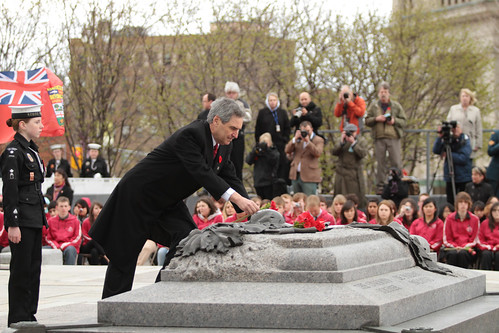
Today was Vimy Ridge Day in Ottawa. See here. Vimy Ridge Day was established in 2003 by the federal government to remember the Canadians who got killed fighting in the First World War. Vimy Ridge Day was the brain child of Brent J. St. Denis, who was then the MP for the Northern Ontario riding of Algoma-Manitoulin. Today’s ceremony got extra attention because the last Canadian veteran of the war died recently.

As someone who researches the history of Anglo-Canadian relations, I’m mildly interested in the social history of the First World War in Canada. I was struck by the fact that none of the speakers at today’s ceremony, not even the Queen’s official representative in Canada(!), could bring themselves to mention the “British Empire.” That’s right, the name of the entity for which the Canadians were fighting went totally unmentioned. This is the elephant in the room nobody can bring him/herself to mention. Instead, there were anachronistic statements to the effect that the Canadians who fought in the war were fighting either for Canada or for the “international community”.

The silence on the British Empire is deafening. I bet nobody mentioned the Conscription Crisis either. Wasted opportunity to educate the public on a bit of history.

For the record, let me state that I’m glad the British Empire no longer exists. It is likely that the British decision to get involved in the First World War accelerated the demise of the British Empire and its break-up into a number of successor states in various part of the world, of which the modern nation of Canada is but one. That being said, I think that the British Empire was an important part of Canada’s history and our public leaders should not be ashamed to mention it. For Canadians, the legacy of the British Empire was pretty mixed. The old Empire was probably not as bad some left-wing historians suggest nor as good as Niall Ferguson argues. But regardless of whether it was good or bad entity, it was an important part of the Canadian story and should not be ignored. As someone with a passionate belief in historical accuracy, it is offends me when the past is distorted through such a bizarre omission. What would we think of a text on Italian history that didn’t mention the Roman Empire. The difference is that the Roman Empire was long ago, whereas the British Empire is still part of living memory (just barely though).

My reading of the situation is this. Canada today likes to think of itself as a tolerant, multicultural nation. We also have large numbers of immigrants from countries where the words “British Empire” evoke a visceral and very negative reaction. Many Canadians admire the other people who helped to overthrow British rule in their part of the world. (My university has a statue of Gandhi). All of  this means that inconvenient truths such as the fact that the First World War was divisive, that Quebeckers and many others hated conscription, that Anglo-Canadians once loved the British Empire, and that British immigrants outnumbered native-born Canadians at Vimy Ridge go totally unmentioned.

Michael Ignatieff, the leader of the Liberal Party and a former historian, was present at today’s ceremony. It is too bad that his current position does not allow him to say something interesting/truthful about Vimy Ridge.

Ignatieff, 9 April 2010


What were the Cultural Causes of the Industrial Revolution?

9 04 2010

That is the theme of a course for PhD students being held in Sweden in October. If I were still a grad student, I would definitely apply to attend.  Since I’m not, I’m going to content myself with reading Joel Mokyr’s new book The enlightened economy: an economic history of Britain, 1700-1850. It’s on my summer reading list.

Anyway, PhD students and supervisors should check out this announcement.

—————————–

The Department of Economic History,
School of Business, Economics and Law, University of Gothenburg,
invites you to the Ph.D.-course

Ideologies, Ideas, and Values during the Industrial Revolution
(11-15 October 2010)

The course will be taught by Deirdre Nansen McCloskey, Distinguished Profes
sor of Economics, History, English, and Communication, University of Illinois at Chicago, and Guest Professor, School of Business, Economics and Law, University of Gothenburg.

Content

Why was Europe the first region to develop economically and why did Britain lead among the European nations?  Recent years have seen a number of important contributions to the field of economic history trying to deal with the issue from new perspectives, using new empirical evidence. The course will study some of scholarly contributions. The issue of ideologies, ideas, and bourgeois values will be an important theme. That is, can the modern world
be explained in merely material terms?  Or do ideas matter!

Participants are expected to write short reviews of the books on the reading list, to be discussed in class in the morning of each day of the course.
Participants will also present a paper on their own research in afternoon seminars, and get feedback from other participants of the course and from Professor McCloskey.

Practical information

The course is open for Ph.D. students in history, economic history, and economics and similar disciplines within social science and the humanities.  The course will take place at the School of Business, Economics and Law in
Gothenburg, Sweden.

There is no fee for participating in the course. The Department will furthermore arrange (and pay for) lodging and lunches during the course, and provide a travel grant to, participating Ph.D. students. The Department will also host an opening reception, and a dinner the last night of the course. Participants are expected to attend during the whole week.

Applications for participation in the course should be sent latest 15 May 2010 by mail to Klas Ronnback, Dept. of economic history, University of Gothenburg: klas.ronnback@econhist.gu.se. Applicants should give a short description of the research field of their doctoral thesis. Since the number of participants will be limited, a selection may be necessary. The result from such selection will be sent to the applicants by the end of May.

Reading list

Robert Allen (2009): The British industrial revolution in global perspective. Cambridge: Cambridge UP.
Jack Goldstone (2009): Why Europe? The rise of the West in world history, 1500-1850. Boston: McGraw-Hill.
Deirdre McCloskey (2010): Bourgeois Dignity: Why economics can’t explain
the modern world. Forthcoming, October.
Joel Mokyr (2009): The enlightened economy: an economic history of Britain,
1700-1850. New Haven: Yale UP.
Jan Luiten van Zanden (2009): The long road to the industrial revolution: the European economy in a global perspective, 1000-1800. Leiden: Brill.
Joyce Appleby (2010): The relentless revolution: A history of capitalism (New York, New York: W. W. Norton & Company, 2010)

Professor Christer Lundh
Klas Ronnback
Department of Economic history
University of Gothenburg
Box 720, SE- 405 30 Göteborg
Sweden
Phone: + 46 31-7734520




Moore on the Tragedy of Caledonia

9 04 2010

Native Protestors at the Douglas Creek Estates in Caledonia

“The Calamity of Caledonia: What B.C. can teach Ontario about Native land claims.”

That’s the title of an excellent article by historian Christopher Moore in the Literary Review of Canada. As a Torontonian who has recently completed a history of the B.C. Court of Appeal, Moore is well qualified to speak about this complex legal-historical-political topic.


The Prof Who Outsourced Her Marking Work to Bangalore

7 04 2010

Bangalore

Lori Whisenant, who teaches business law and ethics at the University of Houston, has outsourced the grading of her students’ papers to a private company in Bangalore. See here. The students get very detailed comments on their essays from Indian writers with postgraduate training.

I have mixed feelings about this idea. It seems to me that the prof who sets the assignment should be the one to mark the assignment. After all, how else can you judge whether the task was an appropriate one that should be included in the course next year? Moreover, some disciplines are very culturally specific. For instance, I throw Hollywood references into my lectures, not Bollywood references. This means that some student essays might not travel that well. (Think gay and lesbian studies). Culture is a de facto trade barrier, which is one of the reasons I’m not too worried that globalization will erode the value of my skills.

That being said, the general concept of outsourcing writing assistance work to a low-cost English-speaking country has some merit, especially when it comes to pre-submission writing assistance as opposed to grading. I should explain that many universities have a place where students can bring drafts of their papers for editorial help before the due date. In some cases, the advice they get is of dubious quality.

I try to give my students detailed feedback on their written work. That’s an important part of my job. But large class sizes are a fact of life and are bound to remain so unless one of the following unpalatable developments takes place: a huge jump in tuition fees to allow for more faculty hiring and smaller classes; keeping the number of professors the same while reducing the proportion of young people who go to university;  a big infusion of government cash to allow for small class sizes; or the division of the existing wage budget into more but smaller salaries (i.e., a paycut for the existing professors).  Don’t hold your breath for any of the above.

Under the current arrangement, there is only so much individualized writing advice a professor can give each student. Moreover, there is much to be desired about the pre-submission assistance many campus writing assistance centres give to students.  Outsourcing the writing assistance work to India seems like a particularly useful idea for universities where it is hard to find qualified workers for on-campus writing centres. In general, good writers want to live in places where there are more opportunities to exercise their skills. This means that the pool of good writers is limited outside of the big cities, especially at universities that lack PhD programs in the humanities.  Emailing the writing assistance work to Bangalore is a superb idea.

In few years, it might be common to overhear students saying that they are planning to Skype their TA in India.


OAH Magazine Special Issue on Business History

7 04 2010

Along with environmental history, business history is one of the fastest growing sub-fields of history at the moment. The January 2010  issue of the OAH Magazine of History was devoted to the current state of business historiography. The basic point of this theme issue was to show historians who do not identify themselves as business historians that business history is very relevant to their teaching and research.

The magazine included the following articles:

FOREWORD
Bringing in Business History Front and Center
Pamela Walker Laird

ARTICLES
Classic Issues and Fresh Themes in Business History
Philip Scranton

American Manufacturing, 1850-1930: A Business History Approach
Mansel Blackford

Business History in the Teaching American History Program
Stuart D. Hobbs

Newspapers, Radio, and the Business of Media in the United States
Michael Stamm

Selling Black Beauty: African American Modeling Agencies and Charm Schools in Postwar America
Malia McAndrew

Robert Noyce, Silicon Valley, and the Teamwork Behind the High-Technology Revolution
Leslie Berlin


New BHC Blog

7 04 2010

The Business History Conference has created a blog. Launched on 1 April, it already looks rather promising.


A Brief History of the Canadian Dollar

7 04 2010

That’s the title of an article in today’s Globe. Check out the article in the Calgary Herald too.


lancement officiel du site web dédié à la société Montreal Telegraph / official launch for the website

29 03 2010

Vous êtes cordialement invité au lancement officiel du site web dédié à l’histoire de la société Montreal Telegraph. La fête se tiendra sur le campus de l’Université Laurentienne jeudi,  le 1er avril 2010 entre 19 h et 21 h à la bibliothèque J.N. Desmarais .

RSVP à Rita Weise, rh_weise@laurentian.ca

****

You are cordially invited to the official launch party for a website dedicated to the history of the Montreal Telegraph Company!  The party will be held on the Laurentian University campus on Thursday April 1st, 2010 from 7 to 9 p.m. in the Instructional Media Room in J.N. Desmarais Library.  All are welcome, but it would be helpful if you could RSVP with Rita Weise, rh_weise@laurentian.ca