Montreal Telegraph Company

28 03 2010

The text below is taken from the Laurentian University website.

“Four graduate students in Laurentian University’s history department have created a website about the Montreal Telegraph Company.

www.montrealtelegraphcompany.com

The invention of the telegraph revolutionized life in many countries in the nineteenth century. Most of the early telegraph lines in Canada were constructed and operated by the Montreal Telegraph Company.

It is common knowledge that the advent of railways had a transformative impact on Canada and many other countries. Most Canadians know about the famous Last Spike. Most Americans are familiar with the construction of the transcontinental railroad in the 1860s. In contrast, the impact of telegraphy on North America is often overlooked. The website is designed to showcase the economic, social, and political effects of telegraphy on British North America after 1844.

It outlines the rise and fall of the company between 1847 and 1881. You will find information regarding some of the key players involved in the company, including its executives, the workforce, and major stockholders. The website also features numerous images relating to the history of the company and the telegraph in general.

Un groupe de quatre étudiants inscrits au cycle supérieur au département d’histoire ont créé une site Web de la Montreal Telegraph Company.

www.montrealtelegraphcompany.com

L’invention du télégraphe a révolutionné le sort de l’humanité dans de nombreux pays au XIXe siècle. La plupart des premières lignes télégraphiques au Canada ont été construites et exploitées par la Montreal Telegraph Company.

L’arrivée des chemins de fer a eu un impact transformateur sur le Canada et de nombreux autres pays. La plus grande partie des Canadiens connaissent le fameux ‘dernier crampon’ et la plupart des Américains sont familiers avec la construction du chemin de fer transcontinental dans les années 1860. En revanche, l’impact de la télégraphie en Amérique du Nord est souvent négligé. Ce site web est conçu pour présenter les effets économiques, sociaux et politiques de la télégraphie en Amérique du Nord britannique (ANB) après 1844.

Il décrit la montée et la déclin de la société entre 1847 et 1881. Vous trouverez des renseignements concernant certains des principaux acteurs impliqués dans la société, y compris ses dirigeants, employés et actionnaires principaux. Le site inclut également de nombreuses images liées à l’histoire de la société et du télégraphe en général.”


Ontario in the Federation

25 03 2010

The Mowat Centre at the University of Toronto has published a study of Ontario’s under-representation in the House of Commons. It’s excellent. Kudos the Mowat Centre for publishing such an excellent report.

“This Mowat Note examines how closely Canada’s system of political representation adheres to the principle of representation by population. It compares Canada’s performance in this area to other advanced democracies with federal systems. The research shows that the Canadian approach does not live up to internationally accepted democratic standards. The principle of citizen equality, according to which citizens should have roughly comparable voting power, is violated to a far greater extent in Canada than in Australia, Germany, Switzerland or the United States. Unless Canadian laws are changed, the inequality of the current system will worsen and the voting power of citizens will increasingly depend on which province they live in.”

Prof. Sancton

The report is interesting, but I am wondering author Andrew Sancton did not look at the United Kingdom as well! The UK, like Canada, includes several self-defined “nations”: Scotland and Quebec both have strong nationalist movements. Nevertheless, the UK now has something close to true Rep by Pop. The story of Representation by Population in UK since 1832 has a very interesting history. [In fact, one can’t fully understand why so many people in Toronto in the 1860s were passionate about Rep by Pop without knowing about this history. One of the reasons why George Brown was so committed to Rep by Pop was his upbringing in a liberal Scottish household in which the memory of Old Sarum was still fresh. I should explain that before the parliamentary reform of 1832, the ruins of the medieval city of Old Sarum were represented in the British parliament,  while the new and populous city of Manchester was without representation. ]Anyway, my point is that knowing how the UK gradually moved toward true Rep by Pop in the 19th or 20th centuries might be useful for Canadians.

Old Sarum


Flanagan on Native Property Rights

24 03 2010

Thomas Flanagan has published a great article in the Globe on restructuring property rights on First Nations communities. I liked how Flanagan distinguished his specific proposal from the famous Dawes General Allotment Act passed by the US Congress in 1887.

The Dawes Act of 1887

The creators of the Dawes Act attempted to use the concept of private property to destroy aboriginal culture. Flanagan makes it clear that his proposal is not aimed at assimilating the First Nations. He just wants to empower them economically.


Why Does Canada Have a More Stable Banking System than the United States?

23 03 2010

Why Does Canada Have a Better More Stable Banking System than the United States?

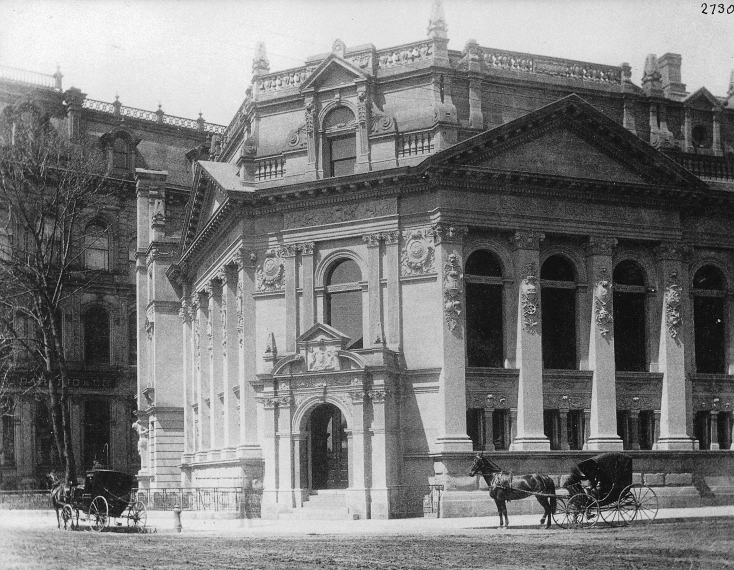
Former Bank of British North America branch in Toronto

That is the research question informing my forthcoming presentation to the Business History Conference at the University of Georgia in Athens. My presentation will take place Saturday 27 March, 3:30-5:00 Concurrent Sessions G, G.1 Rhetoric of Liberalism.

Canada’s banking system is rock solid. In the wake of the 2008 financial crisis, the relative stability of Canada’s banking sector has been recognized. When banks in the United States and the United Kingdom collapsed, Canada did not experience any bank failures. The World Economic Forum’s Global Competitiveness Report rated Canada’s banking system as the most sound in the world.

The Bank of British North America, designed by John Howard and constructed in 1845-6, in 1867, on the northeast corner of Yonge and Wellington Streets. Toronto. Image from Toronto Public Library.

The stability of Canada’s banking sector is nothing new. Historically, bank failures have been quite rare in Canada. Since 1871, Canada has witnessed a few bank failures, such as the collapse of the Home Bank in 1923, but in general bank failures in Canada have been uncommon. During the early 1930s, there was a wave of bank failures in the United States and long queues of anxious depositors lined up at banks. Canada’s banks, in contrast, remained healthy during the Depression. Canada’s banks also demonstrated their stability during the crashes of 1893 and 1907.

Canada and the United States are similar in many ways, but their banking systems are quite different. Some of these differences help to explain the greater stability of the Canadian system. Canada’s banking sector is much more oligopolistic than that of the USA. Canadians are served by a small number of big banks with branches in every corner of the country.  In contrast, the United States has a vast number of small banks. Until recently, there were many laws in the United States that prevented banks from one state from operating in another. It should be stressed that Canada had developed an elaborate system of transcontinental branch banking by about 1900.

Head Office of the Bank of Montreal

In 1867, the British parliament passed by the British North America Act, which created the Dominion of Canada. The new constitution gave exclusive jurisdiction over banking, currency, and interest to the federal parliament rather than the provincial legislatures. In contrast, American states had the right to charter banks and to pass laws related to banking. The legal foundations of Canada’s arguably superior banking system were laid in the banking and currency statutes passed by the new Canadian parliament in the five years after Confederation. My paper examines the making of the Canadian banking law in 1871, which was a turning point in Canadian financial history.  The integration of the financial systems of the previously separate colonies between 1867 and 1871 was a crucial part of the creation of Canada as a nation state. A common currency and common banking system helped to knit the different parts of the Dominion together.

Bank of Montreal branch in Toronto. Picture from McCord Museum, Montreal

In the paper, I look at how the banking laws of other countries, most notably the 1863 National Bank Act in the USA and the 1844 Bank Act in England, influenced Canada’s lawmakers. The personalities mentioned in my paper included Sir John A. Macdonald, Sir Francis Hincks, John Rose, Alexander T. Galt, Edwin King of the Bank of Montreal, Joseph Cauchon, Alexander Mackenzie, and Salmon P. Chase.

The paper is based on published primary sources (newspapers such as the Toronto Globe and the Monetary Times) and archival primary sources (the correspondence of Macdonald and Galt).

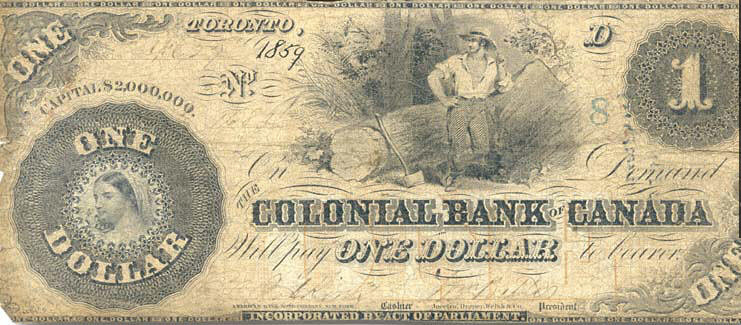
Banknote Issued by the Colonial Bank, 1859.

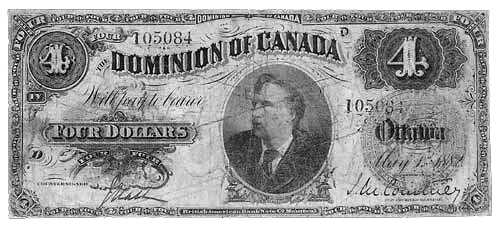
Dominion Note, 1882

In the paper, I argue that while the currency and banking laws passed in 1870 and 1871 were, on balance, good laws, they were written by politicians who were anything but disinterested statesmen. Indeed, the close connections between particular banks and the Prime Minister and the successive minister of Finance would today be regarded as an egregious conflict of interest. I suggest that Macdonald’s massive personal debts influenced the bank laws of 1870 and 1871.

Sir John A. Macdonald, 1883

In the paper, I examine the rivalry between the Toronto and the Montreal banks. I also talk about the impact on banking law of the ongoing agitation against Confederation in Nova Scotia, a province which had been pretty much forced into Canada. Although my paper is primary focused on high politics (i.e., the manouevering of Cabinet ministers, bank presidents, and other elite individuals) of I also look at the attitudes of ordinary Canadians to banking.

I show that while hostility towards financiers and moneylenders was widespread, the attitudes of the populace had a limited impact on what actually went into the statute book.  This is because the political culture and institutions of Canada were, in the 1860s and 1870s,   significantly less democratic than the United States. Although a higher proportion of adult males in Canada enjoyed the right to vote than in Disraeli’s Britain, politicians in Canada still regarded “democracy” as an American, and therefore suspect, concept. In the northern United States, nearly every white man had the right to vote, but the franchise in Canada was restricted by a variety of property qualifications.  Canada’s elites believed in a system that blended monarchy and aristocracy with democracy. Even today, there is considerable resistance in Canada to the idea of direct democracy. Most politicians in Canada and the United Kingdom still look with horror upon the idea of elected judges and the frequent use of referenda in California and other American states!

The Fathers of Canadian Confederation, 1864

This elitist attitude influenced both the procedure by which Canada’s new constitution was adopted in the 1860s, which involved votes in the legislatures of the several provinces rather than approval by the people in referenda. The elitist attitude also influenced banking law. Had Canada’s political system been more democratic, it is unlikely that Canadian legislators would have been so wedded to the gold standard and oligopolistic banking. In 1870, much of the Canadian populace evidenced a strong distrust of banking and financiers. For better or worse, the attitudes of the majority had a minor impact on the making of Canada’s banking law.

British North America Act. Image Source: UK National Archives.


The Canadian Debate on the Legitimacy of Usury in 1870

23 03 2010

I’m sharing an interesting primary source I discovered in the course of researching the history of the laws governing finance and banking in Canada. For centuries, either Christian countries outlawed the payment or receipt of interest or imposed usury laws that made interest over a certain amount (say six percent) illegal. See here. During and after the Enlightenment, there was a move throughout the Western world to abolish the usury laws.

In the 1840s and 1850s, the usury laws were dismantled the Province of Canada (i.e., present-day Ontario and Quebec). The usury laws were repealed or watered down for two reasons: the desire of the political class to make Canada attractive to British investors and the growing influence of classical political economy (the free-market doctrines of Smith, Ricardo, Mill). The Canadian debates over the usury laws are very interesting because they pitted region against region and net debtor against net creditor. The anti-Semitic comments made during these debates were also interesting. Another fascinating aspect of this debate were its implications for Anglo-Canadian relations.

In the 1860s, there was a long campaign in the 1860s to re-impose some sort of statutory limits of usury. This campaign began before the start of the Civil War in the United States: in the 1860s, an ultramontanist Catholic politician proposed making charging more than six percent usury a criminal offence punishable with a term in prison. The dislocations caused by the Civil War in the United States and the cancellation of the Reciprocity Treaty lent impetus to the demand for a usury law.

After 1867, the politics of usury in Ontario and Quebec became wrapped up in the question of how the pre-Confederation financial laws of the provinces should be harmonized. Nova Scotia and New Brunswick, it should be pointed out, still had fairly strict usury laws.

In 1870, Sir Francis Hincks, Macdonald’s Minister of Finance, proposed a law that would have made 8% the maximum rate of interest in all provinces. This bill was defeated due to an unholy alliance of MPs who thought it was too permissive and those who thought it was an undue abridgement of freedom of contract. The Monetary Times, a Toronto publication, published this editorial on the subject.

[Toronto] Monetary Times, 6 May 1870, “Uniformity of Laws: Usury” p. 596

“The usury question has been disposed of for the Session; but there is much reason to fear that like Sir John Macdonald’s apprehension of the Fenian difficulty recurring, it will continue to crop up from time to time. It is very desirable that the nuisance should be abated, and that investors, especially those who live outside of the Dominion, should not have their minds periodically disturbed on the subject, that the law should be considered settled, and not liable to frequent alteration. This condition can be fulfilled only by the usury laws being in complete harmony with public opinion. Bu the opinion of the several Provinces cannot, we fear, during this generation, ever be harmonized. The differences are radical and fundamental, having their seat deep in prejudices derived from religious authority on one side and enlightened economic principles on the other. Ontario has a very decided conviction on the subject; she is fully convinced that the rate of interest should be allowed to regulate itself. Quebec, considered in the aggregate, has, if possible, a more decided opinion on the subject. She places the bills of the Pope above the most irrefragable arguments of Bentham and the whole body of the economists…. when the legislator takes his stand on religious authority, he shuts his ears to argument; it is with him not a question of logic, but of authority.”


Dead Prime Ministers, the Politics of Nostalgia, and Lucky Jim

20 03 2010

In other posts, I have spoken about the opening of a new think tank in Ottawa called the Macdonald-Laurier Institute. The institute’s website suggests that it favours a return to Canada’s “founding values” and praises Sir John A. Macdonald, Canada’s first post-Confederation Prime Minister.  I said that the first policy paper it produced was plausible but that the name of the institute is inappropriate for an organization that wants to publish recommendations in such areas as immigration and Native policy. Macdonald’s governments imposed some racist policies, although I suspect that the institute’s creators were not aware of this when they choose the name. Most Canadians  remember Macdonald as just a jovial drunk.

Sir John A. Macdonald, 1883
Image from Library and Archives Canada

Anyway, this got me thinking about the ways in which the social memory of Macdonald and other early Canadian Prime Ministers continues to be used in Canada today.  Selective social memory is an interesting topic. David Orchard, a onetime candidate for the leadership of the PC party, continues to venerate Macdonald. In the Fight for Canada: Four Centuries of Resistance to American Expansionism, Mr Orchard pays plenty of attention to Macdonald, as well as the famous free trade elections of 1891, 1911 and 1988 and Avro Arrow. Mr Orchard uses the social memory of Macdonald to lend credence to his own protectionist ideas. I suppose he needs all the ammunition he can get, since the overwhelming majority of academic economists support free trade. Economists differ on many issues, but this is something on which they agree.

Laurier

Former Prime Minister Jean Chrétien appears to venerate Wilfrid Laurier.  In 2008, he wrote this statement about Laurier for an essentially celebratory website called Macdonald-Laurier.ca.

“He was close to a secular saint in our household.  As a young man, my father, Wellie, had shaken Laurier’s hand – an experience he cherished for the rest of his long life,  For me, a young boy growing up in rural Quebec, a unilingual francophone growing up in a country whose power structure was decidedly – and almost uniquely English-speaking – Laurier was an inspiration and ideal,  Much in the same way that the election of Barack Obama is inspiring all young children to dream today of exciting and unlimited opportunities, Laurier, a rural francophone, who rose to lead an overwhelmingly Anglo-Saxon Canadian society, was an example to me… Laurier truly believed in the promise of Canada, and he inspired Canadians to make that promise a reality by calling on them to look beyond their particular region, language, or religion. Laurier believed that Canadian unity could be built on diversity, rather than sameness… From 1993 to 2003, the desk in my office on Parliament Hill was Laurier’s own. His portrait hung on the wall. I often found myself wondering, when facing the difficult questions of the day, how to apply his lessons and wisdom. Many of Laurier’s ideas remain as relevant as ever to today’s politics. His wisdom, now a century old, is surprisingly modern.” Chrétien went on to praise Laurier’s belief in “liberalized trade” and efforts “to bring down the walls and fences of protectionism.  He understood that Canada’s true economic promise could only be achieved by opening itself to the world”. Chrétien also extolled Laurier for being “a fierce and courageous advocate of Canadian independence.  For a young country, still very much in the shadow of the British Empire, that was a daunting and audacious stance,  In his time many – if not most – English-speaking Canadians felt themselves more British than Canadian. But Laurier resisted attempts, both at home and abroad, to weave Canada ever more tightly with the Empire.   He put it simply, clearly, unmistakably: ‘Canada first, Canada last, Canada always’ “. Chrétien concludes that “Laurier imagined Canada as a strong, independent country whose voice would be heard on the international stage, and the first modern nation to celebrate diversity, tolerance, and generosity. He built a country in this image through his four terms as prime minister.”

Mr Chrétien’s sentiments are fine indeed, although Laurier’s belief in trade liberalization and Canadian nationalism was only intermittently in evidence. Mr Chrétien’s belief in open immigration is commendable. I note that it was left to one of his successors to issue a formal apology for the Chinese Head Tax.

Robert Borden with Winston Churchill

Robert Borden was a very complex figure, a man who embodies many of contradictions embedded in the words “Progressive Conservative”.  It is therefore somewhat disturbing that political extremists in Canada have adopted Borden as a hero because they admire that racist immigration policies that Borden and most other politicians in Canada (and indeed, the United States as well) supported in the early twentieth century. However, I can understand why they might admire Borden, although I have found evidence in my own research in Borden’s correspondence that Borden was somewhat less racist in thought than his public deeds might indicate. (Part of this research was published in an article in JICH). Anyway, the video I’ve posted below is not for viewing at work (or right before dinner).

As I said in a recent post on nostalgianomics, I have very little time for nostalgia. Some types of nostalgia are essentially benign (e.g., old men admiring vintage cars). However, when nostalgia is translated into the political realm, things are different. The politics of nostalgia are good for neither the discipline of history nor present-day politics. Invoking the memory of past glorious accomplishments, historical heroes, or alleged “golden ages”  really serves no useful purpose. The serious study of history is a powerful tool for making decisions about public policy. But pining for an idealized past is not helpful.

Whenever I see the politics of nostalgia in action, I think of the great comic novel Lucky Jim by Kingsley Amis. The novel follows the exploits of a very junior historian at a small British university in the early 1950s. Jim Dixon is asked by his superiors to give a lecture that is an annual event in the history department. Local dignitaries will be in attendance. The central character has been instructed by the more senior historians to speak on the theme of Merrie England. He is supposed to argue that life in England before the Industrial Revolution was blissful and idyllic. Professor Welch tells Lucky Jim that this talk will determine whether his job at the university will be made permanent. For better or worse, the protagonist gets very drunk and delivers a rambling lecture in which he attacks the senior faculty and the thesis he is supposed to argue. He declares that life before the Industrial Revolution was bloody awful for most people and that it is only the “homemade pottery crowd” who think otherwise.

I share Jim Dixon’s sentiments.  I’m damn glad that I was born when I was and that I grew up in an age with Thai restaurants, antibiotics, inexpensive air travel, multiculturalism, cheap toasters from China, and universal healthcare. It’s just common sense!


My Teaching This Week

17 03 2010

HIST 1407  (Canadian History Survey Course)

A Canadian Broadcasting Corporation reporter interviewing two parachute-qualified officers, one from the Royal 22e Régiment, who are part of the First Rotation Leave, Halifax, Nova Scotia, Canada, 8 December 1944.

My lecture on Monday dealt with the history of the media in Canada. I talked about cultural policy as it applied to magazines, radio, television, and feature films. Topics touched on in my lecture included the introduction of Canadian Content regulations for radio stations, the creation of the CBC and CTV, and subsidies for magazines. I also spoke about the history of the media in Quebec. Although my focus was mainly on giving students the basic facts of the case, I supplied a few of my opinions on this issue. I was pretty critical of cultural nationalism/protectionism and pointed that the it involved the diversion of resources into film production, etc., that could otherwise have been put in the hospitals, highway widening, students loans, etc. I also pointed out that some of the movies produced in the Canadian film boom of the early 1980s were total garbage. I think that students could really relate to this lecture.

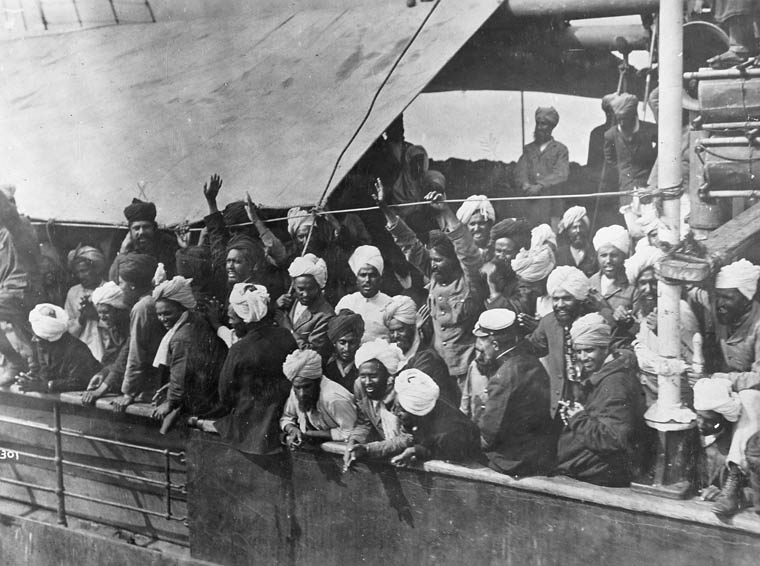
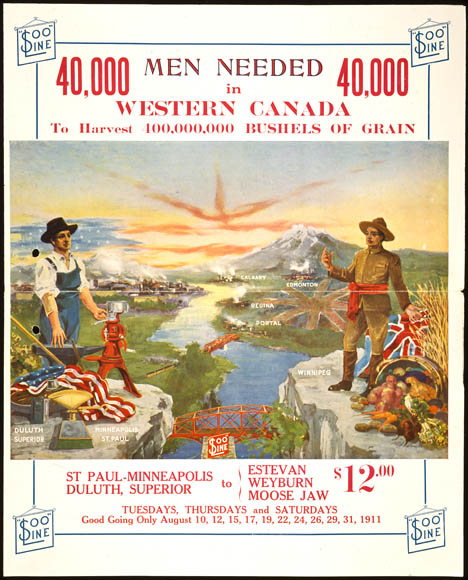
My lecture on Wednesday was on the history of immigration policy in Canada from 1867 to the present. This is a fun lecture to give because the narrative I present is a fundamentally positive one—Canada used to be a really racist country but it later became a beacon of tolerance and progress in the world beset with ethnic nationalism. It’s fun to tell a story that starts out bad and then has a happy ending! The students seemed really engaged in this topic, although perhaps there is less interest in it than there might be in a major urban centre. I began the lecture by speaking about the constitutional division of responsibility for immigration between Ottawa and the provinces, placing the actual text of the relevant section of the British North America Act on the screen. The then talked about the successive Immigration Acts, the Chinese Head Tax, Clifford Sifton and the development of the Prairies, the voyage of the Komagata Maru, Canada’s shameful response to Jewish refugees in the late 1930s, the enormous changes to Canada’s immigration policy under Diefenbaker and Pearson, the introduction of the points system, and the Cullen-Couture Agreement.


Komagata Maru

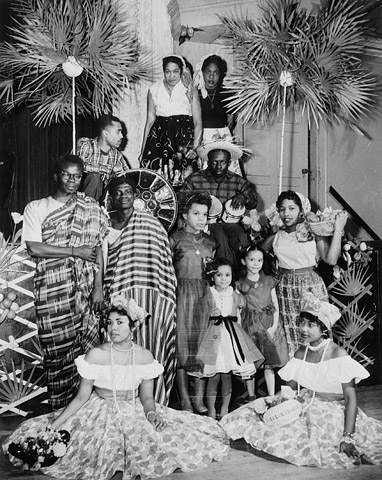
West Indian students in Montreal celebrated the anniversary of the West Indies Federation with exhibitions of limbo, voodoo and calypso dances at the Negro Community Centre. Credit: Canada. Dept. of Manpower and Immigration / Library and Archives Canada / C-045104

In the lecture, I showed how the evolution of Canada’s immigration policy was connected to changes in Canada’s identity and the transition from ethnic to civic nationalism. I touched on our declining birthrate and how Canada’s response to this issue has differed from that of other industrialized countries. I also pointed out that for several decades Canada was a country of net-emigration. Many students were surprised to learn that Canada was a net exporter of people for many years. As a way of illustrating this point, I spoke a little bit about the origins of the California town of Ontario and about French Canadian settlement in the factory towns of New England. I usually mention that the author of O Canada died in Boston, although I forgot to say this when I delivered the lecture this year. In the last part of the lecture, I showed how Quebec’s attitudes to immigration are somewhat different from those in English-speaking Canada and I differentiated Quebec’s inter-culturalism from the multiculturalism of the rest of the country. I concluded the lecture on a very positive, upbeat note and stressed that Canada is a global success story when it comes to immigration: an astonishingly high proportion of our population is of foreign birth, yet we have been able to preserve social cohesion in a way that is the envy of other nations. We are so lucky in Canada to have a consensus in favour of multiculturalism, whereas other countries are stuck with Jean-Marie Le Pen, the BNP, and Lou Dobbs.  I pointed out that Australia, Switzerland, and, more recently, the United Kingdom have copied our points system!

HIST 4165

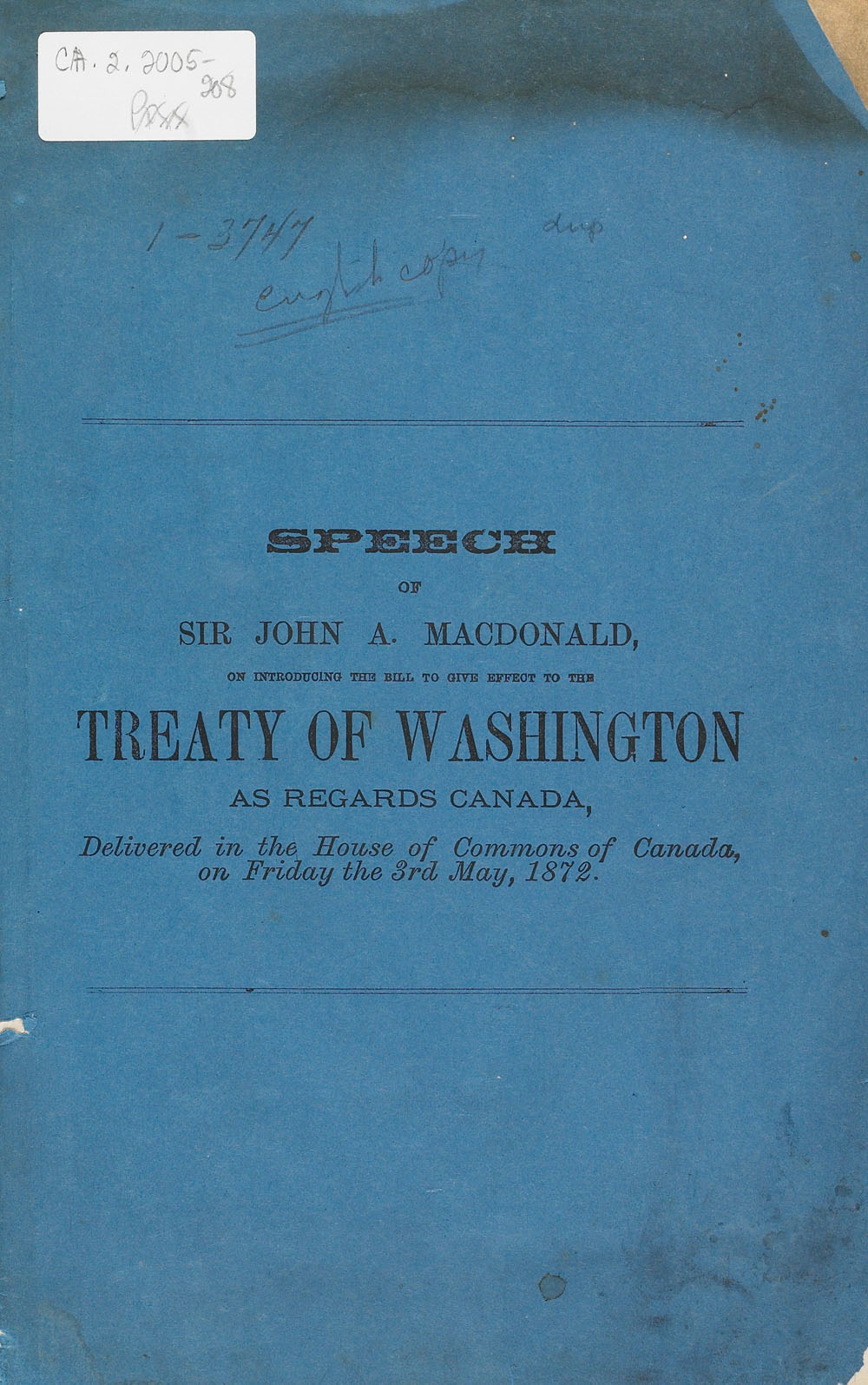
In my 4th-year seminar on British North America in the Confederation era, we heard four students present about their research. One student presented her research on the evolution of abortion law in 19th century British North America. She made some pretty interesting discoveries in the primary sources. The next presentation was on Sir John A. Macdonald and the 1871 Treaty of Washington.

Some good primary source research was presented there. We also heard a fine presentation on the role of evangelical Protestantism in the Sons of Temperance organization. The last presentation to today’s class was on Canadian reactions to 1857 Mutiny in India. This student talked about the formation of a regiment in Canada to help put down the rebellion. The student compared French Canadian and Anglophone reactions to the proposal to dispatch this force to India. I was really impressed with these presentations. After the class the students headed off to the campus pub to drink green beer. They certainly deserve a drink for their hard work this St Patrick’s Day!


New Canadian Think Tank With Unfortunate Name

16 03 2010

A newly-established cheap website think tank, the Macdonald-Laurier Institute, has proposed that the government set aside funds so that every Aboriginal child can go to university. This sounds like a good idea to me. However, the Institute needs to find a far better name. Since 1945, Canada has repudiated pretty much everything Sir John A. Macdonald stood for: the British Empire, unthinking anti-Americanism, hanging Riel, the Chinese Head Tax, Native residential schools, protectionist tariffs, extreme centralization, and spending on grandiose nation-building public works. (Would the Institute support a trans-continental high-speed train? How about giving the federal government the right to veto all provincial statutes?) Adding Laurier to the name of the institute is also unfortunate, although less so. If Laurier stood for anything at all, it was political expediency. Even by that standard, he was less effective than his protégé Mackenzie King. Laurier’s many compromises (between French and English, Catholics and Protestants, protectionists and free traders, racists and anti-racists, imperialists and Canadian nationalists) were ultimately less successful than the similar compromises made by King, who held power for longer. If the Institute wants to be a credible force in the fields of Native, immigration, and economic policy (some of the topics listed on its website), it will need to skim search the Canadian historical record again for a more appropriate name. Macdonald and Laurier were extremely partisan figures, the former calling the latter a traitor during the 1891 election campaign. Are they really suitable role models for today’s politicians?

This Institute may end up doing some useful work (although the fact it has a mediocre website, no physical address, and no university affiliation doesn’t augur well). However, it really needs to dump the existing name. The people who set up this Institute probably know very little about Macdonald and Laurier. If they did, they wouldn’t have chosen this name. The name choice suggests either historical ignorance or a really reactionary mentality. (I believe the former is more probable, because we are in Canada).  The Institute’s website shows the modern Canadian flag as well as the  Canadian Red Ensign is use in the late 1950s and early 1960s. The creators of the website should be aware that the Canadian Red Ensign has appropriated by white supremacist/ neo-Nazi organizations in Canada. Check out the website of the “white nationalist” immigration reform organization Canada First, although don’t do so at work!

The Red Ensign, once the emblem of the Federal Govt, is now the symbol of those who want a return to the good old days in Canada.

Anyway, to someone with enough knowledge of Canadian history, the Red Ensign seems like a singularly inappropriate symbol for an Institute that has visible-minority and francophone directors.   Most of the people on the institute’s board have university degrees, so the fact they would want to identify themselves so closely with Macdonald and the Red Ensign is itself a sad statement the average Canadian’s level of historical knowledge. In the United States, you would never find an organization called the “Jefferson Davis Center for Racial Equality”. That’s because Americans who have made it out of high school know enough about their own history to realize such a name would be ridiculous. Sadly, Canadians get most of the historical information from watching US TV, so they know much less about their own country’s past leaders and symbols.

File this name in the department of the absurd. This is almost as amusing to me as Justin Trudeau’s oration at his father’s 2000 funeral, which began with the words  “Friends, Romans, and Countrymen”. (These were the opening words of the speech Shakespeare’s Mark Antony delivered at the funeral of Julius Caesar, who had been assassinated because he was in the process of establishing a dictatorship in Rome. Justin’s Father, a retired Canadian Prime Minister, had died of natural causes).


New Ways of Teaching Canadian History

12 03 2010

ActiveHistory.ca has published a piece by Steven Maynard of Queen’s University on how he uses the ideas of Michel Foucault in teaching his first-year students Canadian history. “What does a queer, sadomasochistic philosopher have to do with the study of Canada’s past?” To find out, read his post.  Maynard relates how he applied Foucault’s concepts to his lecture on Canada and the First World War. The thing that caught my eye in his piece was that his students organized a Facebook group. I use Facebook in my teaching to communicated information about upcoming lectures, etc, to my students. For instance, I notify my students whenever the PowerPoint Presentation for an upcoming lecture is ready for downloading on our intranet.

While I am on the subject of digital history, I should point out Krista McCracken‘s ActiveHistory piece on the pitfalls of digital memory.


The Bank of Canada at 75

11 03 2010

Bank of Canada building

Canada’s central bank turns 75 today. There have been a number of stories about the anniversary in the media. See here, here, and here.

Governor Mark Carney’s speech on the anniversary says little about the actual history of the institution. The historical parts of his speech focused mainly on the decision of Bank to allow the value of the Canadian dollar to float in 1950. He said:

“In 1950, Canada faced adjustment problems of its own, and the Bank, as a learning institution responded. Large capital inflows threatened to drive up inflation in Canada in the context of our then-fixed exchange rate. In an effort to maintain price stability, the decision, unpopular internationally, was taken to float the Canadian dollar, which duly appreciated. While this was inconsistent with the rules of Bretton Woods, it was consistent with their spirit, as a floating dollar allowed both for domestic stability and for the market to determine the rate, rather than being set by government for national advantage. Canada’s move to a flexible exchange rate was a precursor to the breakdown of the Bretton Woods system 20 years later.”

I think that Mr Carney’s decision to focus on this episode is curious. Today, free-floating exchange rates are uncontroversial. Is it really necessary to defend this decision taken by the Bank in 1950? Aren’t there more controversial actions in the Bank’s history that he might wish to address? The really interesting thing about Mr Carney’s speech are the major omissions.

First, while Mr Carney spoke about the creation of the Bank in 1935, he did not mention that it was nationalized by the government three years later. Wouldn’t it be interesting to know why it was nationalized? Wouldn’t it be possible to draw some useful lessons from this episode?!?!?

Second, Mr Carney ducked the issue of whether the central bank should be independent of elected politicians. Arguments both in favour and against central bank independence can be made. Perhaps the most exciting event in the history of the Bank of Canada was the 1961 fight between Governor James Coyne and the government of John Diefenbaker. It is unfortunate that Mr Carney did not offer some thoughts on this issue. Perhaps Mr Carney wanted to avoid mentioning this episode because it made Canada look like a Mickey-Mouse country.

I looked at the materials on the BofC’s website related to the 75th anniversary. The PDF file “Canada’s Economy since the Founding of the Bank of Canada” set off my BS detector. It included a chart showing that “Real gross domestic product per person has grown almost sixfold over the past 75 years—an indication of improved economic well-being.” There is also chart showing that more Canadians own cars today than they did before the advent of central banking. The document says: “When the Bank of Canada was founded in 1935, the country was still widely regarded as a nation of “hewers of wood and drawers of water.” Back then, there were far more jobs in agriculture than in manufacturing. Today, four out of five jobs are in the services sector.”

Yeah, all of that is true, but it doesn’t necessarily prove that the Bank of Canada was a good economic manager. A somewhat more convincing stat would be to compare the rate of growth in the 75 years before 1935 and the 75 years since. Even then, it would be risky to draw any conclusions from the numbers, since so many other things were going on in the economy. Christ, even my undergraduate students should be able to see through that one.

The National Post published amusingly nutty perspective on the bank’s history from Martin Masse, a former advisor to erstwhile Foreign Affairs Minister Maxime Bernier. See here. Mr Masse thinks that it was a mistake for Canada to leave the gold standard.

If Andrew Coyne says anything interesting about the anniversary on his blog, I shall let my readers know.