The Word of the Week Is Culture

3 07 2012

Banking culture that is. Last week, there were the revelations that traders at Barclays Bank manipulated the Libor rate. This week, we’ve had the academic analysis, journalistic pontificating, and political posturing. Generous portions of the word culture has been poured over the debate, although in some cases the speakers are using it like the intellectual equivalent of custard: it gives you a short-lived sugar high but not the energy you need to get through the day.

Mervyn King, the Governor of the Bank of England, kicked things off four days ago when he said that the Libor scandal proved that “we need a real change in the culture of the industry. And that will require two things, one is leadership of an unusually high order and [the other is] changes to the structure of the industry.” Read more here.

Adair Turner, the head of the FSA, the bank’s regulator, then called for a change in British banking “culture.”

This morning, George Osborne, the Chancellor of the Exchequer, also spoke about banking “culture” in an interview with the Today Programme. Osborne was being asked about this response to the resignation of Barclays CEO Bob Diamond a few hours earlier. Danny Alexander MP, the Chief Secretary to the Treasury, then chimed in with his thoughts on Diamond’s resignation:  “this is the right decision. Responsibility has been taken in the right way and hopefully this will help Barclays to establish a better culture in future.”

Three quick thoughts.

First, what precisely do people mean by the word “culture” here? This term is one of slipperiest concepts in the English language because there are so many damn competing definitions. I suspect that in this context people are referring to the accepted norms and practices within the banking community. That is certainly how I would define this term.  However, I would like to see more precision on the part of public figures when they throw this term around. Perhaps it is too much to expect an elected politician such as Osborne and Alexander to define their terms in the way an academic would in a paper. However, Turner and King should indeed tell us what precisely they mean by “culture” before they use this term. It is reasonable to expect a bit of precision from two regulators who were appointed, in part, on the strengths of their academic credentials.

Second, it is very interesting to hear the head of a regulatory agency, which relies on penalties to encourage correct behaviour, say that what is really needed is a cultural shift within the industry so that people behave themselves even when the regulator isn’t watching.  That’s great. For far too long the rational-actor model of human behaviour has been excessive dominant in the academic disciplines that study finance and the economy more generally. This model has caused people have given too much thought to incentives and not enough to cultural norms. For many people who study finance, the default assumption is that all human behaviour is exclusively self-interested and they people are in it to make as much money as possible.  This theory suggests that if you want them to behave a certain way, they must be incentivised to do so, perhaps by the risk of a fine.  There is, however, another way of thinking about economic behaviour and that involves looking at the ethical norms prevailing in a community. I think that the advantages of using this lens to study banking are illustrated by the events of the last week.

Third, I’m wondering what my fellow business historians can contribute to this debate. Business historians have written a great deal about culture in recent years. Ranald Michie’s Guilty Money: The City of London in Victorian and Edwardian Culture, 1815-1914 (London: Pickering & Chatto, 2009) is an outstanding example of this scholarship. How can the existing research findings of business historians who have investigated the culture of banking be translated into a format that would be accessible to policy-makers and other non-academics? How can we historians plan out new research projects that are relevant to the ongoing debate about the internal culture of banks? These are questions we need to ask right now.


CBC Story on How Canada is Viewed Abroad

2 07 2012

On Canada Day, 1 July, the CBC ran a story about how Canada is perceived around the world. The reporter interviewed a bunch of academics who study Canada and work at universities outside of North America. I answered his questions about British perceptions of Canada as best I could.  Some of my responses made it into the article, but due to legitimate space constraints others did not.  I’m posting my responses to the reporter’s questions below on the off chance they are of interest to others.

How is Canada perceived in your region of the world? 

Canada has an extremely low profile in the UK. British people think about Canada about as frequently as Canadians think about New Zealand. I suspect that the Vancouver Olympics and the Vancouver hockey riots were the only Canadian news stories that were covered on British television in the last five years. Occasionally, the TV news will show pictures of a Canadian forest fire for a few seconds, but only if the footage is really good.   Print media has slightly more information about Canada. A few of the better papers might devote a paragraph or three to the result of a Canadian federal election, although I recall that one paper referred to Canada’s current Prime Minister as “John Harper.”  The Guardian, a left-wing paper with a world-wide readership, occasionally does a story about the tar sands in Alberta, but I suspect these online articles are read mainly by that paper’s many readers in Canada. The Financial Times has good material about Canadian companies such as RIM, but it’s mainly read by  executives and is behind a paywall.

I would say that the advent of social media and viral videos has helped to make images of Canada, or rather image of particular events in Canada, more accessible to British people. Thanks to Facebook, millions of people in the UK saw a picture of a couple lying on a street kissing in the middle of the Vancouver hockey riot. It was a big hit.   I was certainly asked about it on a number of occasions.

As a historian, I’m struck by how little coverage of Canada there is in the British media nowadays. I’m currently writing a book about the Anglo-Canadian relationship just before WWI. At that time, there was tonnes of coverage of Canada in British newspapers, largely because Canada was part of the British Empire. I’m talking front-page coverage here. This lasted until the 1960s, when the Commonwealth became much less meaningful to both countries. Since then, British people have paid attention to Canada only whenever there was a referendum in Quebec or Canada was hosting an Olympic Games. The same pattern show up when you use the keyword search to count the number of references to the word “Canada” in the British parliament. Prior to 1960, you can find many speeches by British politicians that refer to Canada. After 1960 or so, the word frequency drops off considerably.

The degree of awareness of Canada varies enormously in Britain. The general public knows very little about Canada, but there are also people who know a great deal about Canada because their work requires it.

I would say that there is much less truly astonishing ignorance of Canada than there was a few decades ago. In say, the 1950s and 1960s, some British people still thought of Canada as an essentially unsettled area. I think that television, which allowed them to see that there were tall buildings and so forth, ended this romantic view. The fact many British people emigrated to Canada also helped to create a more realistic view of Canada at that time. People knew from letters and photos that their relatives in Canada weren’t living in log cabins. Many British people still think of boreal forest when they hear the word “Canada.” That’s the default mental image.  Intellectually, the British know that most Canadians live in big cities that look basically like big cities in the US.

Canadians continue to be confused with Americans, essentially because we speak with US accents. However, virtually all British people are aware that Canadians dislike being confused with Americans. That’s the one thing they know about Canada.

Some, but not, all British people are under the impression Canada is a US state and that Canadians have the right to vote in US Presidential elections. The key difference is between British people who have actually been to Canada and those who have not. The ones that have been to Canada realize that it’s not simply another US state. A visitor immediately notices that Canadians use a different currency than the United States. At the airport, the customs officials wear uniforms emblazoned with the word “Canada.” This makes visitors aware that Canada has a distinct legal status within North America, even though the cars and the houses look basically the same as in the US.

Many university-educated people in Britain are aware that Canada is an independent country with distinct passports, a seat at the United Nations, and so forth. Within that subset of the population, there are people who are extremely knowledgeable about Canada.  There are British companies, such as Standard Life, that do a great deal of business in Canada. It’s their second-largest market, after the UK. I bet the CEO of Standard Life could tell you the name of Canada’s largest province without having to look it up on Wikipedia.  The same is true for people in minerals and oil.

Several Canadian-made TV shows are broadcast in the UK. However, I don’t think they do much to raise awareness of Canada. The most popular of these shows, Flashpoint, was filmed in Toronto but is set in an (unnamed) US city. There are also several Canadian TV shows aimed at toddlers that are broadcast here. The CBC show, Republic of Doyle, which is manifestly set in Canada, shows here on one of the digital cable channels. British people can watch 30 minutes of Canadian news each day, provided they can understand French and subscribe to TV5, the international French channel.

Blackberry devices are popular but virtually nobody here knows that RIM is a Canadian company.

How has the view of Canada changed over the last few years? 

As I said before, the average British person sitting in a pub doesn’t have a view of Canada aside from forest fires or perhaps the Vancouver hockey riot.  In terms of the university-educated elite, I wouldn’t say that Canada had done anything in the last few years that has changed its image in Britain. However, I would say that British politicians, especially those in Scotland, are starting to pay a bit more attention to Canada. That’s because Alex Salmond, the current First Minister in Scotland, is a separatist. In 2014, Scotland will hold a referendum on independence from the UK. This has prompted many political analysts and journalists to do a bit of reading about Quebec nationalism.  I know that Alex Salmond has studied Quebec nationalism very carefully.
What does Canada mean to your part of the world? 

Trees and beavers and snow.

How is Canada’s role in world affairs perceived in your region?

Canada isn’t perceived as having a role in the world.

How are Canadians regarded?

Canadians are regarded very positively, I would say. Canadians travelling to Britain should let it be known that they are Canadian, not American. I remember that in 2003 there was a great deal of anti-American sentiment in this country.  Lots of totally anti-war Americans got lectures from strangers in pubs about George Bush and the Iraq War. All that’s gone now, thanks to Obama. However, it is still better to be  Canadian than an American here.


Oil in American History

25 06 2012

The June 2012 issue of the Journal of American History is a special issue on “Oil in American History.” Normally, the article in the JAH are behind a paywall. However, the contents of this issue are available to all. See here


Great Job Opportunity for a Historian of the Canadian North/Arctic

25 06 2012

Research Fellow in Northern Colonialism

University of Aberdeen – Anthropology

College / University Administration: College of Arts & Social Sciences

School / Section: School of Social Science

Position Type: Full-time

University Grade Structure: Grade 6  Salary From: £30,122  Salary To: £30,122

The University of Aberdeen invites applications for a Research Fellow to join the Northern Colonialism: Historical Connections, Contemporary Lives programme. This new research initiative is part of the University’s strategic investment in northern research and aims to foster path-breaking interdisciplinary research on the processes and impact of colonialism in The North. The programme builds upon existing expertise in Anthropology, Archaeology, History and Geology and is structured around three themes: Economies and Politics, Environments, and Cultural Transformations. The North is defined here not so much by latitude as by the intersection of climatic, environmental, historical, geopolitical and cultural conditions, all of which come together to give the region a significance for the future of life on earth quite out of proportion to its relatively sparse human population.

You will be expected to undertake research that will address the history and/or politics of northern colonial enterprises. In addition to developing your own research profile, you will have a key role in supporting the activities of the Northern Colonialism programme. You will be expected to contribute to the organisation of academic events and public outreach and to assist with securing external funding which will develop the reach and scope of the programme, both nationally and internationally

The regional and temporal specialties of the successful candidate can be open, but should fall within the remit of the programme as a whole. You will be encouraged to take a broad-based approach to northern colonialism and to focus on the ways in which it has been understood across various academic disciplines. We welcome proposals with a wide geographic frame to enable comparative analyses. Topics could range from resource extraction, governance, Arctic geopolitics, histories and philosophies of science to exploration, mercantile histories or migration histories. Time frames examined could span the 17th century through to the 21st century.

You should have a PhD degree in Anthropology, Archaeology, History or related discipline. We welcome applications from candidates with experience of research in the fields of anthropology, archaeology, history or a related discipline. Experience of working across a combination of these areas is desirable. 

This post, funded by the University for three years will commence on 1st October 2012, or as soon as possible thereafter.  Starting salary will be the first point on the Grade 6 scale (£30,122 per annum).  Consideration will be given to making an appointment at Research Assistant level in the first instance (salary range £25,251 – £28,401 per annum) for individuals in the final stages of completing their PhD.

Should you require a visa to undertake paid employment in the UK you will be required to fulfil the minimum points criteria to be granted a Certificate of Sponsorship and Tier 2 visa.  Please do not hesitate to contact Mrs Heather Crabb, HR Adviser, h.crabb@abdn.ac.uk for further information.

Informal enquiries may be made to Dr. Alison Brown (alison.brown@abdn.ac.uk).  To apply online for this position visit www.abdn.ac.uk/jobs quoting the job reference number SOC011R.    The closing date for the receipt of applications is 16 July 2012.

Closing Date: 16/7/2012


The Adam Smith Institute, Business Ethics, and the Ayn Rand Lecture

23 06 2012

Gordon Gecko’s mantra was “Greed is Good.” In the 1980s and 1990s, there was a tendency, especially among people on the right of the political spectrum, to celebrate the pursuit of money as the driving force behind social progress. I suppose that was the culture of the Reagan-Thatcher era. Since the Enron scandal in 2002, there has been a growing realization that capitalism without ethics is a bad idea.  The GFC in 2008 and the evidence of corporate dishonesty and that has accumulated. For instance, it was revealed that a manager at Bear Stearns described, in a 2005 email, some of the securities the firm was trying to sell to investors as a “sack of shit” (i.e., a product they knew was massively overpriced).

The revelations of recent years have intensified the demands for businesses to be more ethical.  Yes, there have also been demands for tougher laws, better auditors, etc. But many observers think that laws mandating ethical behaviour are not enough: shifting behaviour will involve changing norms and institutional cultures as well. That’s why there has been so much attention given to the question of how business schools train future executives in ethics. When he was appointed Dean of the Harvard Business School, Nitin Nohria announced that business ethics were going to be a mandatory part of the curriculum. Nothia believes that future executives must be taught that the quest for profits must be counterbalanced by the other considerations, such as the interests of other stakeholders and society in general. The message is– go ahead, make a healthy profit, but not at any cost.

Of course, business people don’t stop learning about ethics the moment they graduate from their MBA programme. They continue learning about ethics on the job. If they go to Goldman Sachs, a company that is, or at least was, famous for its strong ethical culture, they will learn a different set of values than if they land their first job at some Enron-style company where most of the apples in the barrel are already rotten. [In his famous resignation letter of March 2012, Greg Smith claimed that the traditional culture of integrity at Goldman Sachs had been undermined during his twelve years at the company].

Businesspeople also pick up messages about business ethics through life-long learning events, such evening lectures in the financial district. For those who are religious, the sermons they hear at church or synagogue may influence their behaviour on the job.   Studying the messages about ethics that businesspeople absorb on and off the job is clearly a really important task for academics. Within my own discipline, business history, there is growing interest in the history of corporate social responsibility and corporate ethics.  There is a growing body of social-scientific research showing how culture and ideology influence present-day managerial decisions. For instance,  we know that investment managers in the US who are registered Democrats are more likely to avoid investing their clients’ money in tobacco companies than their Republican counterparts. See here. Managers don’t park their personal values at the door when they arrive at work in the morning.

This brings me to my next point. The Adam Smith Institute, a think-tank in London, is named after a distinguished economist and moral philosopher. Although Smith wrote in the eighteenth century, his ideas are still very relevant today. Personally, if I were in charge of ethics education at a business school, I would make the students read and debate passages from both Smith’s Wealth of Nations and his Theory of Moral Sentiments. One of the messages of the Wealth of Nations is that greed (i.e., the pursuit of self-interest by individuals) can, in certain circumstances, be good for society as a whole. In Smith’s other classic work, the focus was on charity, benevolence, altruism, and the duties of a citizen.

Reading the two books together would be a good way of getting students to debate how individuals and corporations go about achieving the right balance between selfishness and altruism. I don’t think that anybody expects the managers of for-profit companies to behave like Mother Teresa. We certainly don’t expect households to give 100% of their incomes to charity. At the same time, executives should be taught to limit the pursuit of short-term self-interest at the expense of shareholders, workers, and other stakeholders. Similarly, a private individual who went through life without ever giving a penny to charity would be pretty hard to respect.

Precisely what the right balance between greed and altruism is a question I certainly don’t have the answer to. However, I believe that thinking about the two great works of Adam Smith is a great way of getting people to think about these fundamental issues. It makes you a better person. Adam Smith has been criticized for being an inconsistent thinker, someone who said that greed was legitimate in some circumstances and not others. Smith favoured the free market in most cases, but he also supported a certain number of government regulations in the economy. Nineteenth century German philosophers were particularly exercised by the apparent contradictions between Smith the author of The Wealth of Nations and Smith the author of the Theory of Moral Sentiments. They spilled buckets of ink trying to reconcile the ideas in these two books.  Personally, I think that this alleged inconsistency is one of Smith’s great virtues. Smith represents the great Anglo-American tradition of “muddling through,” of pragmatically judging each issue on a case by case basis rather than trying to impose some deductive continental European ideology that has a snap answer for everything. As long as we live in a mixed economy that consists of private, public, and charitable sector, Smith’s idea will remain relevant.

It is, therefore, most unfortunate that the Adam Smith Institute in London does so little to help disseminate the complex ethical ideas of its namesake. Recently, it has promoted the very different ideas of Ayn Rand. Last Thursday, the Adam Smith Institute hosted the Ayn Rand Lecture, which was held at Drapers’ Hall in the City of London. (Drapers’ Hall, it should be noted, belongs to one of London’s historic guilds).

I suppose the Adam Smith Institute has endorsed the ideas of Ayn Rand because they are congruent with the classical liberal ideology of the think-tank.  Whether or not its decision to use Rand’s ideas as intellectual ammunition is a politically strategic one is something only time will tell. To my mind, a far more important question is this: to what extent would disseminating Rand’s ideas in the City of London have on the prevailing ethical standards in that community. This is a vitally important question for any number of reasons. For one thing, foreigners flock to the City of London to do business is that the people there have long had a reputation for honesty and fair dealing.

Let’s say for the sake of argument that large numbers of people in the financial district become followers of Ayn Rand. Would that be good for the ethical tone of the City?

Let’s take a look at Rand’s message. Ayn Rand was a Russian-American philosopher who celebrated greed, denounced all forms of religion, sneered at charity, and has had a major impact on American culture.  Rand expressed her philosophy is a series of novels and non-fiction works. Rand’s writings were characterized by the extremism and dogmatism for which her homeland is famous. For instance, Rand did not advocate trimming the budget for welfare by a certain percent or making it harder for the able-bodied unemployed to claim benefits, policies that traditional Anglo-American centre-right political parties might support. Instead, Rand advocated the abolition of all welfare-state programmes, along with the abolition of the Post Office and publicly owned roads.

Although Rand’s ideas were, in a sense, deeply alien to the Anglo-American political tradition of moderation and compromise, they have become popular in the United States. As the University of Virginia historian Jennifer Burns has noted, Rand’s ideas have had a major impact on US politics since the 1950s. Rand’s influence contributed to the rise of an extreme form of free-market fundamentalism within the Republican Party.

Randian philosophy has inspired a generation of libertarian activists who believe that any form of progressive taxation is evil and that it is truly immoral for the government to spend any amount of charity for the disadvantaged in society. The Randians have marginalized the moderate, Eisenhower-style Republicans and have shifted political discourse in the US far to the right. In his period as chairman of the Federal Reserve, Alan Greenspan, a follower of Rand, encouraged US policymakers to dismantle many of the financial regulations that were imposed after the Great Depression.

Burns’s focus is on Rand’s ideas on the political life of the US, not the activities of business people. However, I would speculate that the small minority of business people who identify with the belief-system of Ayn Rand are probably more ruthless than their counterparts who subscribe to more mainstream political ideologies or to one of the major organized religions.

It would also be interesting to measure whether followers of Rand were more or less honest than businesspeople who subscribe to other belief systems. We know that religious people are less likely to cheat or display other anti-social behaviour when playing games with fake monopoly money in a laboratory setting. See here. There’s actually a vast literature on the behavioural economics of religion.  Of course, not all religions have the same economic teachings. One would imagine that followers of a religion that permits lying would be, say, more likely to cheat on their taxes than someone who goes to a church that teaches that lying is wrong under all circumstances.

I bring up this point because Rand’s message on the legitimacy of lying was a bit muddled, for while she condemned dishonesty in her non-fiction works, her novel Atlas Shrugged celebrates a conspiracy by rich industrialists who live in a tax-haven in the Rocky Mountains that is hidden from the outside world by a sort of invisibility ray.

To my knowledge, no behavioural economist has conducted a study to determine whether fans of Ayn Rand are more or less dishonest than other economic actors. One theory is that fans of Atlas Shrugged would more honest than other people. Another interpretation is that they would be more likely to engage in different types of dishonesty.  For instance, they might emulate the heroes in Atlas Shrugged and hide their cash in offshore tax havens, such as the Cayman Islands. [Sadly invisibility rays do not yet exist].

I’m unaware of any research on this subject, but would welcome any suggestions/links to papers if my readers know of work on this subject.


CFP: Financial Institutions and Economic Growth in Historical Perspective

19 06 2012

Call for papers:
London Frontier Research in Economic and Social History (FRESH) Meeting

Topic: Financial Institutions and Economic Growth in Historical Perspective

First Bank of the United States, Chestnut Street, Philadelphia

Date: December 14-15, 2012

Hosting Institution: Department of Economic History, London School of  Economics

Keynote Speakers: Alan Taylor (Virginia), John Turner (QUB) and Joachim Voth
(UPF).

Local Organizers: Olivier Accominotti, Chris Minns.
FRESH Organizers: Paul Sharp, Jacob Weisdorf and Rowena Gray.

FRESH meetings are aimed at researchers in any field of  economic and social history. The meetings build on the concept that scholars present their ongoing research at an early stage, i.e. normally before it becomes  published as a working paper or the like, and certainly before it is published in
books or journals. The main aim of the meetings is to gather researchers in a  friendly and collegial environment where they can present their research and  receive constructive criticism from their peers.  The FRESH meeting organizers strive to accommodate as many speakers as  possible. Accepted papers will receive 45 minutes each (25 minutes for  presentation and 20 minutes for discussion). However, in the interest of
avoiding parallel sessions, the presentation time may be shortened.
For this meeting we particularly encourage papers on financial institutions,  financial crises and economic growth, but submissions from scholars working in  other areas are also welcome.

Prospective speakers should submit a one-page abstract and a short CV to Olivier Accominotti (o.accominotti@lse.ac.uk) no later than August 31, 2012.

Notification of acceptance will be given by the end of September 2012.


The World Economy Over the Last 2,000 Years

19 06 2012

This graph probably won’t surprise any readers who are familiar with the literature on the Great Divergence: it is well-known among historians that the relatively large share of world economic activity enjoyed by the West in the last few centuries is rather atypical. For most of recorded history, Asia, not the North Atlantic region, was the centre of the world economy.  Nevertheless, it is worthwhile reposting it here.  This elegant graph was produced by Michael Cembalest, an analyst at JP Morgan, using data generated by the late great Angus Maddison.

A couple of quick thoughts.

First, it is clear that US relative decline began in the late 1940s, as the economies of Europe and Japan began to pick themselves up off the floor. The next few decades saw continued US relative decline, coupled with rapid advances in living standards in the US. The lesson, relative decline doesn’t have to be scary. Luckily, we don’t live in zero-sum-game world.

Second, the brownish-orange part of the graph shows just how important India was at one point. It reminds me to read Prasannan Parthasarathi‘s new(ish) book   Why Europe Grew Rich and Asia Did Not: Global Economic Divergence, 1600-1850. Cambridge: Cambridge University Press, 2011. This book on the Great Divergence focuses on India, not China.  Another book to put on the summer reading list. I know from published reviews that the author thinks that India’s failure to industrialise was basically due to British rule. It will be interesting to see how he responds to the arguments Greg Clark offered in A Farewell to Alms.


Delaware and the so-called Race to the Bottom

17 06 2012

Ever wonder why so many US companies are incorporated in Delaware?

Business historian Bob Wright explains why in an excellent post on the Bloomberg Echoes Blog. See here


Albrecht Ritschl on the Marshall Plan, Greece, and the Eurozone

17 06 2012

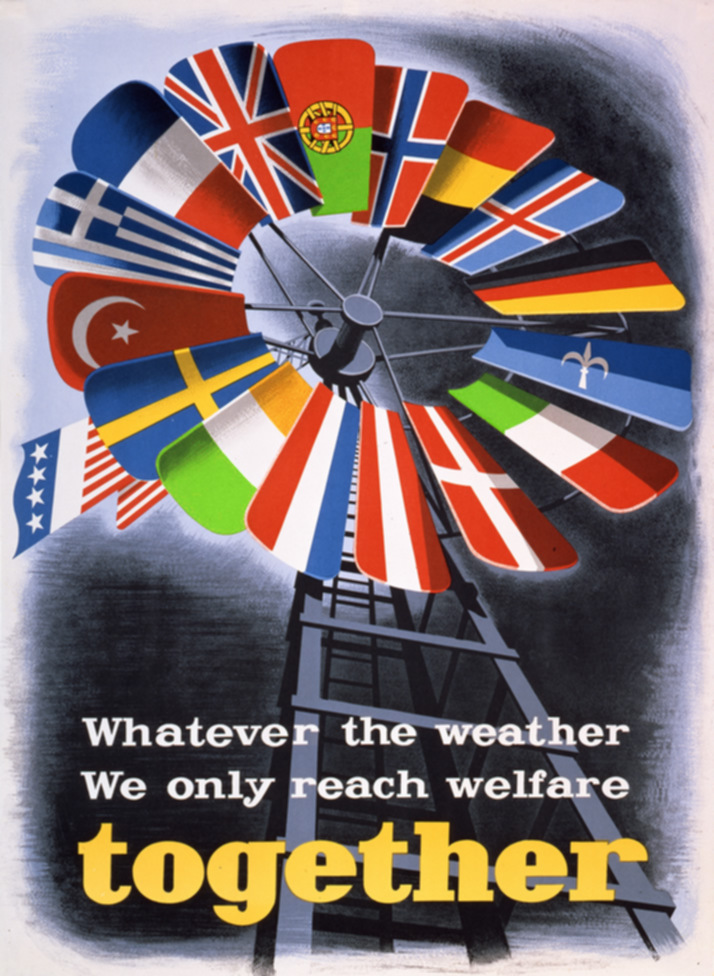
Albrecht Ritschl, who is an economic historian at LSE, has published a great blog post comparing the help Germany has given to Greece in recent years with the financial assistance packages offered to Germany at various points in the 20th century (the Dawes Plan of 1924, the Young Plan of 1929, and the Marshall Plan of 1948). As we all know, German taxpayers have footed the lion’s share of the bill to assist Greece and other Eurozone countries. Defenders of this arrangement argue that the poorer Eurozone countries have a moral claim on Germany because the latter became rich as a result of Marshall Plan assistance from the United States. The use of this historical analogy has provoked widespread debate.

Poster promoting the Marshall Plan.

Ritschl’s blog post of yesterday was prompted by a 12 June  New York Times piece in which the economist Hans-Werner Sinn of the University of Munich invokes comparisons with the Marshall Plan to defend Germany’s position against Eurobonds, the pooling of sovereign debt within the euro zone. Sinn argued that Germany has given Greece vastly more than it was itself given by the United States.

Ritschl questions Sinn’s numbers, arguing that he has underestimated that amount of aid given to Germany under the Marshall Plan and has overestimated that amount of help Germany has given to Greece. According to Ritschl, the financial assistance packages given to Greece in recent years are more like the Dawes Plan of 1924 than the generous Marshall Plan of 1948.

Here is the key part of Ritschl’s piece:

Under the Dawes Plan of 1924, Germany’s currency had been put back on gold but Germany went on a borrowing binge. In a nutshell, Germany was like Greece [in the early 2000s] on steroids. To stop this, the Young Plan of 1929 made it riskier to lend to Germany, but the ensuing deflation and recession soon became self-defeating, ending in political chaos… As far as historical analogies go, what Southern Europe received when included in the euro zone was closer to a Dawes Plan. And just like in Germany in the 1920s, the Southern Europeans responded with a borrowing spree. In 2010 we didn’t serve them a Marshall Plan either, but a deflationary Young Plan instead. This latter-day Young Plan is not even fully implemented yet. But we see the same debilitating consequences its precursor had around 1930: technocratic governments, loss of democratic legitimacy, the rise of political fringe parties, and no end in sight to the financial and economic crisis engulfing these states, no matter how many additional aid packages are negotiated. Woe if those historical analogies bear out.

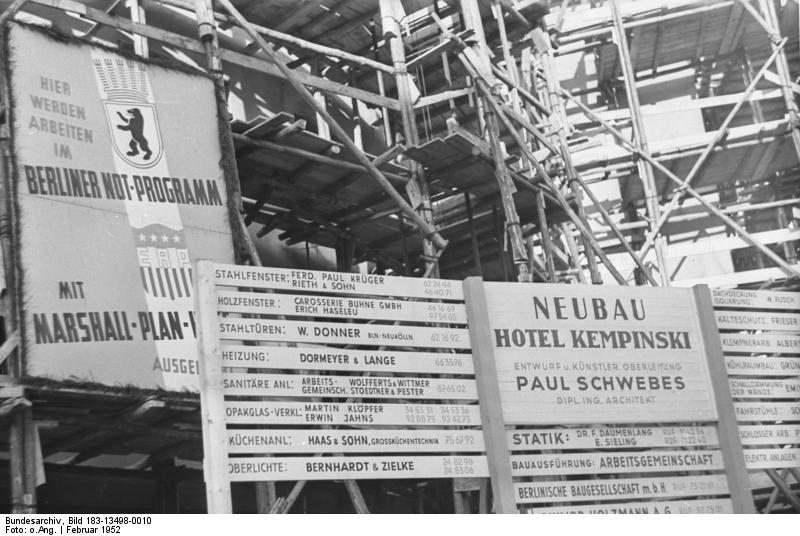
Hotel being built in West Berlin with Marshall Plan money, 1949. Note the number of sub-contractors (windows, wiring, etc) who were involved in this project.

Based on my limited reading in this area, I’m inclined to think that Ritschl has a better argument than Sinn. I understand the frustration many German taxpayers feel with Greece. Much more needs to be done if this currency union is going to work. (In fact, I’m not convinced that a currency union of territories in which different languages are spoken is compatible with democracy). However, I think that the attitude of much of the German populace towards Greece and other poorer parts of the EU suggests a distinct lack of awareness of and gratitude for the help Germany was given in its hour of need in the late 1940s. I note with interest that Professor Sinn was born on 7 March 1948, less than a month before President Truman signed the Marshall Plan into law.

The US law authorising the Marshall Plan.


Conference on the War of 1812

13 06 2012

12-14 July 2012, Senate House, University of London

2012 will be the bicentennial of the beginning of the War of 1812-14. Once described as the ‘forgotten’ war, there are already indications that there will be widespread commemoration ceremonies across North America, mostly sponsored and organized by national, state and provincial governments, by tourist organizations, and by local historical societies. We have therefore decided that it would be an appropriate time to hold an international conference that revisits the scholarly literature and scholarly debates over the causes, conflicts and consequences of the War as well as the way in which the War has been remembered and commemorated in Britain, Canada and the United States over the past two centuries. The conference on ‘The War of 1812: Memory and Myth, History and Historiography’, organized by the Institute for the Study of the Americas, and Canterbury Christ Church University in partnership with the National Maritime Museum in Greenwich, will be held in the Senate House of the University of London, beginning on the afternoon of Thursday, 12 July 2012 and running until the early evening on Saturday, 14 July 2012. A detailed timetable will not be issued until a few weeks before the programme but we are attaching below a list of the confirmed contributors If you would like more information please contact either Phillip Buckner (phillipbuckner@hotmail.com) or Tony McCulloch (tony.mcculloch@canterbury.ac.uk). If you would like to pre-register for the conference, a registration form is also attached.


WAR OF 1812 CONFERENCE: CONFIRMED PARTICIPANTS


Matthew J. Bellamy (Carleton University): ‘At War with Beer: The War of 1812 and the Canadian Brewing Industry’.


Troy Bickam (Texas A&M University): ‘Contesting the American Revolution during the War of 1812’.


Brittney-Anne Bos (PhD student, Queen’s University, Canada): ‘Deconstructing the Myth Behind the Man: Sir Isaac Brock and Monuments to the “British Gentleman Hero”’.


Thomas A. Chambers, (Niagara University): ‘”American Antiquities Are So Rare”: Remembering the War of 1812 on the Niagara Frontier’.


Michael Patrick Cullinane (Northumbria University): ‘Sulgrave Manor and 100 Years of Peace Among English-Speaking Peoples’.


James G. Cusack (University of Florida): ‘The War of 1812 and the Spanish Floridas: Seige, Terror and Looting in Neurtral Territory’.


William S. Dudley (formerly Director, Naval Historical Centre, Washington): ‘The American Navy In Adversity: Logistics in the War of 1812’.


R. David Edmunds (University of Texas at Dallas): ‘Tecumseh’s Confederacy:  Who Joined, Who Didn’t, and Why.’


Ralph Eshelman (Independent Scholar, USA): ‘What Theater of War In the United States Suffered More: A Case for the Chesapeake’.


Nicole Eustace (New York University): ‘The “Beauty and Booty” Scandal of 1812: Sexual Passions, Patriotic Myths, and the Mantle of Liberty’.


Charles H. Fithian (Delaware Division of Historical and Cultural Affairs): ‘“For the common defense”,“Infernals” and a “Maraudering Species of War: Delaware and the War of 1812′.


Alan Gordon (University of Guelph): ‘Marshalling Memory: An Historiographical Biography of Brigadier-General Ernest Alexander Cruikshank’.


Donald Graves (Independent Scholar, Canada): re military history of war


John Grenier (US Air Force Academy): ‘The Frontier Wars of 1812-1814:  The War of 1812 as Americans’ Final Conquest of the Transappalachian West.’


John Grodzinski (Royal Military College, Canada): ‘The Constraints of Strategy: Lieutenant-General Sir George Prevost as Commander-in-Chief of British North America during the War of 1812’.


Ricardo A. Herrara (Combat Studies Institute, Combined Arms Center, Fort Leavenworth, Kansas):

‘Toward an American Army: American Soldiers, the War of 1812, and National Identity’.


Donald R. Hickey (Wayne State College, Nebraska): ‘Myth and Memory:  How

Americans, Canadians, and Brits Have Mis-remembered the War of 1812.’


Gary Hughes (New Brnuswick Museum): ‘Myth, Fact and Circumstance: Looking Back at the History of the 104th Regiment of Foot’.


Susan Jerome (University of Rhode Island): ‘A Symbol of Patriotism – The Stonington Battle Flag’.


Faye Kert (Independent Scholar, Canada): ‘“True, publick and notorious”: The Privateering War of 1812’.


Renée Lafferty (Brock University): ‘”The Account We Must Render to God:” Luck, Prayer, and Providence in the Winning and Losing of the War of 1812’.


Andrew Lambert (King’s College London): ‘The War of 1812 and the evolution of American Culture’.


Paul La Violette (Independent Scholar, USA): ‘Myths surrounding the Battle of New Orleans’.


Roch Legault (Royal Military College, Canada): ‘The Key Ally: French Canada and the War of 1812’.


Doug Leighton (Huron College, University of Western Ontario): ‘After Moraviantown: Guerrilla Warfare in the Thames River Valley, 1813-1814’.


Sarah Lentz (Hamburg University): ‘The American Government Loan of 1813: The Role of Nationality, Patriotism, and Public Opinion in Transatlantic Financial Networks in Times of War’


Thomas Malcomson (George Brown College, Toronto) : ‘For “…the Want of a sufficient Number of able Seamen…repeatedly and earnestly requested…”: The British Navy’s Efforts at Manning the Great Lakes during the War of 1812 and its Impact’.


Magdalena Marczuk-Karbownik (University of Łódź, Poland):  ‘Was the Monroe Doctrine a Consequence of the Treaty of Ghent?’


Edward J. Martin (PhD student, University of Maine):  ‘Maine’s Mode of Privateering: A Tale of Fraud, Collusion and Vigilante Violence in the Northeastern Borderlands, 1812-1815’.


Keith Mercer (Saint Mary’s University): ‘Paradoxes of Patriotism: The British Navy in Nova Scotia during the War of 1812’.


Maria Moncur (Phd student, Queen’s University, Canada): ‘Battles Fought and Forgotten: Historical Storytelling and the War of 1812 in New York and Ontario, 1815 to 1915’.


Lisa R. Morales (North Central Texas College): ‘”War Cannot Be Carried on Without Money”:

The Strange Financial History of the War of 1812’.


Cecilia Morgan (University of Toronto): ‘The War of 1812 in Upper Canada and its Afterlife: Gender, Commemoration and memory in Nineteenth and Twentieth Century Ontario’.


Daniel S. Murphree (University of Central Florida): ‘A View from the Southern Borderlands: Reinterpreting the War of 1812 from a Florida Perspective’.


Charles Neimeyer (Director, United States Marine Corps History): ‘War Comes to Washington: The Chesapeake Campaigns of 1813-1814’.


James Paxton (Moravian College): ‘The Farmers’ War:
The Canadian Militia in the War of 1812’.


James Piecuch (Kennesaw State University, Georgia):  ‘Allies No More: The Southern Natives’ Response to the War of 1812′.


Justin Reay (Oxford University): ‘”With a lone ship he swept the oceans”: David Porter and the cruise of the Essex in the Pacific 1813-1814′.


John Reid (St. Mary’s University, Halifax): ‘”In the Midst of Three Fires, a French one, an American one, and an Indian one”:  Imperial-Indigenous Negotiations during the War of 1812 in Eastern British America’.


Jonathon Riley (Director-General & Master of the Armouries, United Kingdom): ‘In the Shadow of Vienna: the peace negotiations in Ghent, 1814-1815’.


Julia Roberts (University of Waterloo): ‘Captain Wilson, George Jones, and Versions of the History of 1812’.


James Tyler Robertson (PhD student, McMaster Divinity College): ‘Expel the Faithless Foe:

British North American Churches and the Role of Religion in the War of 1812’.


J. Simon Rofe (University of Leicester): ‘Theodore Roosevelt: The Historian of the War of 1812?’


Jeff Seiken (Historian, U.S. Air Force): ‘“It is Victories We Want”: American Naval Planning and Operations in 1812 Revisited’.


Scott S. Sheads (Historian, Fort McHenry National Monument/National Park Service): ‘September Glory: A Flag Hoisted – An Anthem Born, September 14, 1814’.


Donald G. Shomette (Independent Scholar): ‘American Naval Weapons Innovations during the War of 1812’.


David Skaggs (Bowling Green State University): ‘Invading Canada: William Henry Harrison, Oliver Hazard Perry and the Campaign into Southwestern Upper Canada, 1813’.


Gene Smith (Texas Christian University): ‘Fighting for Freedom:  Race, Liberty, and Power during the War of 1812’.


Joseph Stoltz (PhD student, Texas Christian University): ‘Hiding Behind the Cotton Bales: The Persisting Myths and Historical Memory of the Battle of New Orleans’.


John Sugden (Independent Scholar, United Kingdom): ‘Tecumseh and the Revolt in the West, 1805-1818’.


Alan Taylor (University of California, Davis): ‘Tales of Freedom and Slavery in the War of 1812’.


Guillaume Teasdale (University of Ottawa): ‘“The Frenchman was only shot and scalped”: French, Indians, British-American Imperial Rivalries and the War of 1812 in the Great Lakes’.


Jean-René Thuot (Université du Québec à Rimouski): ‘Loyalty to the Regime: Prominent Men, Militia and French Canadian Identity through the 1812 War’.


Len Travers (University of Massachusetts): ‘Embracing Mr. Madison’s War: New England Accepts “Victory”’.


Wes Turner (Brock University): ‘The Life, Death and Legacy of Major General Sir Isaac Brock’.


Steven Watts (University of Missouri): ‘Crisis and Sanctification: The War of 1812 and American Culture’.


John McNish Weiss (Independent Scholar, United Kingdom): ‘Cochrane and his Proclamation: Liberator or  Scaremonger’.


Harvey Armani Whitfield (University of Vermont): ‘Black Refugees, the War of 1812, and the Role of Dislocation and Migration’.


Glenn F. Williams (National Museum of the U.S. Army): ‘Defending the New Nation, 1784-1811: Fact and Fiction about the U.S. Army on the Eve of the War of 1812’.


Elaine Young (PhD student, University of Guelph): ‘Bloody Battles to Baseball Diamonds: Tourism and Leisure on the battlefields of the Niagara Frontier’.