My Teaching This Week (20 February 2012)

21 02 2012

In my history of globalisation class, my lecture this week was on the history of the Multinational Company. I started the lecture by giving the students a brief history of the legal concept of the corporation. I then moved on to discuss early-modern chartered trading companies such as the East India Company. I also spoke about 19th century Free-Standing Companies, the origins of some of today’s great multinationals, and the role of multinationals in the two world wars. I would say that the students were most interested in my discussion of IBM and the Holocaust. In the seminar associated with this lecture, the students discussed Harm G. Schroter,  2008. “Economic culture and its transfer: an overview of the Americanisation of the European economy, 1900-2005.” European Review of History 15, no. 4: 331-344. The students seemed pretty interested in this article, which generated a great debate about the welfare state, the difference between European and American values, and selective Americanisation. I got the impression that my students like American fast food and music but have no wish to adopt the values that have been in evidence in the ongoing Republican primary race in the US.

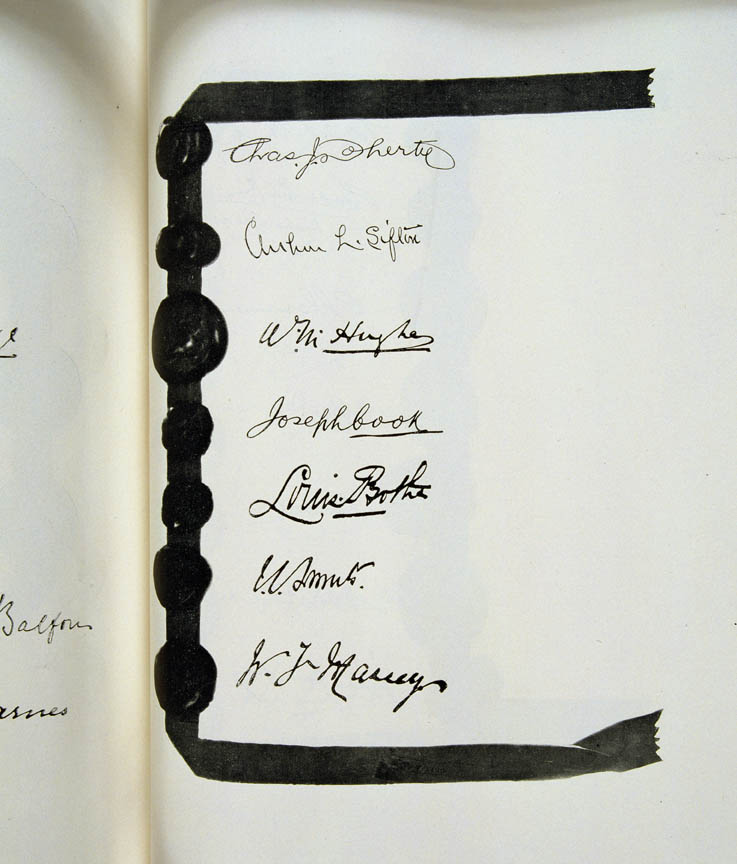
I also teach a class on the history of nationalism in the Western world since 1775. My lecture this week was on the impact of the First World War on nationalist movements and the concept of self-determination. In the lecture, I spoke about Woodrow Wilson’s conception of nations. As a way of illustrating my general points about the evolving nature of nationalism, I spoke about the impact of this war on the followings nationalisms: Australian nationalism, Zionism, German nationalism, Italian nationalism. In lecture, I showed some primary sources related to the Versailles Treaty that I had taken from the Founding Documents section of the online Museum of Australian Democracy.  I emphasized the signature page of Versailles Peace Treaty, which contained spaces for the signatures of the representatives of the British Empire’s self-governing Dominions. I explained what the presence of these signatures signified for diplomacy.
In my US history survey class, my lecture this week was on the Great Depression and the New Deal. In seminar, the students discussed an assigned section of   David Reynolds, America, Empire of Liberty: A New History. (London: Penguin, 2010) and a podcast on the history of unemployment from BackStoryRadio .


Prof. Philip Scranton on Attitudes to Short Selling

21 02 2012

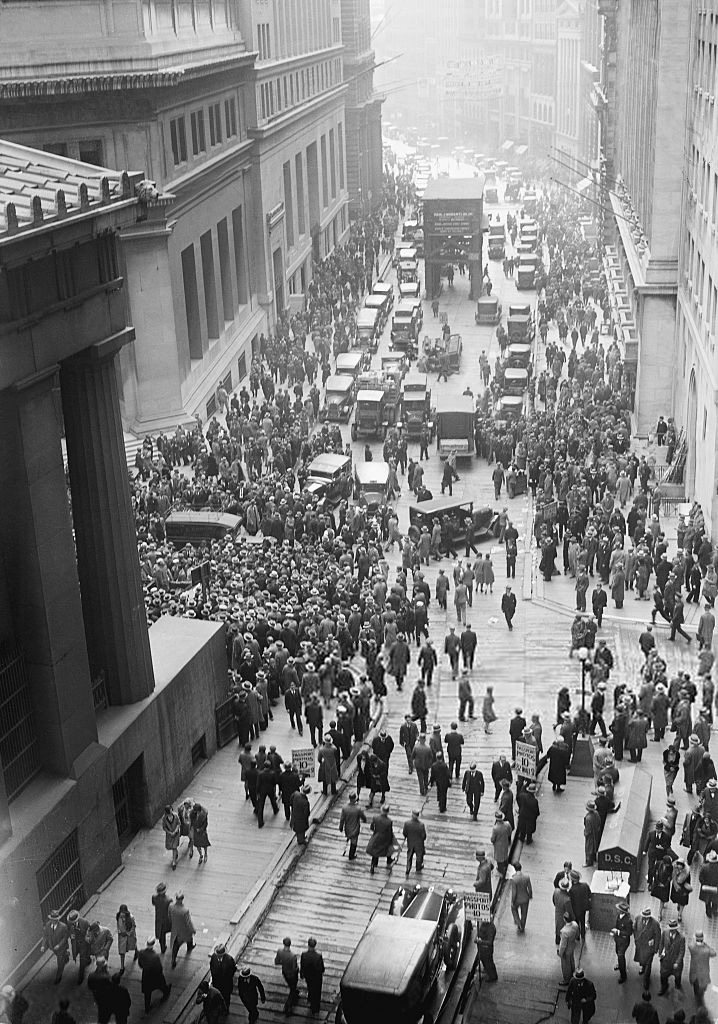
Crowd Outside NYSE, 1929

Bloomberg’s Echoes Blog, which is devoted to business and financial history, has published a great post by Phil Scranton on the place of short-sellers in American public opinion during the Great Depression.  As Scranton reports, “In the midst of the Great Depression, people who bet on stock-market declines were considered unpleasant, unwanted, un-American, un-something.”


CETA and the Oil Sands

21 02 2012

In the past, I’ve blogged about the ongoing negotiations for a Canada-EU trade agreement. See here, here, and here.  I’m a pretty enthusiastic supporter of the agreement.  As a citizen of both Canada and the EU, I think that the agreement would be good for both parties.

I am, therefore, a bit concerned to hear that the whole question of Alberta’s tar sands threatens to derail the whole agreement. For more details, see here, here, and here.


Cocacolonization

20 02 2012

Coca-Cola Plant, West Germany, 1953. Image Courtesy the Bundesarchiv.

I’m currently teaching a class on the history of globalisation. It’s designed to introduce first-year history, politics, and IR students to economic history, business history, and global history. Right now, my students are researching their essays. One of the available topics  is: How did people in Western Europe react to “Coca-colonization” after 1945?

This essay question will allow them to explore issues related to the Americanisation of Western Europe after 1945. As I’ve explained to the students, Coca-Cola was really just a symbol of an ongoing struggle over Americanisation more generally. However, anti-American Europeans did try to ban the actual product in the early 1950s, as Richard F. Kuisel showed in “Coca-Cola and the Cold War: The French Face Americanization”, 1948-1953, French Historical Studies 17 (1) (Spring, 1991), pp. 96-116.


Here is the list of sources I gave to my students to get them started on their library research.

Sources: Judt, Tony. Postwar: A History of Europe Since 1945. London: William Heinemann, 2005; Berghahn, Volker R. 2010. “The debate on ‘Americanization’ among economic and cultural historians.” In Cold War History, 107-130; Schroter, Harm G. 2008. “Economic culture and its transfer: an overview of the Americanisation of the European economy, 1900-2005.” European Review of History 15, no. 4: 331-344;  Duignan, Peter, and Lewis H. Gann. The Rebirth of the West: The Americanization of the Democratic World, 1945-1958. Cambridge, Mass., USA: Blackwell, 1992; Lundestad, Geir. Empire by Integration: The United States and European Integration, 1945-1997. Oxford: Oxford University Press, 1998; Nixon, Sean. “Apostles of Americanization? J. Walter Thompson Company Ltd, Advertising and Anglo-American Relations 1945-67.” Contemporary British History 22, no. 4 (December 2008): 477-499; Hilger, Susanne. 2008. “‘Globalisation by Americanisation’: American companies and the internationalisation of German industry after the Second World War.” European Review of History 15, no. 4: 375-401; Gassert, Philipp. “The Anti-American as Americanizer: Revisiting the Anti-American Century in Germany.” German Politics & Society 27, no. 1 (April 30, 2009): 24-38.


The Centre for Economic History, University of Reading

17 02 2012

AS: The University of Reading has long been known for research into business history.  Since 1997, there has been a Centre for International Business History within Reading’s Henley Business School. I note with interest that the university is now expanding its focus to include economic history as well. This is welcome news, as I feel that sometimes there aren’t enough conversations between business historians and economic historians. Anyway, I’m posting the programme of the  event that will mark the official launch of Reading’s Centre for Economic History. All of the papers look interesting, but I would imagine that the presentation by Harold James on the history of European  monetary integration will attract the most attention. That’s extremely topical research.

The Centre for Economic History, University of Reading

Launch Event

‘Crisis and change in historical perspective’

Friday 23rd March 2012, ICMA Centre.

We are pleased to invite you to join us for the launch of the Centre for Economic History at theUniversityofReading.

In the context of today’s climate of economic uncertainty we take a long historical perspective to examine and reflect upon crisis and change. Through presentations by leading academics followed by round table discussions by participants we will explore how the experiences of the past can inform our evaluation of the present.

09.30                              Registration

09.45                              Welcome

10.00               Prof Harold James,PrincetonUniversity

Making the European Monetary Union.

11.15                              Coffee

11.45               Prof Nick Mayhew, Winton Institute for Monetary History,Oxford

Money and prices in medieval and early modern England.

1.00                 Lunch

2.00                 Dr D’Maris Coffman, Centre for Financial History,Cambridge

Re-thinking the origins of the British public debt, 1643-1742.

3.00                 Prof Philip Cottrell,UniversityofLeicester

Banking in Greece during the 1880s

4.00                 Tea

4.30                                  Prof Brian Scott-Quinn, ICMA Centre,UniversityofReading

What financial crises all have in common or do they not have a common cause

6 pm           Drinks Reception and formal launch of the new Centre.

For further details of the day contact Margaret Yates:  m.h.yates@reading.ac.uk

To book a place contact Astrid House:  a.house@reading.ac.uk


Chris Dummitt’s New Canadian History Blog

14 02 2012

Christopher Dummitt, a Canadian historian who teaches at Trent University, has launched a new blog. See here.

Dummitt’s entry into the world of blogging doesn’t mean that he isn’t also active when it comes to academic publishing. As others have observed, academic blogging and actual publishing are complementary activities: the best academic blogs are usually maintained by  active scholars.  Dummitt certainly falls into this category. His first book was The Manly Modern: Masculinity in the Postwar Years(Vancouver, 2007). It was a history of some of what people thought it meant to be both modern and masculine in the decades after the Second World War. The book picked up themes from an earlier article Dummitt had published that has since been republished several times, ‘Finding a Place for Father: Selling the Barbecue in Postwar Canada’. (I’ve used this article in teaching and the students really enjoyed it).

In 2009, Dummitt co-edited a collection of essays with Michael Dawson, Contesting Clio’s Craft: New Directions and Debates in Canadian History (London, 2009).  Yours truly had a chapter in this collection,  ‘Canadian Progress and the British Connection: Why Canadian Historians Seeking the Middle Ground Should Give 2 1/2 Cheers for the British Empire’.

Dummitt is currently researching a book about William Lyon Mackenzie King.  He also has a review of Allan Levine‘s new biography of King in today’s Globe and Mail.

Rt. Hon. William Lyon Mackenzie King and his dog "Pat"


Trading Consequences

14 02 2012

A few weeks ago, I mentioned on this blog that a team of historians in Canada and Scotland had won a big grant from the Digging Into Data challenge.  The blog related to their project, Trading Consequences, is now up and running.

Trading Consequences will “investigate the environmental and economic histories of the rapid expansion of commodity frontiers and trade in the British Empire and Canada during the nineteenth century…This collaborative project between environmental historians in Canada and computational linguistics and computer science scholars in the UK will use text mining techniques to explore hundreds of thousands of pages of historical documents related to trade in the British Empire during the nineteenth century. Although our research will have a global scope, it will particularly emphasize the role of Canadian natural resources in the network of commodity flows.”

This project sounds fascinating and I’m certain that I will find ways to take advantage of all of the data they will be making available to the public.

Teams: York University, Canada: Prof Colin Coates (PI), Dr Jim Clifford, Prof Gillian McGillivray University of Edinburgh, UK: Prof Ewan Klein (PI), Dr Claire Grover, Dr Beatrice Alex, Dr James Reid (EDINA) University of St Andrews, UK: Prof Aaron Quigley (PI)


Read more here.


Shermer on the War Between the States

13 02 2012

Bloomberg’s Echoes blog recently featured a post by Elizabeth Tandy Shermer on competition between American states for business. Today, we take it for granted that US states will engage in bidding wars to encourage companies to locate factories and call centres in their states: tax abatements, subsidized electricity, and weak workers’ rights are among the incentives state governments dangle in front of firms.  Many critics worry that this practice will lead to a race to the regulatory bottom. Shermer, who recently completed a PhD on the economic history of Phoenix, Arizona, explores the historical roots of this practice, which she trace back to a policy started by Mississippi in 1936. In the postwar period, other predominantly agricultural states adopted similar policies with the aim of luring factories from the north-east and the Midwest. Shermer suggests that the poorer American states, which were stunningly successful in attracting manufacturing in the post-war era, have recently become victims of globalisation. Today, the “right-to-work” sunbelt states have to compete not just with unionized states such as Michigan but also with jurisdictions in the developing world, which typically offer an even more attractive package of incentives to manufacturers.

Shermer concludes the post as follows:

Arizonans and Tar Heels really just won the battle, not the war. Southern and Western metropolises struggled to hold on to and attract more investment during the 1980s and 1990s. Now, rivals come from the cash-starved Midwest and Global South, where executives can find a ready supply of workers, an advantageous tax code and little regulation. Unemployment is actually higher now in the once-dynamic South and West, a shock to the states that were once national leaders in population, recruitment and production.


Shermer’s post got me thinking about the history of jurisdictional arbitrage and competition for mobile businesses. There is a fair bit of secondary literature on the history of competition between US states. For a good bibliography of works on this subject, see here.  Competition between Chinese provinces and cities for factories is a major theme of the political economy literature on that country, see here. As in the US, there has been a similar race to the regulatory bottom.  However, I’m left wondering whether similar work has been done on the history of competition between jurisdictions within non-US federations (e.g., Australia, Mexico, Canada, Germany, Switzerland). It seems to me that the existence of jurisdictional arbitrage of this sort would bias investment towards industries that are very mobile (e.g., call centres) and the expense of things like mines. Comparing investment patterns in federations that permit this sort of jurisdictional arbitrage with those that do not might allow us to determine the extent to which competition between sub-national jurisdictions distorts investment decisions.


A Former Slave’s Letter to his Master: What a Viral Letter Says About Historical Knowledge in the 21st Century

3 02 2012

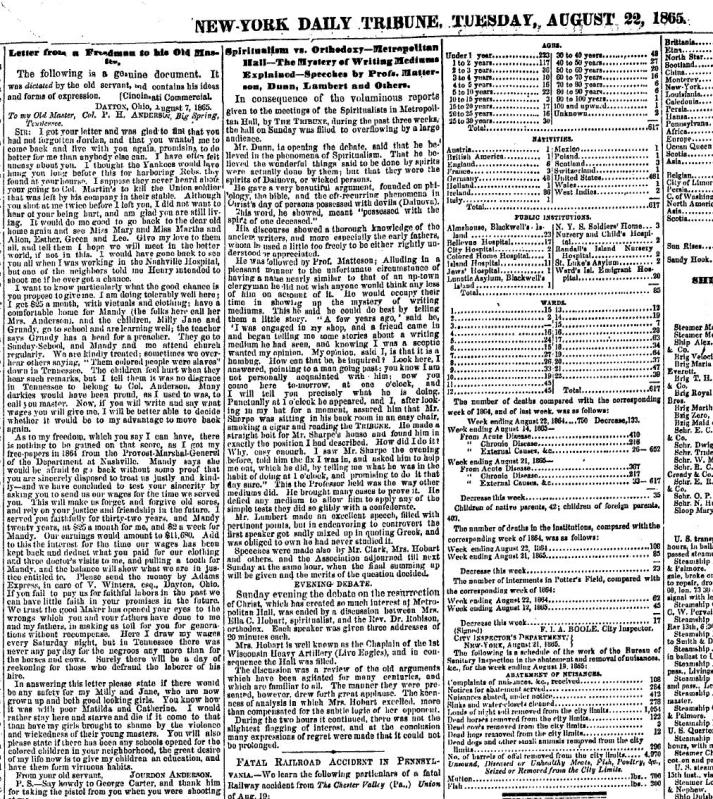
In August 1865, just a few months after the close of the American Civil War, a former slave named Jourdan Anderson wrote a letter to his ex-master. Anderson was then living in Ohio, had been owned by Colonel John H. Anderson of Big Spring, Tennessee.  The letter was reproduced in the New York Daily Tribune at the time. A few days ago, a transcription of the letter appeared on the Letters of Note website. It has since been shared by vast numbers of people on Twitter and Facebook. Many of you may have seen it already, but I thought I would share it here for the benefit of readers who haven’t yet seen it.

The re-publication of this letter in the last few days has inspired a number of people to use digitised databases to discover what happened to Jourdon Anderson after 1865. People all over the United States have discovered bits of data about Anderson. Aggregated together via the internet, they have given us a better sense of what happened to him during the period of Reconstruction and Jim Crow.  This is a classic case of historical research as a distributed process.

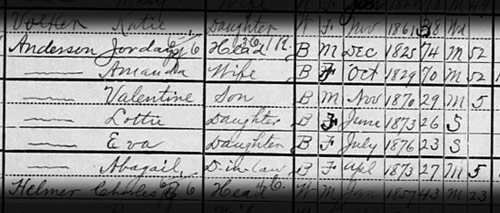
Some curious internet users exploited digitized census data to track Anderson down. According to the US Census of 1900, Anderson was still alive and well. The census taker in his neighbourhood recorded the following details about Anderson’s family. (See below). Luckily, this particular census taker had good penmanship!

A search of the local newspapers in Dayton, Ohio, which have also been digitised, shows that Anderson died in 1905. Thanks to the genealogy website ancestry.com, we also have a very good idea of who Anderson’s descendants are. (A family tree has been put online).

The digitization of primary sources is obviously a great boon to micro-historians and genealogists. It also has massive potential for academic historians working on a wide range of topics.

Kris Inwood’s research team at the University of Guelph recently landed a big grant from the Digging Into Data Challenge to do research using digitized census data from Britain, Canada, and the United States. See more here.  It will be interesting to see what sorts of findings come out of this research project.


The Simpsons and Economic Inequality

2 02 2012

Let me direct you to a light-hearted yet important blog post by Dani Rodrik. Ensure that you click the link to the PowerPointPresentation.