Krugman to UK: Don’t Worry, Be Happy

6 12 2011

Paul Krugman recently posted some interesting data regarding British debt to GDP from 1830 to the present. Krugman argues  that the current panic about the level of public indebtedness in Britain doesn’t really match up with the facts: relative to the size of the overall economy, Britain’s national debt is not massively larger than it was for much of its history.

Krugman makes a partially valid point. It is certainly true that the political right in both Britain and the United States have exaggerated the extent of the public-sector debt problems of those countries as a pretext for cuts to social spending. Compared to heavily indebted nation-states, such as Japan, the public debt burden in countries such as Britain and the United States is actually quite reasonable.  However, the data represented by Krugman’s chart tell us only part of the story (i.e., the total level of public sector indebtedness).  Krugman needs to take private sector indebtedness into account as well, a country’s total debt load includes the debt of financial institutions, non-financial businesses and private individuals (e.g., people with massive credit card bills).


This  chart, which depicts total debt levels as they stood in 2008, should be of concern to British policymakers, as it indicates that Britain was almost as heavily in debt as Japan. It’s just that the debt took a slightly different form.


More recent data shows that the problem hasn’t improved.  In fact, Britain remains the second most indebted major economy, ranking right after Japan.


Echoes: New Group Blog in Business and Economic History

23 11 2011

For some time now, I have been saying that historians have to participate in present-day debates about the economy. For far too long, the media have relied on the expertise of scholars just one discipline, economics. It is nice to see, however, that Bloomberg is now hosting a blog in which historians show how business and economic history are relevant understanding the day’s business news.

Stephen Mihm, an associate professor of history at the University of Georgia, runs the Echoes blog. Along with Phil Scranton and John B. Taylor, Mihm is responsible for arranging for historians to write short posts on current events.

Full disclosure: I absolutely loved Mihm’s 2007 book A Nation of Counterfeiters: Capitalists, Con Men, and the Making of the United States.

Here is Mihm’s description of the blog’s function:

That idea animates our revamped “Echoes” blog, dedicated to the history of economics, business, finance and, above all, capitalism. Our contributors will aim to unearth parallels between past and present, highlighting how the economic crises of our own era are perhaps not as unique as we think.

What we cover will be driven largely by current events. And, if history is any guide, the coming months and years will be dominated by the reverberations from the worst financial crisis since the 1930s. A crew of historians will weigh in on how our own hard times measure up against the Great Depression.

The echoes, of course, will reach back further and range more widely than the 20th century. We’ll try to connect the speculative bubbles of 18th-century Europe with the sub-prime crises of the 21st century; or the breakneck economic growth of the U.S. 200 years ago with the meteoric rise of China today.

Many of history’s best economic stories can’t be reduced to numbers and charts. They’re dramatic tales of hubris, innovation, brilliance and luck — of people caught in the grips of forces that they don’t fully comprehend. We’ll be trying to tell those stories here.

The blog went live on 3 November. Since then, there have been a number of excellent posts, including Bob Wright on violence in the history of Wall Street (see here),  Phil Scranton’s article “This Week in Depression Economics,”  (see here) and a piece by Regina Lee Blaszczyk comparing Steve Jobs with the entrepreneurs involved in Britain’s Industrial Revolution (see here


You can read it here


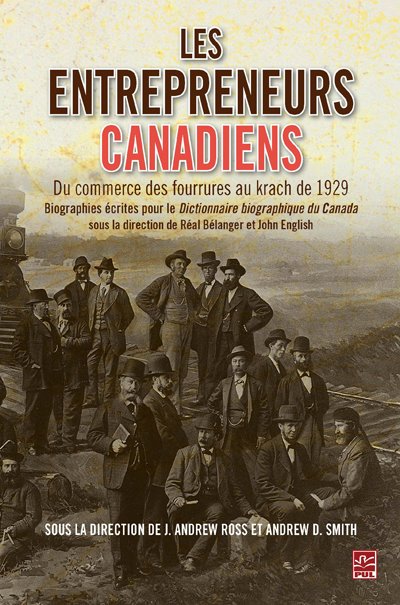
The Perfect Christmas Gift: Canada’s Entrepreneurs : From the Fur Trade to the 1929 Stock Market Crash

21 11 2011


Last Thursday, 17 November 2011, saw the formal launch of a new book related to Canadian business history. The book is a collection of short biographies of historical Canadian entrepreneurs who lived before the 1929 stock market crash. The book, which I edited with J. Andrew Ross of the University of Guelph, is designed to bring historical scholarship on the history of entrepreneurship in Canada to a wider audience. In other words, it is for non-academics who have an interest in Canadian business history.

The French version of the book has just been published by les Presses de l’Université Laval as Les entrepreneurs canadiens du commerce des fourrures au krach de 1929. The English version of the book, Canada’s Entrepreneurs : From the Fur Trade to the 1929 Stock Market Crash, will be published by University of Toronto Press in December. (The idea is that it will be available for shipment to consumers in time for Christmas Eve deliveries).

You can read the table of contents of the French version of the book here. You can order the French version here.

The launch event was at Université Laval in Quebec City. Since I couldn’t make it over to Canada for the launch, I asked by co-editor, Andrew Ross, to read out some remarks I had prepared. Here is the text, in English, that I sent to him. (Dr Ross may have taken a few minor liberties in the translation/delivery):

Today we take it for granted that there are many academics in business schools who study entrepreneurship and its history. However, this is a recent phenomenon.

Modern entrepreneurship studies really began with the seminal writings of an economist named Joseph Schumpeter (1883-1950). Schumpeter came from a  business family and thus knew business first hand. He came to Harvard University from Germany after the rise of Hitler.

Schumpeter and his new colleagues at Harvard, who included Toronto-born business historian Norman Gras (1884-1956), wanted to understand Big Business, the huge corporations that had come to dominate the American economy after 1870.

Schumpeter was convinced that something was missing from traditional economic analysis, namely the role of entrepreneurs, in driving economic growth and technological innovation. Schumpeter was an economist, but he was disturbed that the biographical element was missing from existing studies of the economy—it was all equations and theory and no reference to actual named business people.

The criticism of economics that Schumpeter made in the 1940s is even more true today for both economists and most economic historians.

Perhaps some of our recent financial problems could have been avoided had business education included more business history and business biography alongside financial economics.

Schumpeter argued that entrepreneurs were incredibly important in economic history.

Schumpeter regarded the average person as the ultimate beneficiary of the entrepreneurs with “fiery souls” who establish  new industries by taking ivory-tower inventions and mass-producing them. Schumpeter’s argue that the modern world was essentially made by a long list of entrepreneurs that began centuries ago and continues to this day. Just think of the impact entrepreneurs such as Thomas Edison have had on our lives.

In his 1942 book Capitalism, Socialism, and Democracy, Schumpeter celebrated the achievements of entrepreneurs:

Electric lighting is no great boon to anyone who has money enough to buy a sufficient number of candles and to pay servants to attend them. It is the cheap cloth, the cheap cotton and rayon fabric, boots, motorcars and so on that are the typical achievements of capitalist production, and not as a rule improvements that would mean much to a rich man. Queen Elizabeth owned silk stockings. The capitalist achievement does not typically consist in providing  more silk stockings for queens but in bringing them within the reach of factory girls in return for steadily decreasing amounts of effort.[1]

Schumpeter’s words remind us of why entrepreneurship deserves to be central to the historical narrative taught in elementary schools, high schools, and universities: everyone who uses electric lights, let alone the many products that weren’t even invented in 1942 but which are today part of everyday life, should care deeply about the history of entrepreneurship.

So should environmentalists and those who are worried about the many environmental and social problems caused by the excesses of capitalism.

Entrepreneurs have transformed life in every society, although the fruits of their efforts are more accessible to the citizens of rich countries than to people in other parts of the world.

But what is the specific importance of entrepreneurs in Canadian history, as opposed to the history of the Western World or North America? Can Schumpeterian ideas be applied to any of the classic themes in Canadian political history, such as French-English relations and Confederation ? And what relevance does the study of entrepreneurship have for our understanding of gender and the place of the First Nations, two of the themes that have been explored by Canadian social historians?

In the 1990s, there was a major debate in the field of Canadian history between proponents of traditional political history, such as J.L. Granatstein, and social historians who wanted to shift the focus away from Prime Ministers and towards race, class, and gender.  Today, there is a consensus that both forms of historical inquiry are equally legitimate.

We share this belief. But we would also criticize Canadian political and Canadian social historians for ignoring the role of businesspeople, particularly entrepreneurs , in Canadian history.

Historians interested in the history of economic nationalism in Canada should pay more attention to businessmen. Without practical men capable of implementing it, Sir John A. Macdonald (1815-1891)’s vision of a transcontinental railway would have been impossible to realise. The achievements of these businessmen, whose ranks included William Van Horne and Lord Strathcona, are discussed in our book.

Six of the sixty-one biographies in this volume are of women.  Women have always been active in Canadian business, even in periods when the law was loaded against female entrepreneurs. Readers of our volume will be reminded that women were active in business even in the time of New France. These women succeeded in the face of long odds. Before the Quiet Revolution, married women couldn’t even open bank accounts in this province.  So maybe the female entrepreneurs in a book, which covers the period up to 1929, should be regarded as heroes.

The disproportionate number of entrepreneurs from certain ethnic and religious minorities. This is true in Canada and true in other countries.  In our book, we have included the biographies of German-speaking, Hakka Chinese, and Jewish entrepreneurs in this collection. Many of the other entrepreneurs discussed here were migrants from France, Britain, and the United States.  Immigrants have always been a big part of the reason for Canada’s economic success. For the sake of the economy, one hopes that Canada will remain open to immigrants. Perhaps reading this book will remind a few people of the importance of welcoming immigrant entrepreneurs.

Francophone entrepreneurs are discussed in our book. Their biographies speak to French-English relations, a classic and still important theme in Canadian historiography.

Limitations of the Biographical Approach

The biographical approach to history has many strengths.  But I’m certain that everyone here will agree that it also has weaknesses.

However, one of the problems with the biographical approach is that it requires copious primary sources, ideally archival ones. If there are few primary sources about an individual, it is basically impossible to write their life story.

Unfortunately, the biography of just one First Nations entrepreneur appears in this book.  Maquinna, a Native leader  on the West Coast who participated in the fur trade, will have to represent the large number of undocumented Native entrepreneurs who played such an important role in Canada’s economic history, particularly the early parts.

After Confederation, the reserve system and residential schools imposed on First Nations after Confederation severely limited the entrepreneurial opportunities of First Nations individuals. Until the 1960s, natives were treated like wards of the state and weren’t even allowed to sign commercial contracts.  The rampant sexual and physical abuse of Native kids likely destroyed their self-confidence – and we know that self-confidence is necessary for an entrepreneurial attitude.

Historian Sarah Carter has shown that after 1867 white bureaucrats who micromanaged reserve life consciously decided to destroy entrepreneurial ventures by First Nations people, for instance by denying Indian farmers on reserves permission to sell their crops in nearby towns. The period before Confederation, however, was one of intensely entrepreneurial activity amongst First Nations people. The myth that Natives were gullible fools who traded valuable furs for worthless beads was demolished in the 1970s by scholars who demonstrated that First Nations people were shrewd bargainers.

Trade goods in graves and other archaeological evidence also show that extensive long-distance trade occurred in North America well before Columbus. Commerce was obviously taking place, but we do not know the names of the traders. For historians seeking to reconstruct the activities of individual First Nations entrepreneurs, there is a frustrating lack of primary sources.

In the future, the DCB will publish volumes on Canadian who died in the 1930s, 1940s, and so on. We really hope that these volumes include as many good biographies of businesspeople as the earlier volumes did. Perhaps in a few decades, when we are close to retirement, Andrew Smith and myself will collaborate to edit another edited collection, this one about entrepreneurs of the 20th century.  Such a volume would doubtless contain the biographies of many female, Native, and visible minority businessmen, since the Canadian business class is now far more diverse than it was a few decades ago.

I think that we can all agree that tapping into the entrepreneurial talents of Canadians from all backgrounds and both genders is a damn good thing.


Canada and the Eurozone Crisis

10 11 2011

As frequent readers of this blog will know, Canada and the European Union are in the process of negotiating a free trade agreement, commonly known as CETA. The negotiations began back in 2009. Canada and the European Union completed the ninth round of talks on 21 October in Ottawa. At the close of last month’s bargaining round, Steve Verheul, who is Canada’s chief negotiator, said that his goal was  to reach an agreement on most of the major issues by early 2012. It sounds as if real progress has been made.

So far, so good. However, an article about the negotiations that appeared in today’s edition of Embassy, an online journal devoted to Canadian diplomacy, speculates that the CETA deal could be derailed by the spiralling debt crisis in the Eurozone, which is throwing the continent’s economies and political systems into chaos. The last few days have seen resignation announcements by Greek Prime Minister George Papandreou  and Italian Prime Minister Silvio Berlusconi. As I write this, the European Commission has just announced that it is cutting its growth estimate for the European economy. The bad economic and political news is coming now in a seemingly continuous stream. The sovereign debt crisis has raised some really profound questions about the whole nature of the European political system and the nature of democratic legitimacy. Some of Europe’s leaders believe that the best way to respond to the crisis is change the EU’s political system and move even further away from national sovereignty: France and Germany are certainly pushing for closer integration of economic and fiscal policies in the euro zone (i.e., the right of European Commission to veto national budgets). Read more here and here. To add to the atmosphere of crisis, Ed Milliband, the leader of the British Labour Party, has called for an emergency super summit of EU leaderson the grounds that the existing political institutions of Europe are broken.

What does all of this mean for Canada and the CETA agreement? In the current climate, it is increasingly difficult to predict what sort of condition the European economy will be in in 2012, when the CETA agreement is finalized and presented to their respective governments for ratification. Indeed, it will be hard to predict who will be in power in many of the European countries and what their attitudes to trade liberalization may be.

The recent events in the Eurozone underscore the need to reflect on and to discuss the CETA agreement and what it might do for both Canada and the EU. It is, therefore, a fitting time to gather to talk about CETA.

Next Friday, 18 November 2011, a small conference on CETA will be taking place in London. Full details of the conference are available here. To attend the conference, you must pre-register by 15 November.


Is Canada an Anglo-Saxon Economy?

6 11 2011

We often hear the term “Anglo-Saxon capitalism” bandied about. In the wake of the 2008 global financial crisis, some people announced the “death of Anglo-Saxon capitalism”.  A few days ago, a pundit at Sky News, one of Rupert Murdoch’s UK TV channels, announced the continental Europe needed to save itself by adopting Anglo-Saxon capitalism. Anglo-Saxon capitalism is a term of abuse and praise, used by people all over the political spectrum.

I’ve long been sceptical of the whole concept of “Anglo-Saxon capitalism”. As used by academics and business journalists, Anglo-Saxon capitalism denotes a variety of capitalism that is much more committed to the free market than the sort of capitalism one finds in countries such as France, Germany, and Japan. Anglo-Saxon economies are held to be characterized by weak labour unions, flexible labour markets, relatively low taxes, and the dominance of the economy by the financial services sector.

One of the many problems with the concept of  Anglo-Saxon capitalism is that it overlooks the simply enormous differences within the so-called Anglosphere: Britain, Ireland, Australia, Canada, the United States, etc., have quite different economies, social policies, political systems, etc. Moreover, the essential features of Anglo-Saxon capitalism only really emerged in the Reagan-Thatcher era. Indeed, in the 1950s and 1960s, West Germany was much more committed to the free market than Britain. The enormous differences between the economies of Canada and the United States, few of which can be attributed to the francophone presence in part of Canada, seem to illustrate everything that it wrong with this facile concept.

I don’t really think that “Anglo-Saxon capitalism” actually exists and I think it absurd when scholars publish articles arguing that the distinctive features of the Anglo-Saxon way organizing the economy can be traced back to the Magna Carta or something like that in English legal history. (For a quick primer on “legal origins theory” and the ideas of Rafael La Porta,  Florencio Lopez-de-Silanes, and Andrei Shleifer, see here). I’m not a legal historian (far from it), but legal origins theory really isn’t consistent with my understanding of North American legal history, at least with what I read in such scholarly works as Morton Horwitz’s The Transformation of American Law, 1780-1860 Cambridge, Mass: Harvard University Press, 1977 or Peter George, and Philip Sworden. 1986. “The Courts and the Development of Trade in Upper Canada, 1830-1860”. The Business History Review. 60, no. 2: 258-280.

It was, therefore, with great interest that I discovered a new working paper called  “Anglo-Saxon Capitalism in Crisis?  Models of Liberal Capitalism and the Preconditions for Financial Stability”.

The authors are: Sue Konzelmann, who is a Reader in Management and Director of the London Centre for Corporate Governance and Ethics (LCCGE) at Birkbeck, University of London; Marc Fovargue-Davies, who is a Strategy Consultant and Research Associate of the LCCGE, and Gerhard Schnyder, who is a Lecturer in Comparative Management at King’s College London and a Research Associate of the LCCGE.

None of the authors is Canadian, but they pay a fair bit of attention to Canada (and Australia) in this important paper.

Here is the abstract. I’ve put some of the key sentences in bold.

The comparative capitalism literature sees national business systems as ‘configurations of institutions’, where different socio-economic institutions are interconnected in coherent, non-random ways (Jackson & Deeg 2008). From a comparative perspective it is argued that different countries cluster into a limited number of ‘models’ (Albert 1993, Whitley 2000, Hall & Soskice 2001, Amable 2003). Whilst different classifications exist, virtually all of them group the six Anglo-Saxon countries into the same category of market-based, shareholder-oriented or ‘liberal market economies’ (LMEs).

The similarities in the institutional configuration of the Anglo-Saxon economies would lead us to predict similar conditions for doing business and comparable economic trajectories. However the 2008 financial crisis has demonstrated that the broad categorizations of models of capitalism may conceal important differences among these LMEs. Indeed, the Anglo-Saxon variety of capitalism groups some of the worst hit countries with countries whose financial systems were remarkably stable during the crisis. As evident in the Financial Times’s ranking of the 50 largest banks by market capitalization (Financial Times, March 2009), between 1999 and 2009, American and British banks had lost considerable ground whilst those of the two other main Anglo-Saxon countries,Canada andAustralia, clearly gained. This casts doubt on the conclusion that the 2008 crisis represents a crisis of Anglo-Saxon capitalism as such.

This chapter examines the question of why the four main Anglo-Saxon countries experienced the 2008 financial crisis in such divergent ways, despite their similar cultural attributes (Redding 2005), legal origins (La Porta et al. 1997) and institutional configuration (Hall & Soskice 2001). Of particular interest are the reasons behind the rise to dominance of the British and American financial sectors – and the resulting shift in the balance of the economy in their favour. This is in sharp contrast to the Canadian and Australian systems, where greater restraint prevented a similar outcome.

We explore how political, ideational and historical factors led to different approaches to the regulation of the financial industry, focusing on the influences shaping the process of economic liberalization in each country and their effect on the evolution of corporate governance. Our analysis reveals a clear division in the interpretation of liberal economic theory and the way it was applied. This gave rise to more than just the ‘fundamentalist’ neoclassical incarnation, characteristic of both British and American capitalism: by contrast, the Canadian and Australian systems evolved in a more balanced way, producing an apparently more stable result. From this, it is hard to escape the conclusion that there is in fact no such a thing as ‘Anglo-Saxon Capitalism,’ and consequently, no general failure of liberal capitalism per se. Instead, the 2008 crisis suggests the failing of a particular variety of economic liberalism, where the balance between the state and the private sector had become unsustainable. 

It will be interesting to see whether the bogus term “Anglo-Saxon capitalism” is used less frequently in the future. Konzelmann et al., make a convincing scholarly case in their paper for the view that Anglo-Saxon capitalism does not exist. However, I suspect that this rubbish concept will continue to be cheerfully used by journalists and academics for generations to come.


The Greek Referendum and the Globalization Paradox

3 11 2011

I teach a class on the history of globalisation. It is designed for both students doing degrees in history and IR and politics students who want some historical background. Right now, the students in this class are reading Dani Rodrik’s book The Globalization Paradox.

One of the core arguments of this book is that there is a fundamental incompatibility between globalization on the one hand and democracy and national sovereignty on the other. Participation in the global economy sometimes requires governments to impose economic policies that often go against the will of the majority of the people living in the country. We can live in a globalized world or a world of sovereign and democratic nation states, but we can’t have both, at least according to Rodrik.

I’m not entirely convinced by Rodrik’s thesis. However, in the last few days, we have seen a striking illustration of this point. Greece was recently offered an assistance package by the other European countries that was conditional on the Greek government, which is nominally socialist, making massive structural reforms. These reforms, which involve tax increases, mass privatisation, and cuts to benefits, are unpopular with Greeks. Many Greeks resent the fact that economic policy in their country is now being set by foreign politicians, which seems like an affront to the idea of national sovereignty and downright undemocratic. However, Greece’s leaders agreed to the deal in the belief that it is absolutely necessary for the country’s continued participation in the Euro, which has facilitated economic exchange between Greece and the outside world.

After his return to Greece, the Greek PM decided to hold on referendum on the austerity package he had negotiated with the other European leaders.  In effect, he was reneging on the deal he had agreed behind closed doors with the other EU bigwigs. You can justify the decision to call a referendum on the grounds that it is democratic, but in practice giving the people a say threatens the policies necessary for Greece to remain part of the Eurozone, and possibly the EU as well. Whether leaving the Eurozone and the EU would be good for Greece is, I suppose, a value-laden question. Most anti-globalization people would cheer this outcome as a victory for people power. Most neo-liberals would decry this move as a step backwards to autarky and nationalism. What is clear is that democracy, or at the very least direct democracy, isn’t always compatible with pro-globalization policies.

To my mind, this is a fantastic “teachable moment.” I’m looking forward to hearing what the students have to say about this complex issue with obvious parallels with the breakdown of the gold standard.


CFP: Conference on Historical Analysis and Research in Marketing (CHARM)

1 11 2011

Conference on Historical Analysis and Research in Marketing (CHARM), May 30 to June 2, 2013 in Copenhagen, Denmark. The complete Call for Papers is posted at: http://www.charmassociation.org

Submission deadline for full papers and abstracts is December 16,
2012. Please direct submissions to Dr. Leighann Neilson, Program Chair
and Proceedings Editor at: charmconference2013@gmail.com

Doctoral students with a particular interest in research methods in
marketing history and marketing theory are invited to attend a two-day
workshop which immediately precedes the conference. There will also be
a special track for the presentation of doctoral projects at the
conference itself. For more information on the doctoral workshop see
www.charmassociation.org.

Inquiries about sponsorship opportunities should be directed to Dr.
Stefan Schwarzkopf, Local Arrangements Chair at: ssc.lpf@cbs.dk


Halloween-related history podcast

31 10 2011

AS: The theme of this month’s Backstory American history podcast is the history of spiritualism in the United States. Since it is Halloween, I thought I would share it.

Halloween – despite its solemn Celtic roots – has become a safe way for Americans to transgress social norms and toy with the idea of ghosts in a family-friendly fashion. But for some, spirits from another plane have always been a very real part of life on thisplane.

On this Halloween special, the History Guys explore Americans’ relationship with ghosts, spirits, and witches throughout our nation’s history. Why were colonists so fearful of New England “witches”? How is it that progressive social reformers found a home in the Spiritualist movement of the 19th century? Why do new media technologies always conjure talk of the undead? Can social upheaval help explain our history with the ineffable?

Check out this cool podcast.


Dan Drezner on “Zombies, G20 and International Relations”

31 10 2011

Dan Drezner is a professor of international politics at Tufts University, a contributor to the Foreign Policy blog, and one of the foremost thinkers on international relations in the United States. He also has a great sense of humour.

As an intellectual exercise, Drezner recently gave a talk about how the G20 leaders would react if the world were attacked by zombies. He shows how the various theories of international relations would give different predictions about how nations would respond to such a crisis. Basically, Drezner’s piece is a light-hearted way of introducing undergraduates to different theories of world politics.

Last week, Drezner gave his zombies talk at the Centre for International Governance Innovation in Waterloo, Ontario. You can view his talk online here.


What would happen to international politics if the dead rose from the grave and started to eat the living? On October 26, 2011 at CIGI, Daniel Drezner answered the question that other international relations scholars have been too scared to ask. Addressing timely issues with analytical bite, Drezner looked at how well-known theories from international relations might be applied to a war with zombies. Exploring the plots of popular zombie films, songs, and books, Drezner predicts realistic scenarios for the political stage in the face of a zombie threat and considers how valid — or how rotten — such scenarios might be.


Happy Halloween!


British North America’s Global Age CFP

30 10 2011

AS: This looks like an important conference. Will be of interest to those of us who have tried to integrate Canadian history with the historiography on globalization. 


[Le français suit.] From the outset of the Seven Years’ War in 1756 to the eve of the Great War, the spaces and places, as well as the peoples and predicaments of life in northern North America changed dramatically. In recent years, students of history, both in Canada and across the world, have been repeatedly urged to consider local and national histories within in a global, international, or comparative frame. The L. R. Wilson Institute for Canadian History at McMaster University, in association with the Department of Humanities at Mount Royal University, invite historians of 18th and 19th century British North America/Canada to submit paper proposals for a two day workshop entitled, “British North America’s Global Age,” to be held the 24 and 25 May 2012 at McMaster University in Hamilton, Ontario.

This workshop will bring together scholars working on a wide range of topics and perspectives: historians examining politics, economies, the environment, culture, the labour movement, gender, race, sexuality and colonialism are all encouraged to participate. We are aware that ties to the global can come in a variety of forms: theoretical, ideological, personal, political, familial, and even, affective. The papers selected will be made available to participants beforehand. As such, we are seeking original, previously unpublished and archival researched contributions, between 20 and 25 pages in-length in advance of the workshop. It is our intent to hold short presentations followed by a longer discussion of each submission. Through such an event our goal is to foster an informed and constructive dialogue on the state of the historical literature relating to BNA, its ties to the larger world, and to consider how such scholarship has transformed how we think about and teach the history of BNA. Following the workshop, presenters will have an opportunity to revise and submit their scholarship to a peer-reviewed collection that the organizers will put together on this topic.

Please submit a 250-word abstract, title, and a CV to both Dr. Dan Horner (dhorner@mcmaster.ca) and Dr. Jarett Henderson (jhenderson@mtroyal.ca) by 11 November 2011. —


Du début de la guerre de Sept Ans jusqu’à la veille de la Première Guerre mondiale, les espaces, les vécus et les défis de la vie dans l’Amérique du Nord britannique ont changé d’une manière spectaculaire. Récemment, les historiens et les historiennes ont été exhortés à considérer les histoires locales et nationales dans un cadre mondial. L’institut L.R. Wilson pour l’histoire canadienne, conjointement avec le département d’histoire de l’Université McMaster et celui des humanités de l’Université Mount Royal invitent les historiens et les historiennes qui travaillent sur l’histoire de l’Amérique du Nord britannique à soumettre des propositions de communications, qui auront entre 200 et 300 mots, pour un colloque, intitulé « L’époque mondiale de l’Amérique du Nord britannique » et qui aura lieu les 24 et 25 mai 2012 à l’Université McMaster à Hamilton.

Ce colloque réunira des historiens et des historiennes qui travaillent sur une variété de thèmes, notamment les questions politiques, économiques, environnementales, culturelles, du genre, de la sexualité, de l’ethnicité, de classe et du colonialisme. Les liens mondiaux qui ont influencé la formation de l’Amérique du Nord britannique peuvent être étudiés de plusieurs manières, telles que les idéologies, les biographies personnelles et familiales ainsi que les liens affectifs et les rapports théoriques. Les communications, qui seront acceptées pour le colloque, seront accessibles aux participants et participantes avant la tenue du colloque. Notre intention est de favoriser la présentation de travaux, entre 20 et 25 pages et qui s’appuient sur l’utilisation de sources primaires qui ont été peu utilisés par les chercheurs et les chercheuses. Les présentations lors du colloque seront courtes de manière à favoriser les discussions. Notre but est de promouvoir un dialogue sur l’état de l’historiographie de cette période et ses conséquences sur la manière dont nous conceptualisons et enseignons l’histoire de l’Amérique du Nord britannique.

Après le colloque, les participants et les participantes auront l’occasion de réviser et de soumettre leurs communications qui seront publiées dans un collectif dirigé par les organisateurs du colloque. Nous vous invitons à soumettre un résumé de 250 mots, le titre de votre communication et un CV au Dr Dan Horner (dhorner@mcmaster.ca) et au Dr Jarett Henderson (jhenderson@mtroyal.ca) avant le 11 novembre 2011.