What were the Cultural Causes of the Industrial Revolution?

9 04 2010

That is the theme of a course for PhD students being held in Sweden in October. If I were still a grad student, I would definitely apply to attend.  Since I’m not, I’m going to content myself with reading Joel Mokyr’s new book The enlightened economy: an economic history of Britain, 1700-1850. It’s on my summer reading list.

Anyway, PhD students and supervisors should check out this announcement.

—————————–

The Department of Economic History,
School of Business, Economics and Law, University of Gothenburg,
invites you to the Ph.D.-course

Ideologies, Ideas, and Values during the Industrial Revolution
(11-15 October 2010)

The course will be taught by Deirdre Nansen McCloskey, Distinguished Profes
sor of Economics, History, English, and Communication, University of Illinois at Chicago, and Guest Professor, School of Business, Economics and Law, University of Gothenburg.

Content

Why was Europe the first region to develop economically and why did Britain lead among the European nations?  Recent years have seen a number of important contributions to the field of economic history trying to deal with the issue from new perspectives, using new empirical evidence. The course will study some of scholarly contributions. The issue of ideologies, ideas, and bourgeois values will be an important theme. That is, can the modern world
be explained in merely material terms?  Or do ideas matter!

Participants are expected to write short reviews of the books on the reading list, to be discussed in class in the morning of each day of the course.
Participants will also present a paper on their own research in afternoon seminars, and get feedback from other participants of the course and from Professor McCloskey.

Practical information

The course is open for Ph.D. students in history, economic history, and economics and similar disciplines within social science and the humanities.  The course will take place at the School of Business, Economics and Law in
Gothenburg, Sweden.

There is no fee for participating in the course. The Department will furthermore arrange (and pay for) lodging and lunches during the course, and provide a travel grant to, participating Ph.D. students. The Department will also host an opening reception, and a dinner the last night of the course. Participants are expected to attend during the whole week.

Applications for participation in the course should be sent latest 15 May 2010 by mail to Klas Ronnback, Dept. of economic history, University of Gothenburg: klas.ronnback@econhist.gu.se. Applicants should give a short description of the research field of their doctoral thesis. Since the number of participants will be limited, a selection may be necessary. The result from such selection will be sent to the applicants by the end of May.

Reading list

Robert Allen (2009): The British industrial revolution in global perspective. Cambridge: Cambridge UP.
Jack Goldstone (2009): Why Europe? The rise of the West in world history, 1500-1850. Boston: McGraw-Hill.
Deirdre McCloskey (2010): Bourgeois Dignity: Why economics can’t explain
the modern world. Forthcoming, October.
Joel Mokyr (2009): The enlightened economy: an economic history of Britain,
1700-1850. New Haven: Yale UP.
Jan Luiten van Zanden (2009): The long road to the industrial revolution: the European economy in a global perspective, 1000-1800. Leiden: Brill.
Joyce Appleby (2010): The relentless revolution: A history of capitalism (New York, New York: W. W. Norton & Company, 2010)

Professor Christer Lundh
Klas Ronnback
Department of Economic history
University of Gothenburg
Box 720, SE- 405 30 Göteborg
Sweden
Phone: + 46 31-7734520




Moore on the Tragedy of Caledonia

9 04 2010

Native Protestors at the Douglas Creek Estates in Caledonia

“The Calamity of Caledonia: What B.C. can teach Ontario about Native land claims.”

That’s the title of an excellent article by historian Christopher Moore in the Literary Review of Canada. As a Torontonian who has recently completed a history of the B.C. Court of Appeal, Moore is well qualified to speak about this complex legal-historical-political topic.


The Prof Who Outsourced Her Marking Work to Bangalore

7 04 2010

Bangalore

Lori Whisenant, who teaches business law and ethics at the University of Houston, has outsourced the grading of her students’ papers to a private company in Bangalore. See here. The students get very detailed comments on their essays from Indian writers with postgraduate training.

I have mixed feelings about this idea. It seems to me that the prof who sets the assignment should be the one to mark the assignment. After all, how else can you judge whether the task was an appropriate one that should be included in the course next year? Moreover, some disciplines are very culturally specific. For instance, I throw Hollywood references into my lectures, not Bollywood references. This means that some student essays might not travel that well. (Think gay and lesbian studies). Culture is a de facto trade barrier, which is one of the reasons I’m not too worried that globalization will erode the value of my skills.

That being said, the general concept of outsourcing writing assistance work to a low-cost English-speaking country has some merit, especially when it comes to pre-submission writing assistance as opposed to grading. I should explain that many universities have a place where students can bring drafts of their papers for editorial help before the due date. In some cases, the advice they get is of dubious quality.

I try to give my students detailed feedback on their written work. That’s an important part of my job. But large class sizes are a fact of life and are bound to remain so unless one of the following unpalatable developments takes place: a huge jump in tuition fees to allow for more faculty hiring and smaller classes; keeping the number of professors the same while reducing the proportion of young people who go to university;  a big infusion of government cash to allow for small class sizes; or the division of the existing wage budget into more but smaller salaries (i.e., a paycut for the existing professors).  Don’t hold your breath for any of the above.

Under the current arrangement, there is only so much individualized writing advice a professor can give each student. Moreover, there is much to be desired about the pre-submission assistance many campus writing assistance centres give to students.  Outsourcing the writing assistance work to India seems like a particularly useful idea for universities where it is hard to find qualified workers for on-campus writing centres. In general, good writers want to live in places where there are more opportunities to exercise their skills. This means that the pool of good writers is limited outside of the big cities, especially at universities that lack PhD programs in the humanities.  Emailing the writing assistance work to Bangalore is a superb idea.

In few years, it might be common to overhear students saying that they are planning to Skype their TA in India.


OAH Magazine Special Issue on Business History

7 04 2010

Along with environmental history, business history is one of the fastest growing sub-fields of history at the moment. The January 2010  issue of the OAH Magazine of History was devoted to the current state of business historiography. The basic point of this theme issue was to show historians who do not identify themselves as business historians that business history is very relevant to their teaching and research.

The magazine included the following articles:

FOREWORD
Bringing in Business History Front and Center
Pamela Walker Laird

ARTICLES
Classic Issues and Fresh Themes in Business History
Philip Scranton

American Manufacturing, 1850-1930: A Business History Approach
Mansel Blackford

Business History in the Teaching American History Program
Stuart D. Hobbs

Newspapers, Radio, and the Business of Media in the United States
Michael Stamm

Selling Black Beauty: African American Modeling Agencies and Charm Schools in Postwar America
Malia McAndrew

Robert Noyce, Silicon Valley, and the Teamwork Behind the High-Technology Revolution
Leslie Berlin


New BHC Blog

7 04 2010

The Business History Conference has created a blog. Launched on 1 April, it already looks rather promising.


A Brief History of the Canadian Dollar

7 04 2010

That’s the title of an article in today’s Globe. Check out the article in the Calgary Herald too.


My Teaching Last Week

30 03 2010

HIST 1407 (Canadian History Survey Course)

My lecture on Monday was about Canadian history from 1984 to 1993. I spoke about the following issues: the pre-1983 career of Brian Mulroney; the 1984 election; the nature of the “Mulroney Coalition”; the 1988 Free Trade election (I showed a clip from the 1998 leaders’ debate); the Meech Lake and Charlottetown Accords; Elijah Harper; the Oka Crisis; the emergence of the BQ; the Somalia Affair (there are some great images and video clips available online!); the judicial politics of abortion; Canada’s policies towards the apartheid regime in South Africa; Kim Campbell. I also devoted a fair bit of time to the environmental policies of Brian Mulroney because environmental history is one of the themes of this course.

Brian Mulroney in 1984

My lecture on Wednesday was on an even more recent period of history, 1993-2003. My major focus was on the 1995 Referendum and the subsequent Clarity Act and sponsorship programs. I showed video clips from the night of the referendum. The video clips really captivated the attention of the class. Most of students were born in roughly 1991. I also spoke about Jean Chrétien’s life before 1993, Paul Martin’s career as Finance Minister, and NAFTA.

HIST 4165

4th Year Seminar on BNA in the Age of Confederation

Fenian Raid Medal

We listened to five student research presentation this week. A number of students have selected topics related to what one student has called the War on Fenianism in the 1860s.

Fenian Raids Monument, Toronto, 1890

We heard two presentations on the assassination of McGee and a presentation on the Fenian Raids.

Committee of Safety Minutes, 1866, Page 1, Welland, Canada West

We also heard a student present on the impact of railway construction on the town of Stratford Ontario.

Grand Trunk System Map

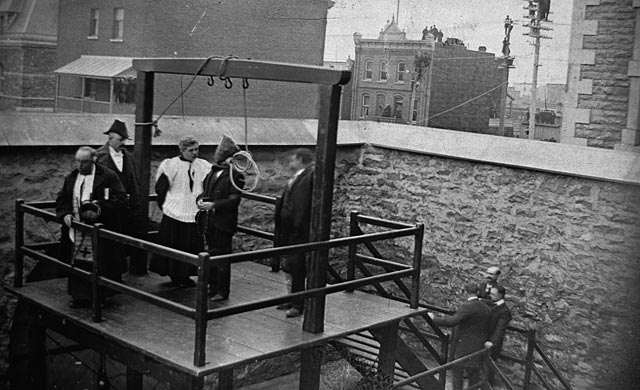
Perhaps the most entertaining presentation related to the abolition of public capital punishment in Canada in the late 1860s. That student has discovered some great primary sources related to her topic!

A Canadian Hanging


lancement officiel du site web dédié à la société Montreal Telegraph / official launch for the website

29 03 2010

Vous êtes cordialement invité au lancement officiel du site web dédié à l’histoire de la société Montreal Telegraph. La fête se tiendra sur le campus de l’Université Laurentienne jeudi,  le 1er avril 2010 entre 19 h et 21 h à la bibliothèque J.N. Desmarais .

RSVP à Rita Weise, rh_weise@laurentian.ca

****

You are cordially invited to the official launch party for a website dedicated to the history of the Montreal Telegraph Company!  The party will be held on the Laurentian University campus on Thursday April 1st, 2010 from 7 to 9 p.m. in the Instructional Media Room in J.N. Desmarais Library.  All are welcome, but it would be helpful if you could RSVP with Rita Weise, rh_weise@laurentian.ca


Montreal Telegraph Company

28 03 2010

The text below is taken from the Laurentian University website.

“Four graduate students in Laurentian University’s history department have created a website about the Montreal Telegraph Company.

www.montrealtelegraphcompany.com

The invention of the telegraph revolutionized life in many countries in the nineteenth century. Most of the early telegraph lines in Canada were constructed and operated by the Montreal Telegraph Company.

It is common knowledge that the advent of railways had a transformative impact on Canada and many other countries. Most Canadians know about the famous Last Spike. Most Americans are familiar with the construction of the transcontinental railroad in the 1860s. In contrast, the impact of telegraphy on North America is often overlooked. The website is designed to showcase the economic, social, and political effects of telegraphy on British North America after 1844.

It outlines the rise and fall of the company between 1847 and 1881. You will find information regarding some of the key players involved in the company, including its executives, the workforce, and major stockholders. The website also features numerous images relating to the history of the company and the telegraph in general.

Un groupe de quatre étudiants inscrits au cycle supérieur au département d’histoire ont créé une site Web de la Montreal Telegraph Company.

www.montrealtelegraphcompany.com

L’invention du télégraphe a révolutionné le sort de l’humanité dans de nombreux pays au XIXe siècle. La plupart des premières lignes télégraphiques au Canada ont été construites et exploitées par la Montreal Telegraph Company.

L’arrivée des chemins de fer a eu un impact transformateur sur le Canada et de nombreux autres pays. La plus grande partie des Canadiens connaissent le fameux ‘dernier crampon’ et la plupart des Américains sont familiers avec la construction du chemin de fer transcontinental dans les années 1860. En revanche, l’impact de la télégraphie en Amérique du Nord est souvent négligé. Ce site web est conçu pour présenter les effets économiques, sociaux et politiques de la télégraphie en Amérique du Nord britannique (ANB) après 1844.

Il décrit la montée et la déclin de la société entre 1847 et 1881. Vous trouverez des renseignements concernant certains des principaux acteurs impliqués dans la société, y compris ses dirigeants, employés et actionnaires principaux. Le site inclut également de nombreuses images liées à l’histoire de la société et du télégraphe en général.”


Ontario in the Federation

25 03 2010

The Mowat Centre at the University of Toronto has published a study of Ontario’s under-representation in the House of Commons. It’s excellent. Kudos the Mowat Centre for publishing such an excellent report.

“This Mowat Note examines how closely Canada’s system of political representation adheres to the principle of representation by population. It compares Canada’s performance in this area to other advanced democracies with federal systems. The research shows that the Canadian approach does not live up to internationally accepted democratic standards. The principle of citizen equality, according to which citizens should have roughly comparable voting power, is violated to a far greater extent in Canada than in Australia, Germany, Switzerland or the United States. Unless Canadian laws are changed, the inequality of the current system will worsen and the voting power of citizens will increasingly depend on which province they live in.”

Prof. Sancton

The report is interesting, but I am wondering author Andrew Sancton did not look at the United Kingdom as well! The UK, like Canada, includes several self-defined “nations”: Scotland and Quebec both have strong nationalist movements. Nevertheless, the UK now has something close to true Rep by Pop. The story of Representation by Population in UK since 1832 has a very interesting history. [In fact, one can’t fully understand why so many people in Toronto in the 1860s were passionate about Rep by Pop without knowing about this history. One of the reasons why George Brown was so committed to Rep by Pop was his upbringing in a liberal Scottish household in which the memory of Old Sarum was still fresh. I should explain that before the parliamentary reform of 1832, the ruins of the medieval city of Old Sarum were represented in the British parliament,  while the new and populous city of Manchester was without representation. ]Anyway, my point is that knowing how the UK gradually moved toward true Rep by Pop in the 19th or 20th centuries might be useful for Canadians.

Old Sarum