My Teaching This Week

15 02 2010

My Teaching This Week

HIST 1407: Canadian History Since Confederation

Monday’s lecture dealt with Canada in the 1930s. I focused on the devastating impact of the Great Depression and the Smoot-Hawley Tariff. I showed how the lacklustre response of the two main political parties in Canada to the Depression contributed to the rise of new political parties at both the federal and the provincial level. In the lecture, I strove to balance my discussion of the causes of the Depression (the bursting of a stock market bubble, the rise of protectionism, inappropriate monetary policy), high politics, and the impact of the Depression on ordinary people. (I found some great anecdotes in Barry Broadfoot’s oral history of Canada in the 1930s).  In the last part of the lecture, I spoke about Canadian foreign policy in the 1930s with a particular emphasis on the rise of aggressive dictatorships in Japan, Italy, and Germany. The period covered by the lecture ended with the German invasion of Poland in 1939. My  comments in lecture about protectionism in the US in the early 1930s sparked an interesting debate amongst the students about the controversial Buy American Policy and Canada’s elephant-and-mouse relationship to the USA.

Wednesday’s lecture was all about Canada’s role in the Second World War. I stressed that Canada entered the war much earlier than the United States and played an absolutely crucial, albeit indirect, role in the survival of Britain in 1940. At the start of the lecture, I stressed that Canada did _not_ go to war to help the Jews of Europe and that anti-Semitism was, in fact, widespread in Canada. I showed that the whole issue of the Holocaust was pretty peripheral to Canada’s war and that it was only many years after the end of the conflict that Canadians started to see the war as being a crusade to stop a genocide. (I like to point out to students that as late as 1993, the world stood by while a genocide took place in Rwanda).  In writing the lecture, I tried to strike the right balance between talking about the actual fighting overseas, the politics of the war as it unfolded around Mackenzie King’s Cabinet table, and the impact of the war on different groups in Canadian society (women, Japanese-Canadians, Quebec, trade unionists). I emphasized that the roots of the post-war welfare state came out of the Second World War and showed a wartime newsreel about the creation of the Baby Bonus.

RCAF Planes Fly Over England, 1941
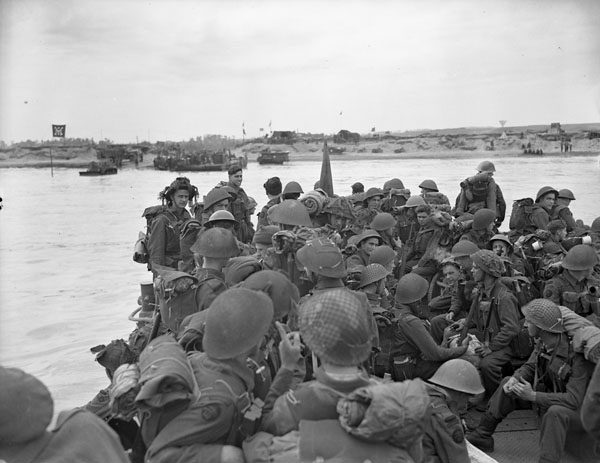
Landing at Juno Beach, 1944

A Canadian sailor prepares to hoist the Union Jack on the expropriated Japanese-Canadian fishing boat KUROSHIMA NO.2, New Westminster, British Columbia, Canada, 29 December 1941

Sudbury, 1942. Mining for Victory

Fourth-Year Seminar

Our focus this week was on opposition to Confederation after 1867. We discussed the reasons why so many people in Nova Scotia and Newfoundland opposed Confederation.  We read the following secondary sources: Phillip Buckner, P.B. Waite and William Baker, “The Maritimes and Confederation: A Reassessment” Canadian Historical Review 71 (1990): 1-45; D.C. Harvey, “Incidents of Repeal Agitation in Nova Scotia” Canadian Historical Review (1934): 48-57; H.B. Mayo, “Newfoundland and Confederation in the 1860s” Canadian Historical Review (1948): 125-142.    We also read several articles on the Nova Scotia secession agitation published the New York Times in 1868 (for an example, click here)

Graduate Teaching
In my seminar for Master’s students, we discussed the following readings: JoAnne Yates, “The Telegraph’s Effect on Nineteenth Century Markets and Firms,” Business and Economic History 15 (1986): 149-163; Ian Radforth, “Confronting Distance: Managing Jacques and Hay’s New Lowell Operations, 1853-1873,” Canadian Papers in Business History 1 (1989): 75-100; Naomi R. Lamoreaux, Daniel M. G. Raff, and Peter Temin, “Beyond Markets and Hierarchies: Towards a New Synthesis of American Business History,” American Historical Review, 108 (2003): 404-33.




An Irish Perspective on the Vancouver Olympics Opening Ceremony

14 02 2010

From the Irish Independent: “Vancouver, apparently, has been consistently rated “the world’s most liveable city”, an experiment in multiculturalism that has achieved improbable levels of harmony despite the fact that for 52 per cent of the population, English is not their first language. And Canada itself is currently in vogue as a cool, progressive country where they’re not big on nationalism or patriotic fervour. “We may not wave the flag like other countries, we are quietly proud,” said Kerrin Lee-Gartner, an Olympic gold medal winner in downhill skiing. And their opening ceremony was suitably classy. Or at least it managed to keep the ludicrousness to a minimum.”


Social Mobility is Easier in Canada than in UK, USA

12 02 2010

at least according to a new OECD report. See here.

“It is easier to climb the social ladder and earn more than one’s parents in the Nordic countries, Australia and Canada than in France, Italy, Britain and the United States, according to a new OECD study. Intergenerational Social Mobility: a family affair? says weak social mobility can signal a lack of equal opportunities, constrain productivity and curb economic growth.”

It sounds that Canadians have more to celebrate than simply the Olympics!!!

The British press is covering this story. “A father’s income determines his son’s to a greater extent in Britain than in any other wealthy nation, with half of a high earner’s “economic advantage” being transmitted to their children, a study by the Organisation for Economic Co-operation and Development has found.”  read the full Guardian story here. It remains to be seen how newspapers in the alleged land of social mobility to the south of our border USA deal with this inconvenient truth!

The OECD has published a cool YouTube video that summarizes the finding of the report.


Historian Andrew Ross on the Unknown Olympic Flag Bearer

12 02 2010

The Olympic Torch En Route to Vancouver

The Winter Olympics will begin in a few hours in Vancouver. (See here, here, and here). Nowadays, it is considered a great privilege for an athlete to be chosen as the country’s flag bearer during the Olympic opening ceremonies.  A few days ago, the identity of the person who will carry Canada’s flag tonight in Vancouver was a subject of speculation on the internet. The photograph of Clara Hughes, the person chosen, will probably grace the front pages of many newspapers tomorrow.

Clara Hughes

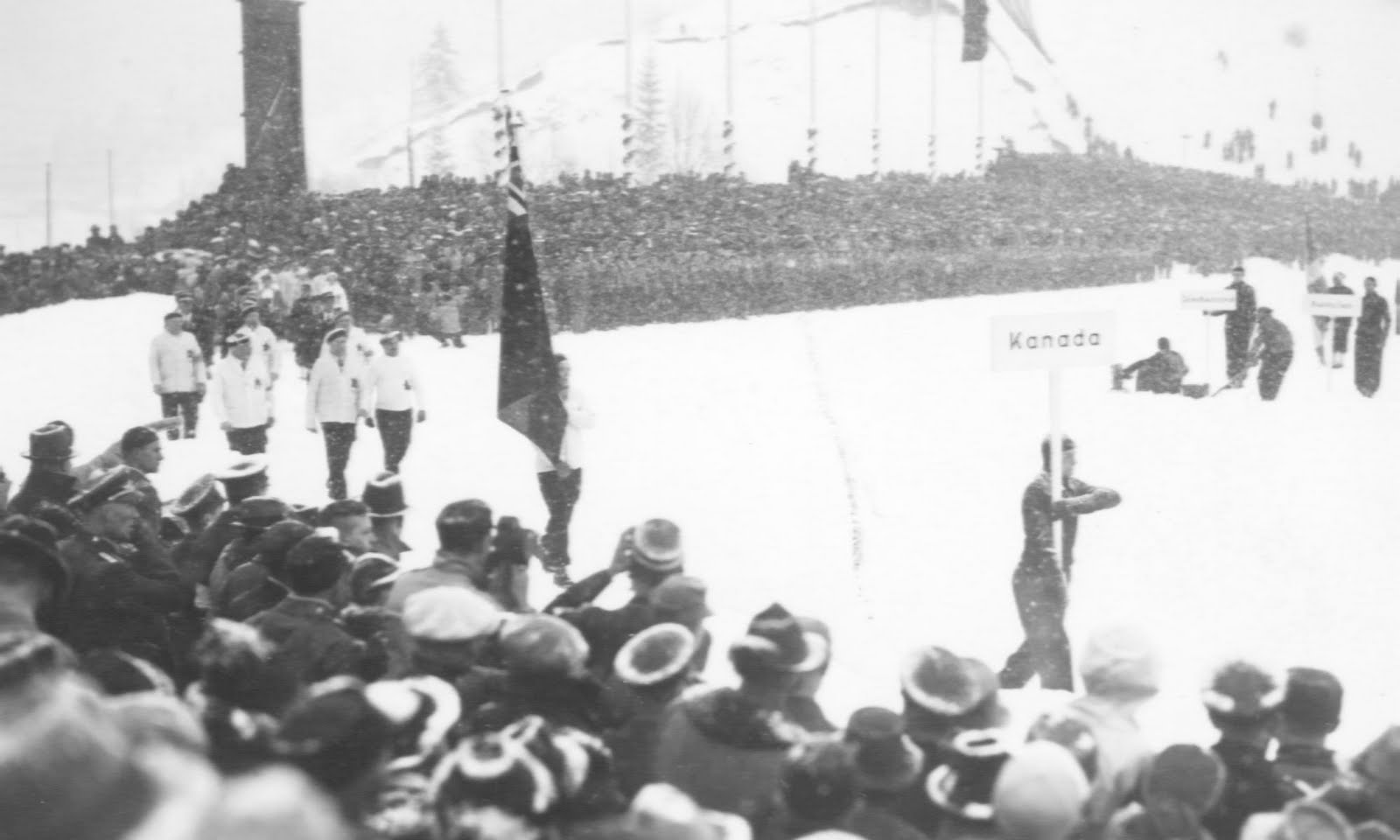
But this was not always the case. For instance, at the time of the 1936 Winter Olympics, nobody thought it worthwhile to record the name of Canada’s flag bearer.

Andrew Ross, Canadian Historian

Dr Andrew Ross, a historian of North American sport and business based at the University of Geulph, has some interesting observations about the identity of Canada’s flag bearer in 1936. Check out his most recent post on his hockey history blog.  Ross reports that historians have tentatively identified the 1936 flag bearer using this grainy photograph.

The Dominion of Canada's Flag at the Opening Ceremonies of the 1936 Winter Olympics


Environmental History and PEI, June 2010‏

12 02 2010

From 7-25 June, the University of PEI is offering “Settling and Unsettling Spaces: Environmental History & PEI,” an intensive, three-week course in the field. Upper-level undergraduates and Master’s students will draw from a range of disciplines in lectures, seminars, and primary research. They will also investigate the Island behind the tourism brochures, through field trips that explore how PEI’s environment and communities have changed over time. If you have questions, contact Josh MacFadyen, jmacfady@uoguelph.ca

As part of that course, students will also participate in the second event, the 13-18 June “Time and a Place: Environmental Histories, Environmental Futures, and Prince Edward Island”. Local, national, and international participants will come together to develop PEI’s environmental history and explore, more broadly, the value of islands in crafting plans for sustainability. The event, organized by UPEI and NiCHE, will include workshops, field trips, public lectures (by Finis Dunaway, Daniel Pauly, Harriet Ritvo, Donald Worster, and Graeme Wynn), and, undoubtedly, lobster.

Thanks to a SSHRC Environmental Issues grant, the registration costs are very reasonable, and registration and travel support will be available to some students. If you are interested in attending, please apply online by 15 February. Space is limited! You will be notified by 15 March if your application has been accepted, and you will be asked to pay registration by 1 May. If you have any questions, please contact: amaceach@uwo.ca


The Canadian War on Queers – Book Launch and Public Talk

11 02 2010

The Canadian War on Queers – Book Launch and Public Talk

You are invited!

The Canadian War on Queers: National Security as Sexual Regulation
By Gary Kinsman and Patrizia Gentile

Thursday Feb. 25, 2:30 p.m., 3rd floor of the Student Centre, Laurentian University

Please join us for a public talk by Laurentian Prof. Gary Kinsman and the book launch for the Canadian War on Queers: National Security as Sexual Regulation (Vancouver: University of British Columbia Press, 2010).

This scholarly event is part of Pride Week 2010 at LU.

Copies of The Canadian War on Queers will be for sale at the event.

The event is co-sponsored by the Department of History.

Book description: The Canadian War on Queers

From the 1950s to the late 1990s, agents of the state spied on, interrogated, and harassed gays and lesbians in Canada, employing social ideologies and other practices to construct their target – people who deviated from the so-called norm – as threats to society and enemies of the state.

Reconstructed from official security regime documents released through the Access to Information Act and interviews with gays, lesbians, civil servants, and high-ranking officials, The Canadian War on Queers offers a passionate, personalised account of a national security campaign that violated peoples civil rights and freedoms in an attempt to regulate their sexual practices. Gary Kinsman and Patrizia Gentile disclose not only the acts of state repression that accompanied the Canadian war on queers but also forms of resistance that raise questions about just whose security was being protected and about national security as an ideological practice.

This path-breaking account of how the state used national security to wage war on its own people offers ways of understanding, and resisting, contemporary ideological conflicts such as the “war on terror.” It is required reading for students, scholars, and social activists in lesbian, gay, and queer studies or anyone interested in the issues of national security, state repression, and human rights.


Flag Debate in New Zealand

11 02 2010

New Zealanders are debating whether they should replace their current flag (see below)

with one that does not make a reference to Britain. A number of designs are under consideration right now, but the country’s Prime Minister has endorsed this rather sharp design:

Some New Zealanders are opposed to changing their flag.  As a recent article in the New Zealand Herald points out, the ongoing debate in New Zealand parallels the great Canadian flag debate of the 1960s. The article quotes Canadian historian Christopher Moore. You can see some great clips related to the flag debate in the CBC archives website. I particularly like the one that shows Prime Minister Lester Pearson explaining to a group of jeering members of the Royal Canadian Legion how the new flag would promote unity between the different elements of Canada’s diverse population.

The campaign for a new flag in New Zealand has been spearheaded by Lloyd Morrison, a businessman who runs a successful international company. The fact a businessperson has raised this issue is significant, because flags are important to a country’s branding. In my view, Canada’s maple-leaf flag is perfect because it emphasizes the country’s best assets: great natural resources, lots of trees, fantastic opportunities for a variety of outdoor sports, things that are central to Canada’s identity. Branding a country is really important for tourism promotion, exports, as well as selling products to domestic consumers.

Some of the most successful Canadian companies also employ the trope of nature in marketing their products. For instance, Roots Canada Ltd. sells comfortable sweatshirts emblazoned with big beavers.  Roots products are more likely to be seen on subway trains than in national parks, but they play on Canada’s perception of itself as a country in tune with nature. It may be that when Canada trashed its old flag in 1965, it was giving up the opportunity to appeal to snobbish anglophile consumers in the United States.

There is some evidence that Canada did trade on its British connection for the purposes of tourism promotion. As late at the 1970s, the Province of Ontario’s tourism slogan for the US market was “We Treat You Royally”. (In 1979, Tourism Minister Larry Grossman told the Ontario legislature that the campaign associated with this slogan had been effective).  However, I would guess that these costs of scrapping the symbols of Britishness were more than offset by the benefits of  emphasizing Canada’s distinct selling points (trees, etc). After all, in an age of cheap airfare, it doesn’t make sense for Canada to try to appeal to the anglophilia of the “Masterpiece Theatre” crowd in the United States, since they can go to England and see the real Stratford for roughly the same money as it would take to drive to the Shakespeare Festival in Stratford, Ontario. People overseas view Canada as one big national park filled with beavers and the odd canoe.

The only possible way we could improve Canada’s current flag would be to change the colour scheme to green and blue, which would emphasize summertime conditions and watersports such as waterskiing, canoeing, etc. The current red-and-white colour scheme reminds people of the fall, when maple leaves turn red, and winter, when everything is covered in drifting snow. (I know that some people come to Canada to ski, but most visits are in the summer).

Have a look at Prof. Catherine Carstairs’s great journal article “Roots Nationalism: Branding English Canada Cool in the 1980s and 1990sHistoire Sociale/Social History 39, no. 77 (May 2006): 235-255. (The article is ungated).

Anyway, I wish our friends in Middle Earth New Zealand well in their search for a new flag. I hope that their government realizes that there could be real economic benefits in changing their flag. As someone who occasionally watches rugby, I like the white fern on the black background.


Review of Ross Thomson, _Structures of Change in the Mechanical Age: Technological Innovation in the United States, 1790-1865_

9 02 2010

Ross Thomson, _Structures of Change in the Mechanical Age: Technological Innovation in the United States, 1790-1865_. Baltimore: Johns Hopkins University Press, 2009. xiv + 432 pp. $68 (hardcover), ISBN: 978-0-8018-9141-0.

Reviewed for EH.NET by Lisa D. Cook, Michigan State University.

The author cleaned the Augean stables of historical data related to invention to bring the reader a rich and detailed study of the early development of the American system of technological innovation. The volume starts with a vivid juxtaposition of the antebellum and postbellum economic and inventive environments. Path-breaking inventors in the mid- to late nineteenth century, like Thomas Edison, Joseph R. Brown, and George Corliss, had the advantage of a pre-existing innovation system resting upon the pillars of ideas, markets, institutions, and skilled labor. In the earlier period output was rising because small-scale production was increasing in scale. Yet, technological progress occurred more slowly, because there was no change in techniques. Among the initial conditions were several factors constraining development and adoption of mechanization, including small markets, scarce human and financial capital, and limited technological knowledge. Thomson argues that the innovation system that developed as a result of actions from above — government — and below — among self-interested innovators — was integral to the success of the American Industrial Revolution.

In Thomson’s view, this new system of firms, individuals, and markets had two critical components. First, knowledge had to be gained and developed. Scientific investigation had to be undertaken (or taken from Britain) and applied. Second, it had to be disseminated and developed further to augment future technological development. He emphasizes important feedback effects throughout the process of innovation and building innovative capacity. Embodied technological progress appeared in machines, which were related or unrelated to a given invention. General purpose technologies were critical for cross-fertilization. Embodied technological progress also appeared in machinists and inventors.

The new innovation system was characterized by two seemingly opposing but intricately intertwined features: structure and change. Structures, like the patent system and scientific institutions, are the midwives that bring to fruition new ideas and technological change. To explain the evolution of structure and change, he organizes chapters chronologically and then thematically.

The significant contributions of this book derive from three sources: the amount and type of data collected and examined, the extension of previous work on major innovators, and the exposition of the relevance of social interactions in innovative systems.

Thomson carefully presents systematic evidence on the emerging innovation system in the mid-1800’s, using data on innovators, firms, industries, patents, and various technologies. One thousand individual innovators and 14 industries are covered in 50 data sets and other primary and secondary sources. The focus of the volume is patented invention. However, like Moser (2005) and a number of subsequent studies, he extends the examination to include exhibits at industrial fairs, including the New York Crystal Palace Exhibition and the New York World’s Fair in 1853 and other unpatented inventions. As a result the data,, and the book more generally, constitute a rich resource for research on innovation during this period.

The research presented on major innovators extends the work of Ciarlante (1978) and Khan and Sokoloff (1993). While he starts from the _Dictionary of American Biography_ (1937) to identify major innovators as do Ciarlante and Khan and Sokoloff, he broadens the scope of investigation by adding those who may not have been as well known or socially connected as those in the _DAB_, e.g., from the _Biographical Dictionary of Civil Engineers_ (1972 and 1991). To demonstrate how learning and dissemination evolved in this innovation system, he provides detailed summaries of data on location, occupation, specialization, educational attainment, and patent usage and commercialization.

Thomson argues persuasively that interactions beyond formal institutions were as important for development of the American system of innovation as those within them. Institutions — firms, markets, occupations, patenting systems, publications, schools, and civil organizations — often created asymmetries in knowledge and in its dissemination, and individuals through networks served as a corrective mechanism. He offers science as an illustration of the balance between institutions and individual networks, given its dual focus on institutions and policies and on individuals with respect to integrating science into economic life.

Further, he asserts that technological centers, large groups that played a significant role in processes of invention, diffusion, and development and fostering growth and innovation broadly across the economy, were the locus of networked innovative activity. In particular, he places machinists and the machinery industry and science and the institutions of transmission of scientific output at the epicenter of this innovation system. Using data from the Manufacturing Manuscripts of the Census and the Patent Office, he exposes mobility and linkages across industries and demonstrates that machinists were such industry-spanning technological centers.

One might have three minor quibbles about this volume. First, while the clear intent is to reinforce and provide further support for his thesis, the book is repetitive in places. For those who will use it as a reference and individual chapters by themselves, this feature may be inconsequential, and each chapter being self-contained may be an advantage.

Second, some counterfactual analysis appears in the volume. Nonetheless, more of such analysis would have been helpful to the reader. For example, in Chapter 8, Thomson argues that without distinct knowledge bases, the U.S. “might well have succeeded in some innovations and failed in others. Without science the United States could have developed the sewing machine but not the telegraph …” (p. 257). Such statements require further probing. International comparisons, particularly to England, are deployed effectively in other places and are desirable here and elsewhere in the book. Are there places where varying innovations emerged in the absence of innovators’ access to many kinds of knowledge? The reader clearly gets the sense that America’s system of innovation was exceptional but is not entirely sure why.

Finally, I believe Thomson misses an opportunity to provide a vivid example of his thesis by repeating the conventional wisdom related to Eli Whitney. A reference to his negative experience with his cotton gin and the patent system is briefly invoked early in the book (pp. 19-20). Lakwete’s (2003) careful research challenges the received wisdom about Whitney and shows that southern machinists and farmers quickly tested and improved his version of the cotton gin. Before Whitney’s patent expired, southern farmers developed incremental improvements and adopted a new gin with circular saw teeth rather than Whitney’s wire teeth, the source of novelty but less of usefulness. This more complete story would have provided clear support for Thomson’s innovative-feedback thesis while acknowledging imperfections in the patent system and its enforcement.

These quibbles notwithstanding, this book accomplishes a Herculean task of data collection and analysis. The antebellum period has been understudied, allowing scholarship on later periods to take the foundations of the innovation system for granted. It is an important work and likely to become required reading for generations of scholars of the innovative process.


Origins Podcast on the Reception of Darwinism in the United States

7 02 2010

Charles Darwin in 1881

The History Department at Ohio State University produces a monthly podcast called Origins. Origins podcasts place a contemporary event in historical perspective. This month, they are looking at the reception of Darwin’s theories in the United States. The writer of this podcast was Prof. Steven Conn.


Paris 1919 (Clip 1) by Paul Cowan – NFB

7 02 2010

Paul Cowan’s feature-length documentary Paris 1919 combines archival footage and dramatic re-enactments to take viewers inside the peace talks that followed World War I.In this clip, the parties gather in Paris to draft the various parts of the peace treaty. John Maynard Keynes sets up the British Reparations Committee, which details the losses in France and Britain.

Vodpod videos no longer available.