My Teaching This Week

7 02 2010

HIST 1407 (First-Year Canadian History Survey Course)

Lectures in this course fall into two categories: lectures on a short period of Canadian history (e.g., a decade) and lectures that trace a theme over a longer span of time. On Monday, I talked about Canada in the 1920s. I spoke about the Winnipeg General Strike, the Canadian economy,  the growth of car and radio ownership, the King-Byng affair, the Balfour Declaration, the Halibut Treaty, the Chanak Crisis, and other incidents in Canada’ s diplomatic history. I worked some material about Mackenzie King’s private life into the lecture. I also mentioned Edwards v. Canada (Attorney General), the case that led to the appointment of the first woman to the Senate in 1930.

A major theme of my lecture on Monday was the role of third parties in Canadian politics in the 1920s. I showed this “heritage minute” in lecture, which generated a debate in the class about the role of the NDP in federal politics today. (Jack Layton visited our campus last week, which was a “teachable  moment” for me).

Here are some of the pictures I found in preparing the powerpoints for my lecture.

Arthur Meighen

King and his dog Pat, 1924

King at the Imperial Conference in 1926, Fighting for Canada's Autonomy
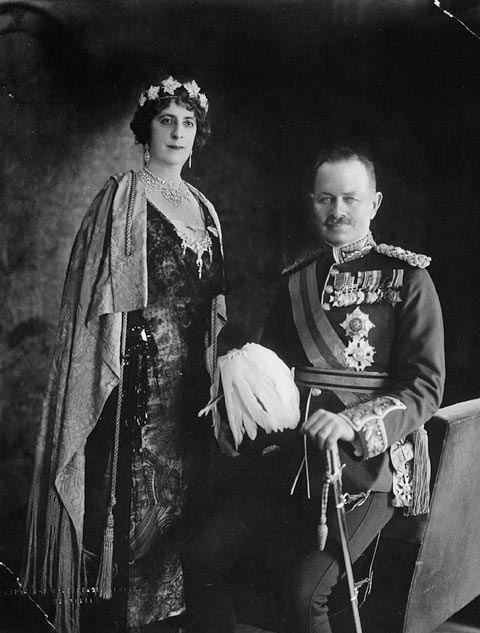
Lord Byng, GG, and Lady Byng

King at the Canadian Legation in Washington, 1927

My lecture on Wednesday was about the history of alcohol in Canada. I spoke about whiskey traders and natives, the Canada Temperance Act, Ontario’s experiment with prohibition, smuggling,  and the influence of religion on attitudes to drinking.

Police Raid on Illegal Bar, Elk River Ontario, 1925

LCBO Store, Late 1920s

LCBO Store, 1950s

Fourth-Year Seminar on Canada in the Confederation Period

Peter J. Smith, “The Ideological Origins of Canadian Confederation” Canadian Journal of Political Science 20, no. 1 (1987): 3-29; Arthur Silver, “Confederation and Quebec” The French Canadian Idea of Confederation, 1864-1900 (Toronto: University of Toronto Press, 1997), 33-50 ;Paul Romney, chapter 7 “Confederation: the Untold Story” in Getting It Wrong: How Canadians Forgot Their Past and Imperilled Confederation (Toronto: University of Toronto Press, 1999).

HIST 5157

In my graduate level course, we discussed Alfred D. Chandler, Jr., The Visible Hand: the Managerial Revolution in American Business (Cambridge, Mass. : Belknap Press, 1977); R ichard John  “Elaborations, Revisions, Dissents: Alfred D. Chandler, Jr.’s, The Visible Hand after Twenty Years,” Business History Review 71 (Summer 1997): 151-200. The students found Chandler’s book to be a difficult but rewarding read.



Rough Cut Video Blog > Hilarious Generic News Report

5 02 2010

Amusing.

Vodpod videos no longer available.


New Historical Films from US NARA YouTube Channel

2 02 2010

YouTube Channel of the United States National Archives and Record Administration has recently uploaded some neat films from NARA’s vaults. Perhaps the most interesting of these archival materials is the WWII propaganda film “Why We Fight”.

Spaceflight junkies will like this video:

One hopes that Canadian archives will soon begin to upload their holdings of film to YouTube.


Sean Kheraj on the Ipad and Historians

29 01 2010

Sean Kheraj has posted some thoughts on the probable impact of the Ipad on the teaching of history. I’ve bookmarked his post so I can read it later. I’m a bit busy today as I am running a workshop.


Congress in World and Global History

27 01 2010

Next year the Third European Congress in World and Global History will be hosted by the Department of Economic History at LSE, on 14-17 April 2011. Though the congress is intended to cover the full breadth of world, global and transnational history, we hope that it will include plenty of economic history, as did the preceding conference in Dresden in 2008. The Call for PANELS is below; please note that the deadline is 28 February (this year).

14 – 17 (not 11-14) April 2011, London School of Economics & Political Science

THEME: CONNECTIONS AND COMPARISONS

Recent decades have seen the re-emergence and, on an unprecedented scale, the further development of various interacting strands of world, global and trans-national history, all sharing the aim of transcending national historiographies. Connections and comparisons have been central to these intellectual enterprises.

We cordially invite proposals for panels examining comparisons, connections and entanglements between polities, societies, communities and individuals situated in, or spanning, different regions of the world. The perspectives involved will range from interactions between humanity and the environment, including over the very long term, through the cultural and economic histories of material and social life, to empires, international organizations, oceans as spaces of sustained interaction between communities from different continents, the experience and consequences of migration, periods of ‘de-globalization’ and ‘globalization’, and the intercontinental sources and consequences of revolutions, whether political, technological, social or ideological. Not least, we encourage critical reflection on the methodological and conceptual issues involved in comparative, transnational and entangled histories: whether in general, or in relation to specific areas of historical inquiry, from religions to real wages, from diasporas to epistemic communities. We look forward to contributions from not only from scholars in various disciplines, based both in Europe and around the world. Conference languages will be English, French and German.

Proposals: We invite proposals for panels comprising 3-6 participants. In addition to the names, affiliations and email and snailmail addresses of the participants, proposals should include titles and abstracts of the panel as a whole (200-600 words) and of each individual paper (100-300 words). Please note that, at this stage, it is only proposals for panels, rather than for isolated papers, that are sought. However, panel proposers are welcome to leave one or two spaces for further papers. After the Steering Committee has selected panels, in April 2010, there will be a second Call, inviting proposals for individual papers to take up any vacant slots in the already-accepted panels.

Proposals should be submitted as email attachments to Katja Naumann at: headquarters@eniugh.org


My Teaching This Week

27 01 2010

HIST 1407: Canadian History Since 1867

I devoted two lectures to the First World War. Monday’s lecture focused more on events overseas (European diplomacy, alliances, living conditions in the trenches, key battles), while the lecture on Wednesday was mainly about events in Canada (the politics of war, conscription, Regulation 17, war production, profiteering, income tax, railway nationalization).

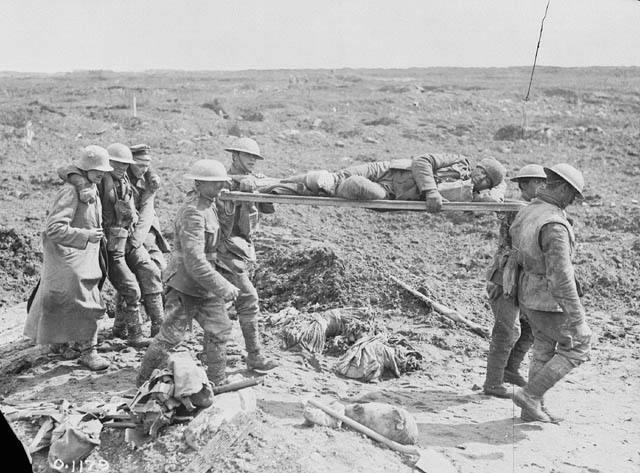
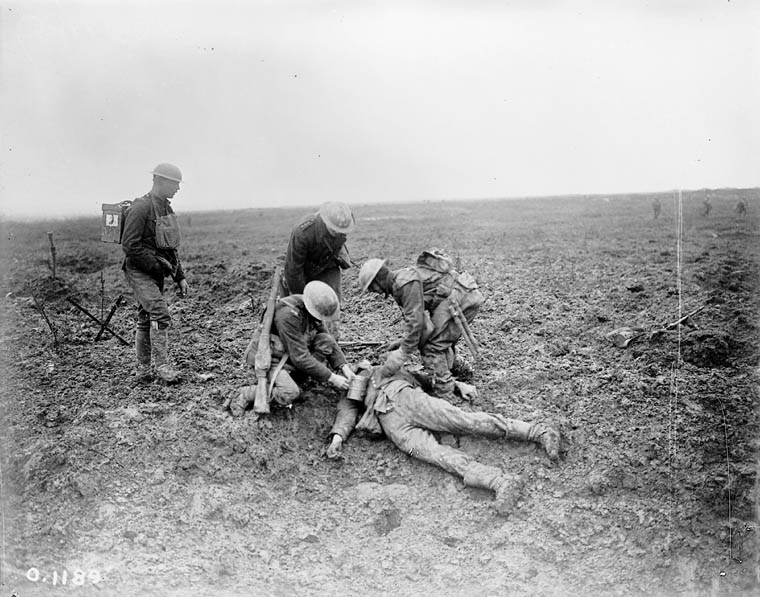
Teaching about the First World War is a treat because it allows me to use fantastic images from the LAC collection as part of my Powerpoint. Here are some examples of the images I used.

German and Canadian Soldiers Working Together to Remove Wounded From Vimy Ridge

Here is another good image, taken on the same day:

Wounded at Vimy

Munitions Factory

Consider this photo of a woman participating in the war economy:

Or this great photo:

Anti-Conscription Protest, Victoria Square, Montreal, 1917

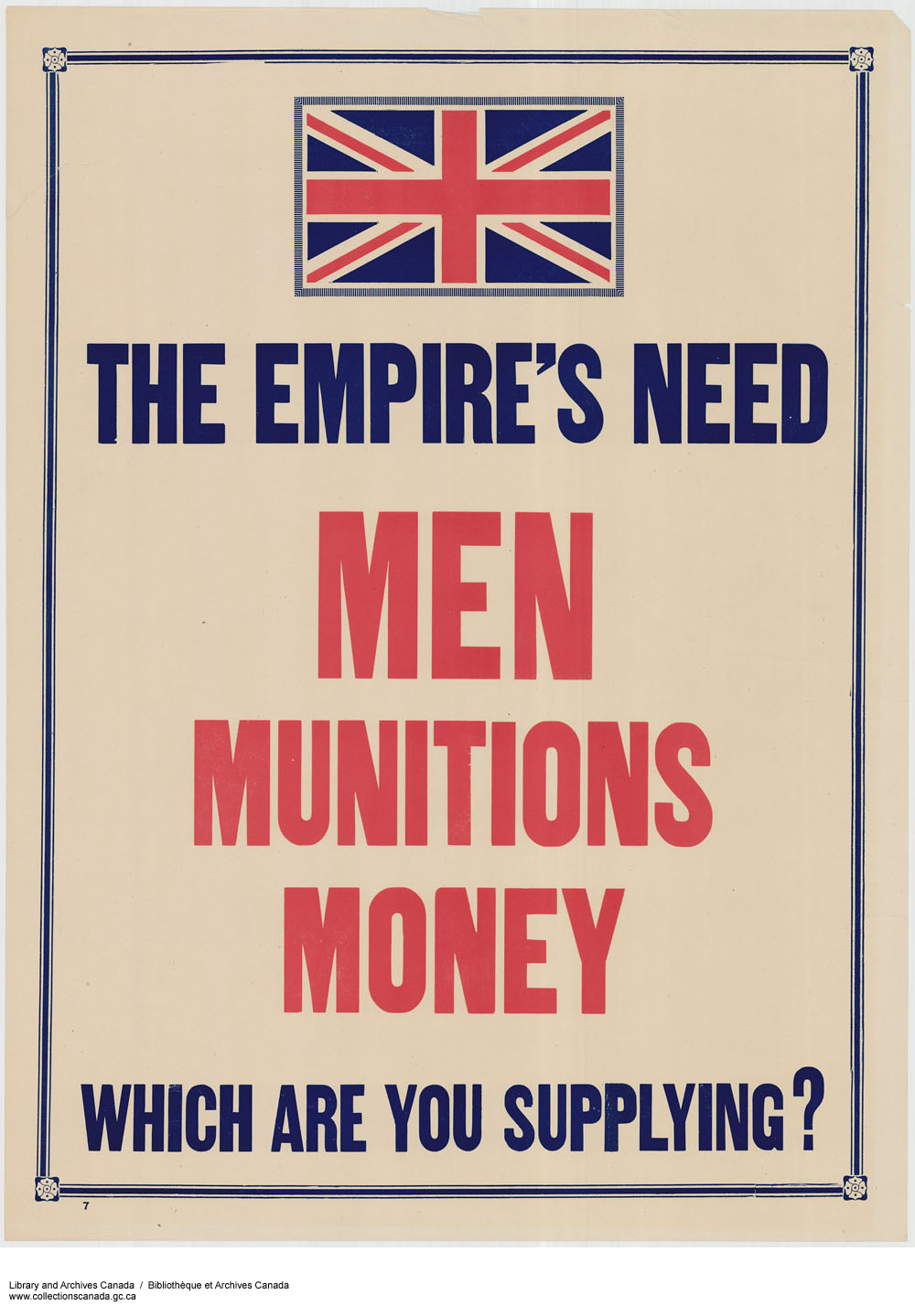
I was also able to show lots of great war time propaganda posters. The LAC some great items in their collection, including:

and

and

and

4th Year Seminar on British North America and the Age of Confederation

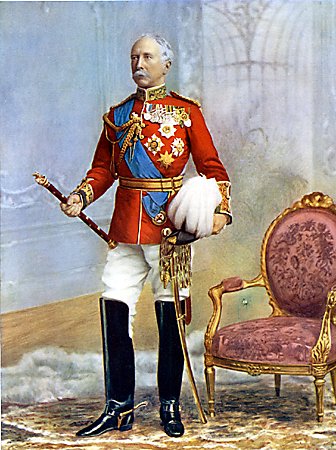
Our focus this week was on BNA reactions to the Civil War. Our readings  were: S.F. Wise, “The Annexation Movement and Its Effect on Canadian Opinion, 1837-67” in Canada views the United States : nineteenth-century political attitudes, edited  by S.F. Wise and Robert Craig Brown (Seattle : University of Washington Press, 1967); Robin Winks, Canada and the United States: the Civil War Years (Baltimore : Johns Hopkins Press, 1960), chp. 2, 3. We also listened to two excellent student presentations on the lives of Sir Charles Hastings Doyle and Garnet Joseph Wolseley.

Wolseley

In seminar, I had my students take 15 minutes to read two primary sources.

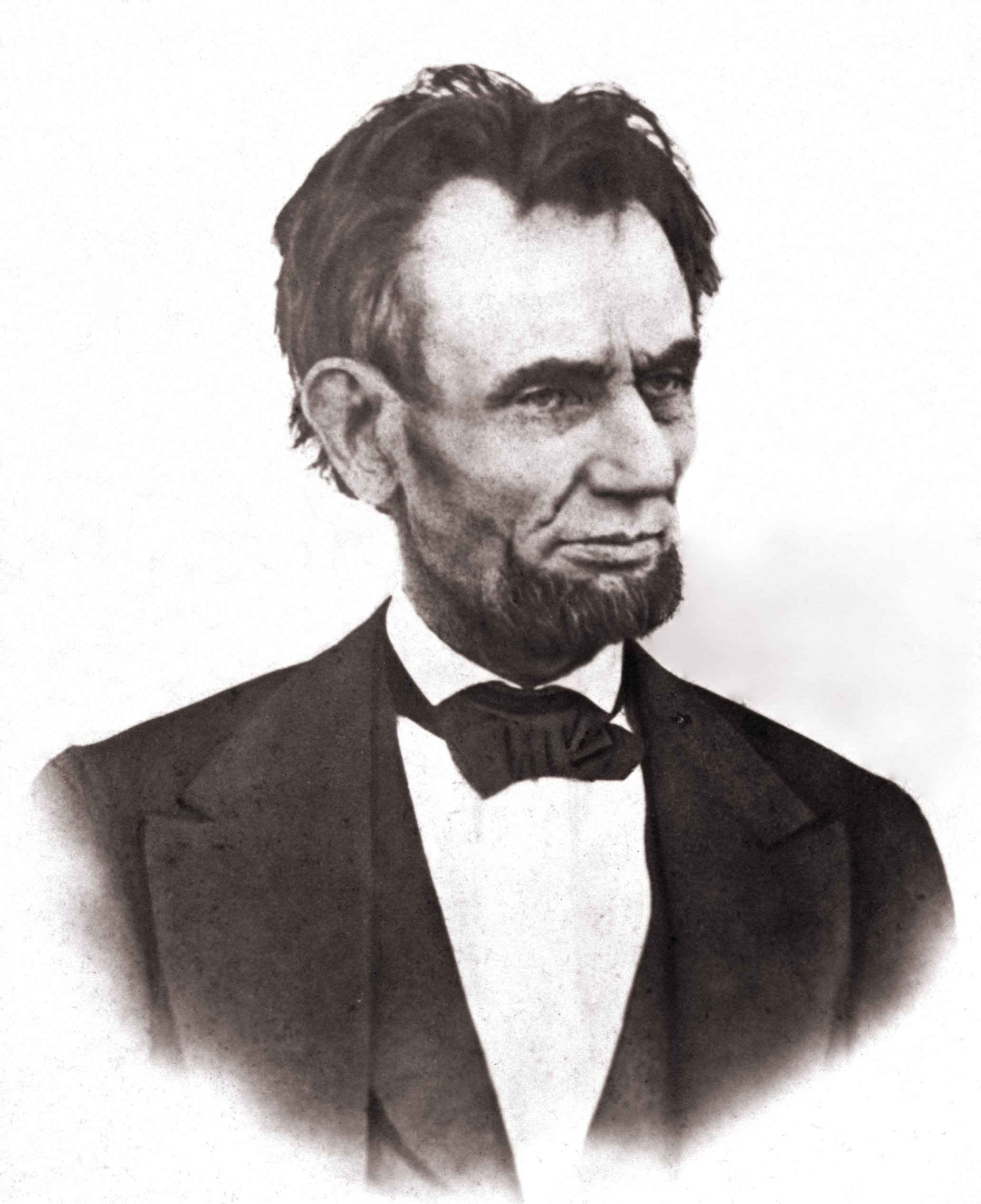
The first was Lincoln’s famous 1862 letter to the New York Tribune newspaper.

Lincoln

Source: The Collected Works of Abraham Lincoln edited by Roy P. Basler, vol. 5, “Letter to Horace Greeley” (August 22, 1862), p. 388.

“Executive Mansion,
Washington, August 22, 1862.
Hon. Horace Greeley:
Dear Sir.
I have just read yours of the 19th. addressed to myself through the New-York Tribune. If there be in it any statements, or assumptions of fact, which I may know to be erroneous, I do not, now and here, controvert them. If there be in it any inferences which I may believe to be falsely drawn, I do not now and here, argue against them. If there be perceptable in it an impatient and dictatorial tone, I waive it in deference to an old friend, whose heart I have always supposed to be right.
As to the policy I “seem to be pursuing” as you say, I have not meant to leave any one in doubt.
I would save the Union. I would save it the shortest way under the Constitution. The sooner the national authority can be restored; the nearer the Union will be “the Union as it was.” If there be those who would not save the Union, unless they could at the same time save slavery, I do not agree with them. If there be those who would not save the Union unless they could at the same time destroy slavery, I do not agree with them. My paramount object in this struggle is to save the Union, and is not either to save or to destroy slavery. If I could save the Union without freeing any slave I would do it, and if I could save it by freeing all the slaves I would do it; and if I could save it by freeing some and leaving others alone I would also do that. What I do about slavery, and the colored race, I do because I believe it helps to save the Union; and what I forbear, I forbear because I do not believe it would help to save the Union. I shall do less whenever I shall believe what I am doing hurts the cause, and I shall do more whenever I shall believe doing more will help the cause. I shall try to correct errors when shown to be errors; and I shall adopt new views so fast as they shall appear to be true views.
I have here stated my purpose according to my view of official duty; and I intend no modification of my oft-expressed personal wish that all men every where could be free.
Yours,
A. Lincoln.”

I then had the students read an editorial about Lincoln’s letter to Greeley that appeared in the Toronto Globe, 28 August 1862.

This generated a good discussion of Canadian attitudes to the Civil War.


Review of Joel Mokyr’s New Book

26 01 2010

Yesterday’s FT had a review of The Enlightened Economy: An Economic History of Britain 1700-1850 by Joel Mokyr
(Yale University Press). You can buy the book from Amazon.ca, as I just did. I expect that this book will inspire Canadian historians to look at similar themes as they relate to our history.


William Hall, VC

25 01 2010

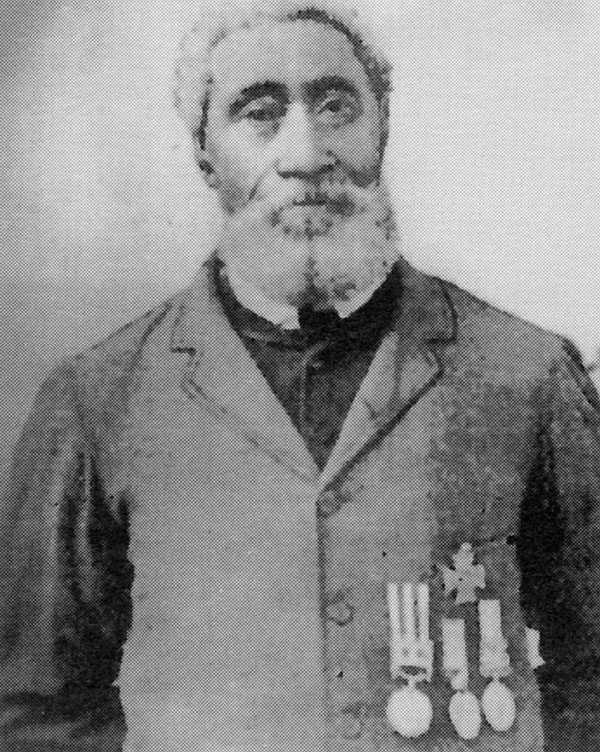
February is Black History Month in Canada and the United States. Black History Month opens with the production of a new play in Ottawa, William Hall. Hall was a Black Nova Scotian who won the Victoria Cross for his efforts in helping to put down the Indian Mutiny in 1857.  I hope to have the chance to see this play at some point. I will also be interested to see the reaction of the Indo-Canadian community to this play.


What Historical Research Can Do For Haiti?

25 01 2010

ActiveHistory.ca, a website devoted to the practical application of historical knowledge, has an interesting post on how history can contribute to ourstanding of the crisis in Haiti.


Globe Editorial on Prorogation

23 01 2010

Today, anti-prorogation rallies were held all over Canada.

I liked aspects of today’s editorial in the Globe about prorogation, especially the references to the struggle to achieve Responsible Government in the 1840s.

“The age-old struggle for parliamentary rights against an arbitrary governor was settled long ago. In Canada; this was exemplified in the quest by Robert Baldwin and Sir Louis-Hippolyte LaFontaine for responsible government. A basic requirement for responsible government in the parliamentary system, where the executive and legislative branches are partly fused, is for the executive to be answerable for its actions to an elected legislature. But a new struggle for parliamentary rights is under way, and this time it is the prime minister who is wielding potentially autocratic powers.”

As someone who spends some of my time trying to interest young adults in the history and principle of Responsible Government, I’m very glad the paper mentioned Baldwin and LaFontaine.The Globe, which itself played an important role in Canadian constitutional history, is helping to perpetuate the memory of these men. Thank you.

That being said, I was a bit disappointed by the timidity and conservatism of the Globe‘s proposed solution to the problem of the unchecked power of Canada’s recent Prime Ministers. The Globe editorial focuses on the codification of the unwritten rules governing prorogation.  This is an excessively modest proposal and one that overlooks some of the other options for constitutional renewal that should be on the table (e.g., Swiss-style direct democracy or proportional representation or more free votes in the House of Commons).

I agree that the codifying  our unwritten constitution would be a good first step towards making Canada more democratic, but we need to go beyond tinkering with parliamentary rules if are to democratize the federal government. It seems to me that ending the democratic deficit will require a profound cultural shift away from our elitist, undemocratic, and unduly centralized political system.  For many years, and indeed, decades, the federal government has been run by a tiny clique of bureaucrats (see Don Savoie’s book on this topic).  The result has been the imposition of policies that are anathema to the wishes of the vast majority of Canadians (e.g., such unpopular policies as the abolition of capital punishment and the participation of Canadian troops in the American-led war in Afghanistan). In some cases the policies rammed down the throats of Canadians are sometimes right-wing, in other cases they are causes dear to the left. What they have in common is that they are schemes hatched by small elites and opposed by the majority.  In a true democracy, such policies would never have been imposed. Alas, Canada’s government is controlled by a tiny group of elites in Ottawa– a handful of unelected judges,  corporate shills, continentalist generals,  and, of course, the powerful denizens of the PMO.

There are many reasons why Canada’s government is less democratic and less responsive to the will of the people than, say, the government of Switzerland, but I would say that the monarchy is a big factor. Other constitutions proclaim the sovereignty of the people (e.g., “We The People”). Although governments in republics frequently flout the wishes of the people, at least there is the idea that the government exists to implement the will of the populace. Monarchies traditionally operated on very different principle, namely, the notion that the ruler was sovereign. The job of the common people, the Third Estate, was to pay taxes, to act as cannon-fodder, and to shut up. Nobody took public opinion polls because the opinions of the peasantry didn’t matter than much. 

Louis XIV

Only gradually did the common people gain a say in their governance. Of course, today’s constitutional monarchies are democracies, but there symbolic and institutional vestiges in the background that legitimize undemocratic behaviour. For one thing, Canadian government officials (judges, MPs, army officers) still swear allegiance to a foreign ruler (the Queen) rather to the people of their country. I would argue that this weakens the link between public servants and the populace and undermines the notion that public officials are the delegates, the attorneys, of the people.

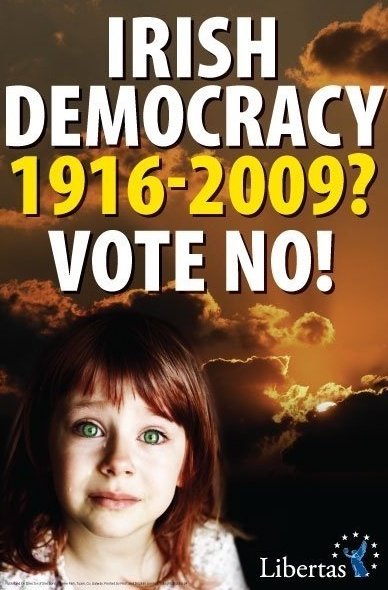
In constitutional monarchies, the rulers’ contempt for the common people is evident in many subtle but important ways. For instance, in the Republic of Ireland, there was recently a referendum on the new EU constitution Lisbon Treaty. In the constitutional monarchy of Great Britian, no such referendum has been held, a small elite of 658 individuals being held to be competent to judge this important issue.

No Side Poster, 2009 Irish Referendum Campaign

If Canadians are to democratize our political system, perhaps we should start by making a symbolic break with the past by abolishing the monarchy, declaring that the people are sovereign, and then creating an elected head of state.