In a new book,The Industrial Revolution in Global Perspective, Robert C. Allen tackles one of the big questions in history, namely, “why did the industrial revolution take place in 18th century Britain and not somewhere in Continental Europe or East Asia?” Allen’s answer to this important question should concern those of us who study the history of North America, since the Industrial Revolution helps to explain, inter alia, why English became the dominant language on this continent. His book will interest economic historians, historians of science and technology, and many others.
Coalbrookdale at Night, 1801
You can watch Allen talk about this book here. The video incorporates a powerpoint presentation with some really good images.
Dr Allen is a member of the Royal Society of Canada, btw.
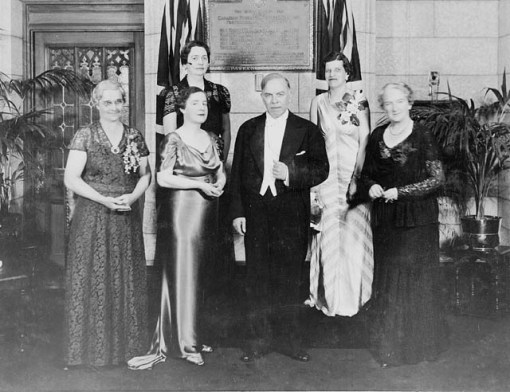
I have mixed feelings about the uncritical praise that has been lavished on the Famous Five rather than on the millions of other women who have lived in Canada. This is, in part, because I favour abolishing Canada’s upper house and moving to a unicameral legislature. (I understand why some people incline towards the Guy Fawkes school of parliamentary reform). I certainly believe that if Canada is going to have an unelected upper house, then women should be allowed to sit in it! The question, however, is whether eliminating the ban on female Senators in the 1920s served to delay the abolition of a fossil institution by eliminating its most egregiously anachronistic feature. Senate abolition was proposed in the 1920s by Prairie populists and others on the political left and is still supported by the NDP. This is one of the few issues on which I agree with the NDP. All of the provinces now have unicameral legislatures- Quebec abolished its unelected upper house in 1968. Unicameralism seems to work well at the provincial level. As far as I know, no province has proposed re-introducing bicameralism.
As well, I’m not a big fan of the “living tree” doctrine of constitutional interpretation that Lord Sankey used to arrive at his decision in Edwards v. Canada, the case commonly called the Persons Case. It seems to me that it has made it easier for judges to read their own values into constitutional texts. Whether the living tree doctrine and the consequent judicialization of Canadian politics will be good for women or Canadians more generally remains to be determined.
Let’s abolish the Senate and then focus on getting more women into the House of Commons the PMO, where the real power is.
P.S. The Ottawa Citizen quiz mentions Marie-Joseph Angélique, a Montreal slave executed for arson in 1734. The students in my pre-Confederation course are currently writing an essay about her trial and execution.
Normally, I deliver two lectures each week to my first-year course on Canadian history. However, there was only one class this week due to the Thanksgiving holiday on Monday. My lecture on Wednesday was about the War of 1812. As it happens, the popular CBC comedy program Rick Mercer Reportsbroadcast on Tuesday evening contained a segment in which host Rick Mercer playfully interviewed some War of 1812 re-enactors in London, Ontario. Mercer is a well-known Canadian nationalist and appears to have relished participating in a War of 1812 re-enactment. About ten students in my class of 94 said that they had seen this segment the night before. During the lecture, I spoke about the place of the War of 1812 in Canadian popular culture, using Rick Mercer’s segment as an example of the use and abuse of history. I also spoke about anti-Americanism as a force in Canadian political culture. Rick Mercer’s show was a teachable moment as they say in the edutainment education business. You can view the segment here:
During our discussion of the War of 1812, one student mentioned a song about the conflict by the Canadian music group the Arrogant Worms. A video of this song has been placed online.
Canadian newspapers have carried a host of stories in the past few days about the Governor-General’s recent and very controversial description of herself as Canada’s “head of state” . See here, here, here, here, here, and here. For a francophone perspective on this terminological question, see here. In my opinion, the debate about whether the Governor-General should be described as “Canada’s de facto head of state” or merely as “the representative of Canada’s head of state, Queen Elizabeth” misses the point: a majority of Canadians believe that that position Queen of Canada should be abolished. (For polling data regarding support for the republican option in Canada, see here).
The monarchy is the elephant in the room that nobody in the political class wants to discuss. Canadian politicians are very hesitant to raise the question of the monarchy’s future because that would mean re-opening the constitution and obtaining the support of all of the provincial governments. Obtaining their support for the abolition of the monarchy would likely involve changing other parts of the constitution (e.g., an unelected upper house, Proportional Representation, possible special status for the nation of Quebec). The lesson most people in Ottawa drew from the two rounds of attempted constitutional reform under Brian Mulroney was that constitutional change should be avoided at all costs. Prime Minister Jean Chrétien astutely avoided the “c-word” when in office between 1993 and 2003.
The downside of this unwillingness to touch the constitution, the third rail of Canadian politics, is that the two most objectionable features of Canada’s constitution, the monarchy and the unelected Senate are condemned to persist in limbo, neither respected by the majority of Canadians nor abolished.
A few years ago, I wrote the following piece for a Canadian magazine. It was originally slated for publication in its May issue (May is when the Queen’s birthday is celebrated in Canada). The magazine decided not to print it after all. Anyway, I have decided to post it here.
Creating a Post-Colonial Canada: Complete English Canada’s Quiet Revolution by Abolishing the Monarchy
by Andrew Smith
As Victoria Day, the Queen of Canada’s “official” birthday, rapidly approaches, it is an opportune time to reflect on the monarchy’s future in Canada.
Queen Victoria, 1845
Many Canadians wrongly regard the monarchy as a pleasingly quaint institution with no practical importance. In reality, this vestige of a failed empire matters a great deal. Abolishing the monarchy would send an important message, namely, that Canadians wish to repudiate all forms of imperialism, both the past imperialism of the British Empire and the ongoing imperialism of the United States. Our foreign head of state contravenes both the spirit of multiculturalism and the principle of national independence, two values that are, in the Canadian context, interdependent and mutually reinforcing.
The broad lesson to draw from Canada’s history in the twentieth century is that the gradual growth of Canadian nationalism and the emergence of a more tolerant society have gone hand in hand. In the early twentieth century, Canada was a Dominion of the British Empire rather than a fully sovereign country. In Canadian society, British Protestants enjoyed a privileged position, non-whites were marginalized, and French Canadians enjoyed a highly qualified tolerance.
South African War Memorial, Toronto
When the Empire went to war in 1899 and 1914, Canadians of British ancestry enthusiastically responded to the call to arms by the land of their ancestors. Most French Canadians said that they would be willing to fight for Canada, but not for the British Empire. The First World War split Canada’s body politic because politicians of Anglo-Saxon descent were determined to apply all of Canada’s resources to Britain’s struggle. By the time of the Second World War, Canada had acquired a stronger separate identity and a Prime Minister eager to accommodate Quebec. Sadly, Mackenzie King’s tolerance did not extend to Jews or Japanese-Canadians, but he was better than his Tory alternatives.
After 1945, the British Empire morphed into the amiable if vacuous Commonwealth. In 1947, the year
Canadian Red Ensign
of India’s independence, Canadian citizenship was created: we were no longer simply British subjects. The climate of opinion in English-speaking Canada changed dramatically in the subsequent generation. As the historian José Igartua has shown, English-speaking Canadians ceased to see the British connection as an integral part of Canada’s identity in the two decades after 1945.
By the time of the 1956 Suez Crisis, Canada was ready to stand up for peace and to denounce British imperialism in Egypt. The Suez Crisis led to the Nobel Peace Prize for Lester Pearson and Tory charges that the governing Liberals had betrayed the mother country, to which, the Conservatives claimed, Canada owed fealty. Many Canadians, however, agreed with the Liberals and were proud of Pearson. The shift in Canadian attitudes to Britain, which Igartua calls English Canada’s own Quiet Revolution, paved the way for the adoption of the current flag in 1965. Within a few years, even the Conservatives had been reconciled to the new flag and the change of attitudes it represented.
The end of Empire witnessed a human rights revolution within Canada. Until the 1960s, Canada’s immigration system gave preferential treatment to British people and was blatantly racist. Canada then moved to a colour-blind points system. Human rights commissions were established in every province. English-speaking Canadian began to display greater sensitivity to Quebec and First Nations. In 1971, multiculturalism became official policy.
Monument to Multiculturalism, Toronto
Today’s Canada is unquestionably a very different country than the old Dominion of Canada. Many of my students are shocked to learn that Canadians soldiers helped the British to conquer parts of South Africa, the land of Nelson Mandela, at the turn of the twentieth century. Their reactions are a measure of how far we have come as a society. However, English Canada’s Quiet Revolution is, alas, not yet complete. We never got around to abolishing the monarchy. Moreover, a small but vocal minority has never fully accepted multiculturalism, the end of Empire, and all that it entailed. This minority, which represents a particular subsection of the political right in Canada, has latched on to the monarchy as a way of legitimizing what is, in effect, a counter-revolution against the developments described by Igartua.
The Monarchist League of Canada argues that the Queen is politically neutral. It is true that the Queen studiously avoids political and other controversies and that her representatives do likewise. But the monarchy is used by right-wing people to bolster obsolete ideas about Canada’s place in the world. On 3 April 2003, Stephen Harper denounced the Chrétien government’s decision not to participate in the Bush-Blair invasion of Iraq as going against Canada’s tradition of helping the other English-speaking powers. Harper ended his ringing speech with the words: “God save the Queen. The Maple Leaf Forever.”
On an earlier occasion, Mr. Harper plagiarized from the Australian Prime Minister, but this time his script was both original and rooted in Canada’s distinct history. The Maple Leaf Forever was a nineteenth-century patriotic song that alluded to the Battle of the Plains of Abraham. Its use was discontinued in the post-1945 period, largely in deference to the feelings of Quebec. (In 1980, O Canada, a song written by a French Canadian, was made Canada’s national anthem in a noble gesture by English-speaking Canada).
Harper’s 2003 speech shows that the monarchy is not politically neutral, at least not in its Canadian context. The monarchy has implications for Canadian foreign policy: it helps to bolster a particular type of ethnic nationalism in English-speaking Canadians that tells Canadians of British descent that they should align themselves with the other Anglo-Saxon countries rather than showing undivided loyalty to Canada.
The current government has toyed with the issue of Senate reform, which is a question of largely symbolic importance since the Senate cannot alter money bills. Canada’s dime-store imitation of the House of Lords will find few defenders. But the monarchy is the part of our constitutional inheritance from Britain that requires much more urgent attention, since it touches on Canada’s place in the world and the relations between ethnic and linguistic groups within Canada. Canada’s first ministers should start a national conversation about replacing the monarchy. Reasonable people can differ as to whether a ceremonial or elective presidency would be a better substitute, but on the necessity of a scrapping the monarchy, there can be little doubt. The new Labor Party government in Australia has committed to ending the monarchy in short order. We should do likewise.”
————————————————-
P.S. It has been pointed out to me that a presidency can be both ceremonial and elective. The President of Ireland has an essentially ceremonial role similar to our Governor-General, but is elected by the people.
P.P.S. The lyrics of the Maple Leaf Forever have been put online by Canada First, an obscure anti-immigrant group in Toronto. See here.
Janet Ajzenstat has replied to a recent post in which I said that Canada’s constitution was partly written and partly unwritten. A written constitution is one in which the political system is blueprinted in one or more written documents. In an unwritten constitution, important offices and practices are defined by custom and tradition, not a written document. The United States has a written constitution that, among other things, describes the powers and mode of selecting the President and the Congress. Britain has a largely unwritten constitution: the office of Prime Minister evolved gradually and there is no constitutional document defining that office or its occupant’s powers or mode of selection. “Responsible Government”, the cornerstone principle of Canada’s system of government, is not described or mandated in any of Canada’s constitutional documents. Indeed, the office of Prime Minister went unmentioned in the British North America Act of 1867. Professor Ajzenstat has said that I was wrong to assert that Canada’s constitution is partly unwritten because there are sections of the British North America Act that allude to Responsible Government and which suggest that the drafters of the statute had Responsible Government in mind. The BNA Act certainly referred to the Ministers of Agriculture and Finance, but it made no reference to the office of Prime Minister. It is true that the written part of Canada’s constitution was created with the unwritten conventions in mind, but this does not mean that Canada’s constitution is entirely or even mainly written. Canada’s constitution is a hybrid, combining bits of the British and American constitutions. Perhaps the most important part of Canada’s written constitution is the preamble, which states that the Provinces of Canada, Nova Scotia, and New Brunswick have expressed their Desire [for]… a Constitution similar in Principle to that of the United Kingdom.” These words entrenched parts of Britain’s unwritten constitution in the Canadian constitution.
It seems to me that it is an indisputable fact that Canada’s constitution is partly unwritten. That’s why the constitutionality of things like last December’s proposed coalition is a matter of passionate debate. (Indeed, the identity of Canada’s head of state is also a constitutional grey area). Whether or not Canada’s half-written, half-unwritten constitution represents an ideal arrangement is, of course, a matter open for discussion.
The Glasgow house commonly believed to be the birthplace of Sir John A. Macdonald is slated for demolition. The house, which was most recently a brothel, will be torn down as part of an urban renewal project led by British department store Selfridges. Selfridges, by the way, is owned by Canadian Galen Weston. The redevelopment plans call for a small memorial to Macdonald.
In this video, Tory Senator Hugh Segal speaks about George Brown’s role in Confederation. The video was shot near the Château Laurier on Canada Day. I thought that I would post this video because Christopher Moore is currently “live blogging” the Quebec Conference of 1864.
From Christopher Moore’s Canadian History blog: “Given the response to the live-blogging of the siege of Quebec, I think we will liveblog the Quebec conference of 1864 next. Starting tomorrow, we will remove to Monday, October 10, 1864 and see how we get along. ” See here.
I teach a Canadian history survey course that is designed for first-year students. The course is designed to teach them about both Canada’s past before 1867 and about the study of history at the university level. Normally, there are two lectures per week. This week, however, I held tutorials during one of the normal lecture slots.
On Monday, I delivered a lecture on the impact of the American Revolution on British North America. Our tutorial on Wednesday looked at the history of slavery in Canada. We discussed slaveholding by First Nations, the enslavement of First Nations individuals by whites, and the smaller number of Black slaves brought into New France and the British colonies. The student will be completing an assignment about a Portuguese-born Black slave named Angélique who was executed for arson in Montreal in 1734.
In my fourth-year seminar, our theme this week was economic change in the 1840s and 1850s. We began the seminar by discussing Adam Shortt, “General Economic History, 1841-67” in vol. 5 of Canada and Its Provinces. This reading gave the students a sense of the overall developments of the period. We then moved on to some more modern interpretations of the period. Lawrence H. Officer and Lawrence B. Smith, “The Canadian-American Reciprocity Treaty of 1855 to 1866” The Journal of Economic History 28 (1968): 598-623 and Peter Baskerville, “Americans in Britain’s Backyard: The Railway Era in Upper Canada, 1850-1880” Business History Review 55 (1981): 314-336. We then took our customary coffee break, after which we listened to excellent student presentations on the lives and times of two important individuals, Isaac Buchanan, a Canadian merchant, and Sir Samuel Cunard, the founder of the great steamship line.
Montreal Wharf, 1874. Note railway boxcars near ship in foreground. Image Source: Library and Archives Canada.
Our discussion was wide-ranging and touched on important themes in the history of technology, international trade (hence the picture of a Montreal wharf), and Canadian-American relations. We also talked about how the rich get rich. Do they do it entirely through hard work and their own unassisted efforts? Or do they sometimes use subsidies and other help from the government to grow their firms? Next week’s seminar is entitled “Ideology”. We shall look at how people in an age dominated by classical liberalism justified an increasing number of interventions by government in the economy.



 The Past Speaks