Are Stagnating Living Standards in the US the Worst Thing in the World?

9 02 2017

maxresdefault

It is rare moment when I disagree with the great economic historian Adam Tooze, the author of such magisterial works as Wages of Destruction: The Making and Breaking of the Nazi Economy. Any academic who critiques such a formidable intellectual is skating on thin ice. However, I really need to dissent from something he has just said. In a thoughtful blog post on some newly published data on inequality in the United States, Adam Tooze opined that

The fact that pre-tax incomes for the least favored half of American’s citizens have not risen, but have fallen slightly over the last forty years ought to be a show stopper. Literally, all other policy discourse should surely cease.

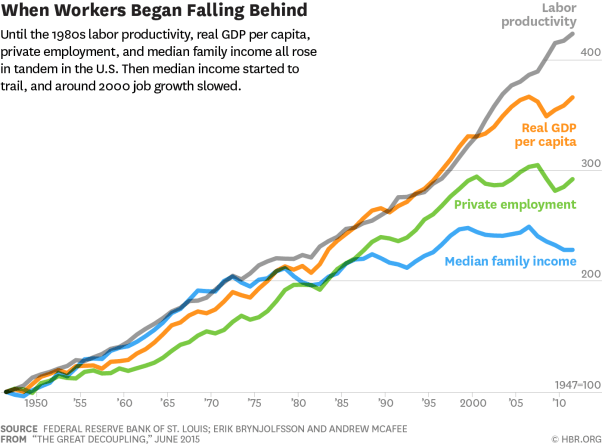
Tooze is right to argue that the accumulating evidence that the living standard of the median American is stagnating, or at least growing at a much slower rate than it did in the long boom following 1945. He is also probably correct to link this phenomenon to rising inequality and to the post-1980 decoupling of median incomes and productivity growth (see image below, which is taken from the June 2015 issue of the HBR). I agree with Tooze that figuring out how to start increasing median living standards in the US and other advanced economies is a central challenge facing our generation.

r1506d_mcafee_whenworkersfallbehind


I do not, however, agree that stagnating US living standards is a policy issue of such overwhelming importance that all other US policy discussions– ranging for marijuana legalization to police brutality towards Blacks to climate change to refugee policy should stop. Even during the Second World War, when Britain faced an existential threat, discussions of non-war policy questions continued– the famous Butler Act was passed in 1944, reshaping the education system. Is it really the case that stagnating living standards are such an emergency issue that all other policy questions should be put on the backburner until it is resolved by the leadership of the US? It is indeed unfortunate that the growth of living standards has, by many metrics, slowed down.  However, I would reject the view that it is a show-stopper that requires us to stop talking about all other issues.  Particularly when viewed from the standpoint of cosmopolitan prioritarianism, it is easy to see that stagnating median living standards in the US aren’t the worst problem in the world. I would say that malnutrition in sub-Saharan Africa is actually a worse problem.


Brexit Terminology: a New Language?

9 02 2017

bbc-tweet-i


How Business-Historical Research Can be Useful in Thinking About the Future of the AoM in the Age of Trump

7 02 2017
I’m a member of the Academy of Management,   a US-based organization that has been convulsed in the last week by an emotional debate about how the organization ought to respond to President Trump’s travel ban and the turn of events in the US (namely that an administration that is highly antagonistic to Muslim, Mexico, China, the European Union, etc). Since about half of the dues-paying members of the AoM work at non-US universities and some academics are talking about boycotting conferences in Trump’s United States, this issue is clearly important.
AoM members have been engaged in a lengthy debate about these matters on social media and on the AoM list-servs. Some members believe that the AoM’s upcoming conference, which is currently scheduled to take place in Atlanta, should be moved to Canada. Others think that the headquarters should be moved to Canada as well.
Here is my contribution to this list-serv debate. As you can see, I show how the research of my fellow business historians is useful in evaluating the view that the AoM’s interests would be best served by shifting its headquarters and events from the United States to a more neutral or at least welcoming country.  This email was written in response to a message from Prof. Andrew Maxwell, who works at a university in the Toronto area. (The AoM’s President is also based in Toronto).
Dear Professor Maxwell:

You make some interesting points about Toronto and Canada.

I see from social media that some people think that the AoM should relocate either its conference and/or its headquarters to Canada to hide the fact it is American.  Speaking as a historian of international business, I don’t know if that strategy would work. During and between the two world wars, some German firms incorporated in Switzerland and other neutral countries in an attempt to present themselves as non-German firms. This strategy worked for some but not all of these organizations.  In some cases, Western government officials saw through the ruse of incorporating in Zurich or Macau, as did some customers in those nations. (Consumers in that era were typically low information people).   I suspect that the many Middle Eastern and Chinese academics who currently pay to attend the AoM won’t be fooled if the mailing address is suddenly changed from Briarcliff Manor to Toronto.  They will realise that the AoM remains an essentially US organization, even if they membership fees are now billed in Canadian dollars and the website has a Canadian IP address. Whether that knowledge would change their willingness to pay to attend the AoM is something I don’t know. I suppose it depends on the extent to which they feel that the attitudes of the current US administration towards Muslims, Mexicans, China, etc reflect those of the US population.

The following pieces of business-historical scholarship may or may not provide useful lessons for the AoM leadership at this time.

Casson, M., & da Silva Lopes, T. (2013). Foreign direct investment in high-risk environments: an historical perspective. Business History, 55(3), 375-404.

Jones, G., & Lubinski, C. (2012). Managing Political Risk in Global Business: Beiersdorf 1914–1990. Enterprise and Society, 13(01), 85-119.

Smith, A. (2016). A LBV perspective on political risk management in a multinational bank during the First World War. Multinational Business Review, 24(1), 25-46.
Andrew

Regards,

Andrew Smith


Junk Social Science, Junk History, and the Quebec Mosque Shooting

5 02 2017

1920px-79_-_quc3a9bec_-_juin_2009

Image of Quebec City by Martin St-Amant.

Canadians were stunned by the news that a gunman with far-right sympathies had gone into a Quebec City mosque and murdered six worshipers. Ever since then, pundits have been trying to make sense of the tragedy. In a few cases, they have blamed Quebec nationalism, which is represented as ethno-nationalist and chauvinist. Overlooking the fact that Quebec nationalism comes in both a narrow ethnic variant and a more inclusive “civic nationalist” one, they have created a narrative arc that links the killer to the recently proposedCharte des valeurs québécoises, to Parizeau’s “money and the ethnic vote”, and all the way back to the right-wing clerico-nationalism popular with Lionel Groulx and certain other Quebec intellectuals in the 1930s and 1940s. English-speaking Canadians love talking about that dark moment in Quebec history, which is one of the reasons they were so receptive to Esther Delisle’s controversial 1992 book The Traitor and the Jew.

J.J. McCullough of Vancouver presented this line of reasoning in a piece about the shooting in the Washington Post, where he spoke of Quebec’s dark history of anti-Semitism, religious bigotry and pro-fascist sentiment, facts which are rarely included in otherwise self-flagellating official narratives of Canadian history. They complain about the exaggerated deference the province gets from Ottawa as a “distinct society” and “nation-within-a-nation,” and its various French-supremacist language and assimilation laws, which they blame for creating a place that’s inhospitable, arrogant and, yes, noticeably more racist than the Canadian norm. Writing for a domestic Canadian audience on the CBC website, Amina Moustaqim-Barrette declared that Québécois nationalism has always been an ethnic, as opposed to civic, nationalism — based in an ethno-cultural identity exclusive to descendants of French colonial settlers.


130910_m464q_ostentatoire-signes-interdits_sn635

Alexie Labelle and Florence Vallée-Dubois have published, in English, a very useful corrective to this view in Policy Options. I am glad that these two PhD students have challenged the junk social science that has surfaced during this dark time. Their piece is well worth reading and in congruent with the mounting evidence that the shooter was inspired by a foreign leader rather than by any Quebec or Canadian political leader. His classmates say that he adored Trump and Marine Le Pen.  Radio-Canada reports that on the eve of the attack, the killer was discussing Donald Trump’s anti-Muslim travel ban on Facebook. He wasn’t discussing Pauline Marois or the Charter of Quebec Values or Lionel Groulx or any other French Canadian individual or institution.


Larry Summers on Trump

4 02 2017

Larry Summers had joined the chorus of establishment figures who are ringing alarm bells about the current direction of travel in the United States. (Last week, David Frum, a former Bush speechwriter and lifelong Republican (!), published an essay in which he charged that Donald Trump is taking the United States in the direction of becoming an authoritarian ‘managed democracy’ along the lines of Erdogan’s Turkey or Putin’s Russia).  Larry Summers, erstwhile Secretary of the Treasury and President of Harvard, is calling on business leaders to resist Trump. I struck/shocked by the historical analogy that was used in the Harvard Business Review’s interview with Summers.

Interviewer:  You’ve mentioned, a couple times, parallels with 1930s Europe. How far would you take the parallel at this point?

Summers: If history teaches us anything, it is that authoritarianism is best combated at early stages rather than late stages. I’m not saying that I think that American democracy is somehow lost…But the resilience of American institutions isn’t something that happens automatically. It’s something that happens because people see dangers and take steps. So I think one can learn from the most extreme instances about the kinds of moral ideas that are important…

Note that Summers is carefully distancing himself from the more hysterical online voices that are talking about Reichstag Fires and possible coups. However, he isn’t dismissing out of hand the suggestion that there are  parallels between Trump’s election and the rise of dictators in the interwar period.

In the days immediately after Trump’s inauguration, Summers was using a very different historical analogy, the election of Herbert Hoover in 1928. You can see Summers using this historical analogy in an interview uploaded to YouTube on 30 January. Hoover’s election was followed by a “sugar rush” surge in share prices that was unsupported by the developments in the real economy. By using this analogy, Summers was lending credence to both the idea that Trump will be a bungler who ruins the economy and to Robert Shiller’s view the recent increase in share prices is not justified by the fundamentals.

In the HBC interview, Summers and his interlocutor are using a far darker historical analogy. Instead of comparing Trump to Hoover the bungler, Summers is comparing him to a dictator. Other centre-left and centre-right commentators in the US have used similar language to describe Trump.

To my mind, the most interesting thing said by Summers is about the impact of “short-termism” on the willingness of US CEOs to speak truth to power by joining the resistance to Trump. A great deal has been written about short-termism and quarterly capitalism, the tendency of the current generation of business leaders to have limited time horizons that contrast with the longer-term orientation that was likely common in US business a generation or two ago. (In my view, the long-term orientation of many US CEOs in the 1950s and 1960s was due to the influence of the philosophy of corporate governance promoted by Berle and Means in an influential book published in 1933–see here for a more detailed explanation).

Summers: But if you’re going to talk about your civic responsibility, as many business leaders do, if you’re going to talk about long-termism, as almost all business leaders do these days, what could be a more important long-term issue for American business than American leadership in the world? And I haven’t seen business leaders speaking out against protectionism in public. It’s very clear that, in private, many of them are deeply troubled by the signs that we’re moving in a protectionist direction.

Summers is right that there has been a lot of rhetoric from business leaders recently about the need to escaped from the curse of short-term thinking. Yes, business leaders in Davos and elsewhere have given renewed attention to the social, geopolitical, and cultural foundations of the business ecosystems in which they operate.  However, I’m not convinced that there has been a genuine shift in thinking towards the long-term, civic orientation that Summers favours. It is true that some business leaders have heroically spoken out against Trump. There may be a larger number of CEOs who are willing to say, in private, the Trump’s actions threaten the business ecosystem in which they have prospered. I suspect that  most business leaders will be like the CEO of Uber— they won’t distance themselves from Trump until their real-time data analytics suggest that consumers are starting to boycott their products. (This CEO resigned from Trump’s economic council after the #DeleteUber protest started getting rolling).

Bottom line: I’m not convinced US CEOs will stand up to Trump and unless they are prompted to by consumer pressure. Historically, CEOs have behaved generally adopted an unheroic stance during takeovers of democratic regimes. Only one or two of the oligarchs in Russia protested Putin’s efforts to construct an autocracy there. Ditto for Italy in the 1920s.  Moreover, the short-term orientation of my most US  CEOs means that they are especially unlikely to speak publicly against Trump, regardless of what they might say to Larry Summers in private. Impatient capital and the US system of corporate governance means that the CEOs of public companies aren’t really free to speak up in defence of Statue of Liberty values.


Location, Location, Location

2 02 2017

I’m sometimes a bit frustrated by my fellow business and economic historians. There is tremendous pent-up demand for our services from private industry: CEOs and other decision-makers recognize the value of our research in understanding such complex phenomena as political risk. However, whenever there is a crisis that illustrates the limitations of research methods of the more successful academic disciplines (by successful, I mean capable to capturing societal resources), we historians squander the opportunity to take advantage of a brief window of opportunity. In 2008-9, there was a lot of talk about business historians displacing the economists, getting our research in the limelight by showing its relevance.  A few business historians, most notable the excellent Bloomberg columnist Stephen Mihm have risen to the occasion but most have not been able to engage with decision-makers and the general public.

Sometimes something as simple as a poor location decision can get in the way of allowing smart academics to speak to smart people in the private sector. Here is a case in point. The British Academy of Management (BAM) is organizing an event called Managing political risk and uncertainty from historical perspective. They have some great speakers and the event is timely for all sorts of geopolitical reasons.

Where is this wonderful event taking place? Will it be held in BAM’s offices on Euston Road in London, which are a few underground stops from the financial district? Is it instead being held a prestigious business school whose alumni network includes people who make firm strategy? It is being held in the evening to allow busy business people to attend after the workday? No, instead it will be held in the city of Coventry in a facility that is a 25-minute walk from the railway station and which is surrounded by a vast, windswept carpark. Coventry University’s London campus, which is in the financial district, would have been a far, far better choice. There simply aren’t a lot of business decision-makers in Coventry.

Anyway, here is a description of the event. Full details are available via BAM.

I wish the organizers of this event the best of luck, but the location is wrong, wrong, wrong!

We are delighted to announce the upcoming Joint BAM SIG Event Managing political risk and uncertainty from historical perspective, taking place on the 27th February 2017 from 10.00 to 17.00 at Coventry University Technology Park.

Description:

In a climate of increased political volatility, this workshop will examine organisational responses to political risk and uncertainty over time. It will explore the development of theoretical and methodological approaches to analysing non-market strategy and the management of political risk, specifically focusing on how history has been used. The workshop aims to generate discussion around the contribution to be made by history to the scholarship in this field.

Invited Speakers

Prof Steven McGuire, School of Business, Management and Economics, University of Sussex

Prof Thomas Lawton, Open University Business School

Prof Emeritus Michael Moran, School of Government, University of Manchester

Prof Neil Rollings, Economic and Social History, University of Glasgow


Never Let a Crisis Go to Waste

1 02 2017

Readers who work in business schools will likely be aware that the (American) Academy of Management is in something of a crisis because of Trump’s famous travel restrictions. I see from social media that many non-US academics, including some big names with tonnes of citations in Google Scholar, have announced their intention to boycott the 2017 meeting in Atlanta.

In this context, I was interested/amused to see how a Canadian organization of business school professors has been trying to leverage the situation to attract people to its own, less-prestigious conference. I am reposting an email I got a few minutes ago with the key sentence in bold.

——————————–

The International Business (IB) division of the of the Administrative Sciences Association of Canada (ASAC) invites you to submit a contribution for its 45th annual conference held by HEC Montreal on May 29 – June 1, 2017
 
The conference theme: “Digital Economies and Cities” highlights the growing importance of technology and information exchanges between community stakeholders including governments, enterprises, and citizens. ASAC’s IB division welcomes submissions on this theme or on any other topic relevant to the division.
 
The submission deadline is 12:00 noon Eastern Standard Time on February 17, 2017.
 
Confirmed Division Speakers includes Professor Henry Mintzberg (http://www.mintzberg.org/). 
 
Montréal’s 375th anniversary presents an excellent opportunity to create a unique atmosphere for the 2017 ASAC Conference. Montréal is a fascinating city, a bold and complex mix of contrasts built on a legacy of heritage and culture with a European flair. Montréal is a cultural metropolis with over 20 classic museums, many theatres and countless performance halls to suit every taste, from fine arts to history to humor and sport enthusiasts. 
 
2017 also sees Canada celebrate its 150th anniversary. There are many celebrations and festivities across the country including free admission to Parks Canada throughout 2017. Canada is also named the Best Travel Destination for 2017 by Lonely Planet. On top of this, Canada is multicultural society and believes “diversity is Canada’s strength”. #WelcomeToCanada
 
 
For the complete CfP for all divisions, please refer to http://www.asac.ca/asac2017confcallforpapers
 
If you have any question regarding to the CfP, please feel free to contact any of the IB Division officers:
 
Editor:             Sophie Veilleux (sophie.veilleux@fsa.ulaval.ca)  Université Laval (Canada)
Coordinator:   Gui Azevedo (gazevedo@audencia.com) Audencia Business School (France)           
Chair:              Pao T. Kao (pao.kao@fek.uu.se) Uppsala University (Sweden) )


The Price of Principles

30 01 2017

boycottapartheid

The last few days have seen extensive online discussions of Trump’s Muslim ban. There have been verbal denunciations by the leaders of most democracies (the UK being the obvious exception) and lots of virtue signalling by private citizens on social media. Talk is cheap though.

I think that the willingness of Western governments to oppose what Trump is doing will depend mainly on their assessment of how far their electorates are willing to pay to do so. If people say, “I am willing to accept a lower standard of living” as the price of doing the right thing in the letters to their parliamentarians, the government may be slightly more resolute. If people signal through action such as consumer boycotts that they really care about this issue, the government will notice. Talk is cheap, but boycotting Esso products and refusing to visit the US until the ban is repealed shows that one is serious.

To be brutally honest, I’m not certain how much I am willing to pay to oppose Trump’s policies. I’ve decided that I will no longer to fuel up at stations owned by ExxonMobil, since Secretary of State Rex Tillerson (who owns $245m in ExxonMobil shares) hasn’t denounced Trump’s policy. However, that’s not much of a sacrifice since there are plenty of non-Esso petrol stations where I live and the Esso station isn’t even the closest one to my house. The price per litre is basically the same. Beyond that, I’m not certain how far I am willing to go.

I would probably oppose any action by the UK government that had enough of an impact on UK government revenue as to impair its ability to subsidize the university sector, where I work. I suppose I have the luxury of favouring the adoption of the moral high ground by the UK government because I don’t work for a company that exports to the US.

I’m going to go on paying membership dues to the Academy of Management, a US organization that has remained silent on Trump’s Muslim ban, because being a member of this organization is essential to my career.  I’m still going to attend the Business History Conference in Denver in late March, since I know the members of that organization HATE what Trump is doing. I’ll try to avoid spending more than in necessary when I am there though. 

I was thinking about these moral issues when I went for my run today and I’m guessing that my willingness to oppose Trump’s Islamophobia extends to about £100 per year or so– that’s a very rough estimate and I arrived at that (arbitrary) figure through no particular methodology. The number just sounds right.

I’m wondering what Chris Blattman and others who think about the economics of effective altruism have to say about this issue. I would appreciate their advice.


Update: I wrote yesterday that the American Academy of Management had remained silent on the issue of Trump’s Muslim ban. A few minutes ago, Academy of Management sent out the following message from its President, who teaches in Canada.

Dear Friends and Colleagues in the Academy of Management:
I’m writing to you today as President of the AOM in the wake of the Executive Order signed by President Trump to suspend entry into the United States of citizens from Iran, Iraq, Libya, Somalia, Sudan, Syria, and Yemen.

Thank you to those who have written to me and to other officers about the new restrictions on travel and their implications for AOM. Thanks as well to those of you who have posted on listservs and social media. The scores of messages that I have read reflect the diversity of our 20,000 members, and of the political, social and cultural traditions of the 127 nations where we live and work. Our members hold a range of views on the public policies that have recently been implemented. Many of you have expressed concern about travel to the Annual Meeting in Atlanta; many are interpreting the Executive Order as a direct attack on scholarship; and some are worried about the implication for pluralism on all sides of this issue. A number of you have asked the AOM to condemn the order as antithetical to scholarly values, academic freedom, and democratic processes. Yet because of our very diversity, the AOM has long had a binding policy that restricts any officer from taking a stand on any political issue in the name of the AOM.

I can affirm as President that the AOM stands behinds its vision, mission, objectives, and core values. The AOM fervently values all its members. We are committed to inclusion, supportive communities, and social and academic freedom as fundamental and undeniable tenets of scholarly association. Our values emphasize the full diversity of member backgrounds and experiences. The AOM Statement of Values expresses that “We respect each of our members’ voices and seek to amplify their ideas.” To enact our values, we are taking initiatives on several fronts. First, the AOM is suspending the requirement of attendance as a condition of inclusion in the program at the Annual Meeting for those affected by the travel restrictions. All scholars whose work is accepted to the conference but are not able to enter the United States from travel-restricted countries will have access to sessions in which they are presenting through virtual means. Second, we will also share with you, via our website, the best information that we have about Visa application processes for those who want to attend. We encourage any member from the affected countries who wishes to attend but cannot because of travel restrictions to contact us so that we can work with you toward participation.

Our mission is “To build a vibrant and supportive community of scholars by markedly expanding opportunities to connect and explore ideas.” To fulfill this mission, the AOM will soon hold specialized conferences outside the United States on topics proposed by and of interest to members. Please see our website for information on this initiative. I invite you to submit a proposal if you are interested in leading one. We also will continue working with our affiliates and associates around the world who convene meetings in support of management scholarship and teaching.

The vision of the AOM is to inspire and enable a better world through our scholarship and teaching about management and organizations. I encourage AOM members to double down on the scholarly agenda. Let us be more engaged, creative, and committed to scholarship and teaching on the issues of our day. Let us stand together in Atlanta in solidarity with our diverse membership as the world’s premiere association of management scholars and business-school professors. Academic integrity is our strength. Through our scholarly discussions and debate, we can find a way forward together. This is the AOM’s purpose and this cannot and will not change.
Sincerely,

Anita M. McGahan
President
Academy of Management


The Use and Abuse of History: Why the 1940s Remain the Go-To Decade of Choice for Western Political Actors

30 01 2017

I’ve been fascinated to see how the past has been used (and abused) by political actors in the Age of Trump. I suspect that this fascination is shared by many use-of-the-past/social memory scholars. History has been used by both Mr. Trump and his allies and his opponents: Trump’s supporters in the US and the hard, pro-US right in the UK were pleased when Trump restored a bust of Winston Churchill to the Oval Office. (The fact that Churchill supported British membership in a United States of Europe was conveniently ignored). As I showed a few days ago, there were many historical references in the first wave of anti-Trump marches, which were led by women. While some of these historical references related to earlier periods of history (such as the struggle for women’s suffrage in the 1910s) many have focused on the years surrounding the Second World War. Consider how the memory of this period is being used:

  1. Churchill’s bust is in the White House because of his wartime leadership, not because of anything he did before or later
  2. Theresa May’s appeasement of Trump has been associated, via Photoshop, with the policies of Neville Chamberlain in the #TheresaAppeaser meme
  3. Sales of 1984, a book written  in the 1940s, surged in the days following the Trump administration’s open admission that it was embracing alternative facts.
  4. The US policies towards Jewish refugees in the late 1930s has been invoked frequently in the wake of Trump’s refugee policy


screenshot-from-2017-01-29-13-03-47

Why does the Second World War continue to loom large in the historical consciousness of the West? Partly it is because this period is objectively important– at least as measured by the body count. Partly it is because references to it are omnipresent in Hollywood films and popular culture more generally, so people have a common frame of reference. Moreover, the conflict is universally regarded as a “just war” by political actors in the English-speaking countries. That shapes how its memory is used.

It’s important to note, however, that neither the Second World War nor the Holocaust dominate the historical memories of people outside of the North Atlantic countries, as the late Peter Novick observed. In much of the rest of the world, the 1940s are not the go-to decade for historical sensemaking. I suspect that observers from East Asia who are unfamiliar with Western historical culture would be mystified by the frequency with which Western political actors mention the war.


Funded PhD Studentship in Economic History: Financial diversification before modern portfolio theory

27 01 2017

AS: The Open University has funding to support a PhD student who is interested in working on financial diversification before modern portfolio theory. The funding package covers tuition fees, a generous research training support grant and a stipend (circa £14,296 per annum) for 36 months, which is long enough to complete a PhD in the UK system. Looks like a great project!


Supervisors: Prof Janette Rutterford, Dr Dimitris P. Sotiropoulos and Mr Daniele Tori (Department for Accounting and Finance, The Open University Business School)


Project description: This project aims to investigate aspects of financial innovation in the UK during the last quarter of the 19th and the first quarter of the 20th century. Its main focus will be risk management in the context of financial diversification. The period roughly between the 1870s up to WWI is considered in the recent literature as the first wave of economic globalization, with the introduction of critical financial innovations on both sides of the Atlantic. From the 1870s, different economies gradually adopted the gold standard, while London served as the global financial centre. Developed capitalist economies experienced the rise of stock exchange securitization and the separation between ownership and control (the so-called ‘managerial revolution’) along with other important financial innovations. These developments were accompanied by high levels of income inequality and financial instability; the first globalization era thus has similarities to the contemporary financialised capitalist world. Its study will not only deepen understanding of an important era in the development of capitalism, but will also offer alternative ways to consider the historical and institutional roots of investor behaviour, financial innovation, and their fragile coupling, i.e. financial instability. Applications should demonstrate an interest in developing both a theoretical and empirical contribution, together with an insight into previous engagement with these issues. Successful applicants will use and build on existing datasets on financial portfolio holdings of individuals and of institutional investors, as well as collect relevant market data. They will also join a growing and vibrant group of PhD students in the Open University Business School.

The deadline for applications is midday GMT on Thursday 30 March 2017. Application must include the following:

  • a 1000 word proposal which indicates your knowledge of the literature, methods and likely approach to your project of interest
  • a covering letter indicating your suitability for the project
  • a completed application form
  • certificates with transcripts, if possible, confirming your professional qualifications relevant to your application

More information about the application process can be found here:

http://business-school.open.ac.uk/research/research-degrees/phd-studentships


Further queries can be addressed to:

Dr. Dimitris P. Sotiropoulos: dimitris.sotiropoulos@open.ac.uk

Prof. Janette Rutterford: Janette.Rutterford@open.ac.uk