Important New VoxEU Book

26 01 2017

The Long Economic and Political Shadow of History, Volume 1
Stelios Michalopoulos, Elias Papaioannou (published 23 January 2017)

Full book can be downloaded here.

This new book is the first in a series of three examining the shadow that history casts over various aspects of the economy and the polity. In particular this volume summarizes some influential works from this vibrant new research agenda and discusses the impact they have on our understanding of the long-run influence of historical events on current economics.

Foreword

Series Introduction: Historical legacies and contemporary development
Stelios Michalopoulos and Elias Papaioannou

Volume I Introduction: A global view
Stelios Michalopoulos and Elias Papaioannou

On the spatial distribution of development. The roles of nature and history
Vernon Henderson, Tim Squires, Adam Storeygard, David Weil

Deep roots of comparative development
Quamrul H. Ashraf and Oded Galor

Barriers to the spread of prosperity
Enrico Spolaore and Romain Wacziarg

Environmental economic history
James Fenske and Namrata Kala

The persistence of technological creativity and the Great Enrichment: Reflections on the “Rise of Europe” .
Joel Mokyr

The economic impact of colonialism
Daron Acemoglu and James A. Robinson

Legal origins
Rafael La Porta, Florencio Lopez-de-Silanes, Andrei Shleifer,and Robert Vishny

The European origins of economic development
William Easterly and Ross Levine

On the long-run effects of colonial legacies. Evidence from small islands
James Feyrer and Bruce Sacerdote

Maritime technology, trade, and economic development. evidence from the first era of trade globalisation
Luigi Pascali


Funded PhD Research: the History and Contemporary Experience of Female Entrepreneurship in West Africa

26 01 2017

Female entrepreneurship in West Africa
ESRC DTP Joint Studentship in the Midlands Graduate School
Aston University and University of Birmingham
The Midlands Graduate School is an accredited Economic and Social Research Council (ESRC) Doctoral Training Partnership (DTP), with the first intake of students to begin in October 2017. It is now inviting applications for an ESRC Doctoral Joint Studentship between Aston University (where the student will be registered) and the University of Birmingham to commence in October 2017.
Contemporary research such as the Global Entrepreneurship Monitor (GEM) shows that female entrepreneurship is more common in Africa than in the rest of the world. This is particularly true of West Africa, which has higher rates of female entrepreneurship than the rest of Africa. Historical research shows that this has a long tradition, with women having been perhaps even more dominant as entrepreneurs before colonialism.
This doctoral research project aims to establish both historical and contemporary reasons for the greater prevalence of female entrepreneurship in West Africa. It is important to understand this because a) entrepreneurship is an important driver of economic growth and job creation, and b) gender has been recognized as an important factor in driving social development, inclusive growth and intergenerational progress. However, high levels of entrepreneurial activity can also be an indicator of poverty and inequality. This doctoral research project should identify the complex reasons behind the predominance of women in West African entrepreneurship.
Research questions:

– Why do women in West Africa chose to become entrepreneurs more commonly than in other areas of the world?

– What drives these choices: necessity, cultural attitudes, lack of alternative opportunities, historical tradition, gender stereotypes?

The student to be recruited to this project would develop these research questions further in line with her/his expertise and interest. The exact choice of case context (country / region) would be a matter of negotiation with the student researcher. Applicants who are invited for interview will be ask to indicate the direction in which they would like to take this project, and how they would develop the topic.

Application Process

To be considered for this PhD, please complete the Joint Studentship application form available online here, together with a cover letter and a CV and along with two references email this to e.bridges@aston.ac.uk.

Application deadline: Wednesday 15 February 2017

Interviews will be held Tuesday 7 March 2017 at Aston Business School

Midlands Graduate School ESRC DTP

Our ESRC studentships cover fees and maintenance stipend and extensive support for research training, as well as research activity support grants.


This award is available to people who are ordinarily resident in the UK. That means that if you are a British citizen who has been living in another country you cannot apply. International students are not eligible to apply for funding from the Midlands Graduate School ESRC DTP.

Informal enquiries about the research or Aston Business School prior to application can be directed to Professor Stephanie Decker.
For more information on how to apply, please go to the Midlands Graduate School:


Peace, Trade, and Canadian Foreign Policy in the Age of Trump

24 01 2017

OLYMPUS DIGITAL CAMERA

On Monday, Donald Trump  signed an executive order that announces his intention to pull the United States out of NAFTA. Coincidentally, Policy Options, the flagship journal of Montreal’s respected Institute for Research on Public Policy, published a piece I wrote that uses history to think about how Canadian policymakers can use trade policy to help build a more peaceful world. The piece, which draws on some of my published research, should interest people interested in capitalist peace theory, Business & Peace, and the future of Canadian foreign policy in the Age of Trumpism.

As long-time readers of this blog know, I am convinced that trade is crucial to building peaceful relations between nations, civilizations, and religious communities. To symbolize this process, I have a picture of a Tim Horton’s coffee shop in Dubai. (Tim Horton’s is an iconic Canadian brand that is currently expanding into the Middle East). Image courtesy of “sandyindubai.”


A Festschrift for Leslie Hannah: Workshop for a special issue of Business History

24 01 2017

A Festschrift for Leslie Hannah: Workshop for a special issue of Business History


March 10th –11th 2017


This workshop will present and discuss contributions to a special issue of Business History that will be a festschrift to honour the career of Professor Leslie Hannah. The sessions will be in Room G15, Henley Business School (central Reading campus). Attendance is free, though attendees are required to register before 6th March 2017 here. The web-link also provides further details on the conference events, venues, etc.


We gratefully acknowledge financial support for this event from the Economic History Society Initiatives and Conferences Fund, and from Henley Business School.


Agenda

Friday March 10th


1.00 pm (tea and coffee available in conference venue).


1.30 Introduction by the editors


2.00-3.00 Competition and the shaping of technological expectations for the power

source of the motor car 1895-1904, James Foreman-Peck, Cardiff Business School


3.00-3.20 (coffee break)


3.20-4.20 Contractual Flexibility within the Common Law:  The Legal Regulation of

Corporations in Britain versus the United States,  Ron Harris, Tel Aviv University,

and Naomi R. Lamoreaux, Yale University and NBER


4.20-5.20 The Concept of the Corporation, John Kay, St. John’s College, Oxford


5.20-5.45 General discussion


6.00-7.30 Woolworths Archive launch event, Museum of English Rural Life, Reading


7.45 Dinner (Reading town centre)


Saturday March 11th


9-10 am Hannah on Hollywood History, Daniel Raff, The Wharton School and NBER


10-11 am Diversification in the UK pre 1914:Evidence from individual investor

portfolios, Janette Rutterford, Open University Business School and Dimitris

  1. Sotiropoulos, Open University Business School


11.00 – 11.20 Coffee Break


11.20-12.20 Reforming the structure of direct taxation: the political and administrative

response to the Meade Report (1978), Martin Chick, University of Edinburgh


12.20 – 1.30 LUNCH


1.30-2.30 Rationalisation and amalgamation in the corporate economy: The Industrial

Reorganisation Corporation and the rationalisation of British electrical and

telecommunications equipment manufacturing Roy Edwards, Southampton

Business School, and Anthony Gandy, London Institute of Banking and Finance


2.30-2.45 Coffee Break


2.45 – 4.00 pm Discussion of the editor’s introduction to the special issue and the paper on Taxes and Industrial Structure by Peter Temin, MIT


4.00 pm Workshop ends


The Uses of History and the Anti-Trump Protests

22 01 2017

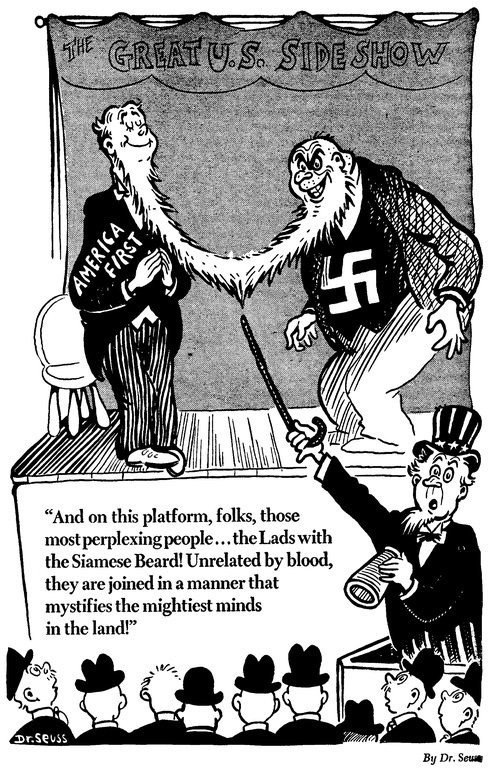
Yesterday, there were protests around the world against the new US President. (As a non-American, I’ve leave aside the issue of whether it is tactically wise to protest a president before he has implemented any policies, an issue that has been debated by Trump’s opponents). What’s interesting to me is the ways in which the past is being used to mobilize supporters and and create historical narratives that link Trump to both the opponents of votes for women and the anti-Semitic America First movement of the early 1940s. For instance, some of Trump’s enemies have been circulating a 1941 Dr Seuss cartoon about America First, while others have been dressing as 1910s suffragettes.  (Luckily Trump doesn’t own any racehorses).

xq-ekwtajqw-uwg_ivn04mcorznin7eefci8r4yhwre


women-protest


Assorted Links

18 01 2017
  1. Theresa May announces her intention to go for “hard Brexit” or “clean Brexit” — exiting the EU without complicated special arrangements, no Norway-style status, nothing but trade on WTO terms. One reading of the situation is that this reflects the victory of the Hard Brexit faction in the Conservative Party. Another is that the British state simply lacks the administrative capacity and human capital needed to negotiate a complicated soft Brexit without two years. Given that the government that is charged with handling Brexit lacked offices (!) until recently, held meetings in Starbucks, and is finding it difficult/impossible to recruit decent staff, I would say that state capacity is a key limiting factor here.
  2. Donald Trump is about to be inaugurated. Many American critics of Trump are fond of referencing Rome’s transition from Republic to Empire. Americans have long analogized their country’s experience with the totally dissimilar society of Ancient Rome, a habit of thought that probably has legitimacy because of the architectural style of the US capitol. Anyway, for those of you who are interested in the use and abuse of historical analogies taken from classical antiquity, it is worth checking out the blog of Professor Neville Morley, who writes about these things. Morley has noted that the “wretched” Thucydides Trap historical analogy recently cropped up in a discussion of Sino-American relations on Newsnight. Check out Morley’s amusing Twitter account: The Thucydiocy Bot ‏@Thucydiocy
  3. Trump’s apparent support for Brexit has revived 2003-era talk about the Anglosphere and the dreams of sort of union between the White, English-speaking countries. [Somehow, wealthy, English-speaking Singapore is rarely or never mentioned in the Anglosphere imagined by British Conservatives and Anglophile Americans. Neither is India or the other Commonwealth countries of the wrong sort]. The understand the historical roots of the perennial Anglosphere concept, see A Genealogy of a Racialized Identity in International Relations  by Professor Srdjan Vucetic of the University of Ottawa.
  4. Over in Davos, the World Economic Forum is continuing to make vigorous use of another historical analogy in its sessions on the Fourth Industrial Revolution. Public officials can learn all about the five skills they will need to survive the Fourth Industrial Revolution.
  5. The UK Foreign Secretary is using historical analogies taken from the film The Great Escape, which is about Anglo-American POWs escaping from a German camp. He did so in the course of discussing Britain’s “escape” from the evil, German-dominated European Union.
  6. Moldova appears to be turning away from the EU and towards Russia by joining a Russian-led trade bloc. Putin’s game plan appears to be going well– the EU contracting rather than expanding, Trump about to move into the White House, NATO’s core principles under attack.


Social Science in the Age of Trump: a Syllabus

18 01 2017

Dan Hirschman has published a great reading list that allows one to use social-scientific research to make sense of Donald Trump’s victory. To Dan’s list I would add Ken Lipartito’s excellent scholarly blog “An Economic History of Trumpism.”


“The Modern Corporation and Private Property by Berle and Means: the Martial Roots of a Stakeholder Model of Corporate Governance”

17 01 2017

AS: I’m going to be presenting this paper at Cass Business School in London on Thursday.

ABSTRACT: Our paper explores how a seminal text influenced corporate governance systems in the United States and abroad. The Modern Corporation and Private Property by Adolf Berle and Gardiner Means (1932) remains one of the most cited works in management. Unfortunately, the radical political vision that informed this book has been ignored or forgotten by the vast majority of management academics who now cite this book. Our paper shows that Berle and Means espoused a stakeholder theory of corporate governance that challenged the idea that the sole purpose of a corporation is to create value for the shareholders. Whereas shareholder value ideology was dominant in the United States in the 1920s, the nation’s corporate governance system moved towards a stakeholder model during the New Deal. We argue that the influential text by Berle and Means contributed to this shift. Our paper, which is based on archival research in the Franklin Delano Roosevelt Presidential Library, explores the cultural shifts that shaped how US companies have historically defined success, treated their workers, and influenced inequality in society. Our paper examines why Berle and Means choose to present a stakeholder theory of corporate governance in this text, which was written between 1928 and 1931. The paper then discusses the reception of the ideas of Berle and Means and documents how their theory came to influence how many US corporations allocated resources among different stakeholders. We suggest, somewhat tentatively, that the ideas of Berle and Means prompted corporate managers to behave in ways that contributed to the relatively low levels of income inequality that prevailed in the United States between the New Deal and approximately 1980. The paper documents how political cultural shifts in the 1970s undermined the popularity of the idea of Berle and Means and promoted a revival of shareholder value ideology. In advancing our explanation for the rise and fall the Berle-Means variant of stakeholder theory, we relate their ideas to United States cultural, political, and military history. We suggest that the same cultural shifts that contributed to the re-emergence of shareholder value ideology in the 1970s were connected to the end of military conscription and the transition to the All-Volunteer Force advocated by Milton Friedman and other economic liberals.

Andrew Smith, University of Liverpool Management School; Jason Russell, Empire State College; Kevin Tennent, University of York Management School. Draft. Please do not quote or cite this draft of the paper without permission. Contact author: adasmith@liverpool.ac.uk

Keywords: corporate governance;  management history;  stakeholder orientation


Deadline Extension: Association of Business Historians Conference

13 01 2017

Note that the deadline has been extended from 15 to 20 January.

‘The Human Factor in Business History’

University of Glasgow, 29 June – 1 July 2017

Call for Papers

Understanding the strategy and structure of firms forms a vital part of the discipline of business history, as does the deployment of essential tools such as typologies of company forms, theories of the firm and firm growth and so on. But it is vital, too, for business historians to recognise and investigate those who stand at the heart of business history: the people who create firms, those who own them and those who work for them in various capacities (whether in head offices, in back offices or on the shop floor) to enable companies to function effectively (or, alternatively, passably or dysfunctionally). It is, after all, people who develop and deploy the skills, relationships and capabilities to allow all of this to happen. Just as important, though, is the human impact of the firm and other organisations that employ people, not least

because even today those employed spend a very large proportion of their time in the workplace. Indeed, they are usually engaged for more time there than in any other activity with the exception of sleeping. The firm is therefore a place not only for work, which itself involves considerable human interaction, but also a focus for social life and identity.


The theme of the 2017 ABH conference is ‘The human factor in business history’.

Proposals for individual papers or for full sessions, panel discussions or other session formats are invited on this topic, broadly conceived. Specific topics might

include, but are not limited to:


 Entrepreneurs, managers and/or workers

 Leadership in business

 Biographical and prosopographical approaches to business history

 Networks and hierarchies in business as social systems

 Cross-cultural issues in business and management

 The impact of automation and technology on human interaction in the

workplace

 Industrial relations and human resource management

 Gender roles and relations in the workplace

 The human bases of company behaviour and misbehaviour

 The human factor in SMEs, family enterprise, corporations and/or MNEs

 Local, regional, national and transnational networks and business

 The workplace as a community and focus for identity

 Business and social movements

 The impact of work and production on humans and the physical environment

As always, the ABH also welcomes proposals that are not directly related to the

conference theme.


How to submit a paper or session proposal


The program committee will consider both individual papers and entire panels.

Individual paper proposals should include a one-page (up to 300 word) abstract and

one-page curriculum vitae (CV). Panel proposals should include a cover letter stating

the rationale for the panel and the name of its contact person; one-page (300 word)

abstract and author’s CV for each paper; and a list of preferred panel chairs and

commentators with contact information. The deadline for submissions is 15 January

2017.


Your application for the conference should come through our online submission

platform.


First you make a choice for uploading a single paper or a full-session. After pressing

each button you will find a mask guiding you through the upload process. Please

have available your CV and your Abstract. Any other idea regarding the conference

– workshops, poster sessions, or panel discussions – must be suggested directly to

the Programme Committee.


Funded PhD: History of the Consumer Goods Industry

12 01 2017


reading-picture


Reading’s Centre for International Business History (CIBH) welcomes applications for Ph.D study in all aspects of the history of consumer goods industries, including fast moving goods, clothing and fashion sectors, consumer durables, housing, and personal transport.
CIBH is able to consider applicants for fully-funded research studentships.
For further details, please contact Peter Scott (p.m.scott@reading.ac.uk).


Please note that unlike ESRC/AHRC PhD studentships, there are no restrictions on student by nationality. Students from all over the world are therefore able to apply!