EURAM Track of Interest to Historians of Corporate Governance
13 12 2016Comments : Leave a Comment »
Categories : Uncategorized
“Racial Peculiarities and National Characteristics”: American Exporters Assess Foreign Merchants in the Interwar Period (1919-1940)
12 12 2016
That’s the title of a paper Rowena Olegario recently presented to the American Capitalism Seminar at Johns Hopkins University. Rowena is starting the planning and team-building phase of a collaborative project on Race and Trust: A Global History of Trading with ‘the Other. If you feel that you have research interests and expertise that would be a good fit for the project, you should let her know.
Abstract
This paper examines how American businesses assessed potential buyers and trade partners in foreign countries, with particular attention to China and Japan, during the interwar period (1919 to 1940). The half-century after 1890 marked the United States’ ascent to economic and political power. In common with the countries of western Europe, Americans attempted to demarcate their country’s internal and external spaces based on notions of “racial” difference. Ethnology, biology, geography and other fields of study were enlisted to give legitimacy and universality to these ideas. Changing notions about race and ethnicity shaped debates about immigration and America’s new role in the world; they also influenced how manufacturers and exporters determined “whom to trust” as trade partners overseas.
Past scholarship has focused on the development of American foreign markets, but very few works have addressed how American businesses assessed foreign merchants. Examining trade journals, Congressional testimony, textbooks on foreign trade, and the voluminous contemporary writings on race and ethnicity, this paper probes some of the complex cultural assumptions that underlay the practices of international trade. The paper represents the first tentative steps of what I hope will be a collaborative project whose working title is “Race and Trust: A Global History of Trading with ‘the Other.’” My plan is to recruit scholars from every geographic region to examine how merchants assessed foreigners as trading partners and customers. Among the questions that will underpin the project are: How malleable were attitudes about foreign ‘others’? What effects did local and non-local events have on these attitudes? On what basis did merchants distinguish among different groups of foreigners, or subsets within racial groups? By going beyond the attitudes of westerners (“Orientalism” and its offshoots) to include non-western merchants from around the globe, and in different time periods, I hope to establish a firm historical grounding for the future study of this topic and contribute to the multidisciplinary literature on commercial trust.
Comments : Leave a Comment »
Categories : Uncategorized
The Study of the Uses of the Past: Why We Need Greater Clarity About When Historical Thinking Makes for Better Decisions
6 12 2016
I recently had the chance to pick up a copy of Hal Brands and Jeremi Suri, eds. The Power of the Past: History and Statecraft. Brookings Institution Press, 2015. This book is broadly similar in focus on The Uses and Abuses of History by Margaret MacMillan in that its looks at how political actors use history. It also has parallels with Alix Green‘s excellent ethnographic study of how history informs policymaking in the UK government.
As someone who is interested in how actors in the private sector use history, I recognize that I need to keep up to date with the literature on how the past is used by people in government. That’s because the political science literature on this subject is somewhat older and, in some respects, more sophisticated than the equivalent literature in management journals. There is now a cluster of academics in management schools who are interested in the uses of the past– some of them have attended a series of seminars run by Stephanie Decker of the UK’s Aston Business School (see here). The research presented at these seminars is good, but it is necessarily less developed than the stream of research in political science that can be traced back to such classics as Richard Neustadt’s Thinking In Time. Political scientists have been arguing about the uses of the past in full-length monographs since the 1980s and 1990s. It seems to me that Uses of the Past scholars in business schools and Uses of the Past scholars in politics and IR could benefit from talking to each other. I certainly believe that political scientists and diplomatic historians interested in the use of history could profit from reading the work in management on the use of analogy.
In their introductory essay, Hal Brands and Jeremi Suri write that
Examining the course of American statecraft over the last century, one cannot escape the conclusion that history— historical knowledge, insights, lessons, analogies, and narratives— permeates the ways in which the United States interacts with the world. From World War I to the Cold War to the war on terror, American officials have frequently drawn on their perceptions
and understandings of what came before as reference points in seeking to deal with the dilemmas of the here and now. EMPHASIS ADDED
The collection of essays edited by Brand and Suri spoke to me because while I often see history being used in a good way by decision makers, I have also observed enough poor uses of history in both the public and the private sectors to wonder whether we would all be better off if senior decision makers stopped try to apply lessons from history. This book captures this tension.
While I liked this book, I was some frustrated in that none of the authors even tried to give us a clear answer to the question of whether the widespread use of history by policymakers actually results in better policies. Is the usage of history a net positive or a net impediment to the making of better policy? The book doesn’t give a clear answer but it seems to echo Richard Neustadt’s view that thinking historical is generally a good thing.
The untested and largely unexamined nature of that assumption irks me. Consider what the book has to say about the use of historical analogy in decision-making. As Brands and Suri note, historical analogy is one part of thinking historically. There is a large body of literature in philosophy and strategic management about the circumstances in which analogic reasoning is helpful. In summarizing the contents of their edited collection, Brand and Suri write that historical “analogies do not always have a negative impact on policy debates; at times, they push decisionmakers in helpful directions that open new possibilities and protect against dead ends.” They note that a person could plausibly argue “that the Munich analogy actually served U.S. policymakers well in the case of the Korean War, for example, by encouraging the administration of President Harry S. Truman to combat a Soviet- backed assault on South Korea that, if successful, might have seriously destabilized the postwar environment. Brands’s paper shows that the Munich and Vietnam historical analogies— which were used frequently during the period before the 1991 Iraq War— influenced US strategy with results that Brands personally considers to have been good. (Readers will recall that the US and its allies liberated Kuwait but decided not to topple Saddam).
The reader is left wondering about whether the use of historical analogy is, in general, helpful. A clear or clear-ish answer to this question would give us some actionable information that would allow us to define the rules of the game for debating foreign policy. If it tuns out that historical analogy is a helpful heuristic in the making of foreign policy, we should encourage more of it. If it isn’t, we should seek to banish all historical analogies from our conversations about foreign policy issues. That would mean that whenever a speaker started to use a historical analogy, we would interrupt them and point out that “we no longer accept historical analogic reasoning around here, in light of the research by Professor X. Please support your position in another way.”
Is historical analogy helpful? Perhaps it would be impossible to answer this question because we don’t yet have a clear yardstick for judging the quality of decisions in foreign policy. In contrast, we do have consensus-based ways of measuring the quality of decision-making in other areas of life, most obviously in sport but also finance and some other sectors. To determine whether using historical analogy improves the making of policy would require a consensus definition of what good policy outcomes look like. That may be hard to achieve. However, as the Good Judgement project of Phillip Tetlock shows, there are ways of measuring the quality of some of the cognitive functions associated with policymaking. One of these is the ability to forecast the future. Tetlock and his co-authors did research into the cognitive and personality traits that are associated with a proven track record of being able to accurately predict the future.
It seems to me that all scholars interested in the use of the past need to start thinking about ways in which a future researcher might possibly determine whether and under which circumstances historical thinking would improve the quality of decision-making. Historians like to assert that knowing historical facts and, more importantly, the mental traits associated with historical reasoning improves decisions. Some version of this claim appears in the prospectus of nearly every university history department in the world, I bet. I’m naturally inclined to support this view but I am also painfully aware that we historians have not yet provided iron-clad proof to support our strong conviction that historical reasoning improves decision quality in many areas of life.
Perhaps one step towards testing the hypothesis that historical thinking improves decision-making is to recognize that “historical reasoning” has many components. I would encourage all the academics who are interested in the Uses of the Past to pay attention to the six historical thinking traits that were identified by the Centre for the Study of Historical Consciousness at UBC. This list of traits is problematic and incomplete, but at least it’s a starting point for discussion.
If we were to accept that the six traits identified by the researchers at UBC do indeed capture the essence of historical thinking, our next challenge would be to determine whether one or more of the six traits does in fact improve the cognition of people in the real world (Presidents, CEOs Prime Ministers, entrepreneurs, investors, social activists etc). Right now, there’s plenty of anecdotal evidence of decision-makers using historical analogies both correctly and incorrectly. We historians can assemble plenty of powerful anecdotal data to support the idea that historical thinking is, in general, a good way to view the world. The History Manifesto by Armitage and Guldi does a fairly good job of marshalling this sort of evidence. I can quote CEOs who have asserted that using history makes them better at their jobs. There are also plenty of examples of people using history in the wrong way. To exit this impasse, we would need to use more systematic quantitative data to demonstrate that the net effect of thinking historically is to improve the “quality” of decisions (in the case of CEOs, as measured by firm profitability or sales or some other metric). Just because someone declares that thinking historically makes them better at their job doesn’t mean that it actually makes them better at their job. We have to find some way of verifying this claim.
How we go about investigating this, I don’t quite know. Maybe randomized control trials in a laboratory run by a decision scientist are the way to go. Maybe we need to look at the performance of investment managers who think more historically than the average investors. Again, I don’t know whether this would work.
In addition to trying to determine whether thinking historically improves decision-making in a narrow instrumentalist sense, we should also try to see whether certain types of historical thinking encourage people to behave in a more or less prosocial fashion. Here is how we might do that. There is research that shows that being exposed to some types of religious images makes people less likely to cheat in games. In fact, seeing Buddhist symbols appears improve the behaviour of Christians playing games in labs. Does being exposed to historical images or historical information makes people either more or less ethical? Are there particular symbols or forms of historical knowledge that associated with particular behaviours? Does looking a war memorial make people more or less likely to cheat in a game? What about a Confederate flag? These are all things we could investigate.
Comments : Leave a Comment »
Categories : Uncategorized
Patriotic Businessmen
2 12 2016In the eyes of some of people, the term “patriotic businessman” might seem like an oxymoron. It’s not, however. When asked about the Trump-Carrier deal (which is a terrible deal in many respects), Bernie Sanders call for the return of an “ethic of corporate patriotism.” That’s terminology that was used by Hillary Clinton and other speakers at the 2016 DNC. Readers will recall that the 2016 involved the appropriation of flag-waving borderline jingoistic patriotism by the Democrats: war hero speakers in uniform were interspersed with calls for (multinational) corporations to be more patriotic. One journalist quipped at the time that the Democrats were learning to “speak Republican”.
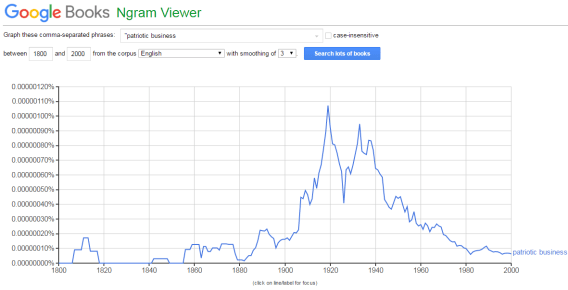
The neologism “corporate patriotism” is a new one but the term “patriotic businessman[men] is much older. I was curious to see what pattern emerge when one searches for in the Google corpus of English-language books. Here’s what I found.

Note the surge in the middle years of the twentieth century, a period associated with total war.
Comments : 2 Comments »
Categories : Uncategorized
The Capitalist Peace in Gujarat
1 12 2016AS: As long-time readers of this blog will know, I’m very interesting in using Capitalist Peace Theory as a lens for understanding history. Capitalist Peace Theory holds commercial interdependence between nations promotes peace. I applied this theory in a recent paper in the journal Enterprise and Society. That paper looked at the role of entrepreneurs in promoting peace between three nations that were led, in the main, by individuals of the same ethnic origin and religion (the US, the UK, and Canada in the era of the Civil War).
Saumitra Jha‘s excellent paper ‘Unfinished Business’: Historic Complementarities, Political Competition and Ethnic Violence in Gujarat‘ examines parallel issues but within the context of a single Indian state. It was published in the Journal of Economic Behavior and Organization. August 2014, Vol. 104, Pages 18-36
Here is the abstract:
I examine how the historical legacies of inter-ethnic complementarity and competition interact with contemporary electoral competition in shaping patterns of ethnic violence. Using local comparisons within Gujarat, a single Indian state known for both its non-violent local traditions and for widespread ethnic pogroms in 2002, I provide evidence that where political competition was focused upon towns where ethnic groups have historically competed, there was a rise in the propensity for ethnic rioting and increased electoral support for the incumbent party complicit in the violence. However, where political competition was focused in towns that historically enjoyed inter-ethnic complementarities, there were fewer ethnic riots, and these towns also voted against the incumbent. These historic legacies proved to be important predictors of the identity of the winner even in very close electoral races. I argue that these results reflect the role local inter-ethnic economic relations can play in altering the nature and the benefits of political campaigns that encourage ethnic violence.
It seems to be that Jha’s paper could be used to help with the theoretical framing of qualitative business-historical research on inter-ethnic trade in this region, or indeed many parts of the world. By taking a close look at any surviving documents produced by firms in the area, we could examine the role of business in promoting ethnic harmony. Someone needs to apply this paradigm to studying the business history of my native Canada, a country that has been characterized by very peaceful relations between its main ethno-linguistic groups and extensive commercial interaction between members of these groups, as in the case of the Montreal-based fur trade after 1760.
Comments : Leave a Comment »
Categories : Uncategorized
Corporate Archives in Global Perspective: Final Programme
23 11 2016Riksarkivet, Arkivgatan 9A, Gothenburg
Thursday 24th November 2016:
10.00 Opening of workshop, words of welcome, practical information
10.15-11.00. Key Note 1: Professor Elizabeth Shepherd (University College London): “Private Interests or National Heritage? The Archival Voice.”
11.00 -12.00 Session I: Voice vs Silence in the Corporate Archive:
Mats Jönsson (University of Gothenburg): “History, Archives and the Pursuit of Competitive Advantage: Upside and Downside: Causes and Effects of the Digital Compilation by a Commercial Film Archive.”
Andrew Smith (University of Liverpool) & Maki Umemura (Cardiff Business School), “Why We Need a Transparency Revolution in Business History.”
Lunch: 12.00-13.00
13.00-14.30 Session II: National vs. International Perspectives on Preservation of Corporate Archives
Karl-Magnus Johansson (Landsarkivet I Goteborg), “Short Introduction to Swedish Corporate Archives and their Preservation.”
Anders Houltz (Centre for Business History, Sweden), “Private Interests and National heritage: A Swedish Model for Preserving Corporate Archives.”
Diego Coraiola (University of Victoria, Canada) & Stephanie Decker (Aston Business School), “International Archives and National Institutions.”
Coffee: 14.30-15.00.
15.00-16.30: Session III Public needs vs Private Interests? Competing Models for Preserving Corporate Archives
Neill Forbes (University of Coventry), “New connections for the BT Archives?
Inte Fintland & Torkel Thime, “The Potential and Possible Problems in Combining Private and Public Archival Material.”
Jarmo Luoma-Aho (Central Archive for Finnish Business Records): “The state subsidy system for private archives and the Central Archives for Finnish Business Records.”
16.30-17.30: Panel Discussion and Closing of Day 1
Friday 25th November:
8.30-9.15 Key Note 2: Professor Charles Harvey (Newcastle University, UK): “History, Archives and the Pursuit of Competitive Advantage: Upside and Downside.”
9.15-9.30: Coffee.
9.30-10.30: Session III: Business Archives and the Control of the Past
Diego Coraiola (University of Victoria) & Wim van Lent: “Creating the Ultimate History: Archives, Memory and Control at the Dutch East India Company.”
Andrew Popp (University of Gothenburg) and Susanna Fellman (University of Gothenburg), “A Stakeholder Perspective on Corporate Archives.”
10.30-11.15 Final Plenary: The Way Forward?
11.15-11.30 Closing of Seminar and Lunch.
Comments : Leave a Comment »
Categories : Uncategorized
Race, “Civilization,” and International Business: Why We Need a History of Trading With “The Other” More Than Ever
21 11 2016We don’t normally associate economic policy (tariffs, trade deals, monetary policy) with identity politics (think of Black Lives Matter, the politics of religious minority, migration and the Clash of Civilizations thesis). Trump’s election illustrates the connections between these issues and should inspire a range of scholars in Business History, International Business, Economics, and other fields to get to do more research on the microfoundations and consequences of these linkages.
The linkages between identity politics and international trade are real and are increasingly recognized by the policywonks who are normally more comfortable talking about the Basel Accords, GATT, or Richard Baldwin’s Great Unbundling. Consider Adam Posen, who is a respected American economist. Posen is President of the Peterson Institute for International Economics, a thinktank in Washington DC. He has served as a member of the Monetary Policy Committee of the Bank of England and in many other prestigious roles. On 15 November, he was speaking about the likely impact of Trump’s election on US trade policy at a conference run by UBS, the Swiss bank. Under Obama, the US had negotiated a variety of trade agreements, including the Trans-Pacific Partnership and a free trade deal with the EU. Carolin Roth of CNBC reported that Posen made this following remark about which of trade deals might survive a Trump presidency:
Adam Posen: “Donald Trump may actually keep TTIP alive if he decides he likes to trade with white people”
Posen’s throw-away line contains an important truth– the politics of international trade is very much influence by identity politics, be they ethno-racial, religious, or whichever other division is most salient to actors at the moment. The academic literature in many disciplines mentions this phenomena, although the literature hasn’t been developed as much as I would like. In his controversial book, The Clash of Civilizations, Samuel Huntington remarked that “Americans react far more negatively to Japanese investment than” European investment.
To my knowledge, the IR and International Political Economy literature hasn’t really developed this idea. Mainstream scholars in International Business have not dealt with this issue either (I stand to be corrected– this isn’t my home field). These gaps or silences in the literature are extremely unfortunate in light of current developments, which include a well-documented rise of ethnic nationalism across the world as manifested by Donald Trump’s adviser Steve Bannon, who declared that there were too many Asians in Silicon Valley. When an interviewer pointed out to Mr. Bannon that measures to reduce the role of Asians in this sector might damage the economy, Bannon replied “A country is more than an economy. We’re a civic society.” (For coverage of the reaction in India to Bannon’s remarks, see here).
We have something similar in the UK– at least one part of the coalition currently pushing for the UK to leave the EU is inspired by the idea of the Anglosphere, an identity that links Britain to its overseas offshoots and which would prefer a customs union with Britain’s alleged “kith and kin” overseas than to the continental Europeans on the other side of the Channel. As the FT’s Martin Wolf has noted, the idea of a special free trade agreement linking the US to other so-called “White Anglo-Saxon nations” is supported by elements within Trump’s base of support, particularly those who has what Wolf refers to as “retrogressive” views on the internal politics of ethnicity.
It seems to me that business historians are uniquely well positioned to develop our understanding how the increasing salience of ethnic, racial, and religious identities might influence international business. We could do so by looking at previous episodes in the history of globalization when the salience of such divisions was increased by cultural shifts that increased the extent to which different cultures were Othered. In the humanities and the social sciences, there is a vast literature on Othering and it is widely understood that the salience of ethno-racial and religious identities is not constant but has fluctuated. Historians have written about how such identities have been created and how the salience of ethno-racial identities was intensified by such phenomena as the late 19th century rise in pseudo-scientific racism. We know that such identities had a significant impact on the diplomatic history of the period (e.g., the growing popularity of the concept of the Anglo-Saxon race promoted Anglo-American rapprochement) see here and here.
Unfortunately, relatively little has been written by economic historians how such identities affected commercial ties across the imagined boundaries separating ethnic, racial, and religious groups. Even less has been written using corporate archival data and firm-level studies, the preferred methodology of most business historians. One work that does address this question is “Empire and Globalisation: Networks of People, Goods and Capital in the British World, C.1850-1914” by Gary Magee and Andrew Thompson. This study, which blends cultural and economic history, considers how the identities of Anglo-Celtic economic actors influenced trade and investment in the British World, a territory that included the British Isles, Australasia, Canada, and, more ambiguously, the United States. This book is based on aggregate date (e.g., trade flows) rather than firm-level data, but based on these data, the authors argue that a shared sense of Britishness distorted commercial decisions and promoted trade between these countries. This conclusion implies that these growing salience of these identities also impeded economic exchange between the predominantly English-speaking countries and those who were deemed non-Anglo-Saxon, and thus inferior. Magee and Thompson suggest that the ideologies of Anglo-Saxonism and Britishness promoted trade between the Anglosphere nations. I’m more interested, actually, in the international trade that didn’t happen or which was made more difficult by these ideologies. Moreover, how were firm strategies affected by such ideologies? Did the growing salience of such identities influence levels of trust and the willingness to lend capital to individuals who were deemed to be “Other”? What do firm records say?
It seems to me that business historians can make a useful contribution here to our general stock of knowledge. Anyone who would be interested in collaborating with me on a grant application or some other project related to the investigation of this theme should contact me. I’ve recently been kicking some ideas around with other business historians I respect. If you are interested in being part of this conversation, let me know.
Comments : Leave a Comment »
Tags: Brexit, Peterson Institute for International Economics, Steve Bannon, Trumponomics
Categories : Uncategorized
Why We Need a Transparency Revolution in Business History
18 11 2016AS: Next week, I will be presenting our paper on research transparency in business history at at the Corporate Archives in Global Perspective conference in Gothenburg, Sweden. I’m particularly excited about talking about corporate archives and research transparency in Scandinavia since that region is noted for excellence in business-historical research, a great system for enabling academic access to corporate archives, and very robust cultures of transparency and freedom of information. (Sweden is generally regarded as a world leader in transparency). Representatives of the leading Nordic corporate archives will be at the workshop and I will be very interested to hear their responses to our proposal for the creation of an international data repository that would serve all qualitative and mixed-method business historians.
Andrew Smith, University of Liverpool Management School; Maki Umemura, Cardiff Business School.
You can see the PowerPoint for our presentation here.
Abstract
The last decade have seen is an increasing emphasis on research transparency in both the physical and the social sciences. The various initiatives to increase research transparency have included data-sharing protocols, changes in journal submission procedures, and funding for replication studies in psychology, in cancer research, in economics, and other fields. The emerging norm in many disciplines is that raw data be published along with the paper, is designed to counteract the impression that researchers sometimes use data selectively or in an otherwise manipulative fashion. In short, we are in the middle of a “Transparency Revolution in Qualitative Social Science” to use the words of Andrew Moravcsik. Unfortunately, the interdiscipline of business history is being bypassed by this pan-disciplinary movement for the creation of research transparency institutions. The failure of business history as a scholarly community to participate in the “transparency revolution” risks placing our sub-discipline in a serious competitive disadvantage relative to other research areas. The failure to create transparency-promoting institutions would likely disadvantage business history as it contends with rival research traditions for scarce resources such as research council funding, venues for the presentation of research, and the creation of academic posts. This paper is designed to initiate a conversation about what these institutions should look like. The paper argues that the business history community should attempt to move towards a regime of Active Citation whereby references to primary sources in paper contain a direct link to a scanned image of the source being quoted or otherwise cited.
Comments : Leave a Comment »
Categories : Uncategorized
CFP: EGOS 2017 Sub-Theme 44: Rethinking History, Rethinking Business Schools
18 11 2016Sub-theme 44: Rethinking History, Rethinking Business Schools
Convenors: Michael Rowlinson University of Exeter, United Kingdom; m.c.rowlinson@exeter.ac.uk; Mads Mordhorst, Copenhagen Business School, Denmark
mmo.lpf@cbs.dk; Ellen S. O’Connor, Dominican University of California, USA ellen.oconnor@dominican.edu
Call for Papers
The EGOS Colloquium in 2017 coincides with the 100th anniversary of Copenhagen Business School (CBS), which will be commemorated in part by the publication of a history of the Business School written by members of the Centre for Business History at CBS. This coincidence provides an opportunity to rethink both the role of history in business schools, as well as the history of business schools themselves, along with the part played by management and organization studies within that history.
Both business schools and organization studies have sought to legitimate themselves through history in relation to older disciplines in the university. Textbooks regularly claim Max Weber as a founder for the so-called “Classical School” of management and organization studies even though Weber himself could never have been an adherent of such a school because it was only invented, along with organization studies, long after he died (Cummings & Bridgman, 2011). When Harvard Business School was facing criticism in the 1930s for the banality of management research, one response from the Dean, Wallace B. Donham, was to hire a historian to study management and to use a donation from the retailer Gordon Selfridge to buy historical business documents from Italy relating to the Medici family during the Renaissance (O’Connor, 2012, p. 58).
History frames discussions about the purpose and future of business schools in general (e.g.: Khurana, 2007; Khurana & Spender, 2012; Locke & Spender, 2011), and of particular practices such as the use of case studies (Bridgman, Cummings, & McLoughlin, 2015). The history of business schools is therefore necessarily contested, for example with the association between management and slavery coming under increasing scrutiny (Cooke, 2003; Roediger & Esch, 2012; Ruef, 2008). This raises questions not only about the historiography of business schools but also about the role of history in debates about the future of business schools.
In the ongoing dialogue between business historians and organization theorists (Bucheli & Wadhwani, 2014; Rowlinson et al., 2014; Godfrey et al., 2016; Greenwood & Bernardi, 2014) there tends to be a division of labor whereby theory comes from organization studies and business historians explain how to use historical sources and methods. The challenge for rethinking history in organization studies is whether these roles can be combined or even reversed, as they have been occasionally in previous collaborations (e.g. Whipp & Clark, 1986).
We encourage submissions that rethink the history of business schools, especially if new insight is gained from using theoretical concepts from organization studies. We also welcome submissions that rethink the role of history in business schools in general and particularly in organization studies, either in relation to research or the curriculum.
References
Bridgman, T., Cummings, S., & McLoughlin, C. (2015): The Case Method as Invented Tradition: Revisiting Harvard’s History to reorient management education. Paper presented at the Academy of Management Conference, Vancouver.
Bucheli, M., & Wadhwani, R.D. (eds.) (2014): Organizations in Time: History, Theory, Methods. New York: Oxford University Press.
Cooke, B. (2003): “The denial of slavery in management studies.” Journal of Management Studies, 40 (8), 1895–1918.
Cummings, S., & Bridgman, T. (2011): “The relevant past: Why the history of management should be critical of our future.” Academy of Management Learning & Education, 10 (1), 77–93.
Godfrey, P, Hassard, J., O’Connor, E., Rowlinson, M., & Ruef, M. (2016): “What is Organizational History? Towards a Creative Synthesis of History and Organization Studies.” Academy of Management Review, 41 (4), October.
Greenwood, A., & Bernardi, A. (2014): “Understanding the rift, the (still) uneasy bedfellows of history and organization studies.” Organization, 21 (6), 907–932.
Khurana, R. (2007): From Higher Aims to Hired Hands: The Social Transformation of American Business Schools and the Unfulfilled Promise of Management as a Profession. Princeton: Princeton University Press.
Khurana, R., & Spender, J.C. (2012): “Herbert A. Simon on What Ails Business Schools: More than ‘A Problem in Organizational Design’.” Journal of Management Studies, 49 (3), 619–639.
Locke, R.R., & Spender, J.C. (2011): Confronting Managerialism: How the Business Elite and Their Schools Threw Our Lives Out of Balance. London: Zed Books.
O’Connor, E.S. (2012): Creating New Knowledge in Management: Appropriating the Field’s Lost Foundations. Stanford, CA: Stanford Business Books.
Roediger, D.R., & Esch, E.D. (2012): The Production of Difference. Race and the Management of Labor in U.S. History. New York: Oxford University Press.
Rowlinson, M., Hassard, J., & Decker, S. (2014): “Research strategies for organizational history: A dialogue between historical theory and organization theory.” Academy of Management Review, 39 (3), 250–274.
Ruef, M. (2008): “Rakesh Khurana: From higher aims to hired hands: The social transformation of American business schools and the unfulfilled promise of management as a profession.” Administrative Science Quarterly, 53 (4), 745–752.
Whipp, R., & Clark, P. (1986): Innovation and the Auto Industry. London: Frances Pinter.
Michael Rowlinson is Professor of Management & Organizational History in the University of Exeter Business School, UK. He has played an important part in the “historic turn” in organization studies. He was the editor for ‘Management & Organizational History’ (2008–2013) and is currently a Senior Editor for ‘Organization Studies’ as well as a co-editor for the Special Topic Forum of the ‘Academy of Management Review’ on “History and Organization Studies: Toward a Creative Synthesis”.
Mads Mordhorst is Associate Professor at the Department for Management, Copenhagen Business School, Denmark, and Director of Centre for Business History and Head of the CBS initiative “Rethinking History at Business Schools”. His research focuses on business history from a cultural and historical perspective with an emphasis on identity construction. He is editor of two forthcoming special issues, “Towards a Narrative Turn in Business History?” and “Uses of the Past: History and Memory in Organizations and Organizing” in ‘Business History’ and ‘Organization Studies’, respectively.
Ellen S. O’Connor is Senior Research Fellow, Institute for Leadership Studies, Barowsky School of Business, Dominican University of California, USA. She studies classical management texts and the history of business schools and management education. Currently, she is working on a book about chief executives who wrote management and organization theory.
Comments : Leave a Comment »
Categories : Uncategorized
New Book on the First World War and International Business
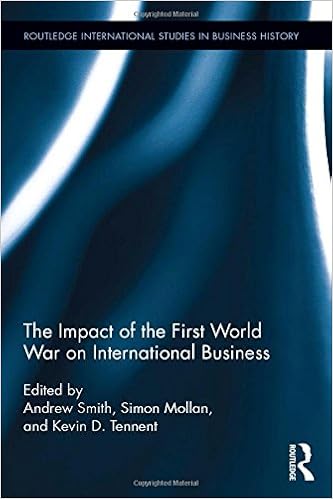
16 11 2016Our edited collection on the impact of the First World War on international business has been released and can now be purchased from Amazon.
In 2014, people throughout the world commemorated the centenary of the start of the First World War. For historians of international business and finance, it was s an opportunity to reflect on the impact of the war on global business activity. The world economy was highly integrated in the early twentieth century thanks to nearly a century of globalisation. In 1913, the economies of the countries that were about to go war seemed inextricably linked. The Impact of the First World War on International Business explores what happened to international business organisations when this integrated global economy was shattered by the outbreak of a major war.
Studying how companies responded to the economic catastrophe of the First World War offers important lessons to policymakers and businesspeople in the present, concerning for instance the impact of great power politics on international business or the thesis that globalization reduces the likelihood of inter-state warfare. This is the first book to focus on the impact of the First World War on international business. It explores the experiences of firms in Britain, France, Germany, Japan, China, and the United States as well as those in neutral countries such as the Netherlands, Sweden, and Argentina, covering a wide range of industries including financial services, mining, manufacturing, foodstuffs, and shipping. Studying how firms responded to sudden and dramatic change in the geopolitical environment in 1914 offers lessons to the managers of today’s MNEs, since the world economy on the eve of the First World War has many striking parallels with the present.
Aimed at researchers, academics and advanced students in the fields of Business History, International Management and Accounting History; this book goes beyond the extant literature on this topic namely due to the broad range of industries and countries covered. The Impact of the First World War on International Business covers a broad range of geographical areas and topics examining how private firms responded to government policy and have based their contributions mainly on primary sources created by business people.
Comments : Leave a Comment »
Categories : Uncategorized