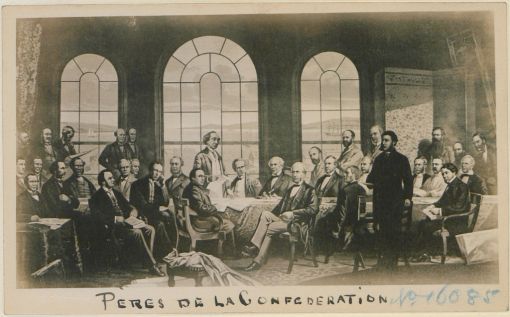
AS: As a business historian, CBHA member and author of works on Canadian Confederation, I am very pleased to see the CBHA has established a formal affiliation with The Confederation Debates project. The 150th anniversary of Confederation will be a wonderful “teachable moment” to allow business historians to share their knowledge of how business shaped the making of the Canadian constitution and Canada more generally. The Confederation Debates project involves the innovative use of digitized primary sources.
The Confederation Debates is a national non-partisan legacy digitization and dissemination project that is making the country’s founding records accessible to Canadians of all ages and walks of life. Before each province and territory became a part of Canada, their local legislatures (and the House of Commons after 1867) debated the extent, purposes, and principles of political union between 1865 and 1949. Indigenous Peoples and Crown officials have also negotiated treaties that committed both parties to lasting relationships. The Confederation Debates brings the records of all of these exchanges together for the first time, and makes them accessible to specialists as well as the general public though a variety of deliverables including:
a website where anyone can view the records, and help us to correct typos made by our text scanning software after watching a short 3 minute YouTube video;
A legacy website hosted by the University of Victoria that will include a map where visitors can enter their postal code and learn whether the local leaders were for, or against, joining Canada;
Grade 7/8 and high school lesson plans that give equal voice to pro- and anti-Confederation positions;
Provincial or regional e-books, with introductions composed by recognized scholars;
Confederation “Quotes of the Day” published in both official languages to Twitter, Instagram and Facebook between 1 July 2016 and 1 July 2017 that spotlight all sides of the debates.
I’ve just learned that the distinguished business historian Chris Kobrak has died. I’ve known Chris from conferences for a number of years and over the course of the last eighteen months I got to know him quite well. I deeply respected Chris as a human being and a scholar and proximity to him caused me to be a better person by being more international, more financially literate, more generous with money, and to pay more attention to ethics. When I say pay attention to ethics, I do not mean to suggest that I was unethical before I met Chris. Rather, I mean that I am more conscious of ethical issues when engaged in writing and thinking about business history and in thinking university teaching and life more generally.
To understand why Chris was an important figure in the global business history community, we need to consider his family background and career. Chris’s family history is connected to some of the great events of the twentieth century. His father, who was a German Jew, escaped Germany at the last possible moment, arriving in the United States in the late 1930s, at a time when the Western democracies were slamming their gates shut to such refugees. Chris’s father was one of the lucky people who was able to escape from the Nazis. Chris’s mother was from Ireland and he was brought up near New York, the great melting pot. Although Chris’s father had every reason to hate Germany, he encouraged his son to learn German and to become familiar with German culture. This knowledge would later allowed Chris to write so perceptively about German business history. Chris also maintained his connections with Ireland and was, in my estimate, unusually well informed about Irish affairs for a non-Irish person.
Chris began his doctoral studies in history at Columbia University in the late 1970s, working under Volker Berghahn on a topic in German business history. Halfway through his PhD, he decided to quit and go into private industry to make some money. At the time, one of his contemporaries in the PhD program correctly predicted that he would return to academe and the study of business history after he had spent some time working in an actual business. Chris had a successful career in business that included a stint running the Japanese subsidiary of a US company in the late 1980s, at the height of the bubble. He arrived in Tokyo with zero knowledge of Japanese but at the end of his time there he was fluent enough to run a board meeting. After retiring from business, his personal life brought him to Paris. Despite knowing no French on his arrival, he quickly mastered the language, putting your Canadian author to shame through this witty banter and repartee with Parisian waiters and waitresses. He began teaching business at ESCP, which is one of the world’s older business schools. Since ESCP wanted its faculty to have or to acquire PhDs, he wrote to his old PhD supervisor in Columbia, asking whether it would be possible to resume work on his dissertation after many years. Chris then completed his dissertation and began a prolific career publishing books on German business history that were informed by massive archival research, a deep knowledge of many aspects of German history, and his immense knowledge of accountancy and business more generally. Chris’s training meant that he was able to understand the most complex balance sheets, a set of skills few business historians have (that certainly includes me).
Chris understood the numbers and the purely economic side of business. However, his research on German business history was always informed by a very strong sense of ethics, particularly his writings related to the period from 1933 to 1945. Chris was a strong classical liberal who believed in free markets. Perhaps in some ways he can be called a conservative in his politics. However, his belief that capitalism is a good system did not at all prevent him from calling out corporate misdeed or exposing evil actions by corporations. He was a critical friend of business who was not afraid to speak truth to power. He was not a mindless cheerleader for business. I also know that Chris was truly appalled by the recent developments in the United States, particularly the rise of the Alt-Right, xenophobia, and the attendant persecution of a religious minority (in that case, Muslims). In the last year of his life, the refugee crisis was very much evident in Chris’s neighbourhood in the 11th arrondisement of Paris, as there were families of Syrian refugees begging on the street. Even after the Bataclan terror attack, which took place near his house, Chris displayed a compassionate attitude towards refugees and I strongly suspect that this was connected to the fact his father had been a refugee. I know that Chris was angered when the Canadian government announced that it would participate in air strikes against ISIS. I did, however, hear him praise the Canadian government’s decision to admit refugees. My point is that his political views were complex, like those of all first-class scholars.
Chris helped me to organize and fund a small conference on the intersection of business and environmental history that took place at Rotman in 2014. Even though he knew nothing about the sub-discipline of environmental history, Chris provided excellent feedback to all of the scholars who presented. He devoted considerable effort to thinking about all of the papers, including the very embryonic works presented by PhD students. Some of the papers from this workshop will soon appear in a special issue of a journal. Chris also served as a commentator at a 2014 workshop on the impact of the First World War on international business. (His encouragement and mentorship made that workshop possible). An edited volume based on the workshop was recently published, but I don’t think that Chris had time to read it.
Last summer, I saw further evidence of Chris’s generosity with his time. He attended a workshop at EHESS in Paris brought French and Japanese academics together to discuss the recent energy histories of their countries (both of which are characterized by heavy reliance on nuclear power). The workshop was in a hot room and some of participants became drowsy and rather inactive. Chris continued to ask great questions designed to help the scholars who were presenting. Chris’s questions were always insightful and displayed a surprisingly deep knowledge of the subject. (At least this level of knowledge was surprising to me, someone who knows next to nothing about nukes). I noticed that at the end of the conference he tracked down a talented young PhD student from the University of Kyoto to get his contact details. I knew exactly what Chris was doing—he had spotted a rising star and wanted to keep in touch with him.
At a conference held last year in Berlin, Chris commented on my paper on the history of a nineteenth-century Canadian sugar refining company. At a time when slavery was still legal in some but not all of the sugar-producing islands of the Caribbean, this company decided to source its raw sugar from the countries in which slavery was still legal for the simple reason it was cheaper. Ironically, the firm’s founder was a supporter of the abolition of slavery who gave money to organizations the helped escaped American slaves to establish themselves in Canada. Our paper examined the company’s reasons for doing so and consumers’ responses to this moral choice. Anyway, Chris loved our paper and encouraged us to develop our analysis of the ethical reasoning of the firm’s managers. He made a number of perceptive observations about the nature of business ethics and business decision-making. One of these observations drew on his knowledge of something he had observed during his business career, which had overlapped with the era when the morality of investing in South Africa had been vigorously debated. I certainly share Chris’s belief that to be a true friend of capitalism, a business historian needs to be ruthlessly critical of those business leaders who engage in unethical behaviour, be it profiting from the Aryanization of Jewish firms or the enslavement of Africans or something in the present day.
Chris played an important role in the global community of business historians. Many business historians, like most academics in general actually, are a bit parochial in the sense that research the histories of companies in just one country and that country happens to be the one in which they were born and have spent their entire life. That isn’t to say that they don’t good research, merely that their frame of reference is national. However, I’ve noticed that the people at the very peak of the discipline of business history (e.g., Geoffrey Jones or the late Alfred Chandler) are far more international in their outlook—their research tends to be comparative and transnational and their research collaborations and biographies are similarly international. Chris was very much a business historian of this type. His extensive connections to firms, business archives, and academics on multiple continents meant that he was able to play an important role as a sort of human bridge or go-between in international business history organizations. He could talk to the US business historians and the German business historians and the Japanese ones and then get them to agree a common plan of action. As I have matured as a scholar and a person, I have sought be more like Chris in this respect—more international and less parochial.
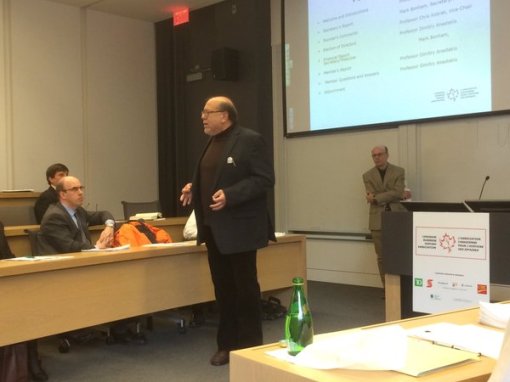
As he approached mandatory retirement age at ESCP, a new opportunity for Chris opened up. French universities still have mandatory retirement, a rule that was eliminated in universities in the Canadian Province of Ontario around the year 2005, the year I got my PhD. At the time, I was appalled by the decision to end mandatory retirement for tenured academics, since I thought it would protect deadwood and blight the career prospects of young scholars. Seeing Chris in action at the University of Toronto has helped to convince me that scrapping mandatory retirement was the right policy. In 2012, Chris was hired as the L.R. Wilson/R.J. Currie Chair of Canadian Business and Financial History in Toronto’s Rotman School of Management. This chair was created through the generosity of donors who wanted to re-invigorate academic research into Canadian business history. When Chris’s appointment was announced, there was the predictable grumbling that someone who was neither Canadian nor a scholar of Canada had been appointed. Chris swiftly devoted himself to research and writing about Canadian financial history—University of Toronto Press will publish an important volume on that subject posthumously. More importantly, Chris devoted his considerable energies to institutional work aimed at bringing about a renaissance in Canadian business history: he was instrumental in the creation of the Canadian Business History Association, a bilingual society devoted to the study of Canadian business history that brought together academics, businesspeople, and others. The CBHA was modelled on Germany’s Gesellschaft für Unternehmensgeschichte, an organization Chris knew very well. Chris and his colleagues at Rotman were extremely energetic at securing financial support from a wide range of donors. In its short life, this organization has done a great deal to provide practical support to younger scholars both financially and through encouragement and feedback. I would imagine that the CBHA will create some sort of memorial, perhaps an award, in his memory.
After his appointment by the University of Toronto, Chris performed public intellectual functions as well, taking advantage of his proximity to downtown Toronto, the home of the English-Canadian TV networks and national newspapers. He appeared frequently on The Agenda, TVO’s flagship program for debate and analysis. The Agenda rivals the finest BBC program for its ability to make abstract academic knowledge relevant and accessible to the general public and many smart people have appeared on this show. Chris performed brilliantly in this distinguished venue, which reflected well on him and, by extension, the business history community. You can see Chris talking about the future of Greece in the Eurozone here.
Chris remained committed to the craft of history and to the writing of narrative accounts of companies. In that sense, he was a fairly traditional business historian. He had little time for the approach to business history one finds in some management schools, which is to dig up a primary source or two, stir in a few cups of “Eurotheory”, and then present research findings that would be of zero interest to any actual businessperson. For that reason, he wasn’t, at first, terribly interested in the emerging stream of research in management on “the Uses of the Past.” However, he did believe that business historians did have the capacity speak to key themes debates in finance, strategy, and other core management disciplines and he uses his position at Rotman to bring respected business historians into contact with respected scholars in strategy and finance.
Last autumn, I finally convinced Chris to work with me on a paper that would examine how historical knowledge is used by people in finance. Other academics have published works on how banks use their historians (e.g., by stressing how old the bank is in advertisements targeted at depositors). Our research was different and would have involved interviewing people in Toronto’s financial district about how they apply lessons from history in business decision-making. We know that CEOs often read works of history (generals also like reading history, although they tend to prefer military history). We know from a study involving interviews with Dutch C-Suite executives that many businesspeople believe that learning about various types of history improves their decision-making. However, we don’t quite know exactly how this process works—what specific types of business decisions are improved by knowing about history? What specific types of historical knowledge improve business decision-making? We planned to run a bunch of interviews designed to answer these questions. The idea was that Chris would use his extensive networks and Rotman position to get us the interviews with these extremely busy people. Our ultimate goal was to publish a paper in a Special Issue of the Strategic Management Journal that will be devoted to what history can offer strategy. We both felt that this research project would be of interest to a wide range of knowledge users, not just business school academics, since would allow us to go beyond the platitude that “learning history makes for better decisions” to an understanding how precisely particular types of historical knowledge improve particular cognitive functions in business. Alas, this research project won’t actually take place as I lack Chris’s connections and, of course, detailed knowledge of financial decision-making. I’m saddened because I was really looking forward to learning by working alongside Chris on this research.
One of the things we have lost with the passing of Chris is an encyclopaedic knowledge of restaurants in European cities. I would like to conclude this blog post by sharing a restaurant recommendation he made. His favourite restaurant in Paris was the Auberge Pyrénées Cévennes Rue de la Folie Mericourt. He ate there frequently and knew the staff very well. (Chris once treated me to a very expensive meal there that I would never have selected from the menu had he not insisted I order it). I would encourage all of those who knew Chris or admired his research to eat there and to tell the staff that Chris sends his regards.
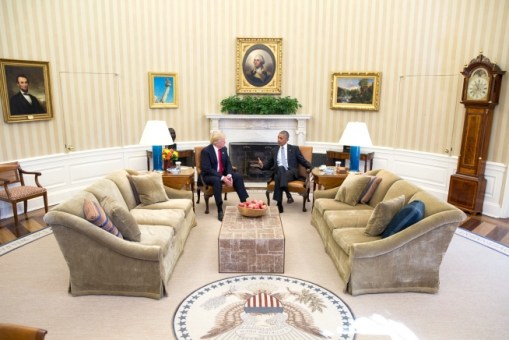
AS: I’m very interested in capitalist peace theory, the idea that trade between nations makes the world more peaceful, and believe that business historians are well positioned to test, refine, and modify the theory. (I’ve published a co-authored paper in this area). For that reason, I make a point of following the literature on Business and Peace, a newly fashionable area of research in both management schools and peace studies (see here, here, here, and here). At the very end of last year, Jason Miklian of International Peace Research Institute, Oslo (PRIO) published a thought-provoking paper on the various ways in which business is said to promote peace. It is worth reading by everybody as we prepare to enter the Age of Trump.
December 29, 2016 Abstract: The conjunction of business and peace is a growing global phenomenon, but conducted and researched over a vast array of fields and contextual settings. This article provides theoretical order for this disparate material, illustrating cutting-edge research and highlighting the most urgent knowledge gaps to fill. Extracting findings from the business community, international organizations, and the academic community, this article maps these findings into five assertions about how businesses impact upon peace: economic engagement facilitates a peace dividend; encouraging local development facilitates local capacities for peace; importing international norms improves democratic accountability; firms can constrain the drivers or root causes of conflict; and undertaking direct diplomatic efforts with conflict actors builds and/or makes peace. These assertions provide a framework for categorizing and testing prominent business-peace arguments. They also support preliminary arguments that businesses cannot expect to be rewarded as peacebuilders just because they undertake peacebuilding activities, that economic opening only brings as much peace as a local regime will allow, and that truly courageous business-peace choices are rarely made in fragile contexts. This framework can encourage more coherent scholarly findings and more effective business engagements within the complex and challenging realm of peacebuilding.
The excellent Bloomberg columnist Justin Fox has published a great piece on the current state of corporate governance in the United States. He speculates that the “shareholder value” view of corporate purpose — that corporations exist to maximize value for their investors — is finally on its way out…. Donald Trump is effectively challenging the gospel that shareholder interests should come first.
As Fox points out, the doctrine that the sole or primary purpose of a public company is to make money for shareholders has long been challenged by a group of academics who believe that CEOs should revert to running firms with the interests of a wider group of stakeholders in mind. (That was the dominant philosophy in corporate America from teh 1930s to the late 1970s). What is new is that the President-elect is questioning the ideology of shareholder primacy through his repeated criticisms of US corporations for sending manufacturing jobs overseas and otherwise being insufficiently patriotic. In effect, Trump has been calling on US corporate managers to adopt the ethos that pervaded US business life in the years between the New Deal and the 1970s, when CEOs saw themselves as stewards who would manage in firms in a way that balanced the interests of workers, shareholders and other stakeholders. In that era, US corporations certainly regarded their interests as closely tied to those of the nation, as evidenced by Charles Erwin Wilson’s famous declaration during his Senate confirmation hearing that For years I thought that what was good for our country was good for General Motors, and vice versa. The difference did not exist. Our company is too big. It goes with the welfare of the country.
Fox’s article deals with many of themes (the impact of shareholder primacy, short-termism, and the obligations of corporations to the nation-states that charter them) that are examined in the paper I wrote with Kevin Tennent and Jason Russell. The title of our paper is: “Berle and Means Reconsidered: the Military Roots of a Philosophy of Stakeholder Governance”. If all goes as planned, we will be presenting this paper on the conference circuit (Academy of Management, EURAM, BAM, Association of Business Historians) this summer. Our paper examines the relationship between military service and the ethos of public service associated with it and competing ways of thinking about the social responsibility of business corporations. We structure our analysis around a discussion of The Modern Corporation and Private Property by Adolf Berle and Gardiner Means (1932), a text that influenced a generation of US business executives that remains one of the most cited works in management.
Our paper shows that Berle and Means espoused a stakeholder theory of corporate governance that challenged the idea that the sole purpose of a corporation is to create value for the shareholders. Whereas shareholder value ideology was dominant in the United States in the 1920s, the nation’s corporate governance system moved towards a stakeholder model during the New Deal. Berle and Means clearly disagreed with the view that the primary purpose of a corporation was to serve the interests of the shareholders. The communitarian ethos advocated by Berle and Means can be seen in this passage:
Neither the claims of ownership nor those of control can stand against the paramount interests of the community. . . . Should the corporate leaders, for example, set forth a program comprising fair wages, security to employees, reasonable service to their public, and stabilization of business, all of which would divert a portion of the profits from the owners of passive property, and should the community generally accept such a scheme as a logical and human solution of industrial difficulties, the interests of passive property owners would have to give way…It is conceivable—indeed it seems almost essential if the corporate system is to survive—that the “control” of the great corporations should develop into a purely neutral technocracy, balancing a variety of claims by various groups in the community and assigning to each a portion of the income stream on the basis of public policy rather than private cupidity (Berle and Means, 1933, 356, emphasis added).
In the paper, we argue the ethos espoused by Berle and Means remained dominant in the US corporate world until the late 1970s, when it was challenged by the re-emergence of shareholder value ideology.By the time Gardiner Means died in 1988, the shareholder-centric ideology of corporate governance presented by Jensen and Meckling (1976) had largely displaced the stakeholder approach espoused by Berle and Means.
There is something of an affinity between the view of the purpose of the corporation outlined by Berle and Means and that recently advocated by Donald Trump on Twitter in that they both challenge shareholder primacy. Of course, there are massive differences between Berle and Means on the one hand and Trump on the other. These differences are evident in terms of temperament and style of communication. Berle and Means wrote a scholarly book. Trump writes tweets in the middle of the night. Berle and Means patriotically served in the military when called to do so in 1917. Trump obtained dubious medical deferments during the Vietnam War, although that doesn’t stop him from being a cheerleader for war now that he is too old to serve. There is also a massive disconnect between Trump’s rhetoric on Twitter and the way in which Trump’s companies have actually been run. I’m probably the last person in the world who would defend Trump. However, I do think that Fox and other observers are right to argue that Trump is pushing back against shareholder value ideology in his own crude fashion. I suppose the danger of someone like Trump being the champion of some variant of the stakeholder model is that he may end up discrediting the entire concept.
I would also hasten to add here Hillary Clinton, Trump’s Democratic opponent, also critiqued the doctrine of shareholder primacy. She did so by calling for a return to “corporate patriotism” during her campaign. Her first use of this term was during the Democratic presidential primaries, when she was battling with Bernie Sanders, a fierce critic of outsourcing and globalization. Campaigning in Detroit in March 2016, Clinton criticized the outsourcing of US manufacturing jobs to low-wage countries: “I’m not asking corporations to be charitable, although that’s important. I’m asking corporations to realise that when Americans prosper, they prosper too. The idea of corporate patriotism might sound quaint in era of vast multinationals, but it’s the right thing to do” and in the long-term interests of the companies themselves, as “more money in the hands of working people helps everyone, including businesses” .
In her speech to the July 2016 Democratic National Convention, Hillary Clinton once again called on American corporations to begin acting in a more “patriotic” fashion. Clinton’s call for a “New Bargain” with American workers, which was delivered after a series of military speakers had warmed up the audience, echoed the ideas of Berle and Means and challenged the view that the sole purpose of a company is to make money for its worldwide shareholder base. Noting that the US left had appropriated the rhetoric of militarism and patriotism, Megan McArdle quipped that progressives had “learned to speak Republican” .
I think that McArdle is on to something there. The US has been on a war footing ever since 9/11. For fifteen years, nationalistic flag waving and patriotic exhortations to “service” to the nation (i.e., military service) have been everywhere. In this political climate, it is not surprising that the idea that a CEO’s primary duty is to maximize returns for his or her global shareholder base would come to be regarded as unpatriotic. The US appears to be locked in a cycle of perpetual war, fighting perceived Others in the Middle East and elsewhere. Given this cultural and political context, it will be difficult to defend the Friedmanite thesis that the sole purpose of a corporation is to make profits for the shareholders. This idea may have flied in the peaceful days of the 1990s, but it doesn’t fit the nationalist and anti-globalization mood of the present.
McGill-Queen’s University Press has published Laurence Mussio’s new history of the Bank of Montreal in both English and French.
Description of the English version:
For the past two centuries, the Bank of Montreal has been at the centre of Canada’s economic and financial development. Marking the bicentennial of Canada’s first bank, A Vision Greater than Themselves tells the story of the financial institution from its origins to the present through its iconography.
Exploring the Bank of Montreal’s past through images of objects, its leaders, key documents, and forgotten advertisements, Laurence Mussio illustrates how the Bank of Montreal emerged over time. He shares perspectives on leadership, culture, community, triumphs, and challenges to offer a glimpse into the bank’s personality, innovations, technologies, nation-building projects, and architectural legacy. The mosaic that emerges provides a unique understanding of the Bank of Montreal’s experience over the years. Individually, each visual reveals a self-contained story that is both entertaining and extraordinary. Collectively, these objects impart a much larger story. Throughout this volume’s pages, a picture emerges of a bank that has shaped and been shaped by Canada and the North Atlantic world.
You can order the book here. Mussio’s scholarly history of the Bank of Montreal, which will also be published by MQUP, is titled Whom Fortune Favours.
Canadians will be aware that the country is preparing to celebrate the 150th anniversary of Confederation, the date conventionally seen as marking the establishment of Canada as a nation-state.
The government has planned a wide range of programs to mark the anniversary, perhaps the best-known of which is commitment to provide free entry to all national parks in 2017.
The theme of this year’s Canadian Business History Association conference will be 150 Years of Canadian Business.
The conference, which will take place in September, will consist of multiple plenary sessions by industry categories and with appropriate academic, archival, government, public and industry leader speakers. Several prominent keynote speakers will be engaged on broader themes for keynote presentations.
Every few years, fears of technological unemployment come back to the fore. The latest round of debate in the media about job losses and the social dislocation caused by automation suggests to me that we are at that time in the cycle once again. (See here, here, and here). The idea of technological unemployment often surfaces in discussions of the proposed universal basic income (a benefit to be paid to all citizens). I just discovered a great blog post in which Louis Anslow shares images and text from the past two centuries that capture how previous generations thought about technological unemployment. He writes:
Tchnology has always triggered fears of mass unemployment. In 1811 it was the Luddites, who assumed they were done for. In the 1930s, it was vaunted economist John Maynard Keynes, who implicated technology as one reason for the unemployment of the Great Depression.
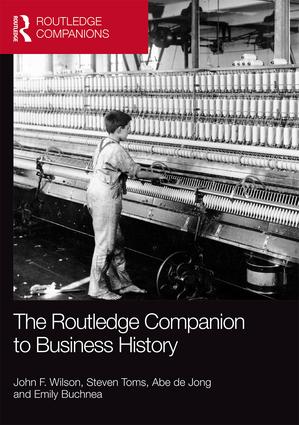
AS: Routledge has just published an important new volume in its Routledge Companions in Business, Management and Accounting series. I am very pleased to promote it here.
———————
The Routledge Companion to Business History is a definitive work of reference, and authoritative, international source on business history. Compiled by leading scholars in the field, it offers both researchers and students an introduction and overview of current scholarship in this expanding discipline.
Drawing on a wealth of international contributions, this volume expands the field and explores how business history interacts theoretically and methodologically with other fields. It charts the origins and development of business history and its global reach from Latin America and Africa, to North America and Europe. With this multi-perspective approach, it illustrates the unique contribution of business history and its relationship with a range of other disciplines, from finance and banking to gender issues in corporations.
The Routledge Companion to Business History is a vital source of reference for students and researchers in the fields of business history, corporate governance and business ethics.
Table of Contents
Part I: The Discipline of Business History 1. Introduction (John Wilson, Steve Toms, Abe De Jong and Emily Buchnea) 2. Business History: Agendas, Historiography and Debates (Steve Toms and John Wilson) 3. Origins and Development of the Discipline (Matthias Kipping, Takafumi Kurosawa and Dan Wadhwani) 4. Interdisciplinary Approaches and Methodology (David Higgins, Abe De Jong and Hugo Van Driel) Part II: Business Ownership 5. Personal/Family Capitalism (Andrea Colli) 6. Managerial Capitalism (John Quail) 7. Banks and Private Finance (Chris Colvin) 8. Stock Markets and Financial Capitalism (Andrew Smith and Kevin Tennent) 9. Co-Operatives and Not for Profit Organisations (Tony Webster) Part III: International Varieties of Capitalism 10. Africa (Gareth Austin) 11. Australia (Simon Ville and David Merrett) 12. Eastern Europe (Martin Kragh) 13. Latin America (Rory Miller) 14. North America (Mark Wilson) 15. Western Europe (Keetie Sluyterman and Gerarda Westerhuis) Part IV: Institutions 16. Pre Modern and Early Modern (Mark Casson and Catherine Casson) 17. Networks and Clusters (Emily Buchnea) 18. Business Institutions and the State (Bob Millward) 19. Evolution of Corporate Governance (Anna Tilba) 20. Globalisation and International Business (Cheryl Mcwatters and Pierre Gervais) Part V: Management and Ethics 21. The Managerial (Mitch Larson) 22. Gender and Business (Helen Doe) 23. Financial Crises and Scandals (Steve Toms) 24. Changing Perspectives on Business Ethics (Bernard Mees)
Association of Business Historians Annual Conference 2017
‘The Human Factor in Business History’
University of Glasgow,
29 June – 1 July 2017
Call for Papers
Understanding the strategy and structure of firms forms a vital part of the discipline of business history, as does the deployment of essential tools such as typologies of company forms, theories of the firm and firm growth and so on. But it is vital, too, for business historians to recognise and investigate those who stand at the heart of business history: the people who create firms, those who own them and those who work for them in various capacities (whether in head offices, in back offices or on the shop floor) to enable companies to function effectively (or, alternatively, passably or dysfunctionally). It is, after all, people who develop and deploy the skills, relationships and capabilities to allow all of this to happen. Just as…
AS: I thought I would bring the attention of my readers to an International Business conference that is receptive to historical research.
The John H. Dunning Centre for International Business at the Henley Business School (University of Reading) is pleased to invite submission of papers for the 44th Academy of International Business (UK & Ireland Chapter) Conference and 6th Reading International Business Conference on 6-8 April 2017 at Henley Business School, University of Reading. The theme for the conference is “Contemporary Issues in International Business: Are we seeing the tail-end of globalization?”
We intend to maintain the Reading tradition of open-ended debates and interactive plenary sessions. Confirmed speakers include: Snehal Awate (IBS), Sjoerd Beugelsdijk (Groningen), Italo Colantone (Bocconi), Jonathan Doh (Villanova), Fabienne Fortanier (OECD), Elisa Giuliani (Pisa), Dana Minbaeva (CBS).
Submissions are welcome in all areas of International Business.
Deadline for submission for Main Conference has been extended to 6 January 2017
Deadline for submission for Doctoral Colloquium and panel proposals is on 24 January 2017. For details and guidelines on the doctoral colloquium go to our website
Proposals for special tracks and panel sessions are welcome and should be sent to aibuki2017@henley.ac.uk, by January 24th 2017.
The conference will begin in the afternoon of the 6th April 2017 with the Conference Welcome and Opening Plenary at 5.30 pm. It will close by 5pm on the 8th April 2017. The Doctoral Consortium will be held on the afternoon of 6 April 2017.
For further details and submission details see here :






 The Past Speaks