CFP: Management & Organizational History Special issue call for papers: Imperialism and Coloniality in Management and Organization History

14 04 2016

image-20160331-9712-13y7504

As a recent blog post by Andrew Dilley has shown, nostalgia for the days of the British Empire and the associated imperial trading system has informed the current debate in the UK over #Brexit. It is, therefore, a good time for business historians to think about Business and Empire. I am therefore very happy to promote the CFP for a special issue of Management & Organizational History on this subject. The deadline is 16 December. The guest editors of the SI are Simon Mollan and Bill Cooke, both of the University of York Management School (here in the UK).

——-

The ongoing dialogue about the role that history can play in the formation of organization theory, and the role that organization theory can and does play in management and organization history (Maclean, Harvey, and Clegg 2015; Rowlinson, Hassard, and Decker 2014; Taylor, Bell, and Cooke 2009; Clark and Rowlinson 2004) should enjoinder greater engagement with areas where historians have long engaged in theoretical work. Classical theories of imperialism (Hobson 1902; Lenin 1999; Schumpeter 1951), historiographical theories of imperialism (Cain and Hopkins 2002; Gallagher and Robinson 1953; Jones 1980; West 1973), and post-colonial theory that explores the operation of capitalism (for example, Chibber 2014; Quijano 2007; Moraña, Dussel, and Jáuregui 2008) are all theory-sets that draw heavily on historical analysis. The already rich relationship between history and theory in these connected fields provides an opportunity to explore the contribution that management and organization history can make to both the theories and history of imperialism and coloniality, and how a reflection on these topics can provoke a richer and theory-informed understanding of how management and organizations replicate and form circuits of power–globally and locally.


Topics might include but are not limited to:

  • The absorption and co-option of knowledge from colonized peoples into the organization(s) and management of empire
  • How management and organization perform agency and create structure in imperial and post-colonial contexts
  • Management and organization historical studies that explore classical, historiographical and post-colonial theories of imperialism and coloniality
  • New management and organization theories of imperialism and coloniality
  • Organizations as sites of contestation and liminality in imperial and colonial encounters
  • Management and organization as acts of colonial violence
  • The relationship between business, management, organization and (under)development in imperial and post-colonial periods
  • Management and organization as processes, and organizations as institutions, in the transmission of imperial power
  • Managers as colonial elites; colonial elites as managers
  • The development of management thought and its relationship to (neo)imperial ideas
  • Slavery and forced labour in the management and organization history of empire
  • Representations of empire in corporate history
  • Corporate archives as archives of imperialism
  • The colonial heritage of multinationals

References

Banerjee, Subhabrata Bobby. 2008. “Necrocapitalism.” Organization Studies 29 (12): 1541–63.
Cain, Peter J., and Anthony G. Hopkins. 2002. British Imperialism: 1688-2000. London: Pearson Education.
Chibber, Vivek. 2014. Postcolonial Theory and the Specter of Capital. Verso Books.
Clark, Peter, and Michael Rowlinson. 2004. “The Treatment of History in Organisation Studies: Towards an ‘Historic Turn’?” Business History 46 (3): 331–52.
Cooke, Bill. 2003. “The Denial of Slavery in Management Studies.” Journal of Management Studies 40 (8). Blackwell Publishing Ltd.: 1895–1918. doi:10.1046/j.1467-6486.2003.00405.x.
Gallagher, John, and Ronald Robinson. 1953. “The Imperialism of Free Trade.” The Economic History Review 6 (1). Wiley Online Library: 1–15.
Hobson, John Atkinson. 1902. Imperialism: A Study. Vol. 3. London.
Jones, Charles. 1980. “‘Business Imperialism’and Argentina, 1875-1900: A Theoretical Note.” Journal of Latin American Studies 12 (2). JSTOR: 437–44.
Lenin, Vladimir Ilʹich. 1999. Imperialism: The Highest Stage of Capitalism. Resistance Books.
Maclean, Mairi, Charles Harvey, and Stewart R Clegg. 2015. “Conceptualizing Historical Organization Studies.” Academy of Management Review.
Miller, Rory. 1999. “Informal Empire in Latin America.” Winks, Robin W., The Oxford History of the British Empire 5.
Mollan, Simon. 2009. “Business Failure, Capital Investment and Information: Mining Companies in the Anglo-Egyptian Sudan, 1900–13.” The Journal of Imperial and Commonwealth History 37 (2): 229–48.
Moraña, Mabel, Enrique D Dussel, and Carlos A Jáuregui. 2008. Coloniality at Large: Latin America and the Postcolonial Debate. Duke University Press.
Platt, Desmond Christopher Martin. 1977. Business Imperialism, 1840-1930: An Inquiry Based on British Experience in Latin America. Oxford: Clarendon Press.
Quijano, Aníbal. 2007. “Coloniality and Modernity/rationality.” Cultural Studies 21 (2-3). Taylor & Francis: 168–78.
Rowlinson, Michael, John Hassard, and Stephanie Decker. 2014. “Research Strategies for Organizational History: A Dialogue between Historical Theory and Organization Theory.” Academy of Management Review 39 (3): 250–74.
Schumpeter, Joseph A. 1951. The Sociology of Imperialism. Meridian Books.
Taylor, Scott, Emma Bell, and Bill Cooke. 2009. “Business History and the Historiographical Operation.”Management & Organizational History 4 (2): 151–66..
West, Katharine. 1973. “Theorising about ‘imperialism’: A Methodological Note.” The Journal of Imperial and Commonwealth History 1 (2): 147–54.



Search for a New Editor for Journal of Historical Research in Marketing

12 04 2016
AS: I have been asked to disseminate this announcement.
Emerald is seeking a new Editor for Journal of Historical Research in Marketing to take over from the outgoing Editor, Professor Brian Jones, in January 2017.
 
JHRM publishes 4 issues per year and features many world class authors such as Shelby Hunt, Russell Belk, William Wilkie, Mark Tadajewski, Nick Alexander, and Jon Stobart. Full details of the journal are provided on the home page at www.emeraldinsight.com/jhrm.htm The journal was launched in 2009, is included in Scopus and registers over 25,000 article downloads per year.
 
Please send expressions of interest in this role to the Publisher, Richard Whitfield,rwhitfield@emeraldinsight.com including a brief outline of your vision for development of the journal, your suitability for the role including any experience in Editing/Guest Editing. Please also include a copy of your CV. Don’t hesitate to ask any questions you may have and do forward this to anyone who you feel may be particularly interested in this opportunity.
 
The journal uses the ScholarOne submission system for which full training would be provided.
 
The closing date for expressions of interest in this role is 2nd May 2016.


Historical Research and the Panama Papers

8 04 2016

800px-ciudad_de_panama

The Panama Papers are front-page news around the world and nowhere more so than in the UK, where the tax arrangement’s of David Cameron’s family are facing intense public scrutiny (see here, here, and here).  The international furore over the Panama Papers revelations follows many months of debates about international taxation, particularly the taxation of multinational firms such as Google.

At such a time, it is helpful to put contemporary debates about tax havens and cross-border tax strategies into a business-historical perspective. Luckily, a recent paper by Simon Mollan and Kevin Tennent allows us to do that. I’m sharing the details of their paper here in the hopes that it gets the attention from the media and policymakers that it deserves.

International Taxation and Corporate Strategy: Evidence from British Overseas Business, circa 1900-1965

Abstract:

In this article we establish the impact and importance of international taxation on British overseas business circa 1900 to 1965. As the levels of national taxation rose across the twentieth century, different states began to compete for taxable income. This created international double taxation whereby taxation was due twice on the same income or profit. We examine the difficulties that this caused and the responses of firms to this challenge, through the adoption of tax-minimisation strategies, alterations to corporate structure, and the relocation of corporate domicile. We discuss how international taxation was one of the secular changes in the international business environment that contributed to the rise of large-scale multinational enterprises. We conclude by making a call for greater consideration of international taxation in international business history.


‘Transactionography’ for Multilingual Historical Financial Records

8 04 2016

AS: I’m drawing an important event that is taking place today at Wheaton College, where Naoki Kokaze & Kiyonori Nagasaki of the University of Tokyo will be presenting research that will likely interest a wide variety of scholars in economic history, business history, archival science, and digital humanities.


Paper Abstract:

This presentation deals with transactions held between the governments of Great Britain and China in 1863, in which some warships were purchased by the Chinese government of the Qing dynasty. The purpose of those transactions for the Chinese government was to contribute with minimal financial cost in the suppression of the activities of pirates and rebels in Chinese territory without building a navy, by introducing the advanced Western military technology. On the other hand, the purpose for British government was to decrease the burden of the duty required to maintain the order of the China seas–a job previously performed by the British navy rather than the Chinese maritime force, and also to aim to reduce the naval expenditures. Thus there were financial and military aims for both governments behind the transactions.

Financial records respecting those transactions can be found both in ‘Hansard 1803-2005’, archives about British parliamentary debates available online, and in ‘Hǎi Fáng Dàng jiǎ’, Chinese official archives relating to coastal defense edited in 1957. We will attempt to mark up these transactions by the ‘transactionography’ methodological approach proposed by Dr. Kathryn Tomasek in her article published in 2013, ‘Encoding Financial Records for Historical Research‘.

This methodology is an extended model of Text Encoding Initiative (TEI), the de facto standard for marking up sources for humanities, in order to mark up appropriately various kinds of Historical Financial Records (HFRs) containing histories of the exchange of goods and service, such as receipts or account ledgers. Although the markup structure might be intricate if trying to describe, e. g., the difference of information which could be found between the historical sources as annotation based on TEI, the ‘transactionography’ would further be applied to historical researches of the various disciplines, taking into consideration the value of HFRs and the flexible structure of this methodology.

In fact, we have already made efforts to mark up trade statistics of Chinese maritime customs in 1860 based on the ‘transactionography’ model. The transitional result of the attempt was presented in a workshop of Digital Humanities in Japan, and discussed among Japanese DH researchers in May 2015. On the basis of this result, we’ve been developing our research.

There are two aims of this presentation: at first, to investigate the extensibility of the ‘transactionography’ model for markup of macro commercial transactions, and secondly, to attempt to mark up multilingual HFRs.

Regarding the first point, Tomasek focused on micro commercial transactions relating to a personal life in the article. But, naturally enough, a commercial transaction is included in the trade which is also performed between states as well as in the individual realm. When it comes to marking up of those macro commercial transactions, the issue of how to tag the states or the governments which were subjects of commercial transactions is expected to be left as a problem.

With regard to the second point, we look for a possibility that ‘transactionography’ can be applied to markup of HFRs written in English and Chinese, and through which we are actually capable of illustrating a model about the linkage between the markup of multilingual HFRs.

At the conference, we would be happy to hear arguments that can deepen about the extensibility of the ‘transactionography’ with your all participants, based on the contents we will offer.


Business History at the Canadian Historical Association

6 04 2016

Canadian business history is definitely making a come-back and we can see evidence of this is a variety of different academic organizations and disciplines. Signs of renewed interest in business history will certainly be in evidence at the 2016 meeting of the Canadian Historical Association in Calgary. Here are some of the relevant panels.

Management, Marketing, Trade, and Debt: Stories from Canadian Business History | La gestion, le marketing, le commerce et la dette : récits de l’histoire des affaires canadiennes

Chair|Animateur : Chris Kobrak (University of Toronto)

Anne Pezet (HEC Montréal): La constitution des pratiques de management au Québec de la Grande dépression aux années 1960 : étude de la diffusion des dispositifs de management au travers du journal Les Affaires

Felicity Barnes (University of Auckland): Britain’s Farms: Canada, Australia, New Zealand and campaigns for the British commodity market, 1922-1939

Ashley Campbell Johnson (Binghamton University): A Transnational Automobile Industry: Changing the Story of Free Trade on the U.S.-Canadian Border Before World War II

Daniel Simeone (McGill University): Imprisonment for Debt, Commercial Trust, and Rootedness: The Over-Imprisonment of Jewish and foreign-born debtors in Nineteenth Century Montreal

106. Canada’s History of Capitalism: New Directions and New Narratives |
L’histoire canadienne du capitalisme : nouvelles orientations et nouvelles narrations
Chair|Animateur : Dimitry Anastakis (Trent University)

Participants :
Donica Belisle (University of Regina)
Kurt Korneski (Memorial University)
Don Nerbas (Cape Breton University)
Jason Russell (Empire State College)
Daniel Simeone (McGill University)

This is great stuff. Very encouraging to me.

P.S. I really admire the innovative teaching of Anne Pezet, who has created the coolest business history course ever at HEC.


EBHA Dissertation Prize

6 04 2016

During the joint 1st World Congress of Business History and 20th Annual Congress of the European Business History Association in Bergen 25-27 August 2016, the EBHA will award a prize for the best dissertation in business history submitted to a European university in the previous two years (The dissertation should have been accepted prior to the hand-in dead-line, April 15, 2016). Eligible dissertations may be in any European language. Three finalists will be selected from the dissertations submitted for consideration, and the authors will be required to give a presentation based on their dissertations at a plenary session at the EBHA congress/World Congress of Business History in Bergen. All three finalists will receive a certificate that they have been among the short-listed candidates and will be eligible for reimbursement of part of their travel costs. All three will also be eligible for a waiver of their registration fees for the conference. In addition, the prize winner will receive EUR 500 and a special certificate. The finalists are invited to have written versions of their presentations published in the Newsletter of EBHA.


The prize and the travel cost reimbursement fund have been funded since 2010 by the William Lind Foundation, located in Scotland. Procedure for entry All candidates wishing to enter the prize competition must meet the criteria indicated above and must attach a summary of 1-2 pages of their dissertation to the application along with a printed copy of the dissertation itself. The candidate must document that the thesis has been accepted. If possible an assessment report should be added to the application. Supervisors of candidates may also be invited by the candidate to write a 1 page recommendation outlining the strong points of the thesis. Recommendation and assessment reports are, however, optional, and absence of these documents will not count against the candidate in the competition. A printed paper version of the dissertation and accompanying documentation as specified above must be submitted for consideration to the following address: Professor Susanna Fellman Economic History PO Box 625 School of Business, Economics and Law Gothenburg University SE-40530 Gothenburg Sweden


In addition, an identical electronic version of the dissertation and accompanying documentation as specified above in PDF format, should be submitted by email to susanna.fellman@econhist.gu.se The deadline for application for the prize is 15 April 2016.

Dissertations submitted after this date, submitted only in electronic form, or submitted without a summary and a documentation of acceptance, will not be considered further. For more information about the Dissertation prize (for example the criteria for judging), we refer you to the EBHA website: http://ebha.org/?seite=dissertation_prize


Thoughts on BHC 2016

3 04 2016

Here are some thoughts on the state of business history in the age of Donald Trump

donald_trump_approves_2016

If Donald Trump represents the worst aspects of the United States, the Business History Conference represents the very best.  At the BHC, American philanthropy, American academic excellence, and American creativity come together to produce a genuinely impressive annual event that attracts business historians from around the world. It is always inspirational to come to the BHC to see top quality researchers present their findings. In the metrics-focused, over-managed UK higher education sector, the research institutions tend to incentivize volume of publications over creativity in research, normal science over truly innovative research.  That’s not the case in the US. It is very healthy hanging around North American academics who manage to combine good research, dedicated teaching, and vibrant non-work lives. The absence of the REF system in North America makes workaholic tendencies less common in the US than the UK sector, in general.

This year, the organizers of the BHC made a decision to hold the conference on the West Coast of the US with a view to encouraging participation by Asian business historians. Business history has always been strong in Japan, but it appears to be growing in importance in mainland Asia as well, as Chinese and other universities develop their research capacity in this area.  There was a good contingent of PhD students and academics from Kyoto University, which is an emerging research pole. Kyoto is training up a generation of business historians from mainland Asia, which is very encouraging to see.

I presented three papers at this year’s BHC (actually I presented two of them, with a third being presented by my excellent co-author, Miriam Kaminishi). At a pre-conference PDW workshop, I presented a paper in which I explore how archivally-focused business historians can contribute to the application of the Judgement-Based View to entrepreneurship research. I got great feedback there. On day 1 of the main conference,  we presented a research paper at a panel on New Takes on Entrepreneurship.

Chair:  Sabine RauKing’s College London
Discussant: Mary YeagerUniversity of California, Los Angeles


Mark Casson, University of ReadingTeresa da Silva Lopes, University of York, and Geoffrey JonesHarvard Business School
International Business Theory and Expatriate Entrepreneurship: Why Explaining the Unconventional Matters


Henderson CarterUniversity of the West Indies
Resisting Hegemony: Black Entrepreneurship in Colonial Barbados
[Abstract]   [Paper]


Miriam Kaminishi, Macau University of Science and Technology, and Andrew D. Smith, University of Liverpool
A Postcolonial Reading of Western Representations of Chinese Entrepreneurship in the Treaty Port Period, 1841-1911
[Abstract]


On Day 2, I presented  another paper at the Varieties of Corporate Governance

Chair: William HausmanCollege of William & Mary
Discussant:  Chris KobrakRotman School of Management

Sakari SiltalaUniversity of Helsinki
Spheres of Influence: The Finnish Forest Industries Association and the Birth of Pillarisation in Finnish Society at the Beginning of the Twentieth Century


Nandini ChandarRider UniversityPaul MirantiRutgers Business School, and Deirdre Collier, Fairrleigh  Dickinson University
Finance, Organization, and Democracy at the Bell System: The Case of Bell Telephone Securities, 1921-1935


Andrew Smith, University of Liverpool, Jason Russell, SUNY – Empire State College, and Kevin Tennent,University of York
Rediscovering the Radical Stakeholder Theory of Corporate Governance of Berle and Means


I got very helpful feedback at both panels that will be very useful going forward. I also served as a discussant at an excellent panel on new research on Canadian business history.

Laurence B. MussioMcMaster University
The Canadian Banking Ascendancy: Power, Authority and Reputation in Canadian Banking, 1895-1929


Thomas FothUniversity of Ottawa, and Cheryl S. McWattersUniversity of Ottawa
Making the Case for Investment in Mental Health in the First Half of the Twentieth Century: Scientific Administration of the Canadian Mental Hospital
[Abstract]


Matthew J. BellamyCarleton University
From ‘Pilsener’ to ‘Blue’: The Rebranding of Labatt’s Lager, 1962-1970


I should mention that at this year’s BHC, Donald Trump was something of a running joke, which I suppose isn’t surprising since basically all US historians and management academics despise this individual.  The BHC presenters come from a variety of philosophical traditions ranging from socialist to libertarian, but pretty much every academic dislikes the hypernationalist and misogynistic presidential candidate who famously declared that he loves the “poorly educated”. Presenters worked humorous references to making America great again, etc, into their talks. For instance, one presenter said that he was planning to “make PowerPoint great again”.

P.S. An added bonus of the conference was that it was located next to a food festival where delegates could sample some of Portland’s amazing street food scene.


portlandstreetfestival


Canada Misconceptions

1 04 2016

Canada is big in the UK right now. In the last few months, references to Canada have been everywhere in the media as a variety of political actors in Britain have attempted to use Canada, or rather than image of Canada, as an exemplar of what Britain should do. I’m writing this blog post to set a few things straight.

On the left, Canada is praised for embodying progressive values. There is some evidentiary basis to support this viewpoint, as by most statistical measures, Canada is a relatively tolerant society towards newcomers and does a very good job of absorbing immigrants into its large middle class. However, I find that the progressive love fest with Canada is based on some misconceptions. Consider Gabby Hines’s recent and highly problematic column in the Guardian, where she wrote:

What’s puzzling is that Canada has been through most of the same grim experiences – the banking crash, recession, a series of thwarted Islamist terrorist attacks followed by a shootout inside its parliament building – that elsewhere are blamed for feeding the politics of hate.

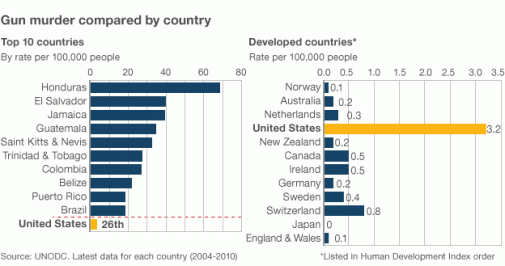
With all due respect, the comments I have quoted display a mixture of ignorance and a failure to think statistically. Canada has not gone through the same grim experiences as other Western countries. Its banks were famously stable during the financial crisis, which perhaps contributed to the UK government’s decision to promote Mark Carney from Governor of the Bank of Canada to Governor of the Bank of England. The subsequent recession in Canada was mild and short relative to comparator countries. It is true that there was a shooting in Ottawa that can probably be described as an Islamic terrorist attack, although the exact motives of shooter, who was a homeless man of partial Algerian ancestry remain a mystery. While I am very sorry that a young father lost his life in this attack, we need to put this event into proportion. There is an epidemic of mass shootings in the United States, with killing sprees as cinemas, elementary schools, and the like being just part of the background of national life.

65077559_us_gun_compared_624

The shooting in Ottawa stood out because it is so unusual for Canada. In Western Europe, which has a far lower gun violence rate comparable to that of Canada, there is a serious problem with terrorism. Believe me when I say that I have no desire to minimize this problem or its underlying socio-economic, cultural, and psycho-sexual causes of attacks by young Muslim men:  I was 150 metres from the Bataclan theatre during the recent terror attacks.  However, the situation is Canada is very different: Canada’s Muslim population is generally affluent and generally assimilated,  the  Muslim Mayor of Calgary (see below) being a great example.   My point is that columnists such as Gabby Hines need to think about this sort of context before arguing that what works in Canada can be easily brought to the UK.

800px-naheed_nenshi_cropped


On the Eurosceptic right, Canada is being used in a different way. Boris Johnson, the Mayor of London, has argued in favour of Britain’s exit from the European Union on the grounds that the UK could simply negotiate a trade agreement with the EU similar to that of Canada. The crux of Johnson’s argument is that Canada has been able to combine free trade with the EU with the capacity to negotiate free trade deals with rest of the world. I hardly know where to begin with this argument. The recent Canada-EU trade agreement is a step in the right direction as it liberalizes trade in many areas, but the barriers remain far higher than those of trade between EU and EFTA countries. Moreover, this agreement took many years to negotiate (negotiating a trade deal with the EEC has been a goal of Canadian policymakers since the 1970s) and the bargaining round that led to the current agreement took seven years and still isn’t quite finished.  In 2011 I ran a small conference in London at which the tortuously slow pace of the trade talks was discussed (see also here, here, and here). As David Cameron rightly pointed out in his response to Boris Johnson, leaving the EU and then negotiating a trade deal would expose UK business to years of paralyzing uncertainty.

British people on both the left and the right have a distorted view of what Canada is. It is entirely legitimate for political actors in the UK to point to specific policies in Canada that are worthy of emulation. However, it is important to have an accurate idea of what Canada is like in the first place.


Some Thoughts on the Journal of Management Studies Conference

28 03 2016

I recently attended a conference at the University of Warwick that had been organized by the Journal of Management Studies.  It was an excellent conference on many levels. Administratively, it was very well executed and I think that organisers of other conferences could learn a great deal from the attention to detail paid by the planners of this event. I really like how seating at meals was arranged in such a way as to bring participants of various levels of seniority, disciplinary background, and nationality together at the same table.

As the theme of the conference was connecting Eastern and Western Perspectives on Management, I had the chance to listen to a wide range of excellent papers that deal with differences between “the east” and the so-called “west.”  Many of the papers were culturally-informed  and explored cultural and religious variables  that influence innovation, boundary spanning, and other business phenomena. I was especially pleased to see that a number of the attendees, including the journal editors who were present, were conscious of the dangers of essentializing the imagined differences between the West and Asia.

The chair or my session was Li-Qun Wei of Hong Kong Baptist University.  My co-panelists were Ossi Pesämaa, Martin Svensson “A Critical Theoretical Review and Empirical Comparison between the West and Asia” Runtian Jing, Andrew H. Van de Ven “Managing Organizational Momentum for Change: Connecting Chinese and Western Perspectives.” I presented the paper I had co-authored with Miriam Kaminishi “Recurring Debates in English-Language Analysis of Chinese Entrepreneurship: Towards A Genealogy of Theoretical Frameworks.” I got good feedback on this paper that will be helpful during the revision process.

The conference concluded with a sort of roundtable session with journal editors in which  the journal’s openness to qualitative research was highlighted.


Study for a Funded PhD With Us!

17 03 2016

I am pleased to announce that we are now in the process of recruiting a PhD student. The PhD student, who will receive a full tuition-fees waiver and a living stipend, will work on a project of their own design that relates to the archives of Barclays Bank, our private-sector partner. At the end of the process, you will received a PhD from the University of Liverpool. This PhD project could lead to employment in private industry or as an academic in either management or archives and records studies.

If you wish to discuss this matter with me before the application deadline, please email me. Full details of the studentship are below. As you can see from the description below, we are seeking applications from people who have been ordinarily resident in the UK for at least three years. Our preference would be for a PhD student who already has a Master’s degree, although a strong candidate with a good degree in any humanities or social science subject would also be considered.
AHRC Collaborative Doctoral Award Studentship 2016: ‘Accounts with Interest’ – Opening up the Archives of Barclays Bank

The University of Liverpool and Barclays Group Archives (BGA) invite invitations from suitably qualified candidates for the first of two fully-funded AHRC Collaborative Doctoral Award PhD studentships. The project will centre on access to, and the research use of, data – and particularly nominal data – held within the Bank’s archives.

The successful candidate student will enjoy privileged opportunities to work in situ as a member of the professional archival team responsible for Barclays Group Archives in Wythenshawe, Greater Manchester: S/he will explore the possibilities for developing access to the rich information resources available in these archives, focusing in particular on the customer/nominal data. Such information exists in a number of different locations across the bank’s holdings, but its research potential remains to be fully realised.

‘Accounts with Interest’ is conceived as a genuinely interdisciplinary project; we are keen to attract suitably-qualified candidates from any area of the humanities and social sciences who can demonstrate their potential to conceive a coherent research project aimed at enabling access, adding value to the information held in archival records, and promoting audience development. Thus, while the research might be conceived with the framework of archival science or organisational studies, and take a methodological stance from either of those disciplines, it is not restricted, or limited to, either. Whatever approach is adopted, outcomes of the project will include enhanced understanding of the research potential of the materials, and of how Barclays can provide enhanced corporate and (appropriate) public access. The candidate will work closely with a second studentship holder, to be appointed from October 2017, whose research will take place within a technology/digital humanities-based framework. It is anticipated that the successful candidate will either have completed (or be close to completing) a Master’s degree by 1 September 2016.

Download AHRC Collaborative Doctoral Award Studentship 2016 (pdf) for further details or email Dr Margaret Procter, Senior Lecturer, Record and Archive Studies or Dr Andrew Smith, Senior Lecturer in International Business.

Deadline for applications and interviews

The deadline for receipt of applications is 5.00pm on Wednesday, 6 April 2016.

Interviews will be held in Liverpool on 19/20 April 2016.